The Rating on the Label Is the Rating of the Weakest Component
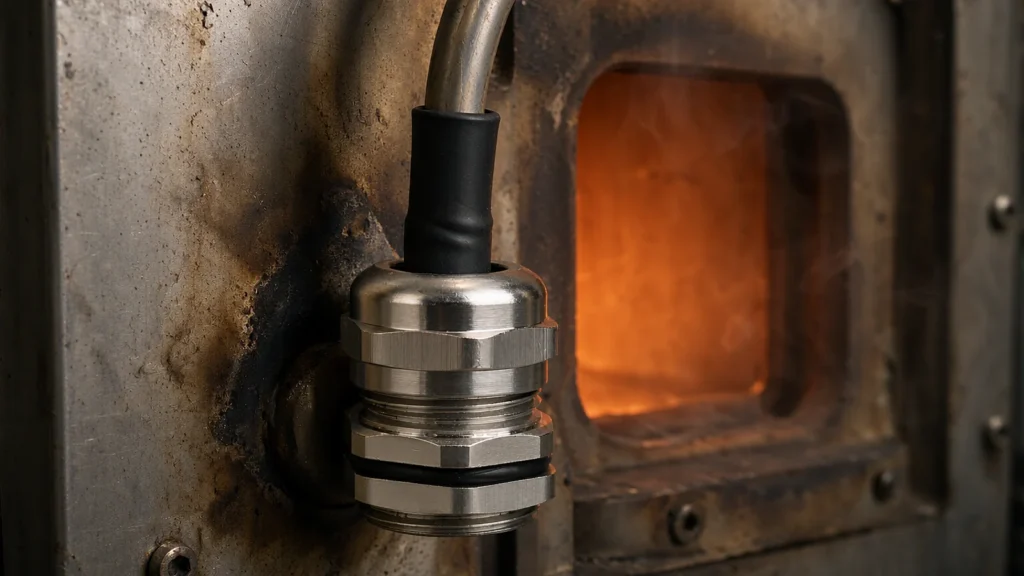
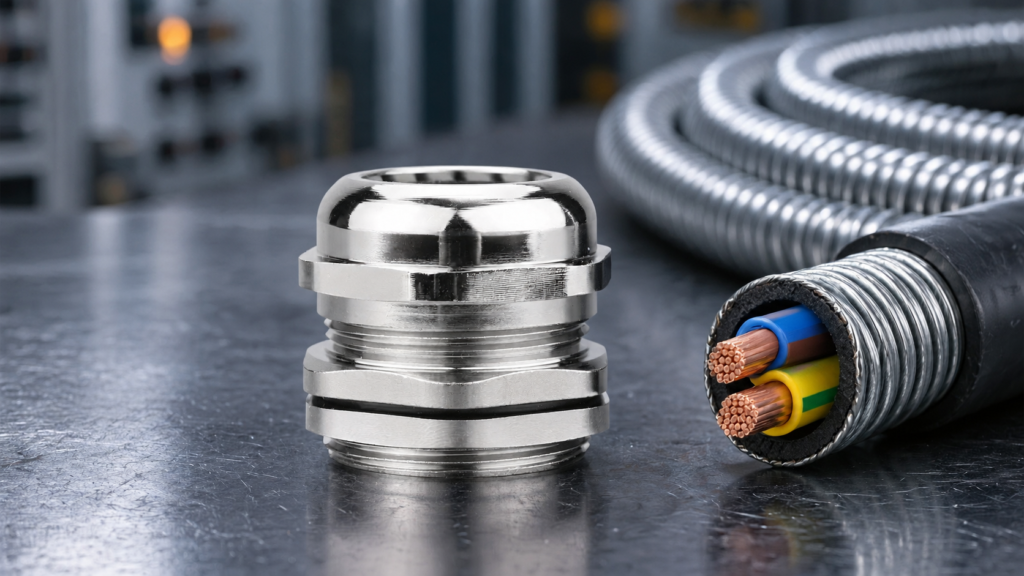
A high temperature cable gland is rarely sold as a temperature problem. It is sold as a stainless steel gland, and the temperature figure follows it in the catalogue. That figure is usually the limit of one component inside the assembly, and it is almost never the metal.
The practical consequence is that two suppliers can quote very different numbers for what looks like the same part, and both can be telling the truth — one is quoting the housing, the other the seal. This article is about working out which number applies to your installation, where the heat actually arrives, and what to write on the order so the answer does not change between the sample and the shipment.
The Temperature Chain: Which Component Sets the Limit
A gland in hot service is a chain of four materials, and the installation is only as good as the coolest link. Housing, sealing insert, face washer and cable sheath all see roughly the same heat, and the one with the lowest practical limit defines the assembly.
Component
Typical material
What sets the limit
Housing and thread
Nickel-plated brass, 304 or 316L stainless
Oxidation and strength loss at high temperature; plating integrity
Sealing insert
EPDM, NBR, silicone
Compression set and hardening; this is normally the binding constraint
Face washer
Same elastomer family as the insert
Same mechanism, but it is compressed against a hot metal face
Cable sheath
PVC, PE, XLPE, PUR, silicone
Softening, then embrittlement — and it is the part you cannot replace
Note the last row. The cable is usually the real limit, and it is the one component the gland supplier does not control. A stainless gland with a silicone insert rated for hot service, gripping a PVC cable rated for a fraction of that, is a hot-service entry on paper only.
Radiant, Convective and Conducted Heat Are Not the Same Problem
Three heat paths reach a gland, and each needs a different answer. Treating them as one number is why hot-service entries fail in furnaces and succeed in ovens with the same reading on the thermometer.
Path
What it looks like on site
What actually helps
Radiant
Line of sight to a hot surface; the gland is hot while the air is cool
A shield or a change of angle, not a better seal
Convective
Hot air moving through an enclosure or up a duct
Air movement control, enclosure ventilation, distance
Conducted
Heat travelling along the metal wall or the cable itself
Thermal break, longer thread run, cable routing
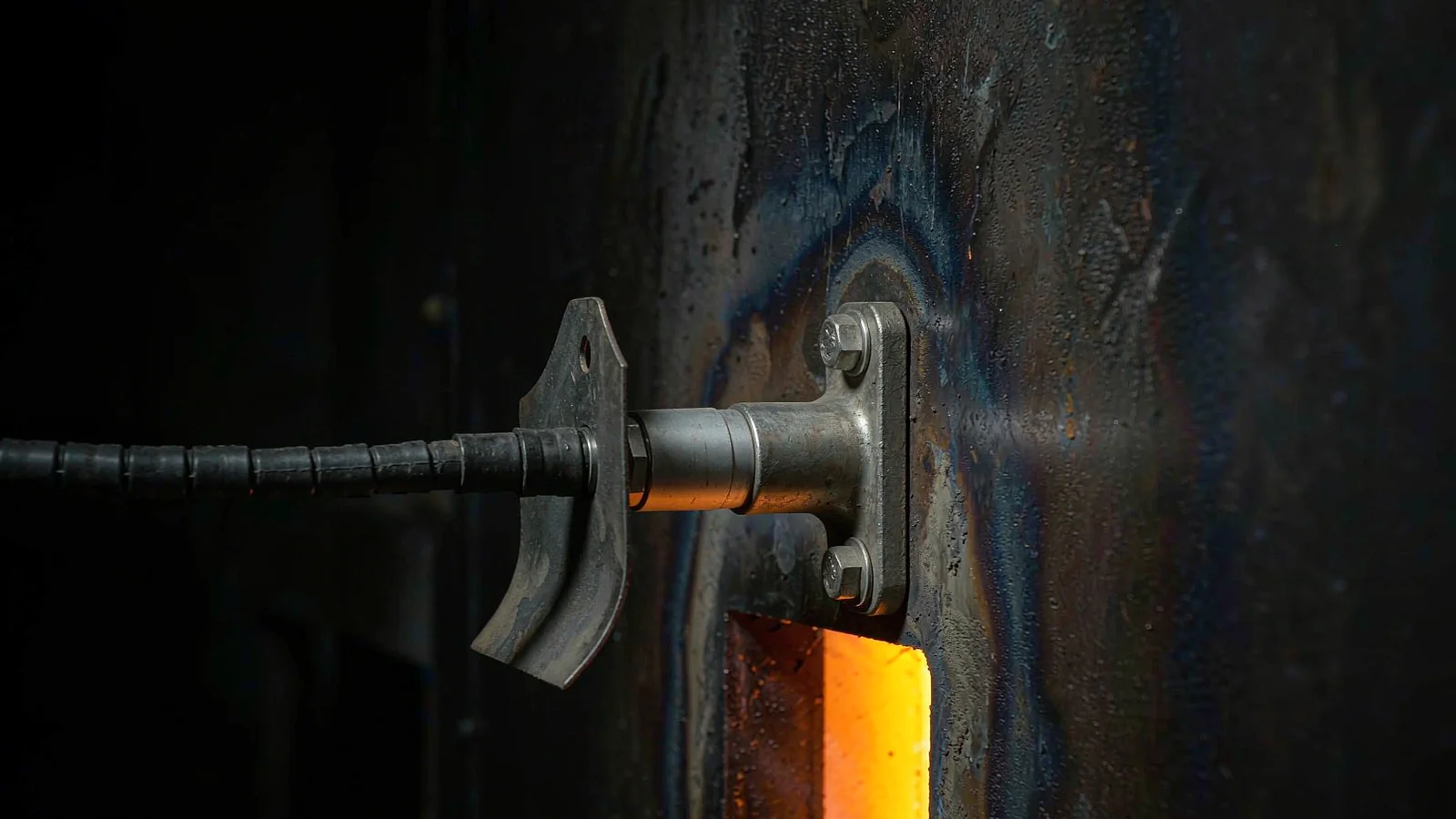
Radiant heat is what catches people out. A wall-mounted thermocouple reads the air temperature and reports 60 °C; a gland with a direct view of a heated platen six hundred millimetres away can be at twice that. The same asymmetry explains why a gland facing the heat source fails while an identical one on the opposite side of the box gives years of service.
Distance and angle are cheaper than alloy. A stand-off moves the gland out of the conducted path and out of the radiant view.
Material Pairing: Brass, Stainless and the Seal Between Them
The housing choice is easier than the seal choice, because the two metals behave predictably and the elastomers do not.
Nickel-plated brass is the default industrial choice and holds up well in most hot, dry indoor service. Above the range where standard inserts survive, brass becomes the weaker element — not because the metal melts, but because the plating degrades and the assembled rating is set by parts that cannot follow. Stainless steel, 304 or 316L, is the answer when temperature arrives together with corrosion, and it removes the plating question entirely.
Seal selection is where the temperature job is actually decided. Standard nitrile inserts are the usual limiting component. EPDM buys a modest increase and better weathering. Silicone is the material that makes a stainless gland into a high-temperature gland, and it is also the one to specify by name rather than by assumption, because “high temperature version” means different compounds to different factories.
Also check what happens to the seal against the cable, not just against the housing. A silicone insert gripping a PVC sheath at a temperature the silicone tolerates will still leave a softened sheath that has crept out of the seal. The seal materials guide covers compound behaviour in more detail.
Why the Seal Fails Before the Metal
An elastomer in a gland is held under compression for years. Heat attacks that state in three stages, and all three are invisible from outside.
Compression set. The rubber takes a permanent deformation and stops pushing back. The seal is still in place and still looks correct, but it is no longer pressing on the sheath.
Hardening. Plasticiser and volatiles leave, the compound stiffens, and the small compliance that absorbed thermal movement disappears.
Reversion and cracking. At the top of the range or in the presence of hot air, the surface degrades. The first sign is usually a leak, not a visible defect.
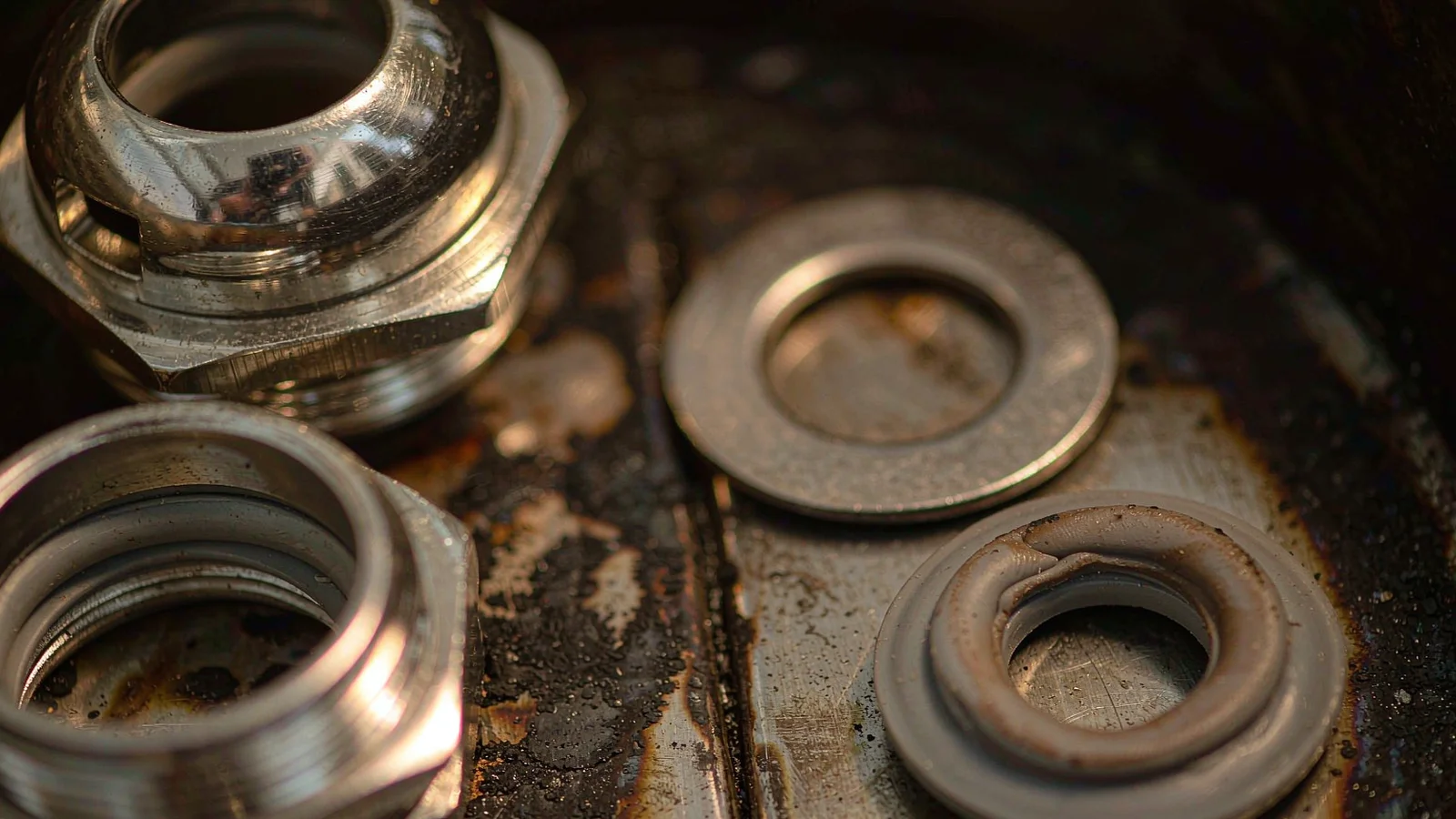
This is why a failed hot-service gland often looks serviceable when removed. The metal is bright, the thread is clean, the seal is in position — and it no longer seals. Replacing the insert is a valid repair only if the replacement is the same compound; a standard nitrile ring in a high-temperature gland resets the clock to the shortest interval.
Thermal Cycling: the Failure No Catalogue Number Captures
A single maximum temperature is the easiest number to quote and the least informative. What actually ages an entry is the number of cycles and the size of the swing, because each cycle strains the seal and the joint differently.
During heating, the brass or stainless housing expands; so does the steel wall it is fitted to, at a different rate. The seal is compressed by the housing and relieved by the cable, and the net effect of a cycle is a small ratcheting change in compression. Over a few hundred cycles the seal has been worked into a shape it will not recover from. Bake ovens, steriliser doors, engine test cells and foundry equipment all produce this pattern, and all of them defeat a gland chosen on peak temperature alone.
The practical countermeasures are unglamorous: keep the entry away from the hottest zone so the swing is smaller, use a seal with better compression-set behaviour, and increase the maintenance frequency rather than the specification. Where a gland is replaced on a fixed interval regardless of appearance, a cyclic application becomes manageable.
Measuring the Temperature You Actually Have
Before choosing a part, get a number that means something. Three rules cover most of the confusion.
Measure at the gland, not in the room. A reading taken a metre away describes the room. Fix a thermocouple to the gland body or use a contact thermometer on the surface.
Record the peak, not the average. A fifteen-minute excursion during a shift change is what destroys seals. Use a logging instrument over a full production week.
Measure the cable sheath, not only the housing. The sheath inside the seal is the component with the least margin, and it is hidden.
Where a permanent instrument is not possible, an irreversible temperature label on the gland body for one production cycle gives a defensible peak figure.
Heat Shields, Stand-offs and Distance
Most hot-service gland problems are solved with geometry rather than with a more expensive part. Three moves, in order of cost.
Change the angle so the entry does not face the heat source; radiant intensity falls with the cosine of the angle and a shield becomes unnecessary. Add a stand-off bracket so the gland sits away from the hot wall and its body is cooled by ambient air rather than heated by conduction. Where neither is possible, a metal shield between the source and the entry — with an air gap — performs better than any wrap applied directly to the gland, because contact wrapping conducts heat into the very part it is meant to protect.
This insert still looks like a seal. Compression set and hardening are what stopped it sealing, and neither is visible from outside.
Documentation: What a Hot-Service Order Should Say
Temperature is the specification most easily lost between quotation and shipment, because it lives in a note rather than in a part number. Write it into the order.
The measured peak temperature at the gland, and whether it is continuous or intermittent.
The cable type and its sheath temperature rating, so the supplier can see the actual chain.
The seal compound required, by name, and whether a spare insert set is included.
The standard the ingress rating was verified to, and whether it was tested at the rated temperature.
That last point is worth pressing on. An IP68 result obtained at room temperature says little about a gland that will sit at the top of its range; the seal that passes cold is stiffer and less compliant when hot.
Specifying a High-Temperature Gland
Four lines cover most hot-service requirements. The point of the table is the middle column: each line is a different reason for heat, not a different temperature.
Application
Dominant heat path
What to specify
Oven or furnace wall entry
Conducted through the wall plus radiant from inside
Stainless housing, silicone insert, stand-off, highest sheath rating available
Engine, gearbox or exhaust proximity
Radiant, often intermittent
Stainless housing, shield or re-angle, peak logging before selection
Steriliser and wash-down door
Cyclic steam and chemistry
Stainless housing, seal matched to both steam and cleaning agents
Enclosure in a hot plant room
Convective ambient
Brass or stainless depending on corrosion; standard seal often adequate
What is the maximum temperature for a stainless steel cable gland?
The metal itself tolerates far more than the assembly. The published range for the finished product is set by the sealing insert and the face washer, so the number to use is the one for the complete part, not for the housing.
Can I replace only the seal in a hot-service gland?
Yes, if the replacement is the same compound and the housing has not distorted. A standard nitrile ring in a high-temperature gland returns it to the shortest maintenance interval.
Is silicone always the right seal for high temperature?
It is the usual answer for dry heat. Where oils, fuels or certain solvents are present, another compound may be the better compromise, and the temperature advantage is worth less than chemical compatibility.
Why does my gland leak only in summer?
Likely compression set that has already happened, exposed by the heat. The seal stopped sealing earlier and the warmer weather finished the job.
Does IP68 still apply at high temperature?
Only if it was tested there. Ask for the test temperature alongside the IP result, and treat a room-temperature result as evidence about the cold condition only. The IP rating guide explains what each digit covers.
Send the measured peak temperature, the cable type and the heat path, and we will say which component sets the limit and whether a standard or high-temperature insert is the honest answer. The stainless steel range covers the housing side; the brass vs stainless comparison covers the choice when temperature and corrosion arrive together.
When it comes to industrial electrical installations, a cable gland isn’t just a fancy connector; it’s the unsung hero that keeps your cables secure, sealed, and safe from environmental hazards. If you’ve ever wondered why there are so many types of threads on these cable glands and how to pick the right one for your project, this […]
How to size an SWA cable gland from the cable itself: the three dimensions that set the inner seal, armour clamp and outer seal, why the same thread has two variants, and how to avoid the wrong-part order.
We use cookies to enhance your browsing experience, serve personalised ads or content, and analyse our traffic. By clicking "Accept All", you consent to our use of cookies.