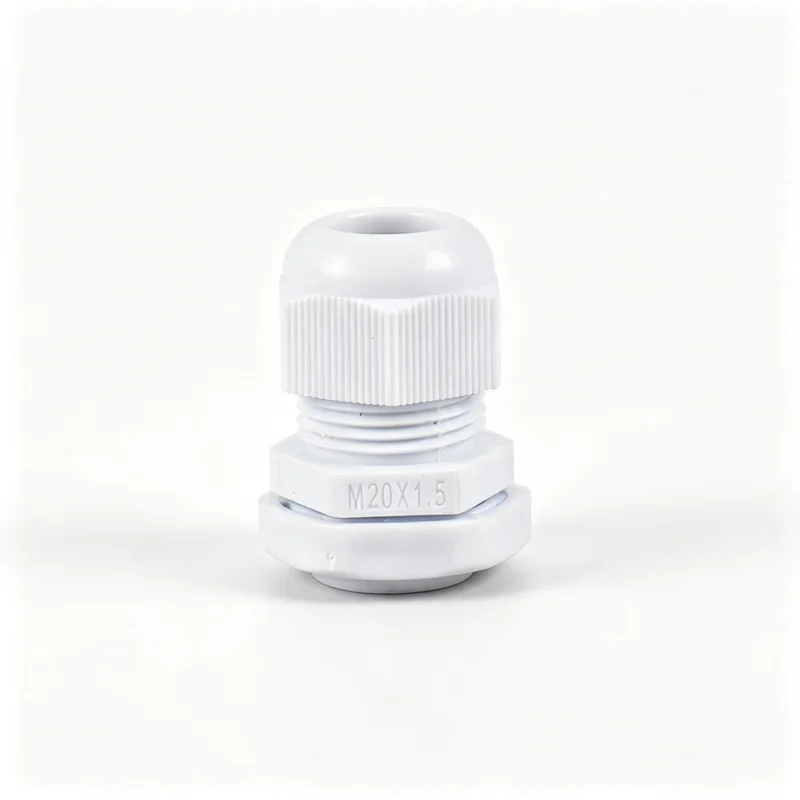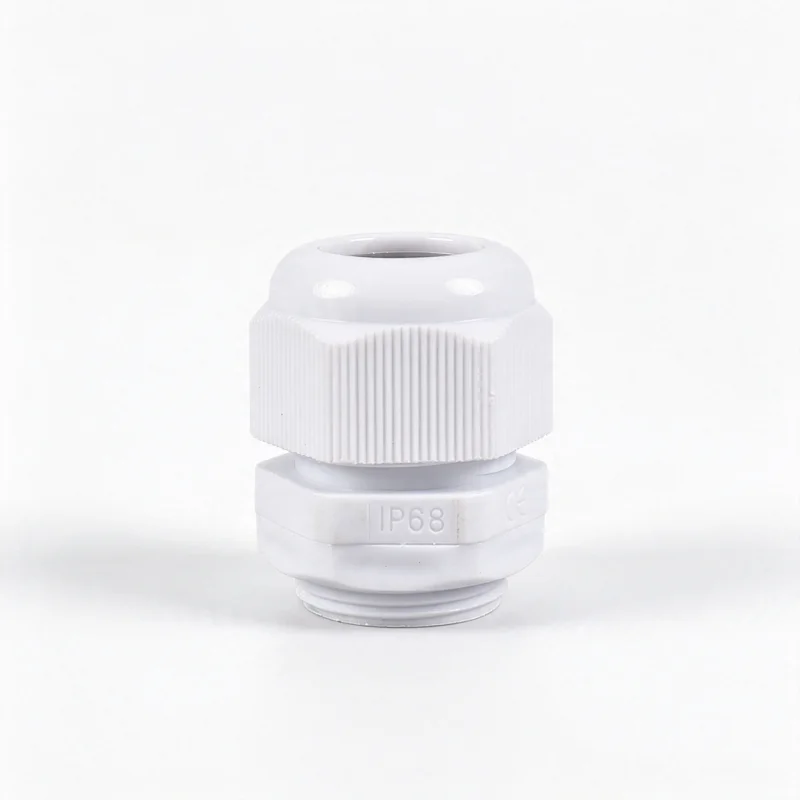
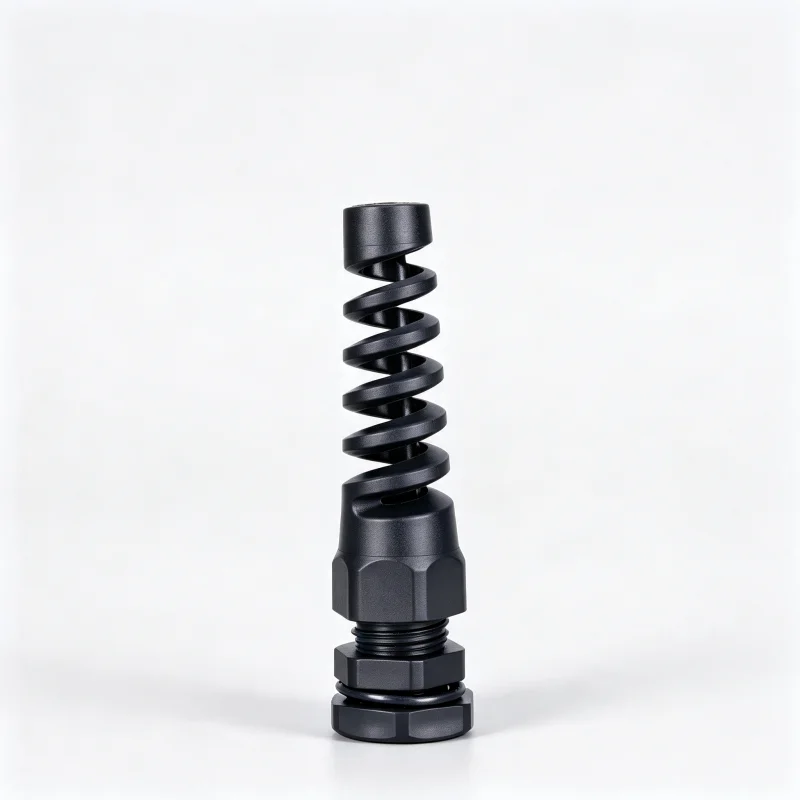

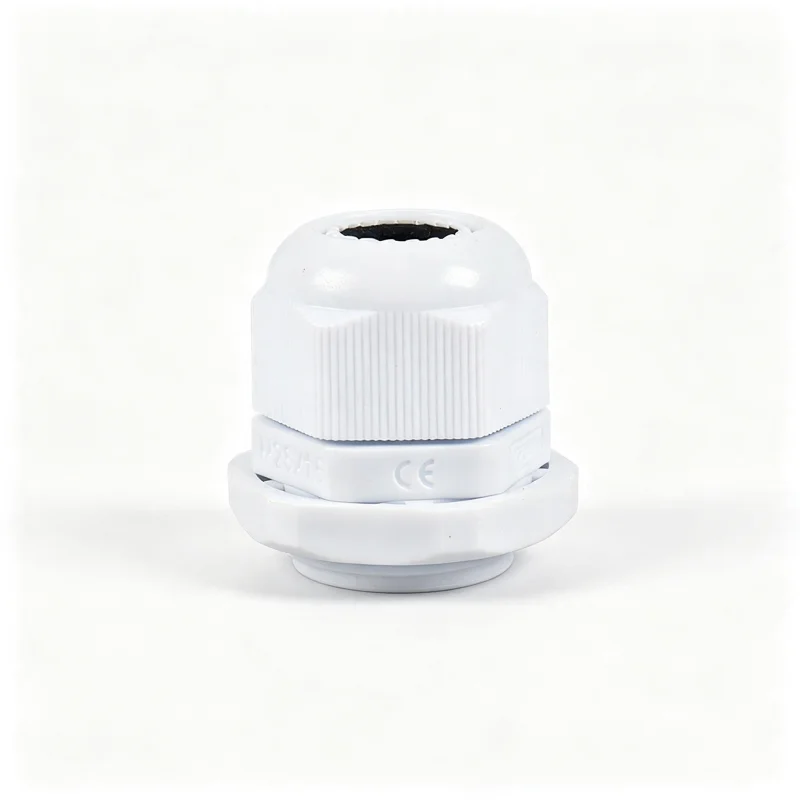
Most nylon cable glands are built to hold a cable still. This one is built to let it move. Under the dome nut sits an articulated section that bends with the cable instead of resisting it, so repeated movement is taken up by the gland rather than transferred into the cable sheath at the point where it leaves the entry.
That single difference decides where the part belongs. On a fixed cable, the standard nylon cable gland is cheaper and does exactly the job. On a cable that flexes, trails or vibrates at the entry, a rigid gland eventually wears a groove in the sheath at the dome nut — and a worn sheath is where water gets in.

Nylon Flexible Cable Gland Advantages
A standard gland grips the cable in a rigid cone. Every time the cable moves, the sheath bends sharply at the exit and the movement is concentrated into a few millimetres of material. On a static installation nothing happens. On a cable that swings through a working cycle — a robot wrist, a drag-chain tail, a door hinge, a hand-held tool — that same point sees thousands of small bends, and polyamide is not what gives way first. The sheath is.
The flexible version replaces the rigid exit with a section that articulates. The bend is distributed along that section rather than at a point, so the cable leaves the gland straight and the movement happens in the gland instead of in the cable. The seal sits behind the flex section, which means it never carries the bending load — that is why the IP68 rating survives a cable that is being worked.
The limit is worth stating plainly: this absorbs flexing, not rotation. A cable that turns continuously — a reel, a capstan, a rotating union — is not a job for a nylon gland of any style, and no amount of articulation changes that.
Operating Temperature: Static and Dynamic
Two figures are published for this series and both are needed, because the same gland can be used on a static cable or a moving one and quoting only the static range would be misleading on a moving application.
| Condition | Operating range | Short-term peak | What sets the limit |
|---|---|---|---|
| Static, cable fixed | −40 °C to +100 °C | +120 °C | Polymer ageing; the same limit as the standard series |
| Dynamic, cable flexing | −20 °C to +80 °C | +100 °C | The flex section is under cyclic strain while it is being aged by heat |
At the cold end the flexing limit is −20 °C rather than −40 °C because polyamide stiffens as it cools, and a stiff articulated section stops articulating — it starts transmitting the bend back into the sheath. At the hot end the dynamic limit is +80 °C rather than +100 °C because the section is under load while it is being aged. Outside either limit the part still seals; what shortens is its flex life, which shows up as a split in the articulation after some thousands of cycles rather than as a leak on day one.

Nylon Flexible Cable Gland Sizes (M12 to M27, PG7 to PG21)
This series is not moulded in the largest sizes, and the reason is mechanical rather than commercial. An articulated section at M63 would have to carry the same clamping load through a much longer moment arm, and the flex life at that scale would not match the number a buyer reads off the datasheet. Above M27 the usual answer is a rigid gland plus a separate cable support downstream, not a bigger flexible gland.
| Code | Thread | Cable range φ (mm) | Thread O.D. (mm) | Thread length GL (mm) | Spanner A&F (mm) |
|---|---|---|---|---|---|
| PG7-NFL | PG7 | 3–6.5 | 12.5 | 8 | 16 |
| PG9-NFL | PG9 | 4–8 | 15.2 | 8 | 19 |
| PG11-NFL | PG11 | 5–10 | 18.6 | 8 | 22 |
| PG13.5-NFL | PG13.5 | 6–12 | 20.4 | 9 | 24 |
| PG16-NFL | PG16 | 10–14 | 22.5 | 10 | 27 |
| PG21-NFL | PG21 | 13–18 | 28.3 | 10 | 33 |
| M12-NFL | M12×1.5 | 3–6.5 | 12 | 8 | 16 |
| M16-NFL | M16×1.5 | 4–8 | 16 | 8 | 19 |
| M18-NFL | M18×1.5 | 5–10 | 18 | 8 | 22 |
| M20-NFL | M20×1.5 | 6–12 | 20 | 9 | 24 |
| M22-NFL | M22×1.5 | 10–14 | 22 | 10 | 27 |
| M25-NFL | M25×1.5 | 13–18 | 25 | 10 | 33 |
| M27-NFL | M27×1.5 | 13–18 | 27 | 10 | 33 |
The clamping range tops out at 18 mm across the whole series. That is a design consequence, not a gap in the range: past 18 mm of cable the bending loads at the entry are large enough that a moulded articulation stops being the right solution. The mounting hole follows the thread O.D. plus 0.2 to 0.5 mm, the same rule as the rest of the nylon range — see the hole size chart for the full list, and the nylon cable gland size chart to compare against the rigid series.
Nylon Flexible Cable Gland Applications
| Application | Why the entry has to articulate | Usual size |
|---|---|---|
| Robot wrist and end effector | Multi-axis movement inside a short cable length | M16 – M22 |
| Drag chain tail | Reciprocating travel, thousands of cycles a shift | M20 – M27 |
| Pick-and-place gantry | Cable trails behind a moving carriage | M20 – M25 |
| Motor terminal box on a vibrating frame | Vibration arrives through the housing, not the cable | M16 – M22 |
| Hand-held and portable equipment | The cable is bent by the operator in normal use | PG9 – PG13.5 |
| Door, lid and hinge entries | Repeated swinging concentrated at one point | M16 – M20 |
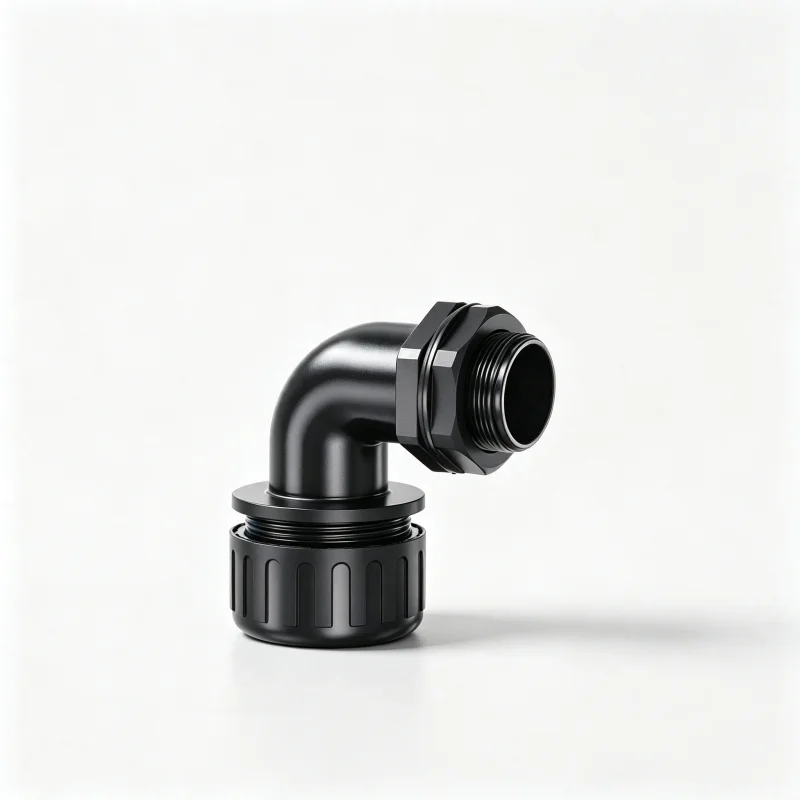
If the cable does not move at the entry, none of the above applies and the standard gland is the correct and cheaper part. If the cable needs to leave the enclosure at a right angle, the 90° elbow gland does that with the same body. If the run is inside corrugated conduit rather than free cable, the part at the wall is a conduit watertight fitting, which is a different product altogether.
How to Choose the Right Size
- Cable OD inside the range, not at its edge. An articulated gland still seals on the sheath. A cable at the top of the range leaves the articulation with no room to move, which defeats the purpose.
- Thread against the knockout. M20, PG13.5 and 1/2" NPT are three different holes with three different pitches — the thread guide has the dimensions.
- Flexing or rotation. Flexing is what this part is for. Rotation is not, at any size.
- The temperature at the entry, in the moving state. Use the dynamic range, not the static one, if the cable moves.
Ordering, MOQ and Lead Time
Black RAL 9005 and light grey RAL 7035 are standard; other colours are made to order. At 1,000 pieces per size there is no tooling charge, and trial quantities from 100 pieces are accepted. Each shipment carries the IP68 test report to IEC 60529, a CE declaration, RoHS and REACH statements and a material certificate. The installation sequence is the same as any nylon gland and is set out in how to install a waterproof cable gland.
Indicative FOB Ningbo or Shanghai, 1,000 pieces per size, tooling included. Trial orders from 100 pieces.
Request a Quote Now
Our team will get back to you within 24 hours.