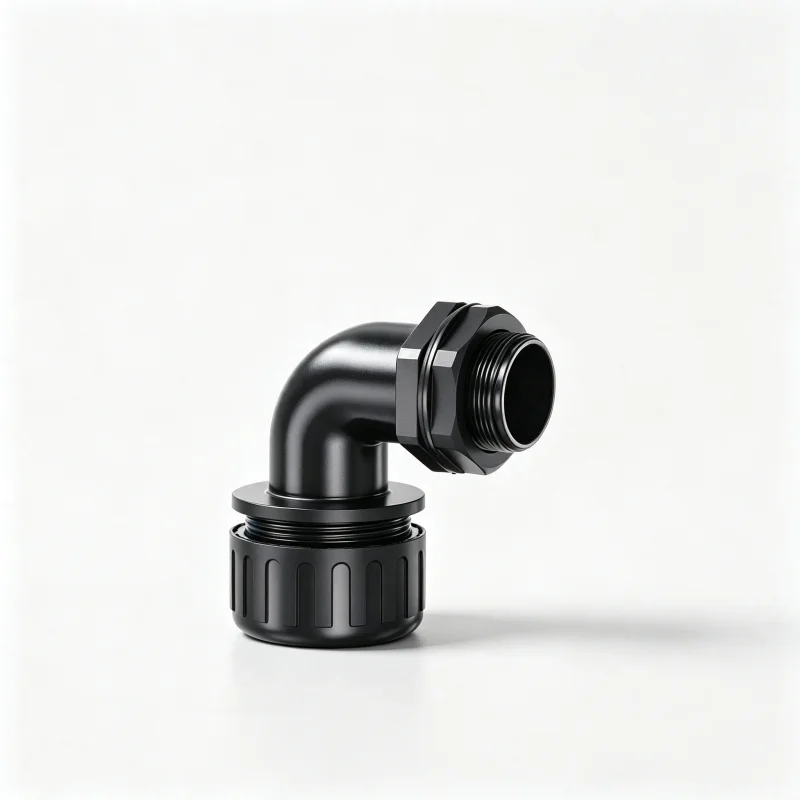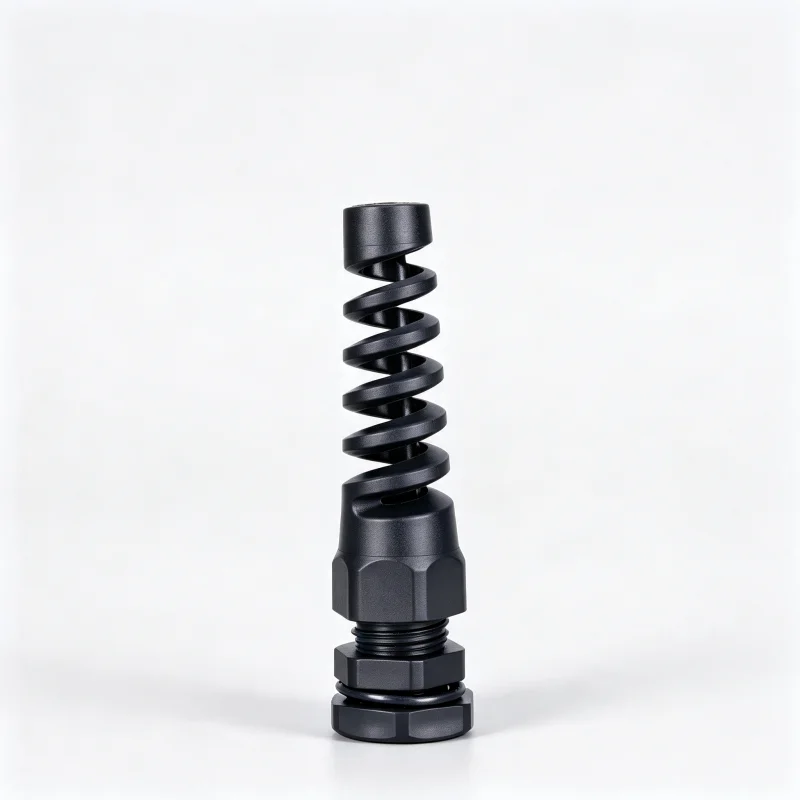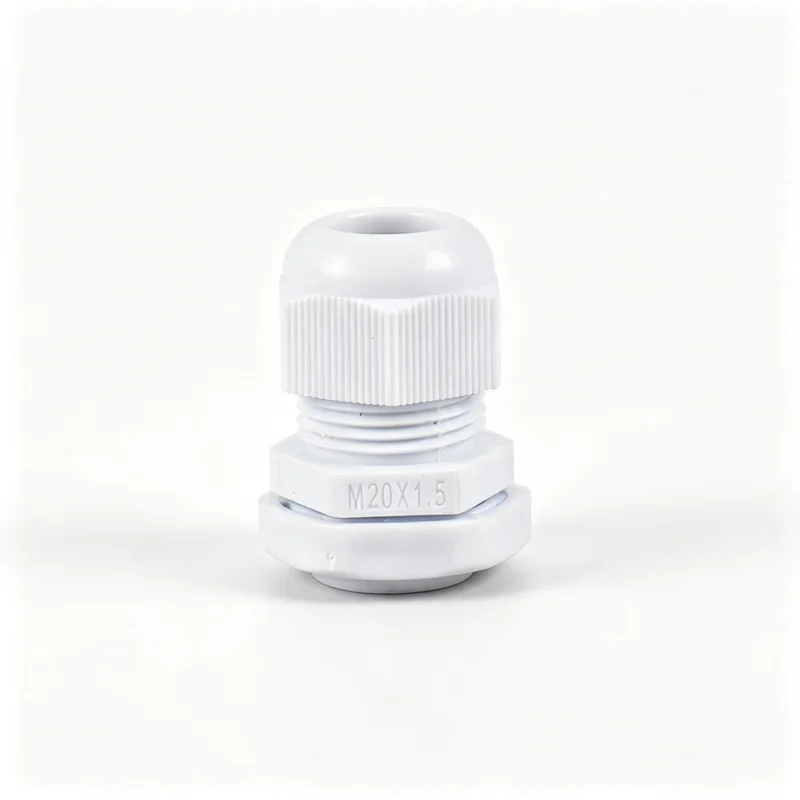
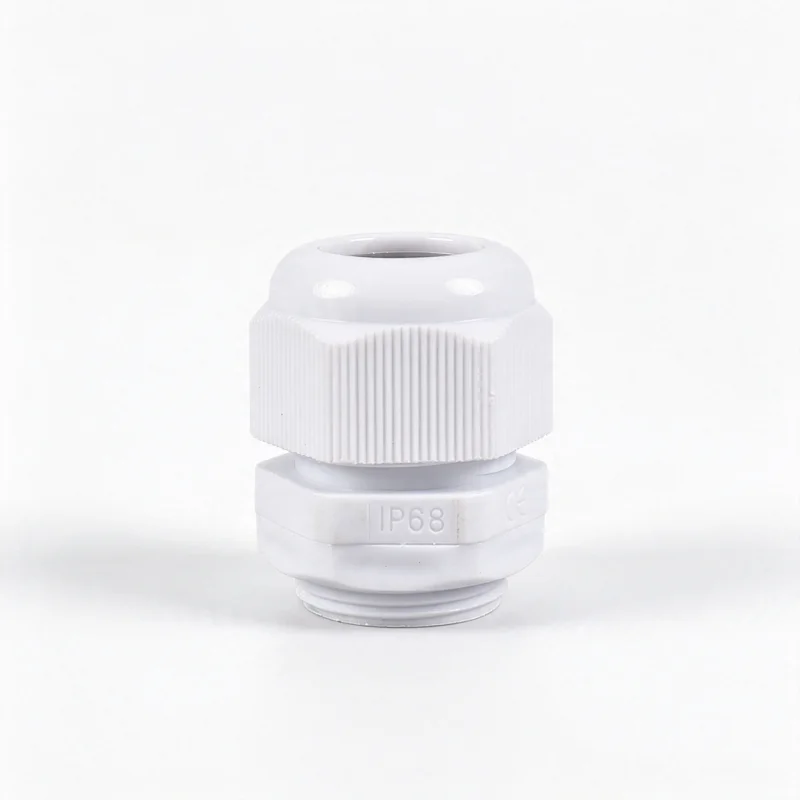
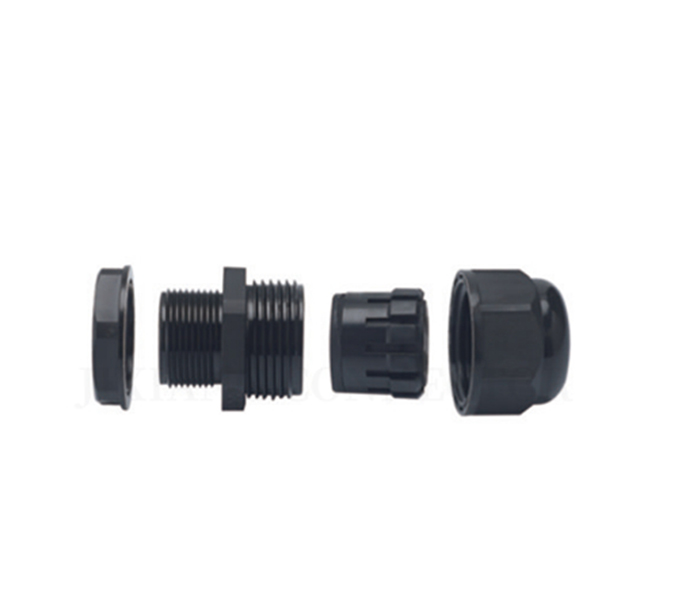


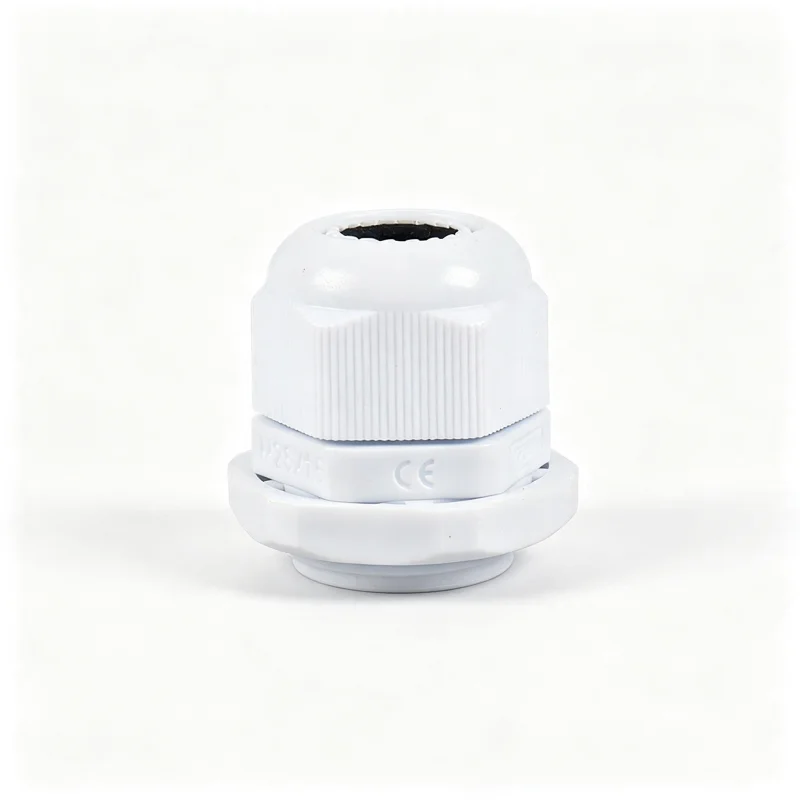
Divided Structure Nylon Cable Gland
| Thread systems | Metric, PG, G(PF), NPT |
|---|---|
| Body material | Polyamide; EPDM seal on the clamping parts |
| Protection degree | IP68 to 10 bar |
| Working temperature | −40 °C to +100 °C static; +120 °C short-term |
| Colours | Black RAL 9005, grey RAL 7035; other colours on request |

Divided Structure Nylon Cable Gland Advantages
The body opens into two halves that close around a cable already in place. The benefit is not convenience — it is that the cable never has to be disconnected, re-terminated or cut. Every application this gland wins traces back to that one fact.
It also explains the price premium over the standard version, and the limits. A split body has a seam, so it has one more place where seating matters, and it provides no shield bonding. Where the entry is new and the cable is bare, the standard gland is cheaper and simpler.
Two Cable Ranges on One Thread
Several small sizes carry two inserts. M12 appears as 3–5.5 mm and as 4.5–7.8 mm, with an identical thread. The model code identifies the insert; the thread size does not. Ordering on thread alone gets the wrong insert on roughly half the small-size orders we see.

| Code | Thread | Cable Range φ(mm) | Thread O.D. C1(mm) | Thread Length C2(mm) | Spanner Size A&F(mm) |
| NLM12A-DS | M12×1.5 | 3-5.5 | 12 | 8.5 | 18/19 |
| NLM12B-DS | 4.5-7.8 | 12 | 8.5 | 18/19 | |
| NLM16A-DS | M16×1.5 | 4-8 | 16 | 10 | 22/19 |
| NLM16B-DS | 4-8 | 16 | 15 | 22/19 | |
| NLM16C-DS | 6-10 | 16 | 10 | 22/22 | |
| NLM16D-DS | 6-10 | 16 | 15 | 22/22 | |
| NLM20A-DS | M20×1.5 | 6-12.5 | 20 | 10 | 24/24 |
| NLM20B-DS | 9-14 | 20 | 10 | 27/27 | |
| NLM20C-DS | 9-14 | 20 | 15 | 27/27 | |
| NLM22-DS | M22×1.5 | 9-14 | 20 | 10 | 27/27 |
| NLM25A-DS | M25×1.5 | 10-16 | 25 | 10 | 33/33 |
| NLM25B-DS | 13-18 | 25 | 10 | 33/33 | |
| NLM25C-DS | 10-16 | 25 | 15 | 33/33 | |
| NLM25D-DS | 13-18 | 25 | 15 | 33/33 | |
| NLM32A-DS | M32×1.5 | 15-22 | 32 | 15 | 41/42 |
| NLM32B-DS | 18-25 | 32 | 15 | 41/42 | |
| NLM40-DS | M40×1.5 | 24-31 | 40 | 20 | 50/52 |
| NLM50-DS | M50×1.5 | 31-41 | 50 | 22 | 62/62 |
| NLM63-DS | M63×1.5 | 44-51 | 63 | 25 | 75/75 |
| NLM75-DS | M75×2.0 | 56-66 | 75 | 25 | 92/92 |
| NLM90-DS | M90×2.0 | 66-77 | 90 | 25 | 110/110 |
Installation Steps
Seat the insert around the sheath first, close the body until the two halves meet with no visible gap, then tighten the nut. A gland closed over a misaligned insert will seal on the bench and weep in service, usually weeks later, when the joint has taken a thermal cycle.
The sealing nut on this series clicks into place and can be re-opened, which is genuinely useful during commissioning — the entry can be checked and reclosed without destroying the insert. It is not a licence to skip the initial seating.
Divided Structure Nylon Cable Gland Applications
- Service work on machines where the cable cannot be disconnected
- Pre-terminated sensor and M12 connector leads entering a panel
- Solar, marine refit and temporary installations on installed cable
- Large entries at M75 and M90, where dismantling the run is not an option
- Panel additions after the original build, when the connector is already fitted
M12 to M90: Size Bands and Their Applications
The cases that justify a split body cluster at the two ends of the range, which changes which sizes are worth stocking.
| Band | Cable OD | The case it is bought for |
|---|---|---|
| M12–M20 | 3–12 mm | Pre-terminated M12 sensor leads and small connectors entering a panel. The split is the only way to add the entry without cutting the connector off. |
| M25–M40 | 10–25 mm | Multi-core cable with a fitted plug, and service work on existing machines where re-terminating is not acceptable. |
| M50–M63 | 30–44 mm | Large pre-terminated power cable. Handling weight, not sealing, is the practical difficulty. |
| M75–M90 | 56–77 mm | Junction chambers and heavy cable where dismantling the run is out of the question. |
Note that several threads appear twice with different cable ranges, for example M12 in both a 3–5.5 mm and a 4.5–7.8 mm version. The thread is identical; only the insert differs. Ordering by thread size alone will get you the wrong insert about half the time on the small sizes.
Installation Faults: Misalignment and Sealing
The failure mode is misalignment. Two halves that are not seated flat before the nut is tightened will seal unevenly, and the leak appears weeks later. Seat the insert around the sheath first, close the body fully until the halves meet with no visible gap, then tighten the nut.
The sealing nut on this series is designed to click into place and re-open, which is useful during commissioning because the entry can be checked and reclosed without destroying the insert. Do not use that feature as a substitute for correct initial seating.
Where the split gland is going onto armoured or screened cable, the shield still needs terminating; the split body seals the entry but provides no bonding path. The stainless steel and EMC series are the ones to look at for that case.
Ordering, MOQ and Lead Time
Give the model code, not the thread, and state the cable OD because the small sizes carry two insert options. Factory pricing is 1,000 pcs per size with no tooling charge; trial orders from 100 to 500 pcs. Above M63 confirm before the enclosure drawing is released.
Send the model code, cable OD and whether the connector is already fitted — that last point decides whether a split gland is the right answer.
Request a Quote Now
Our team will get back to you within 24 hours.