
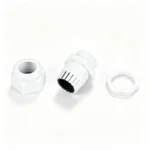

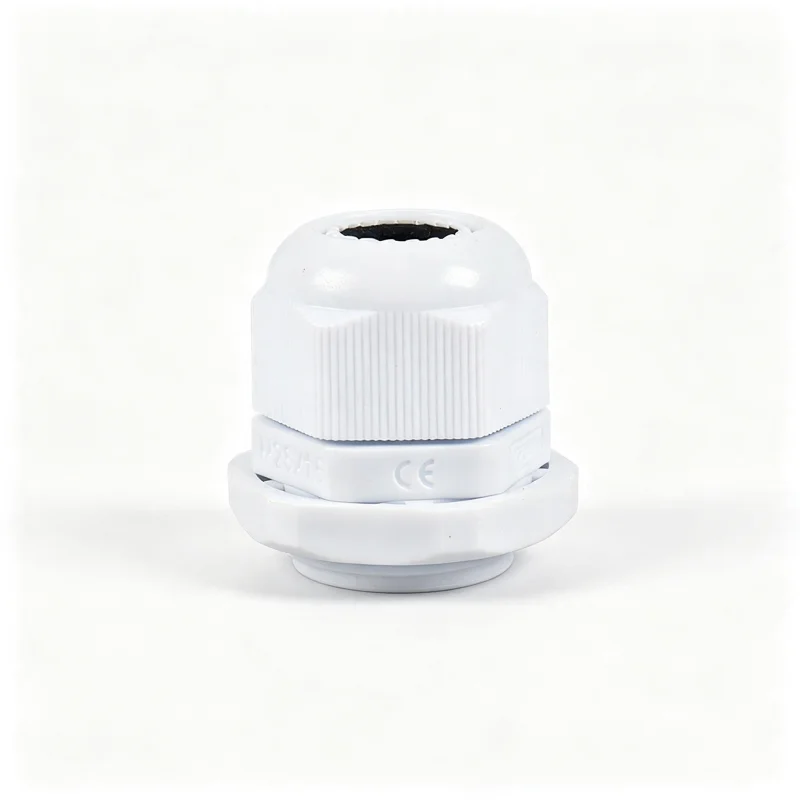
United Structure Nylon Cable Gland
| Thread systems | Metric, PG, G(PF), NPT |
|---|---|
| Body material | Polyamide; EPDM seal on the clamping parts |
| Protection degree | IP68 to 10 bar |
| Working temperature | −40 °C to +100 °C static; +120 °C short-term |
| Colours | Black RAL 9005, grey RAL 7035; other colours on request |

United Structure Nylon Cable Gland Advantages
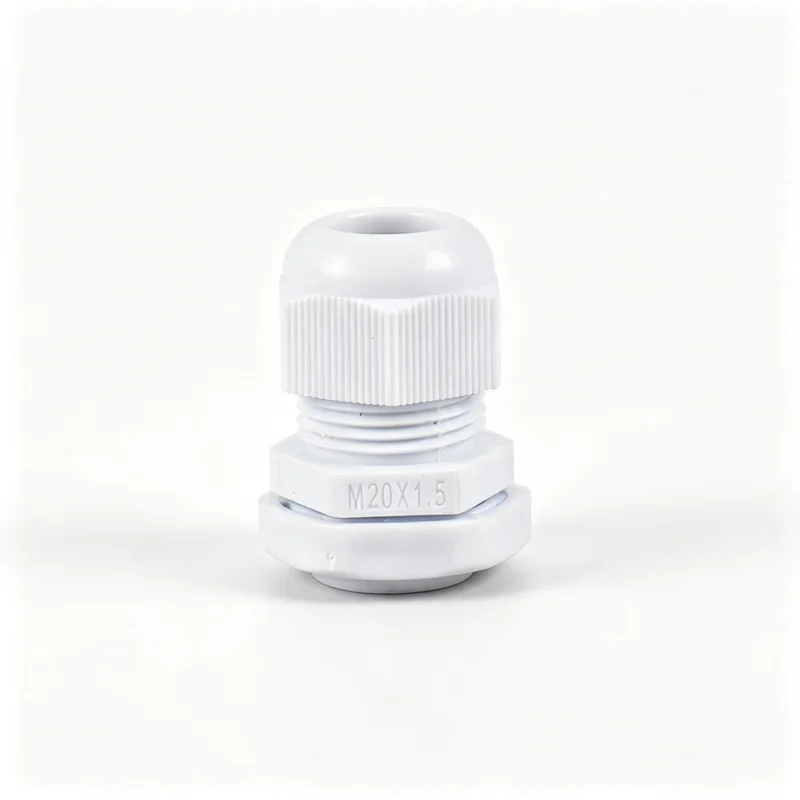
In the united design the body is a single piece. There is no seam to open and no second half to reassemble, which removes a whole class of installation error — the gland that looks closed but is not seated flat.
The trade-off is fixed by the design: the cable must pass through the gland before the conductors are terminated. On new-build wiring that costs nothing. On a retrofit with a connector already crimped on, it is impossible, and the answer is the divided-structure gland instead.
Why the Range Starts at M8
M8 and M10, with a 2 to 6 mm cable range, sit below where most metal glands begin. That band is where sensor leads, instrumentation and small signal cable live, and it is the main reason to specify this series rather than a brass equivalent: a single-entry nylon gland is faster to fit and cheaper than a cable entry frame when only one cable is involved.
At the other end the same body runs to M63 and a 35–46 mm cable. There is no structural change across the range — only the insert and the nut scale — so a panel can be specified entirely from this one series if the cables are being pulled rather than retrofitted.

| Code | Thread | CableRange φ(mm) | Thread O.D. C1(mm) | Thread Length C2(mm) | Spanner Size A&F(mm) |
| NLM8-UN | M8×1.25 | 2-4.8 | 8 | 7.5 | 13/12 |
| NLM10-UN | M10×1.5 | 3-6 | 10 | 8 | 15/13 |
| NLM12A-UN | M12×1.5 | 3-6.5 | 12 | 8.5 | 18/15 |
| NLM12B-UN | 3-6.5 | 12 | 15 | 18/15 | |
| NLM12C-UN | 3-5.5 | 12 | 8.5 | 18/19 | |
| NLM12D-UN | 4-8 | 12 | 8.5 | 18/19 | |
| NLM12E-UN | 3-5.5 | 12 | 15 | 18/19 | |
| NLM12F-UN | 4-8 | 12 | 15 | 18/19 | |
| NLM16A-UN | M16×1.5 | 4-8 | 16 | 10 | 22/19 |
| NLM16B-UN | 4-8 | 16 | 15 | 22/19 | |
| NLM16C-UN | 5-10 | 16 | 10 | 22/22 | |
| NLM16D-UN | 5-10 | 16 | 15 | 22/22 | |
| NLM18A-UN | M18×1.5 | 5-10 | 18 | 10 | 24/22 |
| NLM18B-UN | 5-10 | 18 | 15 | 24/22 | |
| NLM20A-UN | M20×1.5 | 6-12.5 | 20 | 10 | 27/24 |
| NLM20B-UN | 8.5-14 | 20 | 11 | 27/27 | |
| NLM20C-UN | 8.5-14 | 20 | 15 | 27/27 | |
| NLM22-UN | M22×1.5 | 8.5-14 | 22 | 11 | 27/27 |
| NLM24-UN | M24×1.5 | 8.5-14 | 24 | 11 | 27/27 |
| NLM25A-UN | M25×1.5 | 8.5-14 | 25 | 11.6 | 33/27 |
| NLM25B-UN | 12.5-18 | 25 | 11.6 | 33/33 | |
| NLM25C-UN | 12.5-18 | 25 | 15 | 33/33 | |
| NLM32A-UN | M32×1.5 | 14-22 | 32 | 15 | 41/42 |
| NLM32B-UN | 17-25 | 32 | 15 | 41/42 | |
| NLM36A-UN | M36×1.5 | 14-22 | 36 | 12 | 45/42 |
| NLM36B-UN | 17-25 | 36 | 12 | 45/42 | |
| NLM40-UN | M40×1.5 | 23-32 | 40 | 15 | 50/52 |
| NLM50-UN | M50×1.5 | 30-41 | 50 | 15 | 62/62 |
| NLM63-UN | M63×1.5 | 35-46 | 63 | 18 | 75/65 |
How to Choose the Right Size
- Assembly timing. If the cable is already terminated, stop — this is the wrong product, not a difficult installation.
- Cable OD at the small end. M8 and M10 cover only a few millimetres; there is no margin to absorb a mis-measured sheath.
- Grip versus seal. One nut sets both. On small stiff cable that window is narrow, so the insert must match the cable rather than sit near the edge of the range.
M8 to M63: Size Bands and Their Applications
Each band in the range exists for a different reason, and the list below is why the series starts smaller than most metal series.
| Band | Cable OD | Why this band exists in the range |
|---|---|---|
| M8–M12 | 2–6 mm | Sensor leads, signal cable and small instrumentation. Metal glands rarely go below M12, so this is the band a one-piece nylon body wins outright. |
| M16–M25 | 4–18 mm | General panel entries. The largest group of sizes, and the one where stock depth matters most. |
| M32–M50 | 15–41 mm | Multi-core power and motor cable. Seal compression becomes the deciding factor, not the body. |
| M63 | 35–46 mm | Large single entries where a split body is unnecessary because the cable is being pulled anyway. |
The M8 and M10 sizes are the reason to look at this page at all. Below M12 the choice is usually between a nylon gland and a cable entry frame, and a single one-piece gland is cheaper and faster to fit where only one cable is involved.
Installation
Because the body cannot be opened, the cable has to pass through the nut and insert before the conductors are terminated. On a new build that costs nothing. On a retrofit with connectors already fitted it is impossible, and the divided-structure gland is the correct alternative — see the split cable gland guide before ordering.
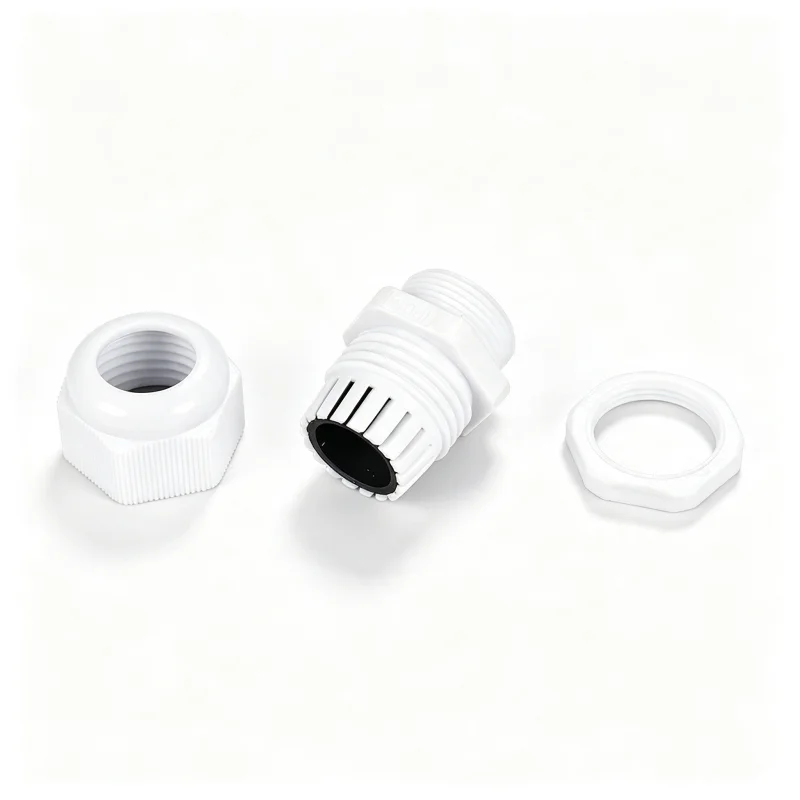
Fit order is body, then locknut, then cable, then tighten the dome nut until the insert closes on the sheath. With no second seal, the single nut sets both grip and sealing, so the setting is a compromise: tight enough to hold, not so tight that the sheath deforms. On small cable at M8 to M12 that window is narrow, which is why the insert must match the cable OD rather than sit at the edge of the range.
United Structure Nylon Cable Gland Applications
- Sensor and instrumentation cable from 2 mm upward
- Small control boxes, terminal enclosures and DIN-rail cabinets
- LED lighting and signage entries
- Motor and power cable at M32 to M63 where the cable is being pulled, not retrofitted
Ordering, MOQ and Lead Time
The code suffix in the table above identifies the united structure; do not order by thread size alone, because the divided version exists in the same threads. Factory pricing is 1,000 pcs per size with no tooling charge, trial orders from 100 to 500 pcs. For M8 and M10, confirm the cable OD first — the range at that end is only a few millimetres wide.
Send thread, cable OD and quantity. For M8 and M10, the cable OD is the number that matters most.
Request a Quote Now
Our team will get back to you within 24 hours.