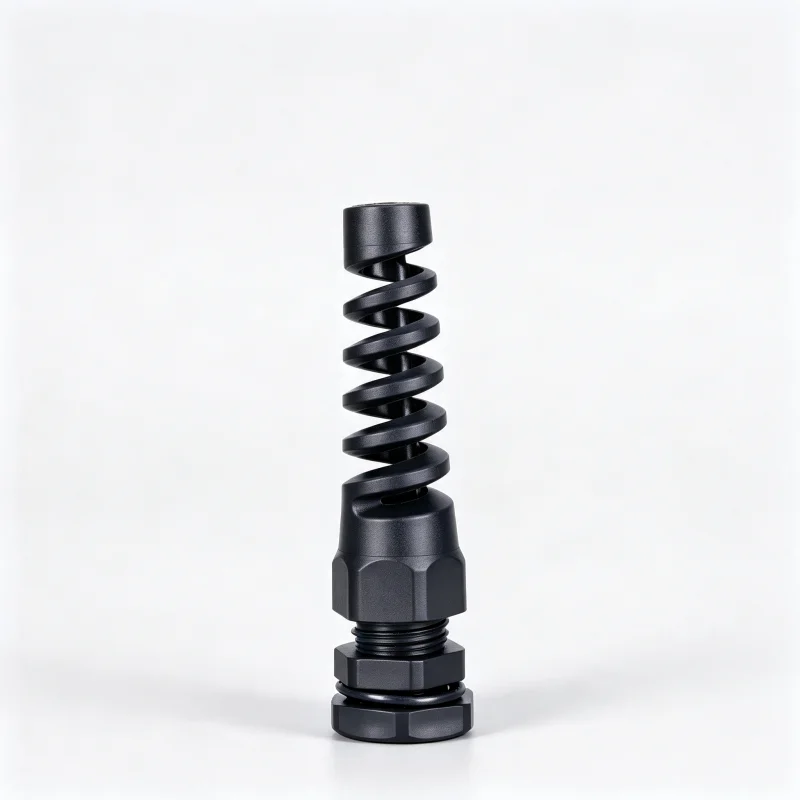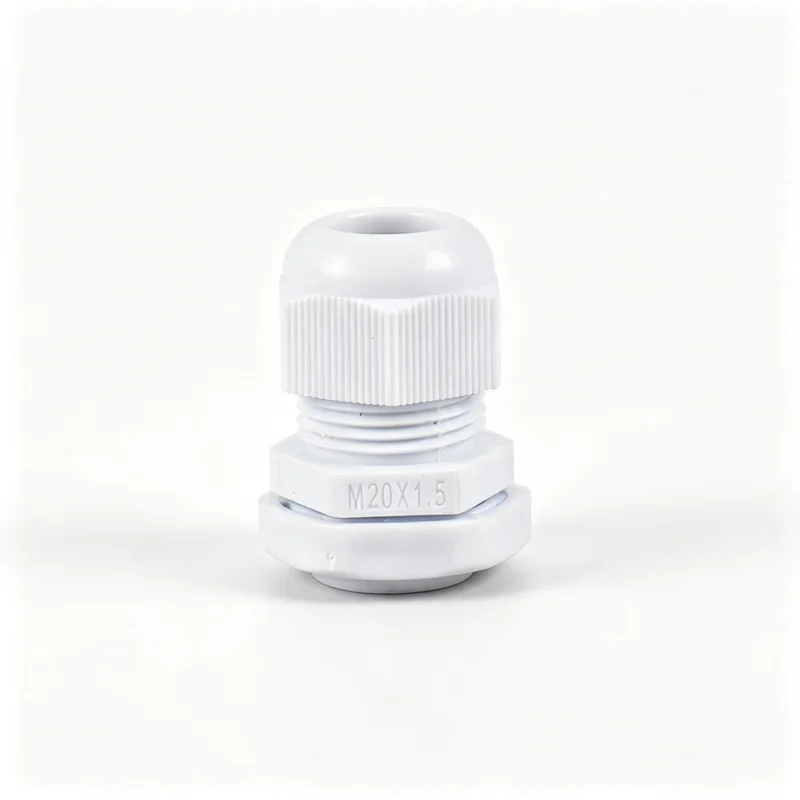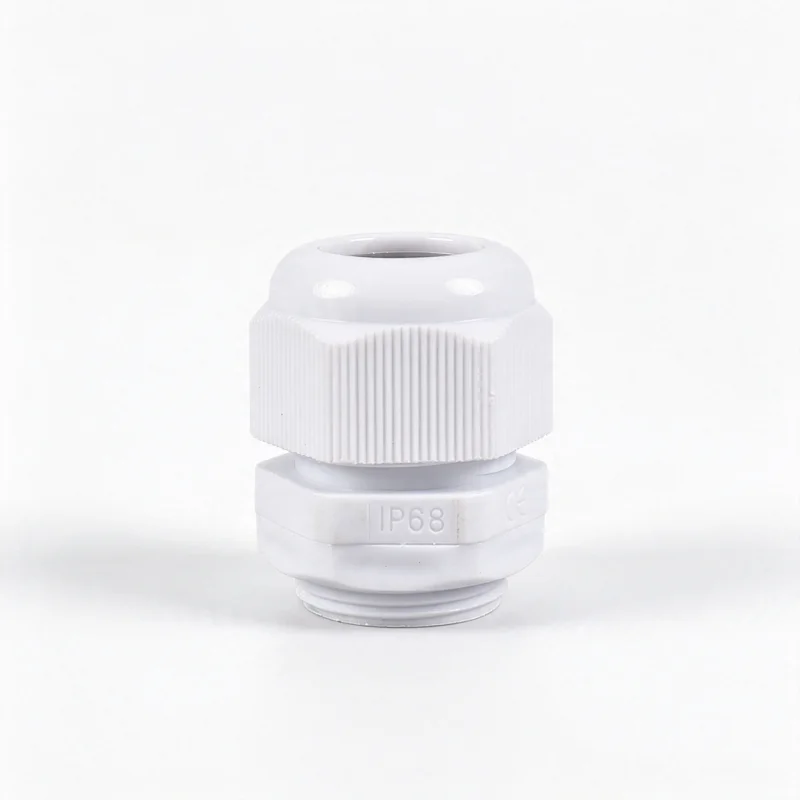
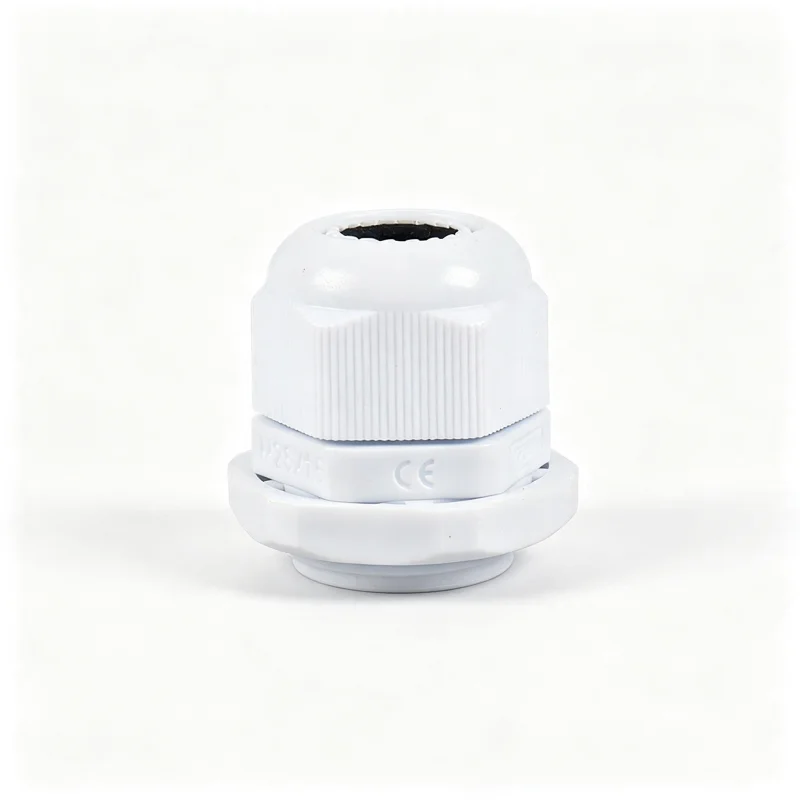
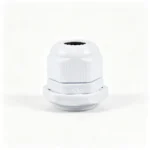

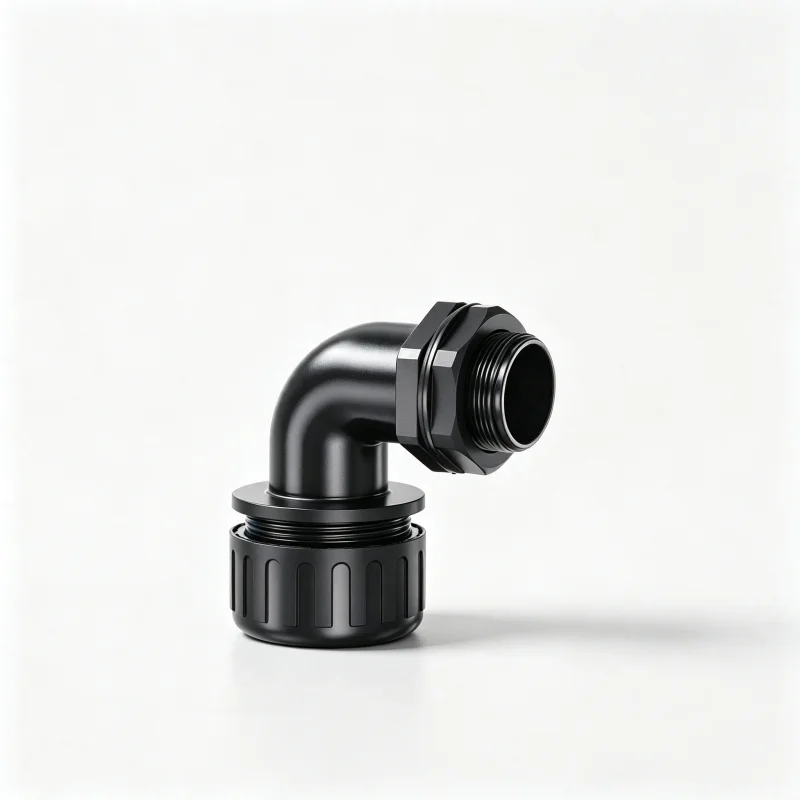
A watertight fitting for corrugated conduit is not a cable gland, and the difference decides the specification. A cable gland grips a cable by its sheath. This fitting grips flexible conduit by its corrugation, and the conductors inside the conduit are never touched by the fitting at all. It terminates a conduit run at an enclosure wall and keeps the interior dry at that joint.
That changes the selection question completely. With a cable gland you start from the cable diameter. Here you start from the conduit — the AD number moulded on the tube — and only then look at the thread the enclosure is tapped for.

What AD Means in Conduit Sizing
Corrugated conduit is sold by AD, the outside diameter measured across the crest of the corrugation. AD13 does not mean 13 mm of usable internal space; it means 13 mm outside, with the wall and the corrugation taking their share. The fitting is moulded to match that crest diameter and the pitch of the corrugation, which is why an AD15.8 tube will not seal in an AD13 body even though the two are 3 mm apart. A fitting forced onto the wrong tube compresses one or two crests and leaves the rest of the joint open — it will pass a visual check and fail on the first wet test.
The practical rule: quote the tube, or its exact AD designation. “Flexible conduit, about 16 mm” cannot be specified from, and it is the most common reason a first sample order is rejected.
Thread and Conduit Size Combinations
This is the part of the range that surprises buyers, and it is where most of the cost saving sits. Because the body is wider than the threaded portion, a single thread accepts more than one conduit size. M16 covers AD13, AD15.8, AD18.5 and AD21.2 — four different tubes on the same knockout. M25 covers AD15.8 through AD28.5.
The consequence runs opposite to what most specifications assume: the thread is chosen by the enclosure and the AD is chosen by the conduit, and the two are matched afterwards from the range instead of by scaling one to the other. It also means a panel tapped for M20 can be re-tubed in a different conduit size later without re-drilling.
| Thread | Conduit sizes accepted (AD) | Thread length options |
|---|---|---|
| M12×1.5 | AD10 | 9 mm |
| M16×1.5 | AD13, AD15.8, AD18.5, AD21.2 | 10 mm, 15 mm |
| M20×1.5 | AD15.8, AD18.5, AD21.2 | 10 mm, 15 mm |
| M22×1.5 | AD15.8, AD18.5 | 15 mm |
| M25×1.5 | AD15.8, AD21.2, AD25, AD28.5 | 10 mm, 15 mm |
| M32×1.5 | AD34.5 | 15 mm |
| M40×1.5 | AD42.5 | 15 mm |
| M50×1.5 | AD42.5, AD48.5, AD54.5 | 15 mm, 25 mm |
| M63×1.5 | AD54.5 | 25 mm |
Nylon Watertight Fitting Sizes (AD10 to AD54.5)
Every combination we mould is listed below. The L suffix marks the longer-thread variant of the same body, which exists for thick walls and for panels with an internal frame behind the skin.
| Model | Conduit (AD) | Thread | Thread O.D. C1 (mm) | Thread length C2 (mm) |
|---|---|---|---|---|
| M12-10 | AD10 | M12×1.5 | 12 | 9 |
| M16-NC13 | AD13 | M16×1.5 | 16 | 10 |
| M16-NC13L | AD13 | M16×1.5 | 16 | 15 |
| M16-NC15.8 | AD15.8 | M16×1.5 | 16 | 15 |
| M20-NC15.8 | AD15.8 | M20×1.5 | 20 | 10 |
| M20-NC15.8L | AD15.8 | M20×1.5 | 20 | 15 |
| M22-NC15.8 | AD15.8 | M22×1.5 | 22 | 15 |
| M25-NC15.8 | AD15.8 | M25×1.5 | 25 | 15 |
| M16-NC18.5 | AD18.5 | M16×1.5 | 16 | 15 |
| M20-NC18.5 | AD18.5 | M20×1.5 | 20 | 10 / 15 |
| M22-NC18.5 | AD18.5 | M22×1.5 | 22 | 15 |
| M16-NC21.2 | AD21.2 | M16×1.5 | 16 | 15 |
| M20-NC21.2 | AD21.2 | M20×1.5 | 20 | 15 |
| M25-NC21.2 | AD21.2 | M25×1.5 | 25 | 10 |
| M25-NC21.2L | AD21.2 | M25×1.5 | 25 | 15 |
| M25-NC25 | AD25 | M25×1.5 | 25 | 15 |
| M25-NC28.5 | AD28.5 | M25×1.5 | 25 | 15 |
| M32-NC34.5 | AD34.5 | M32×1.5 | 32 | 15 |
| M40-NC42.5 | AD42.5 | M40×1.5 | 40 | 15 |
| M50-NC42.5 | AD42.5 | M50×1.5 | 50 | 15 |
| M50-NC48.5 | AD48.5 | M50×1.5 | 50 | 15 |
| M50-NC54.5 | AD54.5 | M50×1.5 | 50 | 25 |
| M63-NC54.5 | AD54.5 | M63×1.5 | 63 | 25 |

IP68 Rating and Sealing
The body is PA66 and the seal is EPDM, compressed onto the conduit corrugation by the dome nut while a gasket seals against the wall. The internal bore is a plain through-passage with no cable seal, because the conduit is doing the protecting. The assembly is rated IP68 at 10 bar: the default test is immersion at 2 m for 24 hours, with 1.5 m / 30 min, 5 m / 72 h and 10 m / 168 h available depending on what the project needs to document.
10 bar corresponds to roughly 100 m of water head, which is well beyond what an outdoor cabinet or a washdown bay will ever see. The figure is published because buyers in pump rooms and below-grade installations ask for it by name. What this fitting does not claim is IP69K — high-pressure jet cleaning is a different test with different acceptance criteria, and a polyamide body with an EPDM seal is not the right component for that duty. For open jets the specification changes rather than the number.
Temperature follows the same dual logic as the rest of the nylon range: −40 °C to +100 °C static or while the conduit is fixed, +120 °C instantaneous, and −20 °C to +80 °C while the conduit is being flexed, with +100 °C instantaneous. Because conduit is usually moving somewhere along its run, the dynamic figures are the ones that apply in practice.
Corrugated Conduit Fitting Applications
| Application | What the fitting is solving | Usual combination |
|---|---|---|
| Machine tools and CNC cabinets | Coolant and oil splash at the entry, conduit run to the machine | M20 / AD21.2 |
| Conveyors and material handling | Long runs with continuous vibration at the wall | M25 / AD25 |
| Outdoor and washdown enclosures | Rain and hose spray on the joint | M25 / AD28.5 |
| Panel-to-panel interconnects | Loose conductors protected between two cabinets | M16 / AD15.8 |
| Retrofit onto existing conduit | Matching an AD already installed on site | Any AD10 – AD54.5 |
| Thick walls and framed panels | Thread too short for the build-up | L-variant, 15 mm or 25 mm |
This is the wrong part for a bare cable entering an enclosure — that is the standard nylon cable gland or, if the cable moves at the entry, the flexible nylon cable gland. The three look similar on a shelf and solve three different problems; comparing them by size alone is how the wrong one ends up on a drawing.
How to Choose the Right Size
- The AD designation on the tube. Not the bore, not an approximate measurement.
- The thread on the knockout. Metric or PG; the thread guide covers the difference.
- Thread length against the wall. The L-variant exists because a 10 mm thread disappears inside a 14 mm wall.
- Whether the run flexes. If it does, specify against the dynamic temperature range, not the static one.
Ordering, MOQ and Lead Time
Black RAL 9005 and light grey RAL 7035 are standard, with other colours made to order. There is no tooling charge at 1,000 pieces per size and trial quantities from 100 pieces are accepted. Each shipment includes the IP68 test report to IEC 60529, a CE declaration, RoHS and REACH statements and a material certificate. Mounting holes follow the same rule as the rest of the range — thread O.D. plus 0.2 to 0.5 mm, tabulated in the hole size chart, with the full conduit range in the nylon cable gland size chart and the installation sequence in how to install a waterproof cable gland.
Indicative FOB Ningbo or Shanghai, 1,000 pieces per size, tooling included. Trial orders from 100 pieces.
Request a Quote Now
Our team will get back to you within 24 hours.