When it comes to industrial electrical installations, a cable gland isn’t just a fancy connector; it’s the unsung hero that keeps your cables secure, sealed, and safe from environmental hazards. If you’ve ever wondered why there are so many types of threads on these cable glands and how to pick the right one for your project, this article is crafted just for you.
Whether you’re a seasoned engineer or a newcomer to cable fittings, understanding the Cable Gland Thread Types is crucial for choosing products that will last and perform under varied conditions. Let’s dive in together and uncover the secrets behind these threads—so the next time you or your team select a cable gland, you do it like a pro!
Basic Concepts What Makes Threads So Important?
Threads on cable glands aren’t just for show. They:
Ensure a tight, secure connection between the cable gland and the equipment or enclosure.
Provide a reliable seal against dust, water, and other contaminants, which is vital for maintaining safety and functionality.
Allow strain relief, helping prevent cable damage over time.
Understanding Cable Gland Thread Types helps you avoid leaks, loose fittings, or early failures.
Feature
Importance
Thread Type
Influences sealing and compatibility
Sealing Mechanism
Ensures dust/water tightness
Material Matching
Prevents corrosion and enhances durability
If you’re sourcing cable glands, remembering these Cable Gland Thread Types Important Points will help you pick the perfect fit for your specific use case. Ready to explore the main thread types? Let’s move on.
3. Common Type in Cable Gland Thread Types
1️⃣Metric Threads (M Series)
Metric threads, marked with an “M” followed by diameter and pitch (like M20 x 1.5), are the international standard across most countries outside North America. These straight threads have a 60-degree flank angle and rely on sealing washers or O-rings for a watertight fit.
Thread Detail
Description
Type
Straight (parallel)
Angle
60° flank angle
Common Sizes
M12, M16, M20, M25, M32, M40, M50
Sealing
Requires O-rings or washers
These are especially popular since the year 2000, when many markets phased out older PG threads in favor of metric sizes following IEC 62444 standards.
2️⃣English Threads (G Threads)
These are known as parallel pipe threads with a 55-degree flank angle. They’re often called G threads and are very popular in Europe.
Thread Detail
Description
Type
Parallel
Angle
55° flank angle
Common Sizes
G1/2″, G3/8″, G1/4″
Sealing
Uses sealing rings or compound
Due to their design, they provide excellent resistance against vibration loosening, ideal for fixed installations.
3️⃣American Threads (NPT)
Cable Gland Thread Types in the National Pipe Thread (NPT) is the go-to standard in North America. It has a tapered profile with a 60° flank angle, allowing the threads themselves to form a tight seal when torqued.
Thread Detail
Description
Type
Tapered
Angle
60° flank angle
Common Sizes
1/2″ NPT, 3/8″ NPT, 1/4″ NPT
Sealing
Self-sealing due to taper (often with tape)
This taper prevents leaks but can make repeated disassembly tricky without damage. A bit of PTFE tape often helps achieve a perfect seal.
4️⃣German Threads (PG)
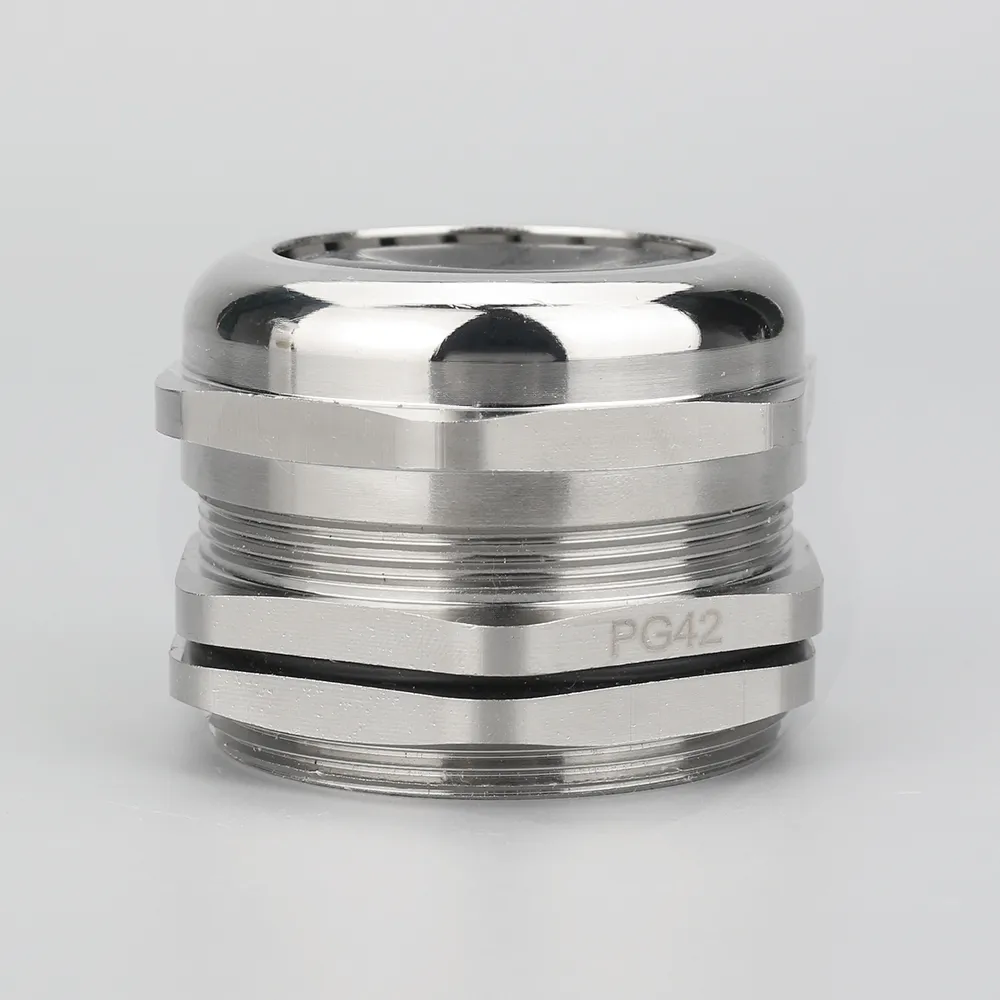
Panzer-Gewinde or PG threads have a unique 80-degree flank angle and are straight in profile. Although largely replaced by metric threads in many regions after 2000, PG threads remain in use, especially in legacy equipment.
Thread Detail
Description
Type
Straight (parallel)
Angle
80° flank angle
Common Sizes
PG7, PG9, PG13.5, PG16, PG21
Sealing
Uses sealing rings or O-rings
PG threads are valued for their strong mechanical grip and typically work well with metal cable glands for harsh environments.
Cable gland thread types there are also other less common standards, such as PT and BSPT, but these are mostly region or application-specific. If your project needs them, consider reaching out for tailored solutions or consulting specific standards.
Thinking about ordering Cable Gland Thread Types that fit your custom specifications? Contact us today to get solutions!
Choosing the right thread isn’t just about fitting the hole. It impacts:
Sealing and moisture protection: Tapered threads like NPT can seal metal-to-metal, but many straight threads need O-rings to prevent water ingress.
Corrosion resistance: Material compatibility matters. Stainless steel threads resist rust better than brass or plastic in harsh conditions.
Installation and maintenance: Some threads wear out faster on repeated assembly/disassembly; others are easier to mount with common tools.
Thread Type
Sealing Method
Maintenance Ease
Common Material
NPT
Tapered metal seal
Moderate; tape needed
Brass, Stainless Steel
Metric
O-ring/washer seal
Easy; O-rings replaceable
Brass, Plastic
PG
O-ring/washer seal
Easy
Brass, Stainless Steel
G
Sealing compound/ring
Moderate
Brass
How to Choose the Right Thread for Your Application
To pick the ideal Cable gland thread types thread, consider the following:
Cable diameter and flexibility: Ensure the gland’s clamping range fits your cable perfectly.
Environmental conditions: Will it face water, dust, chemicals, or temperature extremes?
Regulatory standards: Different countries or industries may require specific thread types or certifications.
Compatibility: Check your enclosure’s thread type and dimensions.
Pro tip: Always confirm the Cable gland thread (male or female) to avoid mismatches during installation.
Considerations
Why It Matters
Cable size & type
Ensures proper sealing and grip
Environmental protection
Avoids failures due to corrosion or moisture
Standards & compliance
Meets legal and safety requirements
Thread compatibility
Prevents leakage and installation issues
If you want an expert opinion on matching thread sizes or need custom cable glands for your project, reach out to us anytime!
Choosing the right cable gland thread types is more than a technical detail—it’s about ensuring your electrical systems stay safe, secure, and durable under real-world conditions. We explored the key thread types: metric, NPT, PG, and G threads, each with unique characteristics suited to different standards and environments.
Whether your project involves harsh industrial settings or sensitive electronic equipment, picking the correct Cable gland thread types will save you headaches later and improve installation success rates.
Remember, if you’re ever unsure which cable gland fits your needs, consulting with an expert or supplier—like us—can make the process smooth and guaranteed. Ready to get the perfect cable gland set up? Contact us today for professional advice and customized quotations!
Thread Types Compared: Sizes, Sealing and Weak Spots
The four thread systems are described one by one above. This table puts them side by side, because the choice is usually made on three things: what the enclosure already has, how the joint is sealed, and which weakness you can live with.
Thread system
Sizes we stock
How it seals
Main advantage
Weak spot to watch
Typical applications
Metric (M)
M12–M63
O-ring or sealing washer on a straight thread
Internationally standard, easy to interchange and replace
The thread itself does not seal — a missing or wrong washer leaks
Industrial automation, instrumentation, control panels
PG (Panzer-Gewinde)
PG7–PG48
O-ring or sealing washer on a straight thread
Simple to install and locks tight; still widespread on European machinery
A declining standard, and PG13.5 is not a drop-in replacement for M20
Legacy European equipment, sensors, lighting
NPT
1/4"–2"
Tapered thread, self-sealing, normally with PTFE tape
Seals well under vibration and pressure without a separate washer
Depends on tape, and is not reusable without re-taping
North American power equipment, process and hydraulic lines
G / BSP (ISO 228)
1/4"–3 1/2"
Parallel thread, seals on a ring or sealing compound
Reusable seal when the ring is replaced at each re-termination
An ignored or worn O-ring is the whole seal — nothing else closes the path
Pipework, hydraulic and special industrial interfaces
Cable clamping ranges follow the size series rather than the thread system: see the full cable gland size chart for M12–M63 and 3–44 mm.
Two rules come out of this table. Seal on the thread form the enclosure actually has, and use an adapter only when the joint is accessible for inspection — adapters add a second sealing interface, and that is where leaks appear. And never mix two thread systems on one gland: a metric body with an NPT locknut will thread together far enough to look correct and still leak under pressure.
FAQ
How do I select a waterproof cable gland?
Look for IP68 or higher-rated glands with seal rings matching your cable diameter and environment.
What is the difference between short and long threads?
Long threads offer more grip and detail on sizes but may require more installation space.
Can I use different Cable gland thread types together?
Not recommended; threads must match (type, pitch, diameter) for a proper seal.
What materials are typical for cable glands?
Brass, stainless steel, and nylon/plastic are common, selected for mechanical strength and corrosion resistance.
Do you provide custom cable glands?
Yes! Custom threads, materials, and sizes can be manufactured to meet specific demands.
What is the difference between PG and metric threads?
They are two different standards, not two names for one thread. Metric (M) threads follow ISO sizes and pitch (M20 × 1.5, for example), while PG threads follow the older German DIN sizes, where PG13.5 is the common equivalent of M20 but is not interchangeable with it. Both are straight threads sealed by an O-ring or washer, so a PG gland will not screw properly into a metric hole of the same nominal size without an adapter.
A brass waterproof cable gland helps protect cable entries from water, dust, and strain in industrial and marine installations. Learn how to choose the right model, size, and supplier.
A VFD cable gland has to bond the cable screen around the full circumference at both the drive and the motor end. How to size one for drive cable, where the bond path breaks, and what a gland cannot fix.
We use cookies to enhance your browsing experience, serve personalised ads or content, and analyse our traffic. By clicking "Accept All", you consent to our use of cookies.