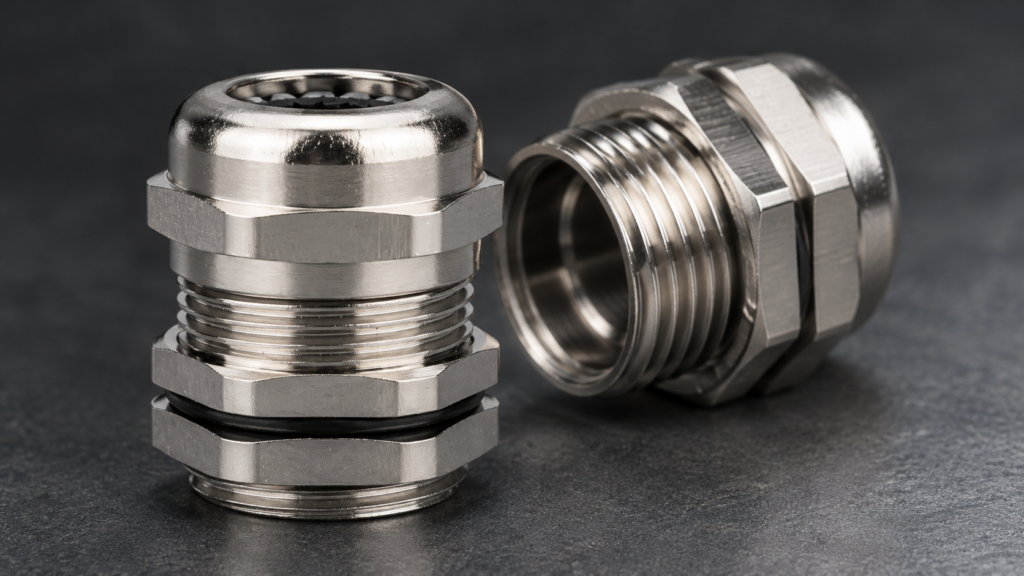
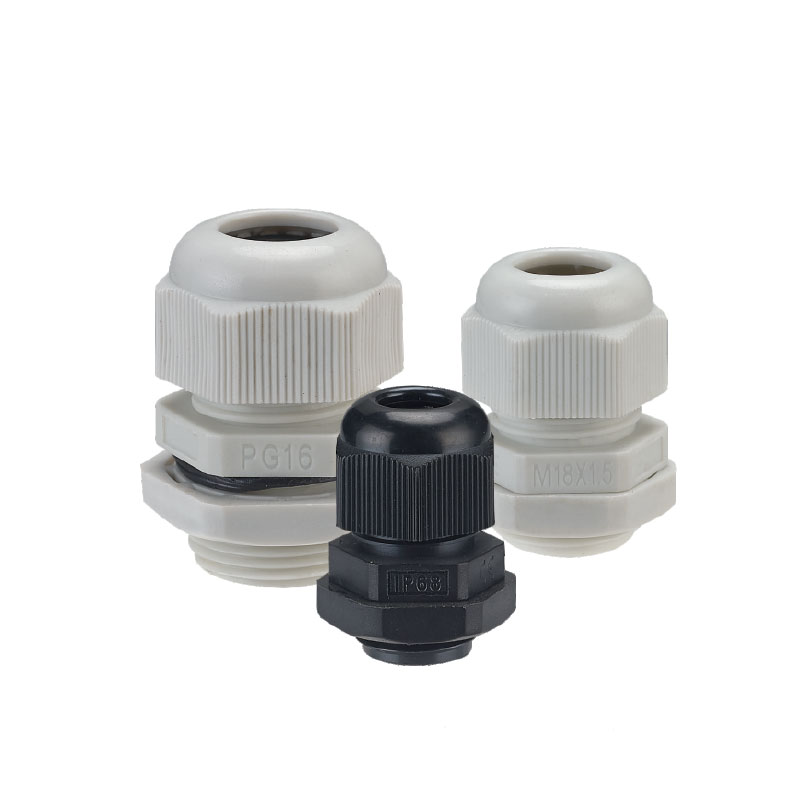
A PG vs metric cable gland decision is not a matter of preference, and the two are not alternative spellings of the same fitting. They are separate thread systems with different geometry, different size numbers and different installation holes. A gland from one system will not seal in the other, and the sizes that look closest are usually the ones that cause the failure.
Feature
Metric (M)
PG
Thread form
Straight, parallel
Straight, parallel
Flank angle
60°
80°
Pitch
1.5 mm across the range
1.41 mm above PG7
Size designation
Thread diameter in millimetres, e.g. M20 x 1.5
Nominal conduit size, not a diameter, e.g. PG13.5
Governing standard
EN 50262 / IEC 62444
DIN 40430, legacy
Where you meet it
New equipment worldwide
German and older European machinery, spares
The size designation is the first trap. M20 means a 20 mm thread diameter. PG13.5 means nothing in millimetres that helps you — the actual thread outside diameter is 20.4 mm, and the number refers to a conduit size that was standardised decades ago.
The Flank Angle Changes How the Threads Touch
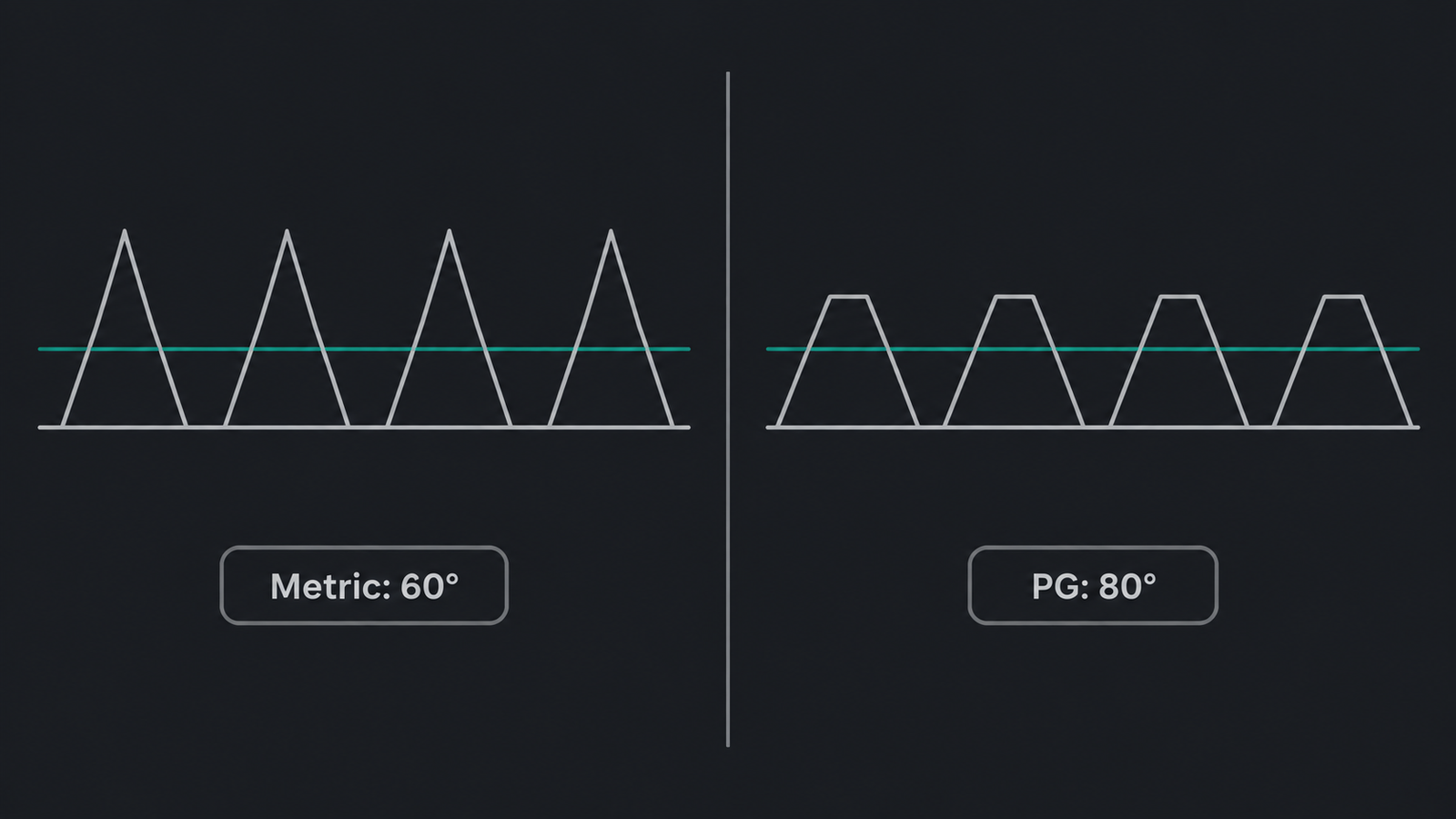
Both threads are straight, so both rely on a washer or an O-ring at the face to seal. Neither is tapered and neither seals on the thread itself. The difference is the shape of the profile: metric threads are cut with a 60° flank, PG threads with an 80° flank, which makes the PG thread noticeably stubbier and shallower for the same pitch.
Two threads with different flank angles can be started into each other, because the pitch is nearly the same and the major diameters overlap. That is exactly the problem. They do not achieve flank-to-flank contact; they touch near the crest, carry load on a small area, and deform the profile as they are tightened. The joint may hold pressure for a while and then creep.
Same pitch family, different profile.
Pitch Is Nearly the Same, Which Is What Makes It Dangerous
Metric cable glands use a 1.5 mm pitch from M12 through M63. PG threads use 1.41 mm above PG7. The two are close enough that a PG gland will often thread two or three turns into a metric hole by hand, and that partial engagement is what convinces an installer that it fits.
At 1.41 against 1.5 mm, the threads are out of phase by roughly six per cent. Over a ten-millimetre thread length that is enough to bind, to shear the crest of one thread, or to stop engagement before the seal face reaches the enclosure. The result is a gland that is tight to the hand, loosens under vibration, and leaks at the washer rather than at the cable.
The Nearest-Size Table and Why It Fails at the Hole
The published equivalence between the two systems is a cable-range equivalence, and it is routinely read as a thread equivalence. That single misreading causes more wrong orders than any other mistake in this product category.
PG size
Thread OD
Closest metric by cable range
Metric hole
What actually happens
PG7
12.5 mm
M12
12.2 mm
PG thread is larger than the hole; will not enter
PG9
15.2 mm
M16
16.2 mm
Drops through with 1 mm of clearance; washer cannot bridge it
PG11
18.6 mm
M16 or M20
16.2 / 20.2 mm
Loose in M20, will not enter M16
PG13.5
20.4 mm
M20
20.2 mm
0.2 mm too large for the hole; the classic near miss
PG16
22.5 mm
M20
20.2 mm
Will not enter; needs an M25 entry and an adapter
PG21
28.3 mm
M25
25.2 mm
Will not enter
PG29
37.0 mm
M32
32.2 mm
Will not enter
PG36
47.0 mm
M40
40.2 mm
Will not enter
PG42
54.0 mm
M50
50.2 mm
Will not enter
PG48
59.3 mm
M63
63.2 mm
Drops through with 4 mm of clearance
Two rows break the pattern. PG13.5 and M20 are close enough in diameter that a fitter will try harder, and PG48 against M63 drops through so obviously that the error is caught. The dangerous case is the one that half works.
What “PG13.5 Equals M20” Actually Means
When a catalogue says PG13.5 is equivalent to M20, it means the two sizes clamp roughly the same cable diameter. It does not mean the threads interchange, and it does not mean the hole is the same. A PG13.5 gland needs a 20.4 mm hole; an M20 gland needs 20.2 mm.
That equivalence is genuinely useful for one job: comparing clamping ranges when you are choosing between a metric panel and a legacy machine. It is useless for ordering, because the deciding dimension is the thread, not the cable range. Order the thread the enclosure was tapped for, then pick the size within that system that covers the cable.
Adapters: The Correct Crossover and What It Costs
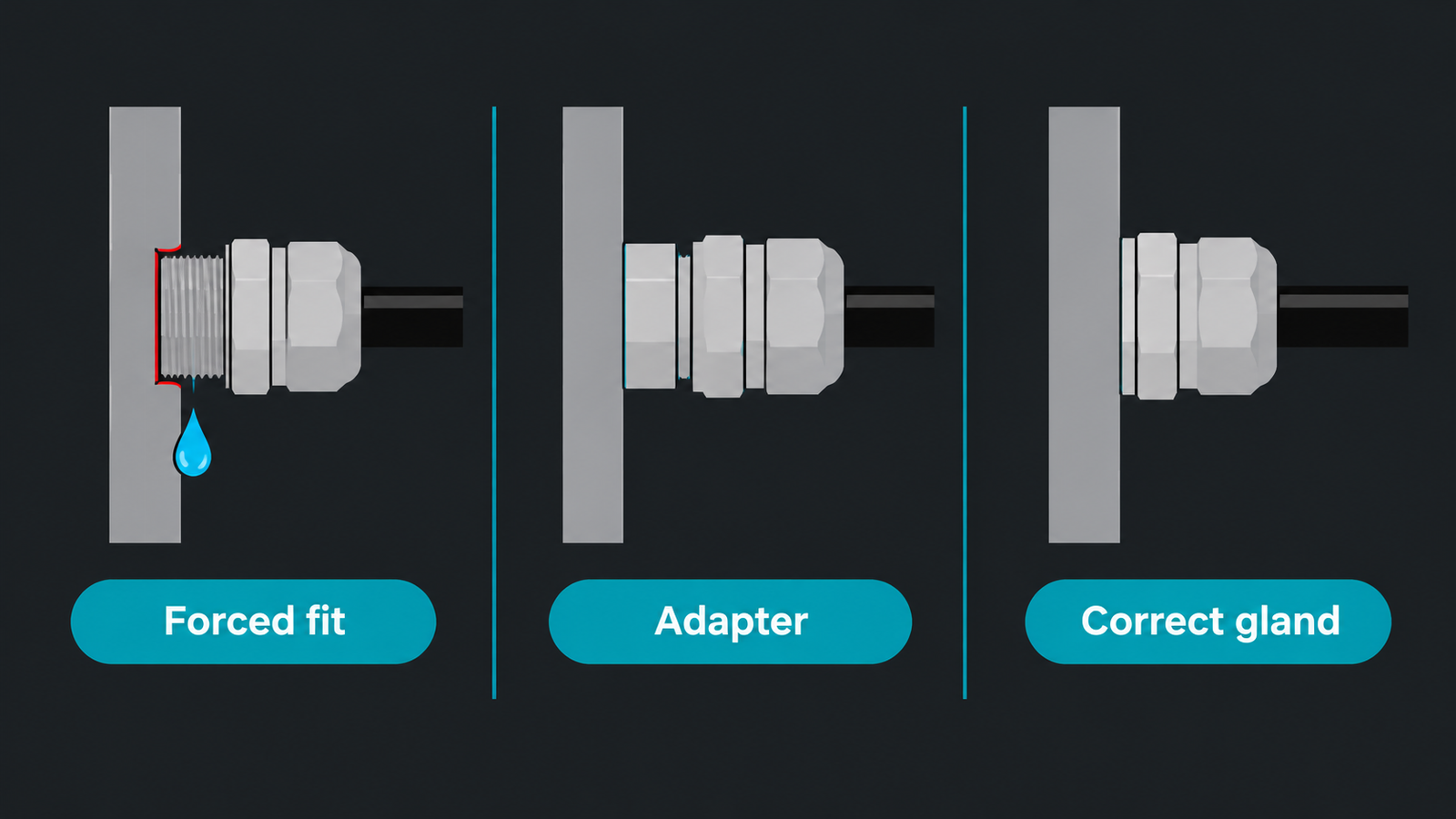
Where the two systems must meet — a PG gland on a new metric enclosure, or a metric gland into an old German pump — the correct answer is an adapter, not force. Adapters come as enlargers and reducers, and they convert one thread form to the other in a single machined part.
Adapters add a joint; forcing adds a leak.
The cost is not the part price. An adapter adds a second threaded joint, which is a second potential leak path; it adds axial length, which matters in a shallow enclosure or where the cable bends immediately inside; and it puts a separate component into the earth path, which is acceptable only if the adapter is metal and fully engaged. On a gland plate with limited depth, an adapter plus a gland can exceed the available space, and the cable then enters at an angle.
For anything beyond a handful of pieces, the cheaper answer is usually to buy the gland in the thread you actually need. Brass and stainless glands are made in both systems, so the adapter is a convenience for small retrofit quantities rather than a design solution.
There is also a maintenance consequence that appears years later. An adapter is a part the next technician has to identify before a replacement can be ordered, and it is rarely documented. Panels converted twenty years ago are now a puzzle: the drawing specifies one thread, the adapter is the other, and the gland in the hole matches neither. Where adapters are used, add the conversion to the panel schedule at the time of installation; it costs one line and saves an hour of measuring during a breakdown.
Legacy Equipment: A Spares Policy That Works
Most PG demand comes from maintenance rather than from new design: German machinery from the 1980s and 1990s, older European pumps and gearboxes, and imported equipment whose drawings specify PG. The policy question is whether to standardise or to keep both.
Standardising on metric is right for new builds, because the thread is the international default and because spares are easier to source. It is wrong as an absolute rule for a plant with a large installed base of PG equipment, because the alternative to holding PG spares is drilling out every old entry. A practical middle position is to standardise on metric for new work, keep a small PG spares kit in the sizes that actually appear on the older machines, and record the thread form on the asset register so the next person does not have to measure it in the field.
The spares kit is usually smaller than expected. A plant with a hundred PG entries often needs four or five sizes, because the machines came from one or two manufacturers and the sizes cluster. Counting the installed sizes takes an afternoon and replaces a shelf of parts that were bought “just in case” and never used.
What a Mismatch Looks Like in the Field
Symptom
Likely cause
What to check
Water at the washer, cable dry
Gland seated on a hole larger than its thread
Measure the hole against the thread OD
Gland turns freely after tightening
Partial engagement, crest-to-crest contact
Count engaged threads; compare flank angle
Thread feels tight but the seal is loose
Two thread forms forced together
Thread gauge, not feel
O-ring cut on installation
Gland forced over a damaged or wrong-size thread
Inspect the first thread on the enclosure
Cable pulls through under load
Wrong size within the correct system
Clamping range against measured cable OD
Four of these five are diagnosed by measuring the hole and the thread outside diameter. A caliper and a thread gauge settle in a minute what a site visit cannot.
Conversion and Selection Table
Type
Specification
Typical application
Indicative FOB price
Brass gland, metric
M12–M63, 1.5 mm pitch, IP68
New equipment, export markets
US$0.08–1.20
Brass gland, PG
PG7–PG48, 1.41 mm pitch, IP68
Legacy European machinery, spares
US$0.08–1.20
Stainless gland, PG
PG9–PG63, IP68
Coastal, marine, chemical
Quoted per size
Indicative FOB Ningbo / Shanghai, 1,000 pcs per size; stainless 300 pcs per size.
No. The PG13.5 thread measures 20.4 mm outside diameter and the M20 clearance hole is 20.2 mm, so it will not pass through. They are close in cable range, not in thread.
Can I force a metric gland into a PG hole?
It will often start because the pitches are close, and that is the danger. Contact is near the crest rather than on the flanks, so the joint loosens and leaks at the washer.
Is PG being phased out?
It has been superseded by metric in new equipment since around 2000 and is no longer chosen for new design, but it remains in service on a large installed base and is still manufactured.
Do I need an adapter?
Only where the two systems must meet, and mainly for retrofits. For anything beyond small quantities it is cheaper and more reliable to order the gland in the thread you need.
Are the hole sizes different for brass and stainless?
No. At the same thread size the mounting hole is the same; the clamping range also follows the size series rather than the material.
A brass waterproof cable gland helps protect cable entries from water, dust, and strain in industrial and marine installations. Learn how to choose the right model, size, and supplier.
Zone 1 and Zone 2 cable glands are selected from the area classification, not the catalogue. See how the zone sets the minimum EPL, what the gland marking must show, and the mistakes to avoid.
We use cookies to enhance your browsing experience, serve personalised ads or content, and analyse our traffic. By clicking "Accept All", you consent to our use of cookies.