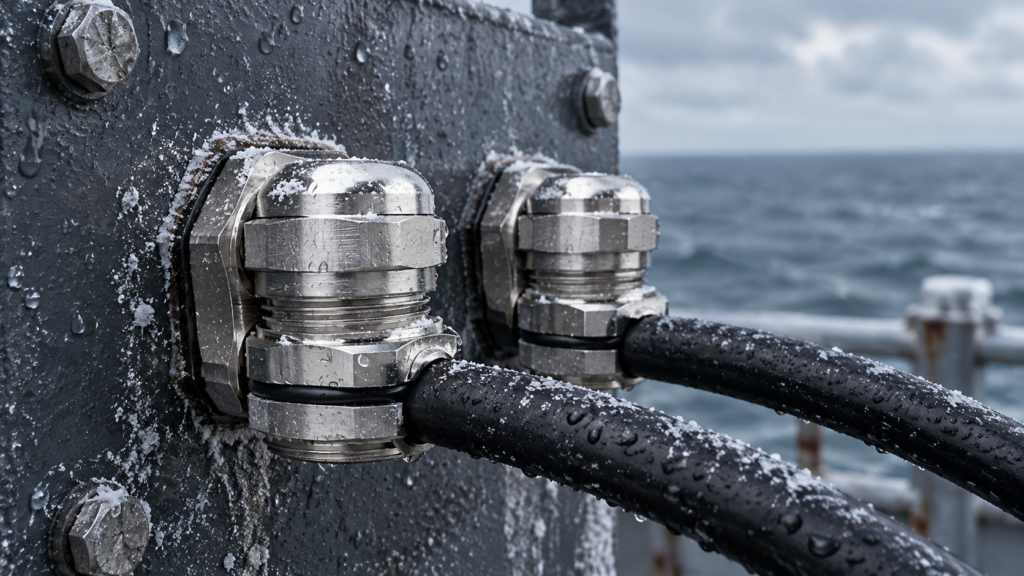
Specifying a 316 stainless steel cable gland for a vessel or an offshore platform usually happens in one line of a bill of materials, as if the sea were a single condition. It is not. Four different exposures are routinely mixed together, and they fail the same gland in four different ways.
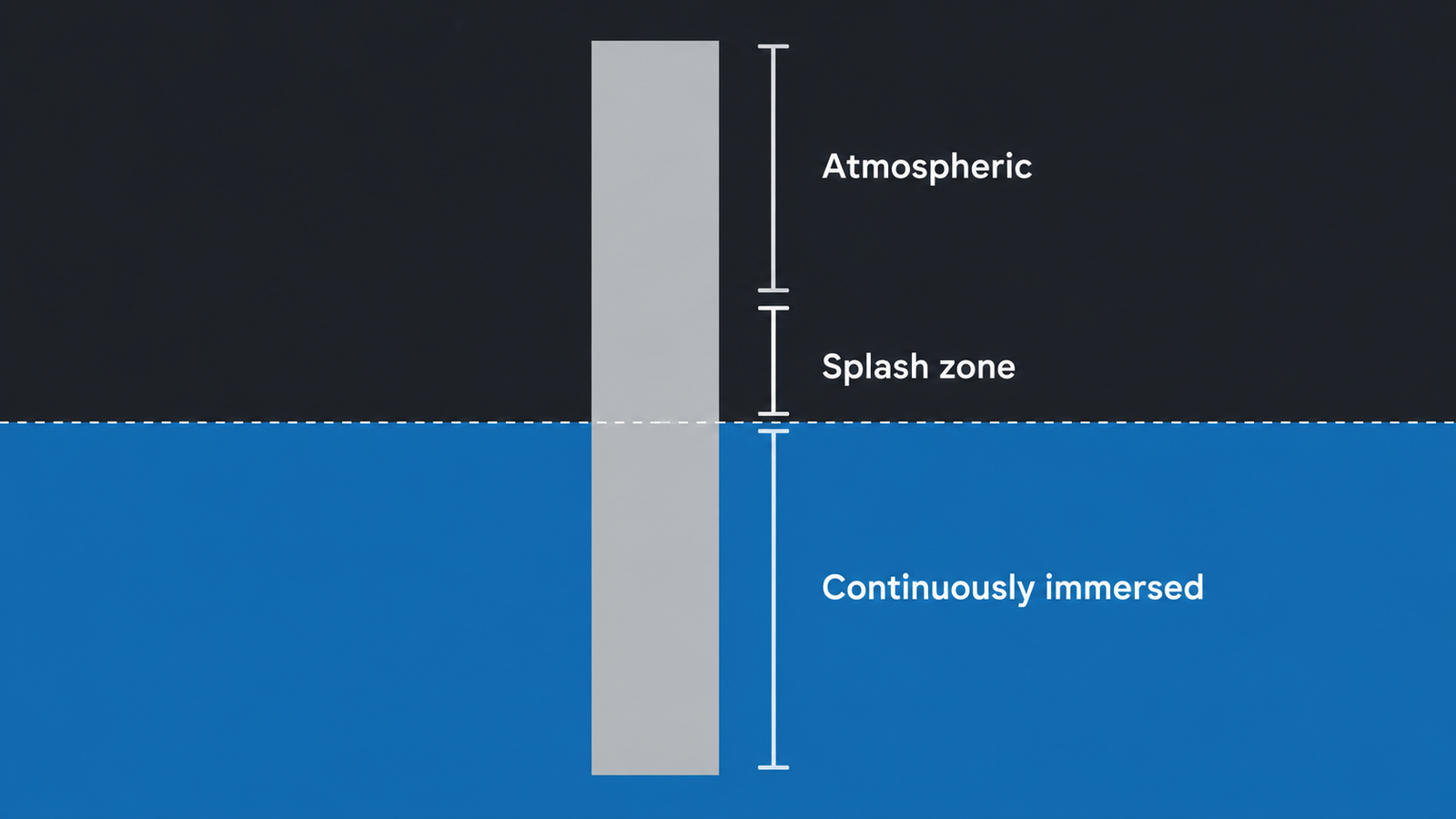
Atmospheric exposure, a few hundred metres inland or high on a superstructure, is mostly airborne chloride that deposits and dries. Splash zone is wet and dry several times an hour, which is the most aggressive cyclic condition on a ship. Immersed or tidal positions stay wet, which removes oxygen from the crevices and changes the corrosion mechanism entirely. Below-deck and machinery spaces are often the mildest of the four despite being on the same vessel.
The position decides the failure, not the alloy alone.
A gland chosen for the atmospheric zone and installed in the splash zone is a specification error that no grade upgrade will fix, and it is far more common than a wrong alloy.
What Salt Fog Testing Does and Does Not Prove
Salt spray results are quoted constantly in this market and read far too optimistically. A standard neutral salt fog test runs a continuous fine mist of salt solution at elevated temperature for a fixed number of hours. It is a screening test: it separates a good coating from a bad one, and it ranks alloys against each other.
It is not a service-life predictor, for three reasons. The fog is continuous rather than cyclic, so it never reproduces the wet-dry rhythm that drives real marine attack. There is no ultraviolet light, so it says nothing about the shroud or the seal. And it is applied to a flat specimen, not to a gland fitted into a hole with a washer, a shroud and a cable inside it.
A gland that survives a long salt fog exposure can still fail in a year on a deck, because the failure is in a crevice the test never created. Treat the number as evidence of material control, not as a warranty.
The Crevice Under the Shroud
Almost every marine gland failure starts in a geometry rather than on a surface. The shroud traps a thin film of water against the body. The washer traps water against the enclosure. The thread traps water between two close surfaces. Each of these is a crevice, and inside a crevice the oxygen is consumed faster than it is replaced, the metal stays active while the surrounding surface stays passive, and 316 loses its advantage.
This is why the grade debate is often misdirected. A 316 gland with a permanently wet crevice under the shroud will pit before a 304 gland that drains. The design of the entry — orientation, drainage, whether the shroud is vented — decides more than the grade.
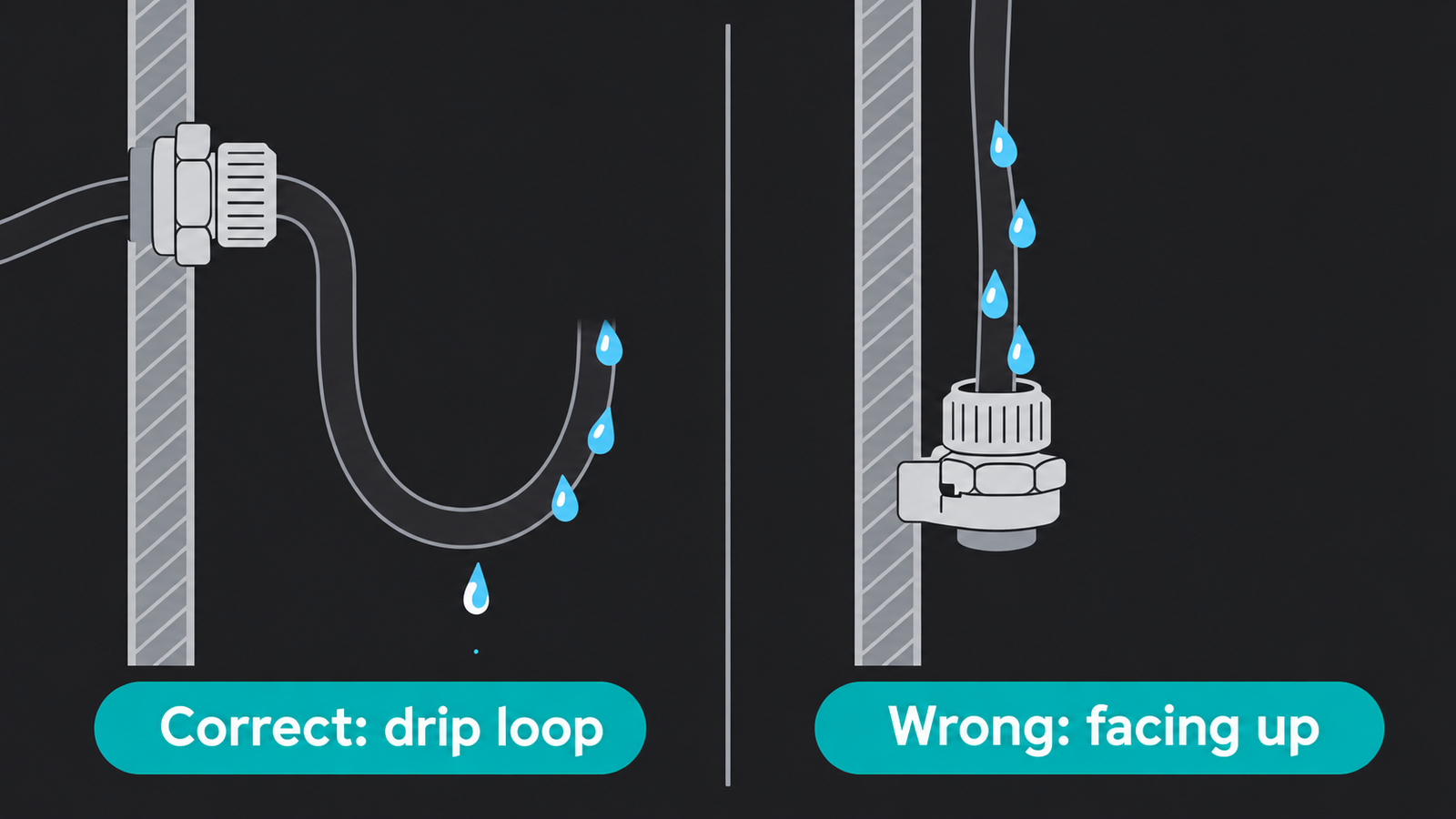
Two practical mitigations cost nothing: mount entries so they face down or sideways rather than up, and leave the shroud in place. The shroud is not packaging; it is the part that keeps the crevice drained and shields the body from spray and sun.
Free Iron: How a Good Gland Rusts in a Week
A brand new 316 gland can show rust stains within days of installation, and the cause is almost never the gland. Carbon steel particles embed in the stainless surface and rust on their own account. The usual sources are a spanner that has been used on galvanised conduit, a wire brush or wool used to clean the thread, drilling swarf from the hole cut above the gland, and grinding dust drifting across a deck.
The remedy is procedural. Keep a dedicated set of stainless tools. Cut and drill holes before fitting, or mask the glands. Clean the surface after installation with a citric or phosphoric passivation treatment rather than an abrasive. And never clean marine stainless with a hypochlorite bleach, which is the fastest way to initiate pitting on 316 in a chloride environment.
If rust blooms appear, remove them with a passivation treatment and find the contamination source. Painting over the stain hides the evidence and leaves the pit underneath.
Contamination source
What you see
Fix
Spanner previously used on galvanised conduit
Rust on the nut flats only
Dedicated stainless tools
Wire wool or a used wire brush
Fine rust in the thread roots
Passivation, then no abrasives
Drilling or cutting swarf from above
Scattered rust spots on the top surface
Drill before fitting, or mask the gland
Grinding dust drifting across the deck
Rust on horizontal surfaces only
Isolate the work area, then passivate
Hypochlorite cleaning agent
Small dark pits, not a bloom
Stop using it; pits do not heal
The last row is the one to separate from the others. Contamination rust sits on the surface; hypochlorite damage is a pit in the metal, and it needs replacing rather than cleaning.
Washdown Is Not the Same as Immersion
Two different tests get quoted as “waterproof”, and they answer different questions. An immersion rating describes standing under a head of water for a defined time and depth. A jet rating describes resistance to a directed high-pressure spray from a nozzle at a stated distance and temperature.
Deck washdown is the second case, and a gland selected only on an immersion rating may not survive it, because the pressure is concentrated at the shroud edge and at the seal face rather than distributed hydrostatically. High-temperature washdown, common in food and pharmaceutical areas and on some offshore accommodation decks, adds thermal cycling to the seal on top of the pressure.
The practical rule for marine work is to specify both: immersion for the worst static case the location can experience, and a jet rating for the cleaning method actually used. Where cleaning is aggressive, the shroud material matters as much as the seal — a nylon shroud degrades in ultraviolet light and cracks at the edge where the jet hits.
Rating
What it tests
Typical marine use
IP66
Powerful water jets from any direction
Deck areas washed by hose
IP67
Temporary immersion at a shallow depth
Bilge and low deck positions
IP68
Continuous immersion at a stated depth and time
Submerged or tidal entries
IP69K
High-pressure, high-temperature jets at close range
Hygienic and accommodation washdown
The depth and time behind an IP68 claim are part of the specification, not a footnote, and they differ between suppliers. Ask for both figures in writing.
Seal, Shroud and O-Ring Are the Short Life Parts
A 316 body can outlast the structure it is bolted to. The parts that fail first are the elastomer and the polymer, and they are usually the parts missing from the specification.
Part
Common material
Marine behaviour
What to specify
Seal insert
NBR
Good water resistance, degrades in UV and ozone
EPDM for exposed decks, NBR acceptable below deck
O-ring
NBR
Same as above, but harder to inspect
Same material as the seal insert
Shroud
Nylon or silicone
Nylon yellows and cracks under UV; silicone holds
Silicone or UV-stabilised nylon on exposed positions
Earth tag
Plated brass or 304
First metal part to show corrosion
Grade stated on the order, replaceable
Mixing seal materials is a quiet source of leaks: an EPDM seal with an NBR O-ring gives two different compression sets at the same temperature, and the joint that was tight in the workshop loosens over a season.
Coupling to Bronze, Aluminium and Coated Steel
A gland is never alone on a marine structure. It sits in a steel bulkhead, an aluminium console or a bronze casting, and the couple matters.
Stainless against bronze is a comfortable pair; the potential difference is small and both are corrosion resistant. Stainless against aluminium is not: the aluminium becomes the anode by a wide margin and pits around the hole, which is why isolating washers and a painted interface are standard practice on aluminium superstructures. Stainless against coated carbon steel is acceptable only while the coating is intact, because at the first scratch the steel becomes the anode and the failure is a ring of rust around the entry.
Where a mixed joint cannot be avoided, decide which part is allowed to corrode and make it replaceable. On a deck, that is usually the washer, not the bulkhead.
Installation Discipline on Deck
Most marine gland failures I would attribute to workmanship rather than material, and the list is short.
One loop of cable is cheaper than a re-termination.
Leave a drip loop so water runs off the cable before it reaches the gland. Enter from below or from the side, never from the top. Do not lubricate the thread with copper-based anti-seize, which is a galvanic couple in chloride; use a nickel or ceramic compound, and only where the thread is not part of a flameproof path. Torque to the datasheet figure with a wrench rather than by feel, then record it. And keep the cable supported so the gland is not carrying the cable’s weight in a seaway.
None of these are material decisions, and all of them outrank the grade question in practice.
For atmospheric and splash exposure, yes, provided the entry drains and the seals suit the exposure. For continuous immersion or warm stagnant seawater, no: use duplex or a 6% molybdenum grade.
Why did my 316 glands rust in the first month?
Almost always free iron contamination from carbon steel tools, wire wool, drilling swarf or grinding dust. Treat with a passivation product and remove the source; the gland itself is usually undamaged.
Which seal material should I specify on deck?
EPDM for exposed positions because it handles ultraviolet light and ozone better than NBR. Keep the O-ring the same material as the seal insert.
How many hours of salt spray should I ask for?
Enough to prove material and coating control, and do not read it as a service life. Long exposures are a screening result; the crevices in a real installation are not reproduced by the test.
Can I use a marine gland on an aluminium enclosure?
Yes, with an isolating washer and a painted interface. Without them the aluminium becomes the anode and pits around the hole, regardless of the gland grade.
NPT and metric cable glands seal in different places. Tapered versus parallel threads, hole preparation, the locknut problem, sealant rules and North American hazardous area entries.
Waterproof cable gland play a vital role in modern industries, especially in the B2B sector. They not only ensure the sealing of cable connections, preventing water and dust ingress, but also enhance the overall safety and stability of electrical systems. Did you know that improper installation of cable glands can not only shorten equipment lifespan […]
Nickel plating is a barrier and a hard surface, not a change of material. How thickness, process and salt spray claims actually read, where plating fails on site, and when to move to stainless instead.
We use cookies to enhance your browsing experience, serve personalised ads or content, and analyse our traffic. By clicking "Accept All", you consent to our use of cookies.