The question “Ex d or Ex e?” assumes the choice is yours. In most hazardous area installations it is not. The Ex d vs Ex e cable gland decision belongs to the enclosure the cable enters: a gland closes that enclosure’s cable entry and has to preserve its protection concept.
What genuinely differs between the two concepts is the engineering underneath. One contains an explosion; the other prevents one from starting. This guide covers how each works mechanically, why the entry thread means something different in each case, and what changes at installation and re-termination.
The Difference in One Sentence
Ex d assumes an internal explosion may happen and contains it. Ex e assumes it will not happen and removes the conditions that could cause it. The flame path, the internal barrier, the thread tolerance and the maintenance burden all follow from that one difference.
Aspect
Ex d — flameproof
Ex e — increased safety
Protection principle
Containment of an internal explosion
Prevention of ignition sources
Governing standard
IEC 60079-1
IEC 60079-7
Role of the entry thread
Part of the flame path
Mechanical attachment only
Gas path through the cable
Blocked by a stopping barrier or certified seal
Not a protection function
Body construction
Heavier wall, controlled flame path dimensions
Standard body with a defined ingress seal
Typical host equipment
Flameproof junction boxes, control stations, motors
Increased safety terminal and junction boxes
Re-termination
Compound types are effectively permanent
Routine, as on a standard industrial gland
How an Ex d Cable Gland Works
A flameproof gland does not stop gas entering the enclosure — the enclosure admits the atmosphere. The gland guarantees that if that atmosphere ignites inside, flame and pressure cannot reach the surrounding area.
The flame path is a machined feature
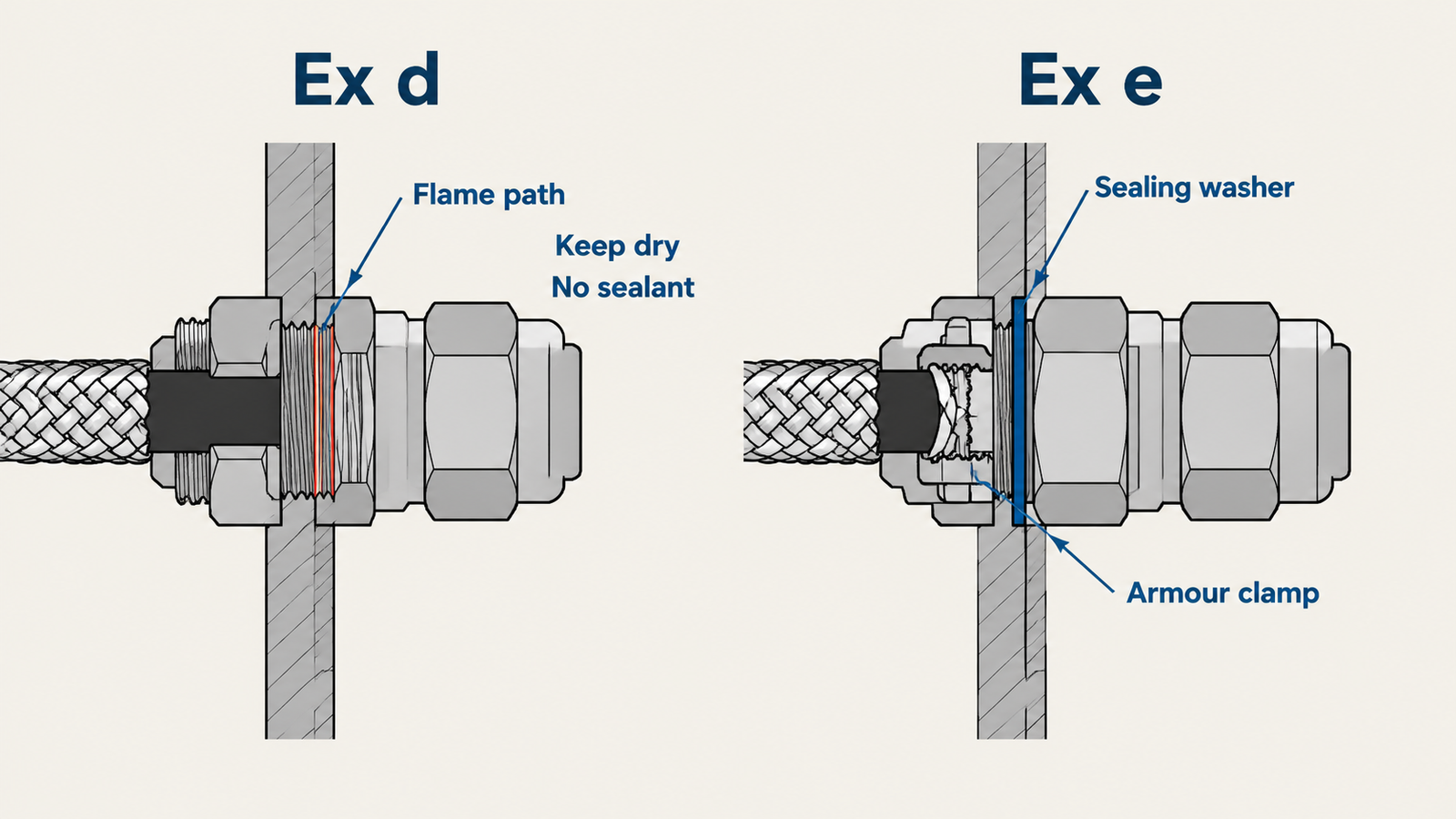
In a flameproof assembly the protection is created by narrow gaps between mating metal surfaces. Flame escaping through such a gap is cooled below the ignition temperature of the surrounding gas. On a gland, two surfaces form that path: the entry thread into the enclosure, and the joints inside the body.
Because the path is a dimensional feature, it works only when the dimensions are right: thread engagement must reach the specified minimum, the form must match the enclosure entry exactly, and the surfaces must stay clean and undamaged. A parallel metric entry and a tapered NPT entry are different geometries rather than different labels, as the guide to cable gland thread types sets out. Sealant tape, paste or paint does not belong on a flame path unless the certificate allows it.
The internal barrier is the part people miss
Stopping flame at the enclosure wall solves half the problem. Gas can also travel along the gaps between cores and sheath, or inside the core insulation, and emerge at the far end of the cable. Flameproof glands therefore address the cable itself, in one of two ways:
A stopping chamber filled with compound. The cores are separated and potted, giving the most dependable barrier. The gland cannot be re-terminated without renewing the compound.
A certified elastomer seal. A compression seal closes around the sheath and cores and allows the cable to be refitted, provided the diameter stays inside the certified range.
How an Ex e Cable Gland Works
Increased safety takes the opposite starting point. There is no containment function, because the design assumes an ignition source will not be created inside the enclosure at all. Temperature rise, creepage and clearance distances, connection integrity and impact resistance are controlled so that no spark, arc or hot surface arises in normal operation.
What the gland actually contributes
The gland’s job here is narrower but still specific. It has to hold the cable against pull-out so terminations are never stressed, maintain the enclosure’s ingress protection, and — for armoured cable — provide a reliable earth path through the armour clamp. None of those depends on thread geometry, which is why the entry thread on an Ex e gland carries no flame path requirement: sealed washers, reducers and adapters behave much as they would on a standard industrial fitting, provided they are certified for the same concept.
Where Ex e is not the answer
An Ex e gland cannot be improvised from a cheap standard one: the seal has to hold through thermal cycling and mechanical load, the armour clamp has to keep earth continuity under vibration, and the assembly has to be certified.
The Rule That Decides: Your Enclosure Chooses the Gland
Certification covers a product, not an assembly. The moment a gland is fitted to an enclosure the two form a single cable entry, and that entry has to maintain the protection concept of the equipment it penetrates. Nothing about the gland can upgrade the enclosure, and nothing about the enclosure can excuse a gland certified to a different concept.
Enclosure at the cable entry
Gland required
If an Ex e gland is fitted
If an Ex d gland is fitted
Flameproof — Ex d / Ex db
Ex d gland matching thread and gas group
Flame path broken; the flameproof scope is lost at that entry
Correct choice
Increased safety — Ex e / Ex eb
Ex eb gland
Correct choice
Acceptable only if the gland certificate also lists Ex e use; the enclosure does not become flameproof
Restricted breathing — Ex nR
Gland marked for Ex nR with the required ingress protection
Requires the Ex nR marking
Requires the Ex nR marking
Dust ignition protection — Ex t
Gland marked for Ex t with IP6X
Requires the Ex t marking
Requires the Ex t marking
Many manufacturers list a multi-certified gland — Ex db IIC / Ex eb IIC / Ex ec IIC on one part — so a site with mixed enclosures can standardise. The marking and the certificate schedule are what make that legitimate: the schedule has to name the concept, gas group, size and thread you are ordering. Our CMP explosion proof gland range is the flameproof series to compare against, and the ATEX vs IECEx comparison covers which certificate your market will accept.
EPL, Not the Letter: Why the Zone Is a Separate Question
If one source states that Ex e is permitted in Zone 1 and another states that it is not, both may be describing real practice — because the letter alone does not determine the zone. The equipment protection level does.
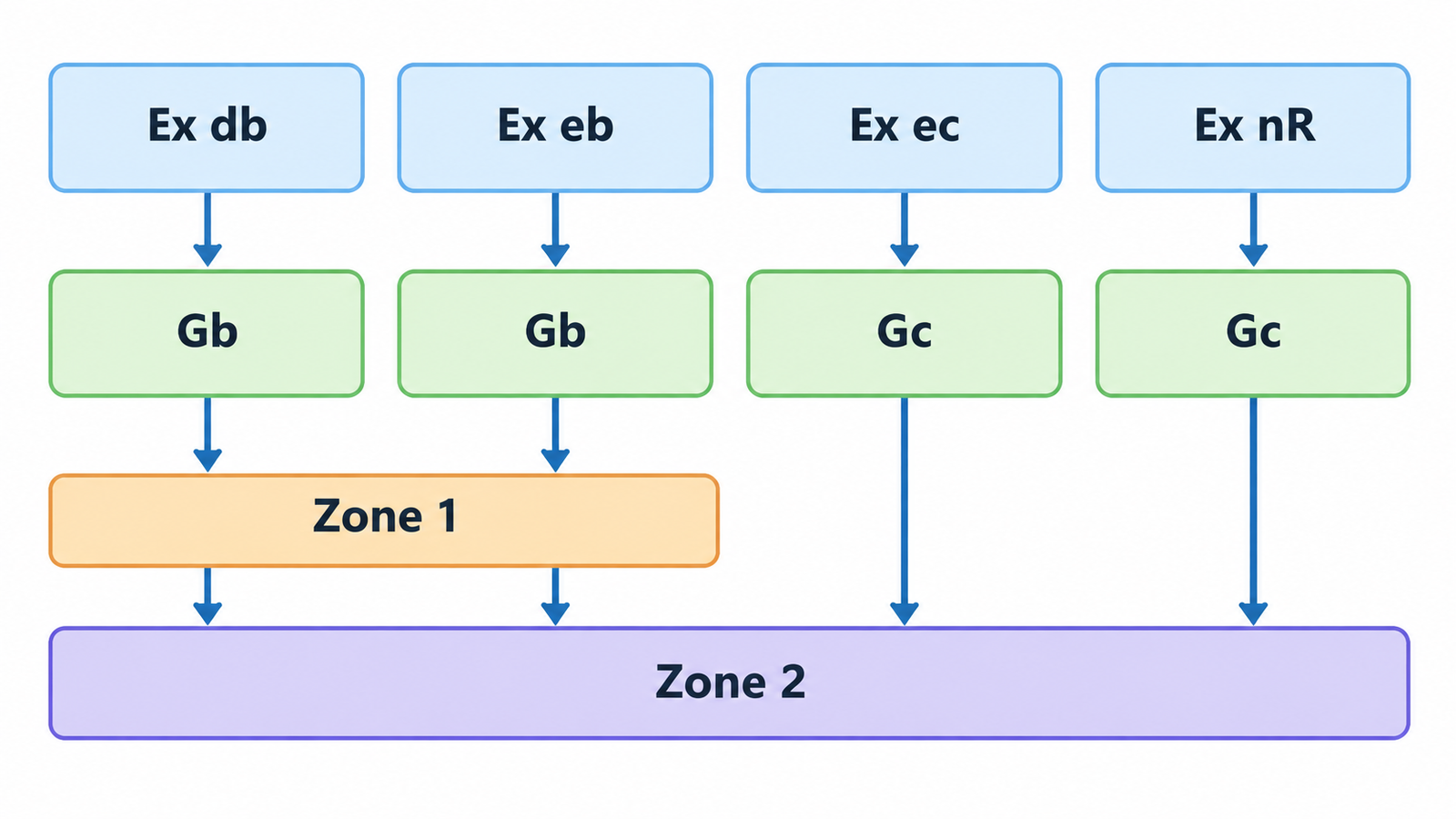
Since IEC 60079-7:2015, increased safety has been split into two levels. Ex eb provides EPL Gb and is suitable for Zone 1 and Zone 2. Ex ec provides EPL Gc and is intended for Zone 2 only. The older single designation “Ex e” corresponds to Ex eb.
Marking
Standard
EPL
Gas zones
Ex db
IEC 60079-1
Gb
Zone 1 and Zone 2
Ex eb
IEC 60079-7
Gb
Zone 1 and Zone 2
Ex ec
IEC 60079-7
Gc
Zone 2 only
Ex nR
IEC 60079-15
Gc
Zone 2 only
The zone comes from the equipment protection level in the marking, not from the protection concept letter.
So “Ex e is Zone 2 only” is correct about Ex ec and wrong about Ex eb. At a Zone 1 entry both Ex db and Ex eb are available, and the decision returns to the enclosure. An Ex ec gland at a Zone 1 entry is not a preference: it is an EPL shortfall.
Installation Differences You Notice in the Field
Task
Ex d gland
Ex e gland
Entry thread preparation
Keep dry and undamaged; no tape, paste or paint unless the certificate permits it
Treated as a normal entry — sealing washer or certified adapter is standard
Adapters and reducers
Must be part of the certified arrangement; an unlisted adapter interrupts the flame path
Permitted when certified for the same concept and EPL
Thread engagement
Specified minimum number of full threads; check it against the certificate
No flame path requirement; ordinary mechanical engagement
Cable preparation
Cores separated and potted, or elastomer seal compressed to the certified diameter
Sheath sealed for ingress protection, armour clamped for earth continuity
Effect of a cable swap
Compound types need a new seal or a new gland
Re-termination within the same diameter range is routine
If it is done wrongly
Flame path broken; enclosure certification void at that entry
Ingress or retention failure; concept lost at the entry
The entry thread is a protected dimension on an Ex d gland and a mechanical joint on an Ex e gland.
For tightening, use the manufacturer’s datasheet figure for that size and body design — it is not transferable between ranges. Judge the result by outcome: the seal deforms evenly, the armour clamp grips without cutting strands, and the cable cannot be turned inside the gland when pulled.
Inspection and Re-Termination: Where the Real Cost Sits
A flameproof gland costs more per unit and takes longer to fit. The entry has to be inspected for the things that create its protection: thread engagement, undamaged flame path surfaces, correct compound fill or seal compression, and a certificate matching that size and thread.
Re-termination is the other side of the same coin. An elastomer-sealed flameproof gland is serviceable when the replacement cable measures inside the certified range; a compound-filled one is not, because the barrier is destroyed when the cable is withdrawn. Increased safety follows ordinary industrial practice — inspect the seal and armour clamp, confirm the tightening figure, verify earth continuity — which is faster and cheaper at the price of a narrower scope.
Common Misapplications
Mistake
Why it is wrong
Selecting by zone instead of by enclosure
The zone sets the minimum EPL; the enclosure sets the concept the gland must preserve
Treating Ex e as a budget Ex d
The two solve different problems; a lower-cost concept is not a substituted one
Using an Ex ec gland in Zone 1
EPL Gc sits below the Gb that Zone 1 requires
Fitting an uncertified adapter to a flameproof entry
The flame path runs through the thread, and an unlisted component interrupts it
Assuming a multi-certified gland is universal
The marking must list the concept, and the schedule must cover that size and thread
Re-using compound after a cable change
The barrier is consumed on removal; the entry is no longer protected
Reading “Ex” in a datasheet as certification
The marking on the product body, plus a schedule naming your part, is the evidence
How to Specify Either One
Work from the enclosure outwards rather than from the gland inwards:
Read the protection concept and EPL from the enclosure nameplate.
Confirm the gas group and temperature class for that location.
Measure the cable outer diameter and identify its construction and armour type.
Identify the entry thread form and size on the enclosure.
Select a gland whose certificate lists that concept, EPL, gas group, size and thread.
Check the certificate schedule rather than the product page for the exact part number.
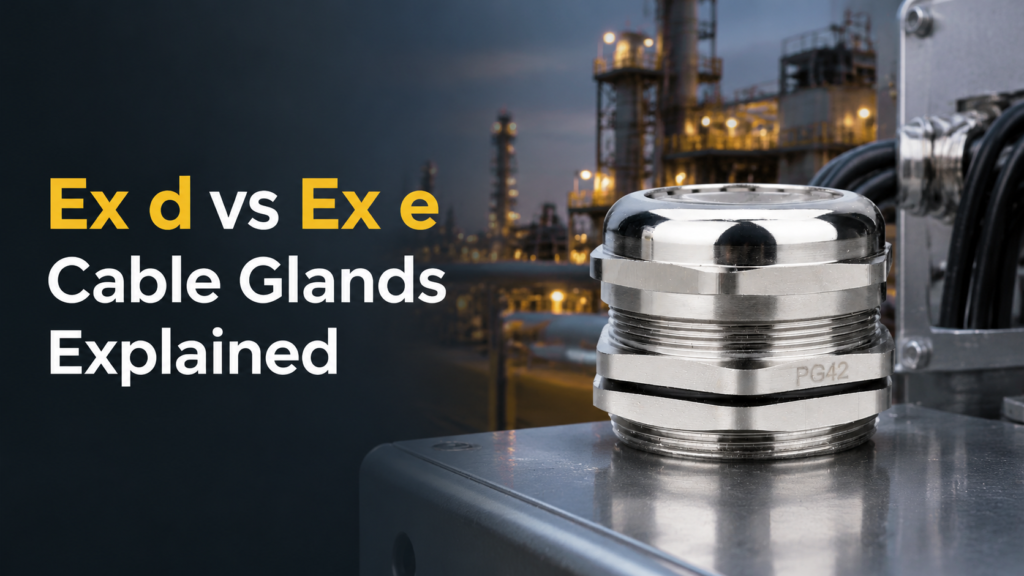
A stainless steel entry such as this PG42 hazardous area gland is chosen only after step five: material is a corrosion decision, not a protection one. The stainless steel range covers offshore, marine and chemical entries; the brass range handles general plant duty at lower cost.
Next Step
Send us the enclosure marking, the zone and gas group, the cable diameter with its construction, and the entry thread. We will confirm which concept the entry needs, quote the correct size, and supply the certificate schedule with the quotation. For the basics, start from the cable gland hub.
FAQ
Can I use an Ex e cable gland on an Ex d enclosure?
No. The cable entry is part of the flameproof boundary, and an increased safety gland has no controlled flame path at the thread, so the enclosure’s flameproof protection is not maintained there. The only exception is a gland whose certificate lists both concepts.
Is Ex e allowed in Zone 1?
Yes, when the marking reads Ex eb. Ex eb provides EPL Gb and covers Zone 1 and Zone 2; Ex ec provides EPL Gc and is Zone 2 only. The older designation “Ex e” normally corresponds to Ex eb, but read the EPL in the marking rather than inferring it from the letter.
Do flameproof glands always need sealing compound?
No. They use either a compound-filled stopping chamber or a certified elastomer seal around the cable. Which is permitted depends on the cable construction, the gas and the certificate, and the schedule states it for each size.
Can an Ex d gland be fitted to an Ex e enclosure?
Only where the gland’s certificate covers increased safety for that size and thread. A flameproof gland does not convert an increased safety enclosure into a flameproof one, and the enclosure’s own concept and EPL still govern what may be installed in that zone.
Does a higher protection concept make a cable gland safer everywhere?
Not automatically. A higher EPL can be used in a lower-risk zone, but the concept still has to match the enclosure at the entry. A flameproof gland on an increased safety box is a mismatch in the other direction, acceptable only when the certificate covers both.
Waterproof cable gland play a vital role in modern industries, especially in the B2B sector. They not only ensure the sealing of cable connections, preventing water and dust ingress, but also enhance the overall safety and stability of electrical systems. Did you know that improper installation of cable glands can not only shorten equipment lifespan […]
Choosing the right waterproof cable gland is crucial for ensuring the safety and longevity of your electrical and industrial installations. These small but mighty components protect cables from water, dust, and environmental damage, making them indispensable in many sectors—from telecommunications to marine and heavy industry. But how do you select the right protection level and […]
If you work in shipbuilding, port equipment, offshore systems, or coastal control cabinets, you already know one truth: water always wants in. Salt fog, vibration, UV, washdown, and tight panel space turn a simple cable entry into a surprisingly expensive weak point. That is why marine waterproof cable glands matter so much in real projects. […]
We use cookies to enhance your browsing experience, serve personalised ads or content, and analyse our traffic. By clicking "Accept All", you consent to our use of cookies.