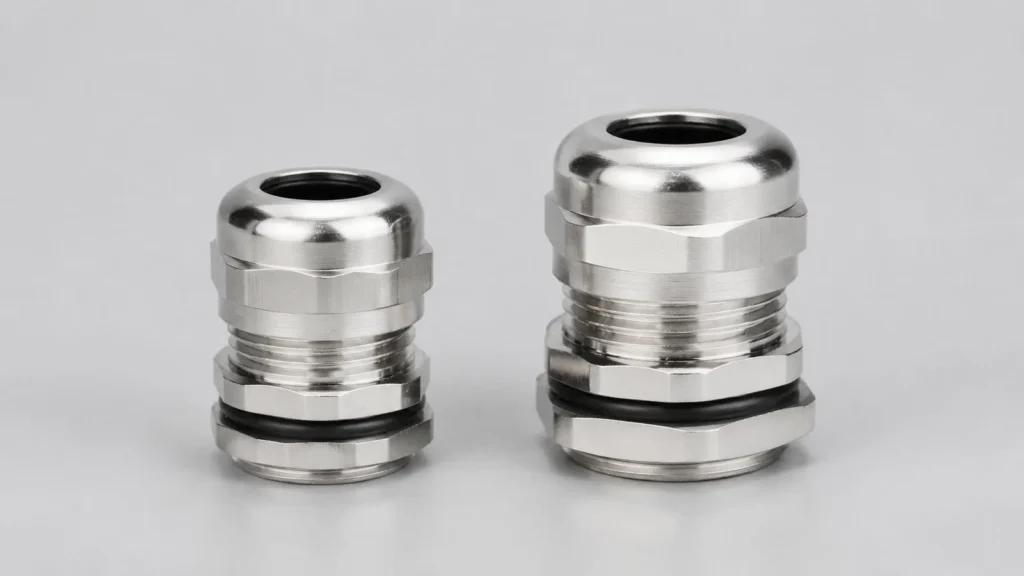
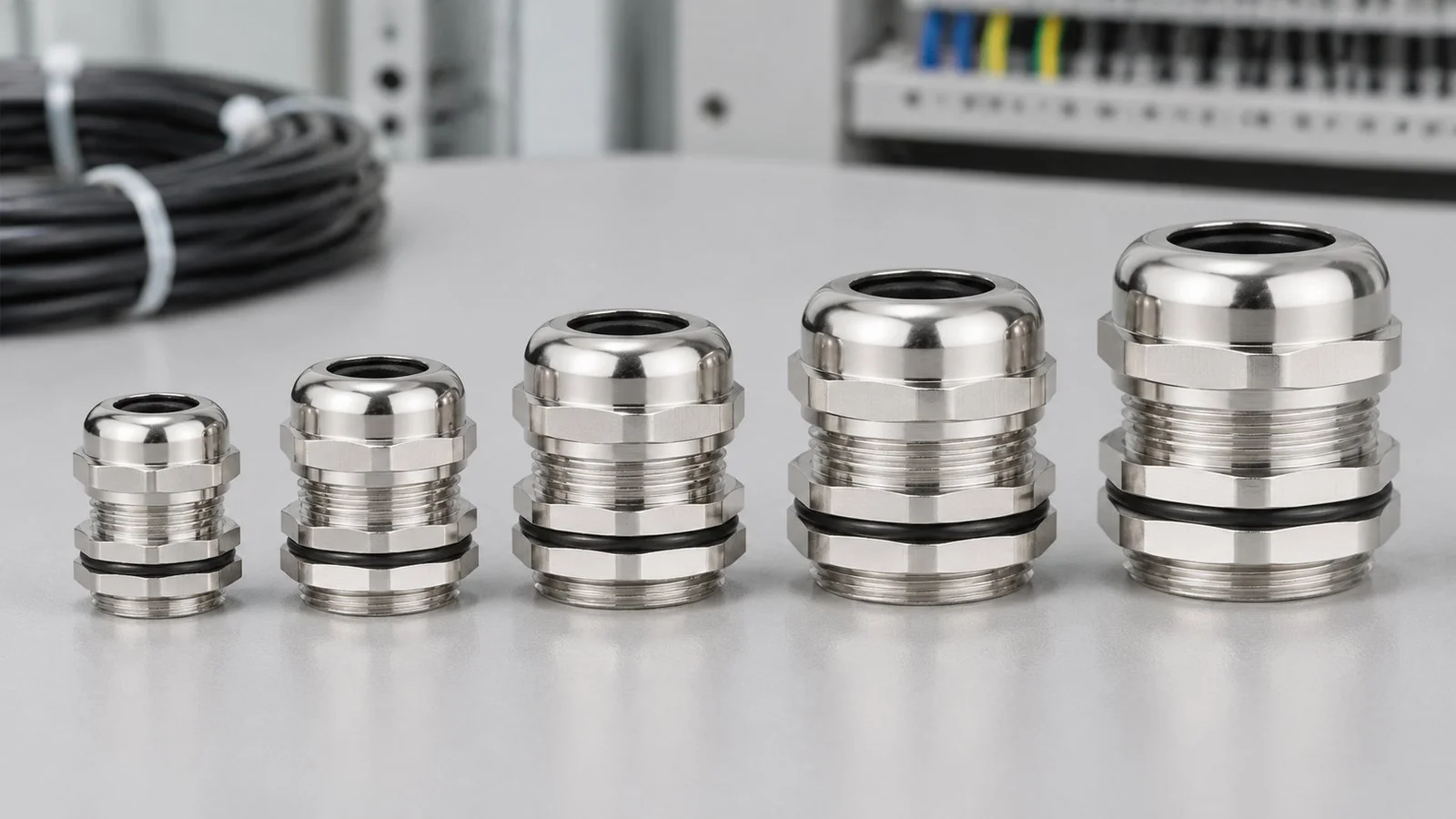
M22 is the size almost nobody designs in and a great many people end up buying. It sits between two first-choice sizes, M20 and M25, and it exists because metric thread standards offer a second series of intermediate diameters for exactly this purpose. On paper that makes it optional. On a real panel it is often the only thread that fits, because the hole was already there and the cable was 14 mm.
This page covers what M22 will and will not do: the five dimensions behind the number, why it is the smallest thread that reaches a 14 mm sheath, where it is interchangeable with M25 and PG16 and where it is not, and why the same nominal size has a different hole in brass than in nylon. For the size either side see the M20 size guide and the M25 size guide.
M22 Cable Gland: The Short Answer
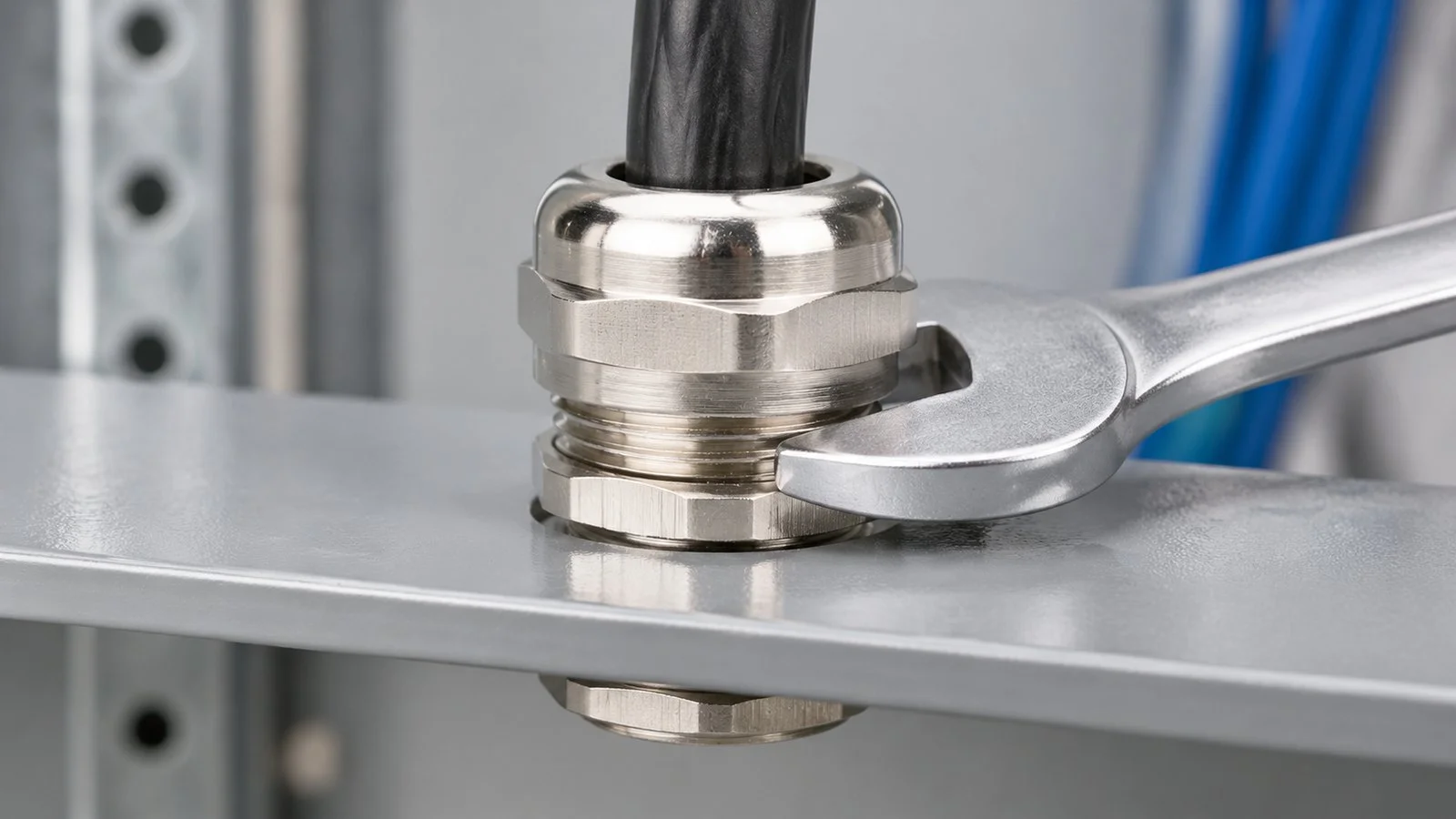
An M22 gland is an M22 x 1.5 metric thread with a 10 to 14 mm cable range, a mounting hole of 22 to 22.2 mm, 8 mm of thread length and a 24 mm spanner. It seals on a face washer under the locknut and grips the sheath with a compressed insert under the dome nut, like every other straight gland in the range.
The number that matters most is not 22. It is the 10 to 14 mm band, because that is what the fitting does and what nothing else in the small sizes can do at this hole diameter.
Why M22 Exists At All
Metric threads are published in a first series and a second series. The first series carries the sizes you would choose on a clean sheet: M20, M25, M32, M40, M50, M63. The second series fills the gaps at roughly three to four millimetre intervals, and M22 is one of those fillers, along with M24, M28, M30, M33, M37, M42 and M48.
That history explains the practical situation. You meet M22 in three ways: an existing 22 mm hole you are not going to ream, a drawing inherited from a supplier who works in the second series, or a cable of 13 to 14 mm where M20 is too small. In all three the size is a constraint to be accommodated, and the question is which other sizes can share that constraint, not whether M22 is theoretically preferable.
The Five Numbers Behind the Name
Dimension
M22 value
What it decides
Thread
M22 x 1.5
The pitch is part of the specification; a locknut or adapter must match it
Cable range
10 to 14 mm
Sheath outside diameter, measured, not the sum of core diameters
Thread outside diameter
22 mm
Drives the hole
Mounting hole
22 to 22.2 mm
Thread diameter plus 0.2 mm, as across the metal range
Thread length GL
8 mm
Must exceed panel plus washer plus locknut plus any earth tag
Bonding length
23 mm
How much sheath ends up inside the body
Spanner size
24 mm
The same wrench as M24 and M25
The 22 mm Hole Is the Real Constraint
Four threads in this catalogue cover the 10 to 14 mm cable band, so the cable does not choose between them. The hole does. And the hole is where two of them stop being interchangeable without any visible sign on the drawing.
Size
Thread O.D.
Mounting hole
Cable range
Shares a 22 mm hole?
M22
22 mm
22 to 22.2 mm
10 to 14 mm
Yes, this is its own hole
PG16
22.5 mm
22.5 to 22.7 mm
10 to 14 mm
No: 0.5 mm too large
M24
24 mm
24 to 24.2 mm
10 to 14 mm
No
M25
25 mm
25 to 25.2 mm
10 to 14 mm
No
PG16 is the dangerous one, because it is the closest neighbour and covers exactly the same cable. Its thread is half a millimetre larger. A hole drilled at 22.5 mm will not seal an M22 gland, because the face washer cannot bridge the gap and simply extrudes outwards under compression. A hole at 22 mm will not accept PG16 at all. Two fittings that look like a straight swap on a cable list are a 0.5 mm decision on the panel, and no amount of tightening fixes the wrong side of it.
M22 Against M20 and M25
The useful comparison is not thread diameter but what the thread length buys. M22 carries M20’s 8 mm of thread and M25’s 10 to 14 mm cable range in the same fitting.
M20
M22
M25
Cable range
6 to 12 mm
10 to 14 mm
10 to 14 mm
Thread length GL
8 mm
8 mm
9 mm
Bonding length
22 mm
23 mm
25 mm
Spanner
22 mm
24 mm
24 / 27 mm
Mounting hole
20 to 20.2 mm
22 to 22.2 mm
25 to 25.2 mm
That combination is M22’s only genuine engineering advantage. Where the panel is thin enough that M25’s 9 mm of thread is marginal, and the cable is 13 or 14 mm, M22 keeps the thread length of the smaller size and still grips the cable. It is a narrow case, but it is the one where M22 is the correct answer rather than the inherited one.
The 14 mm Ceiling
M20 stops at 12 mm on this range, and that is the single most common reason a project moves to M22. A 14 mm sheath is 2 mm outside what M20 can seal, and forcing it produces the failure that looks like a gland fault and is really a sizing fault: the insert cannot compress, the dome nut bottoms out on the body, and the cable slides rather than being gripped.
Moving up from M20 to M22 rather than to M25 keeps the hole at 22 mm instead of 25 mm, which matters on a gland plate that is already drilled, on a terminal box with limited face area, and wherever entry spacing between adjacent glands is tight. The 3 mm saved per entry is the difference between fitting a row and not fitting it.
At M22 the whole stack has 8 mm to fit into. Panel, washer, locknut and any earth tag come out of the same budget.
Thread Length and the Thin Panel
Eight millimetres of GL is not much. Panel thickness plus flat washer plus locknut plus any earth tag has to come in under it, and at M22 that budget is spent quickly on a stiffened enclosure wall. Check the parts rather than assuming a standard stack: the gland that engages two turns will hold, and will not seal.
There is a practical workaround worth knowing. Where the wall is too thin to give the gland a proper bearing face, the failure is usually the panel deflecting rather than the thread being short, and a machined backing pad solves both at once. Where the wall is genuinely thick, the answer is a longer-thread variant of the same thread rather than a larger size, because the cable range does not need to change.
Same Size, Different Hole: M22 Across Materials
M22 in nickel-plated brass is drilled at 22 to 22.2 mm. M22 in moulded polyamide is drilled at 22.2 to 22.5 mm. The cable range is identical at 10 to 14 mm and the thread is the same nominal 22 x 1.5, so the two look like a material substitution on a bill of materials. They are not a hole substitution.
A hole at 22.0 mm will not take the nylon body at all. A hole at 22.5 mm will take the nylon body and will not seal the brass one. Metal bodies are machined and hold a tighter tolerance; moulded bodies need more clearance for draft and shrinkage, and that difference is designed in rather than a defect. If a material change is still possible late in a project, the hole should be drilled to the tighter of the two and opened later if the nylon part is chosen, never the other way round.
M22 sits between M20 and M25 and shares its 24 mm spanner with M24 and M25, which is convenient on site and easy to over-tighten by feel.
Spanner 24 and Shared Tooling
M22, M24 and M25 all take a 24 mm spanner across the body. For a panel builder that is a genuine simplification: one wrench covers three thread sizes and the entire 10 to 14 mm cable band, so a kit does not have to carry a separate tool for each entry size.
It also creates a maintenance risk. Because the same wrench fits all three, an installer who finds a loose gland cannot tell from the tool which thread they are tightening, and over-tightening a nylon M22 to the feel of a brass M25 is easy. Check the fitting rather than the wrench, and where the body is plastic, stop at the point the insert grips rather than at the point the nut stops moving.
Specifying M22 on the Purchase Order
Field
What to state
Why it matters
Thread
M22 x 1.5, not “M22”
The pitch decides whether existing locknuts and adapters fit
Cable range
The measured sheath diameter
10 to 14 mm is a band; a cable at either end behaves differently
Material and grade
Nickel-plated brass, 304 or 316L, or polyamide
Sets the hole tolerance as well as the corrosion answer
10 to 14 mm sheath outside diameter. Measure the finished cable across the sheath rather than adding conductor diameters together, and keep a millimetre clear of either end of the band.
What size hole does an M22 gland need?
22 to 22.2 mm in metal. The moulded nylon version needs 22.2 to 22.5 mm, so a hole drilled for brass may be too tight for nylon.
Is M22 the same as PG16?
No. Both cover 10 to 14 mm cable, but M22 has a 22 mm thread and PG16 has 22.5 mm, so they need different holes and cannot be substituted once the panel is drilled.
Can I use M22 instead of M25?
Often yes, since both cover 10 to 14 mm, provided the hole is 22 mm rather than 25 mm. M22 also has 1 mm less thread length, which matters on a thick or stiffened panel.
Why does my M22 gland not seal on a 22.5 mm hole?
Because the face washer cannot bridge the extra clearance. It extrudes outwards instead of compressing against the panel, so tightening makes the leak worse. The fix is a stepped washer or a welded pad, not more torque.
A chemical resistant cable gland is a comparison, not a property. How to build the media list, where each housing material stops, why polyamide cracks, and what certification does not cover.
If you work in shipbuilding, port equipment, offshore systems, or coastal control cabinets, you already know one truth: water always wants in. Salt fog, vibration, UV, washdown, and tight panel space turn a simple cable entry into a surprisingly expensive weak point. That is why marine waterproof cable glands matter so much in real projects. […]
ATEX and IECEx both point at IEC 60079, but one is mandatory EU law and the other voluntary — and their assessment routes are not equivalent. How to read the certificate number before you order.
We use cookies to enhance your browsing experience, serve personalised ads or content, and analyse our traffic. By clicking "Accept All", you consent to our use of cookies.