Waterproof Cable Gland
PG48 Cable Gland Size Guide
PG48 covers 37 mm to 44 mm cable on a 59.3 mm thread, the same band as M63 on a 63 mm thread. Why 3.7 mm decides the panel, and how 14 mm of thread leaves 9.5 mm of usable wall.
Read More
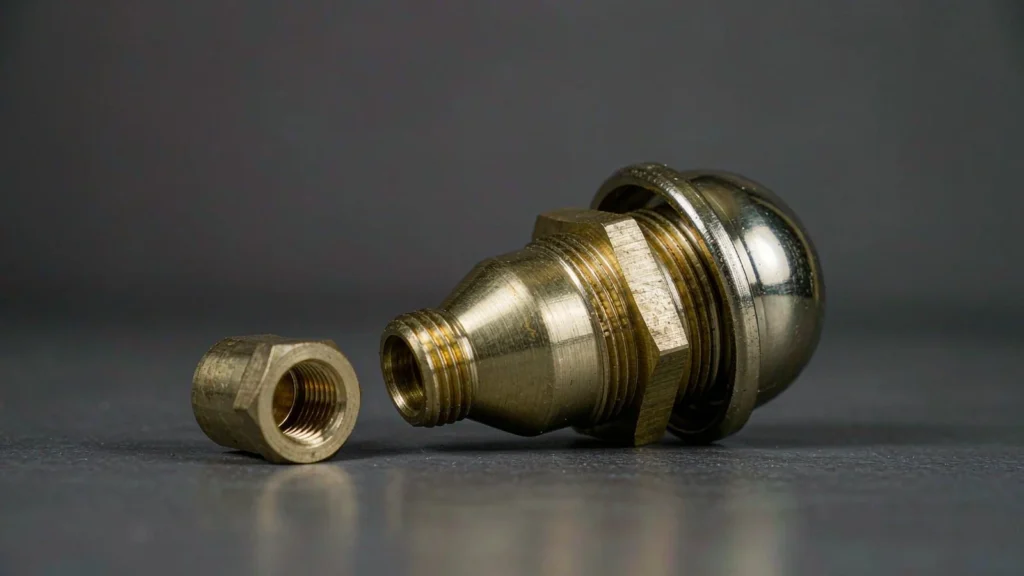
A thread adapter is the part that lets a cable gland of one thread system sit in an enclosure hole of another. It takes a male thread into the enclosure wall and offers a female thread to the gland. Because it works, and because it costs very little, it is the first thing offered when a gland will not fit — and that is exactly why so many installed glands have one in the joint.
The honest description is narrower than the sales description. An adapter converts a thread, and nothing else. It does not enlarge a hole, it does not preserve the gland’s ingress protection, it does not carry the EMC contact path, and in a hazardous area it does not inherit the certificate of either the gland or the enclosure. Every project that gets into trouble with adapters got there by assuming one of those four things were true.
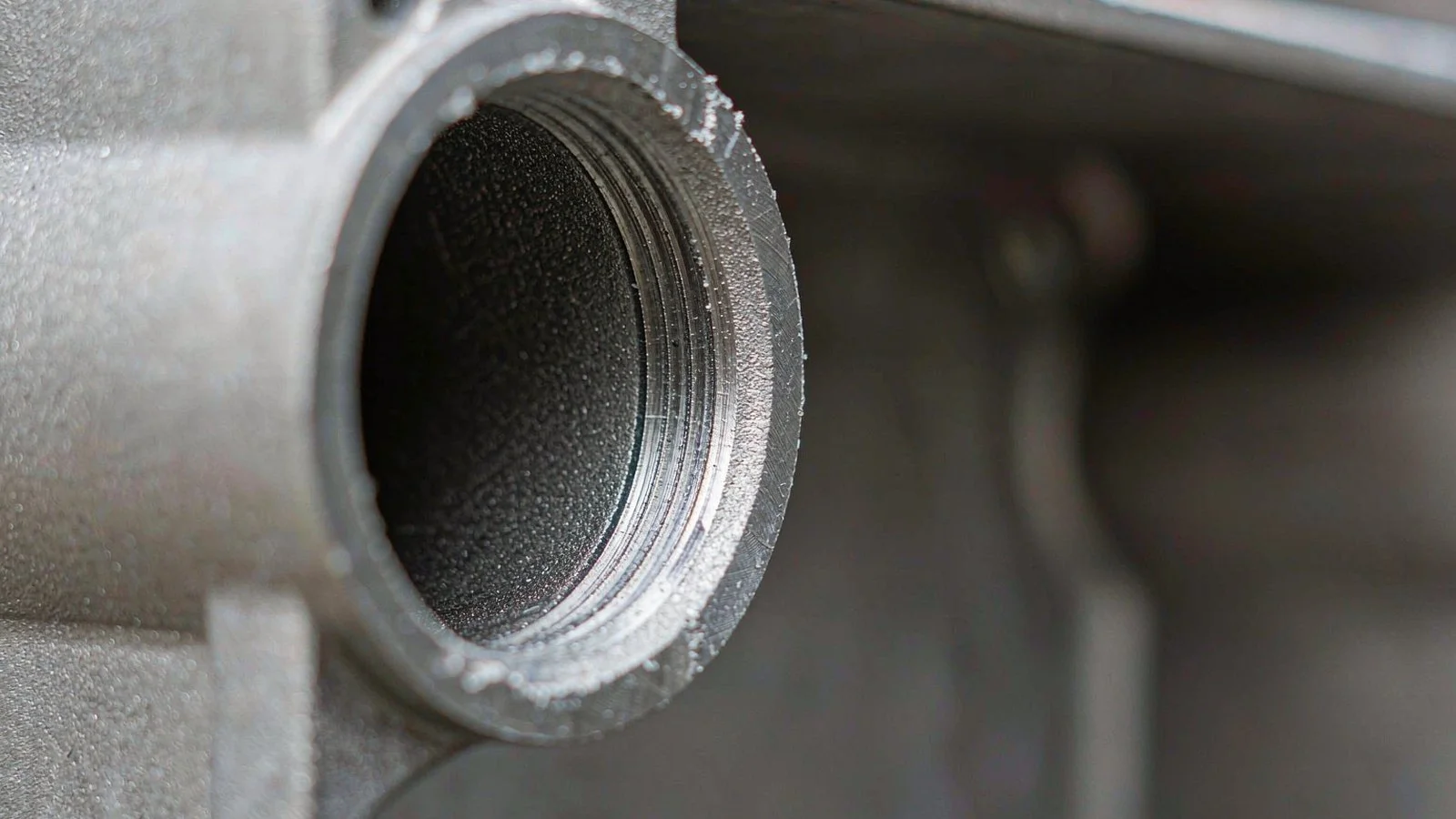
An adapter has an outer thread that goes into the enclosure and an inner thread that receives the gland. The inner thread sits inside the outer thread, so the gland thread is always smaller than, or at most equal to, the outer thread. Two conclusions follow immediately.
An adapter can always reduce. It can never enlarge. If the gland thread is larger than the hole in the panel, no adapter exists that will make it fit, and the only remedy is a bigger hole. Sellers who offer to “convert M50 to PG42” are offering a reducing bush viewed from the other side: the M50 hole takes a PG42 gland, not the reverse.
The tolerance is tighter than most buyers expect. A PG36 hole is 47 to 47.2 mm and an M48 gland thread is 48 mm. Both carry the same 25 to 33 mm cable range, and the difference in hole size is roughly one millimetre — enough to rule the conversion out. One millimetre is the whole margin between “adapter works” and “re-punch the panel”.
| Part | What it does | Where it belongs | The limit |
|---|---|---|---|
| Reducing bush | Threaded inside and outside, hexagonal or knurled, shims a smaller gland into a larger hole | Legacy PG panels, oversized knockouts, mixed-vendor equipment | Adds a joint and moves the sealing face off the wall |
| Conversion adapter | Bridges two thread systems at the same nominal size, usually with a flange | Imported machinery, NPT knockouts, one-off transitions | Flange or O-ring seat is what seals; the threads do not |
| Repair bush | Re-cuts a damaged internal thread and provides a fresh seat | Cast enclosures with stripped or cross-threaded entries | Depends on remaining wall thickness and casting quality |
| Sealing or reducing washer | Not threaded at all; covers the gap between a small gland and a large hole | Where the gland is small but the hole cannot be re-punched | Provides no thread; the gland must still be held mechanically |
The fourth row is the one worth remembering. When the problem is a hole that is too big for a gland that otherwise suits the cable, a flat sealing washer costs less than a threaded bush and adds no threaded joint at all. It only fails when the gland also needs mechanical support, which is most of the time — but the question is worth asking before the bush is ordered.
Adapters are most often bought for a reason that disappears once the catalogue is read properly. Gland sizes are chosen by cable diameter, and the same cable range is normally offered in both metric and PG. Our own range makes the overlap easy to see.
| Cable range | Metric glands | PG glands | Panel hole, metric vs PG |
|---|---|---|---|
| 4 to 8 mm | M14, M16 | PG9 | 14 or 16 mm against 15.2 mm |
| 5 to 10 mm | M18 | PG11 | 18 mm against 18.6 mm |
| 6 to 12 mm | M20 | PG13.5 | 20 mm against 20.4 mm |
| 10 to 14 mm | M22, M24, M25 | PG16, PG19 | 25 mm against 25 mm for M25 and PG19 |
| 13 to 18 mm | M28, M30 | PG21 | 28 mm against 28.3 mm |
| 15 to 22 mm | M32, M33 | PG25 | 32 mm against 32 mm, identical |
| 18 to 25 mm | M36, M37, M40 | PG29 | 40 mm against 37 mm, a real gap |
| 22 to 30 mm | M42 | none | 42 mm, no PG equivalent |
| 25 to 33 mm | M48 | PG36 | 48 mm against 47 mm, too close to adapt |
| 32 to 38 mm | M50 | PG42 | 50 mm against 54 mm |
| 37 to 44 mm | M63 | PG48 | 63 mm against 59.3 mm |
| 42 to 52 mm | none | PG63 | 72 mm, no metric equivalent |
Read the last column as a pair of decisions rather than a table of equivalents. Where the two hole sizes match, the answer to a thread problem is not an adapter but the other gland: M25 and PG19 share a 25 mm hole, M32 and PG25 share 32 mm, and both pairs also share the same clamping range. Where they differ by 3 or 4 mm, the adapter is doing real work.
One trap sits underneath all of it. A 25 mm hole is not automatically a metric hole. PG19 and M25 share the outside diameter but not the pitch, so an M25 gland will start in a PG19 hole, run a turn or two, and bind. The thread feels engaged and is not. This is why we treat PG against metric as a pitch question before it is a size question, and why the hole diameter alone should never be used to decide which gland to buy.
| Cost | What actually changes | How to check before ordering |
|---|---|---|
| Stacked thread length | The adapter occupies thread the gland needed for the panel, so wall engagement drops even though the assembly is longer | Add panel thickness, locknut and adapter length, then compare with the gland’s thread length measured from its sealing shoulder |
| Sealing face moved off the wall | When reducing, the gland’s washer is sized for the gland thread and no longer covers the hole | Confirm the adapter has a flange or an O-ring seat that spans the hole, otherwise the only barrier is thread to thread |
| One more joint | Two threaded interfaces, two torque values and two loosening paths, often at different spanner sizes | Check that the adapter hex still leaves room for a locknut and for a spanner on the gland body |
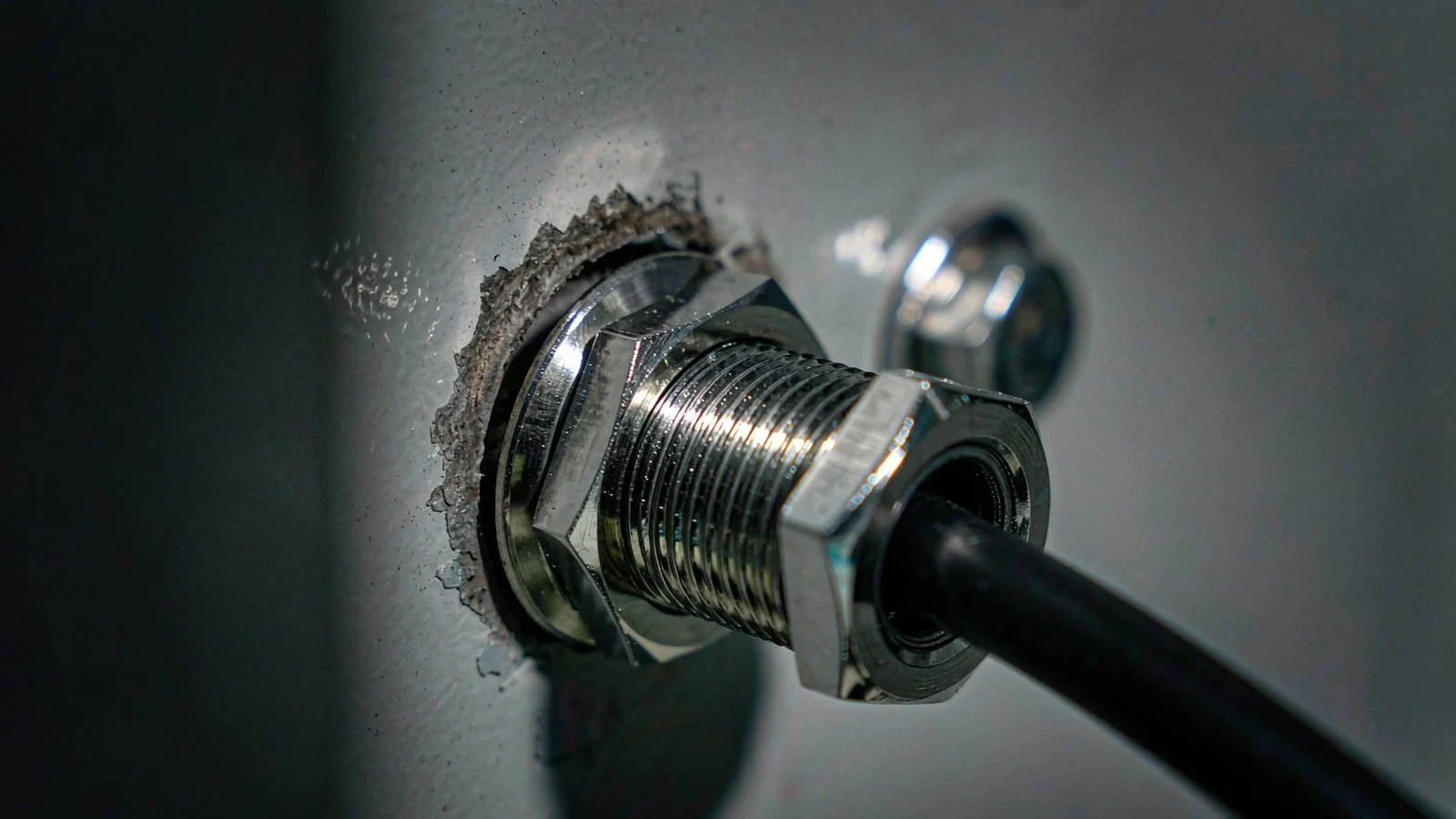
The first row is the one that fails quietly. A gland specified for a 3 mm panel and fitted through a reducer becomes an assembly with 3 mm of panel plus perhaps 5 mm of adapter ahead of the sealing shoulder. The thread that used to pass through the wall now passes through air. Nothing looks wrong in a photograph, and the assembly pulls out under cable load.
| Property | Gland straight into the panel | With an adapter in the joint | What to require |
|---|---|---|---|
| Ingress protection | Seal tested as a gland into a plate | The gland’s IP is not the assembly’s IP; the adapter joint is untested | Flanged adapter with an O-ring, or a leak test on the assembly |
| EMC contact path | The contact spring bears directly on enclosure metal | An extra interface, usually plated, painted or anodised | Metallic adapter with blank mating faces; measure bonding across the assembly, not across each part |
| Earth continuity | Body to enclosure, one interface | A second interface that paint can isolate | Earth tag bonded across the joint rather than through it, see cable gland earthing |
| Flameproof entry | The entry thread is part of the certified enclosure | The flame path length and engagement change | A certified Ex adapter, and enclosure documentation that permits the combination |
For shielded cable the second row is decisive. A 360 degree termination depends on a continuous metal path from the braid to the enclosure, and every additional joint is a place where that path can be interrupted, however slightly. If an adapter is unavoidable on an EMC gland, it has to be metallic, unpainted on both mating faces, and the bonding resistance has to be measured across the finished assembly rather than assumed from the parts. The same logic is behind our note on 360 degree shield termination.
In a flameproof enclosure the cable entry is not an accessory. The entry thread and its engagement are part of what was certified, and the enclosure documentation names the entries that are permitted. Inserting an adapter between the certified gland and the certified enclosure creates a joint that neither certificate describes, which makes the assembly uncertified even though every individual part carries a mark.
Sealing the gap is possible but not free. The adapter must itself hold an Ex certificate that names both threads, the enclosure documentation must permit that combination, and the installer has to be able to show both documents at inspection. Where that paperwork does not exist, the answer is not a better adapter — it is a different enclosure entry. Anyone planning work in a classified area should read the selection logic in our hazardous area cable gland guide first, because the thread question is the last one in that sequence, not the first.
There are four situations where the adapter is correct and the alternatives are worse.
Outside those four, the cheaper and better answer is almost always to buy the gland in the thread the panel was punched for. Our range covers both systems across the common cable sizes, so the same 6 to 12 mm cable is available as M20 or PG13.5, the same 15 to 22 mm cable as M32 or PG25, and the same 37 to 44 mm cable as M63 or PG48. Brass and stainless steel are both stocked in each, with 1,000 pieces per size as the standard minimum for brass and 300 per size for the stainless and explosion-proof variants, FOB Ningbo or Shanghai. Choosing the native thread removes a part, a joint and a torque value from the drawing.
Prices for both thread systems are quoted per size and per material, and move with copper, nickel and freight.
No. The gland thread sits inside the adapter’s outer thread, so the gland is always the smaller of the two. If the gland is bigger than the hole, the panel has to be re-punched or bored out; no adapter reverses that relationship.
Only when the adapter is itself certified as Ex equipment naming both threads, and when the enclosure documentation permits that combination. Otherwise the assembly is a modification of certified equipment and the certificates no longer cover what is installed.
No. The gland’s ingress test describes the gland sealed into a plate, not the gland plus an adapter plus the plate. Unless the adapter has a flange or O-ring that spans the hole and the assembly has been tested, the IP claim does not transfer.
The hole is the same 25 mm, but the pitch is not, so it will start and then bind. It may feel engaged after a turn or two without sealing. Check the thread with a gauge rather than judging by the hole diameter.
Usually not. The same cable range is normally available in both systems, so the gland can be bought in the thread the panel already has. An adapter is only needed where the existing hole has no counterpart in the required system, or where the hole cannot be changed.

PG48 covers 37 mm to 44 mm cable on a 59.3 mm thread, the same band as M63 on a 63 mm thread. Why 3.7 mm decides the panel, and how 14 mm of thread leaves 9.5 mm of usable wall.
Read More
Salt spray hours are a screening figure, not a service life. This guide explains what the tests actually prove, how to read a pitting resistance equivalent, and the surface and geometry factors that decide whether a stainless gland survives.
Read More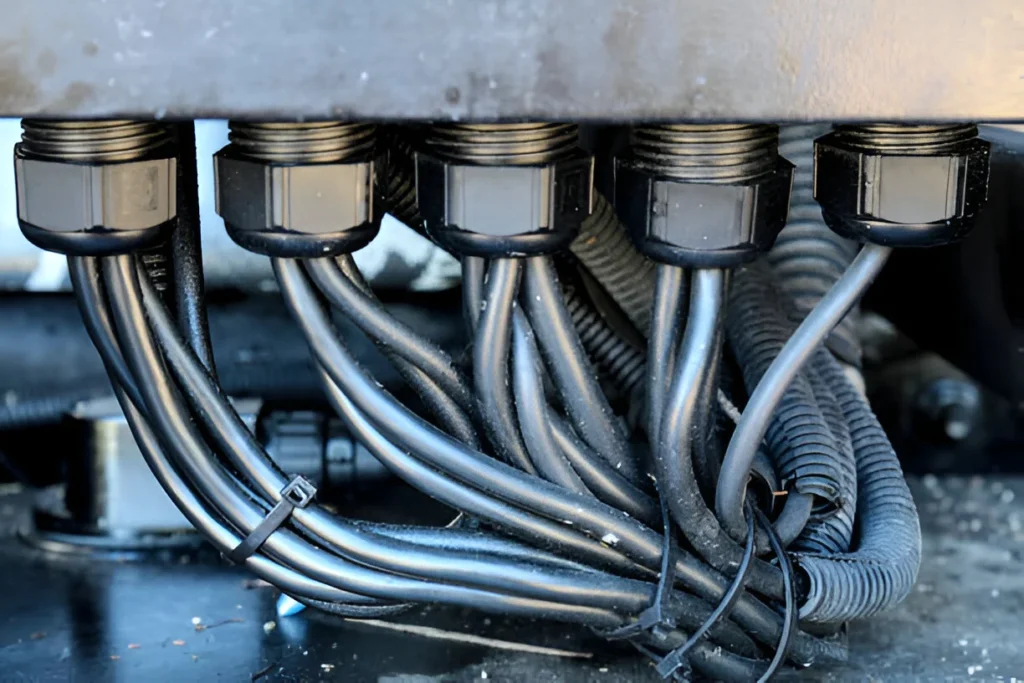
A brass waterproof cable gland helps protect cable entries from water, dust, and strain in industrial and marine installations. Learn how to choose the right model, size, and supplier.
Read More


