PG48 is the size where the PG ladder stops being a tidy sequence and becomes a decision about the panel. Its cable band, 37 mm to 44 mm, is the first band in the range that a metric thread also covers, and the two entries sharing it differ by 3.7 mm of thread: enough to decide which enclosure you can use, and entirely unrelated to the cable. This guide gives the five numbers that define a PG48 cable gland, then the four places where they interact. Every dimension comes from this range’s published PG specification table.
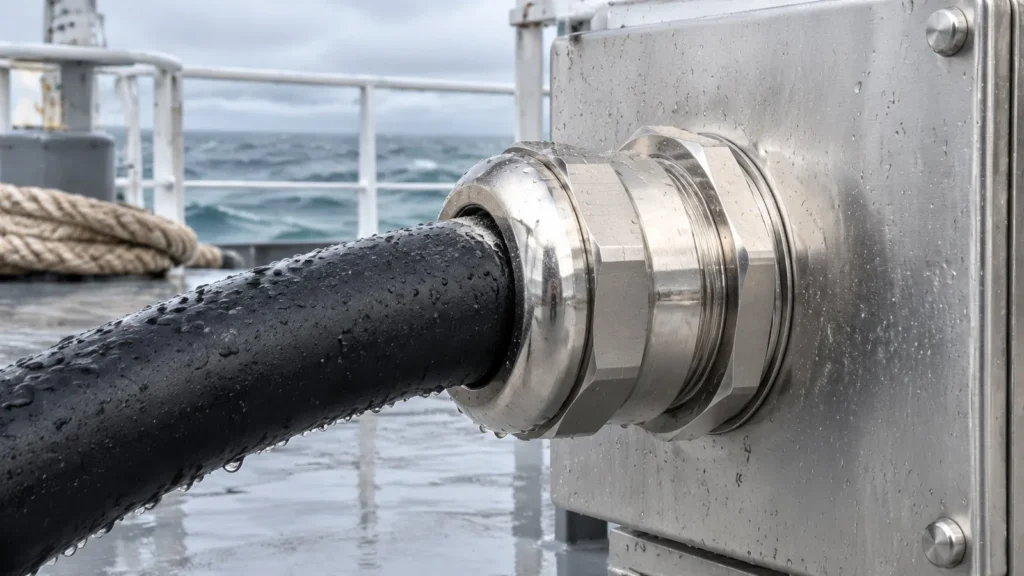
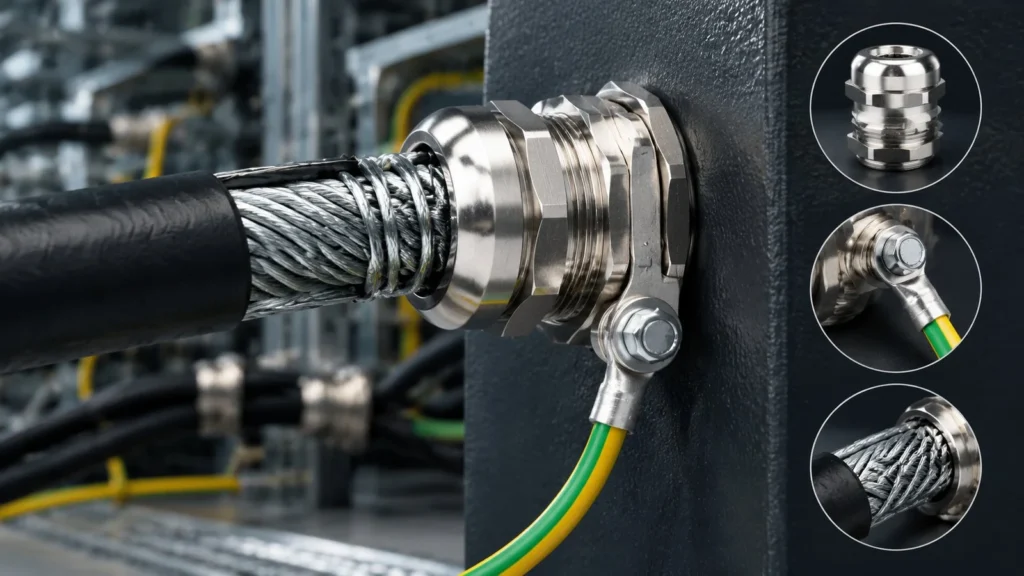
A PG48 entry on a marine panel. At this size the thread length and the spanner, not the cable range, are what the installation turns on.
PG48 in Five Numbers
Four of the five describe the thread and the body. The fifth, cable range, belongs to the insert and is the only line most enquiries contain.
Dimension
PG48 value
What it constrains
Cable range
37 mm to 44 mm
What the insert can grip; the cable must sit inside it, not on the limit
Thread outside diameter
59.3 mm
Which hole the gland enters
Mounting hole
59.3 mm to 59.5 mm
The hole to drill or punch; wider and the washer cannot bridge the gap
Thread length GL
14 mm
Wall thickness plus washer plus locknut has to fit inside it
Bonding length
38 mm
Depth needed inside the enclosure behind the wall
Spanner size
64 mm across flats
Access to tighten it, and the pitch you can use between entries
Build the panel in this order: hole, then GL against wall thickness, then spanner against the space around it, and the cable range last. Doing it in the order the enquiries usually arrive — cable first — is how a 44 mm gland ends up ordered for a 40 mm wall.
A 44 mm Cable Has Two Entries
The 37 mm to 44 mm band is covered by PG48 at a 59.3 mm thread and by M63 at 63 mm. On the cable side they are interchangeable; on the panel side they have nothing in common.
Entry
Cable range
Thread O.D.
Mounting hole
Thread length GL
Bonding length
Spanner
PG42
32 mm to 38 mm
54 mm
54 mm to 54.2 mm
13 mm
38 mm
57 mm
PG48
37 mm to 44 mm
59.3 mm
59.3 mm to 59.5 mm
14 mm
38 mm
64 mm
M63
37 mm to 44 mm
63 mm
63 mm to 63.2 mm
13 mm
38 mm
64/68 mm
PG63
42 mm to 52 mm
72 mm
72 mm to 72.2 mm
15 mm
42 mm
78 mm
Two rows reward a second look. The M63 gives 13 mm of thread against 14 mm on the PG48, so the bigger metric gland is the tighter fit on a thick wall despite its larger diameter. And the spanner is a single value on PG48 but a pair on M63, because the metric bodies at this size come in two hex configurations while the PG body does not. The M63 brass gland is the direct comparison — the same pattern that shows up between PG29 and M37.
3.7 mm of Thread Decides the Panel
A PG48 needs a 59.3 mm to 59.5 mm hole. An M63 needs 63 mm to 63.2 mm. A panel drilled for one will not accept the other, and the failure looks the same from either direction: the thread is the wrong size for a hole nobody wants to re-cut.
Dropping a 59.3 mm gland into a 63 mm hole leaves the washer bridging a 1.85 mm ring on each side. Whether it seals at all depends on the washer outside diameter, which is exactly the sort of question that should not be left to chance at commissioning: the body also sits off-centre under cable load, and an off-centre gland loads one side of the insert. Going the other way is worse, because a 63 mm thread simply will not enter a 59.4 mm hole, and opening a punched hole by 3.7 mm without losing concentricity is a machining job rather than a file job.
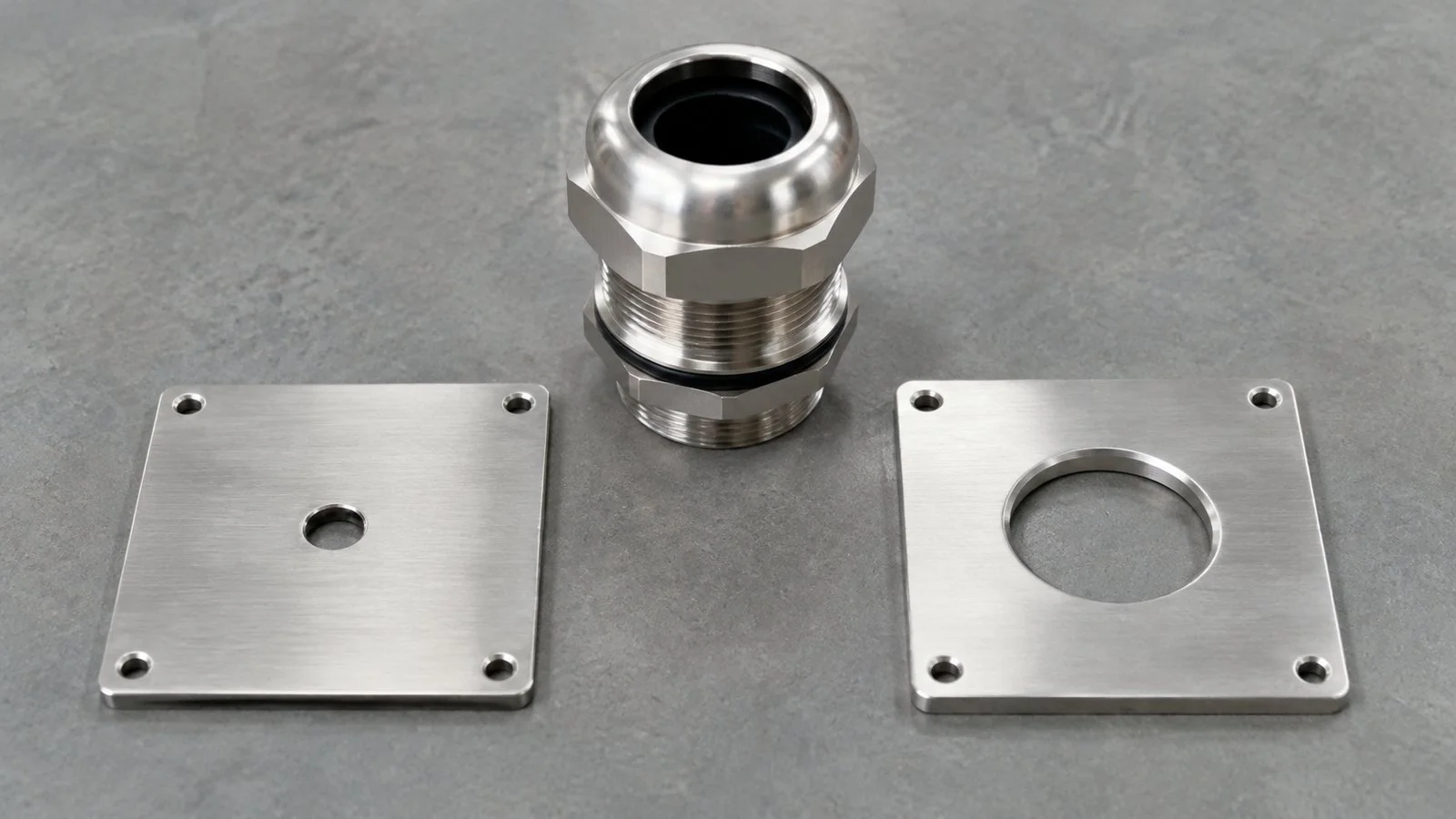
One cable, two panels: 59.3 mm for PG48 and 63 mm for M63. The cable band is identical, so the hole is the only thing separating the two orders.
The Thread-Length Ratio Turns Back
GL grows with size, but more slowly than the thread does. That ratio — thread length divided by thread diameter — is the honest measure of how much wall a gland can cross, and it falls steadily across the PG range.
Size
Thread O.D.
Thread length GL
GL / thread O.D.
PG29
37 mm
11 mm
0.297
PG36
47 mm
12 mm
0.255
PG42
54 mm
13 mm
0.241
PG48
59.3 mm
14 mm
0.236
PG63
72 mm
15 mm
0.208
PG48 sits just above the point where that ratio drops through a quarter, and PG63 is the first size below 0.21. In practice PG48 is the last PG size where 14 mm of thread still buys a ratio above 0.23, which is why it stays the default for thick-walled enclosures. Past it, the same wall thickness that a PG48 crosses comfortably needs a longer-thread variant or a thinner panel, whatever the datasheet’s absolute GL figure suggests. The comparison is worth making explicitly against the metric side as well, where PG and M steps do not line up.
Spanner 64 and the Access Problem
Sixty-four millimetres across flats is the working limit for a standard open-end wrench. Two PG48 entries side by side need more than 64 mm between centres before either can be turned with the spanner flat, and the usual 1.5 times the thread diameter rule leaves a gap that looks generous on a drawing and is not generous with a wrench in hand.
The step above is worse. PG63 lists 78 mm, which is past the range of most adjustable wrenches carried on site, so the biggest entries get installed with a strap wrench, a custom socket or a length of bar — all of which load the hex unevenly and none of which give a reliable feel for the insert compression. On a project with several PG48 entries, the panel layout is a spanner decision as much as a cable decision.
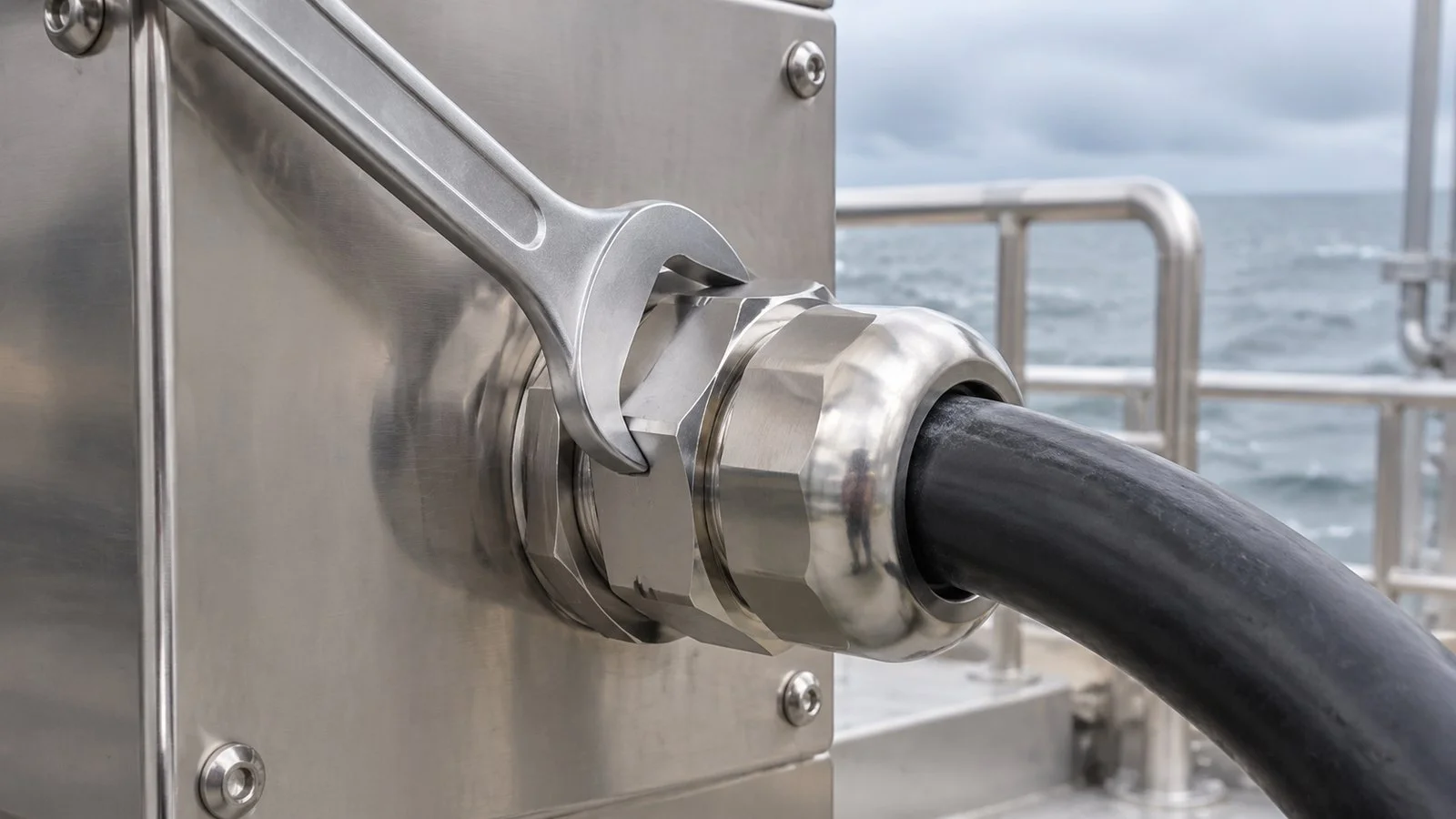
At 64 mm across flats the spanner is the constraint, not the hand. Spacing between adjacent entries has to allow the wrench to swing.
Fourteen Millimetres of Thread, Minus the Stack
The GL figure is not the wall thickness. It is everything the thread has to pass through, and the assembly people forget is the one inside the box.
Item on the thread
Typical thickness
GL remaining
Thread length GL, total
14 mm
14 mm
Locknut
3 mm
11 mm
Sealing washer
1.5 mm
9.5 mm
Panel wall, standard assembly
up to 9.5 mm
0 mm
So a PG48 spans a 9.5 mm wall as delivered, not 14 mm. Beyond that the options are a longer-thread body, a thinner panel, or moving the entry to a raised pad — and a raised pad only works if the bonding length of 38 mm still clears whatever sits behind it.
What Actually Fails at 37 to 44 mm
The insert has to close seven millimetres of range, and a 44 mm XLPE power cable resists compression far more than a control cable does. Tightening the domed nut until the gap closes loads the insert, the jacket and the thread at once; the correct result is an insert compressed evenly around the sheath with no ring pressed into the jacket, and a cable that cannot be rotated by hand afterwards. A jacket that has taken a permanent groove has been over-compressed, and it will relax into a leak path rather than recover.
The second failure is structural. At this size the cable’s own weight and bending stiffness load the entry, and the gland is not a bend limiter. Support the cable close to the entry and let the bend happen beyond the support; a cable pulled tight around a corner transfers that load into the thread and the panel, and a 63 mm hole with an off-centre load is the wrong place to discover it.
Stainless, Brass and What the Rating Needs
On this site the PG48 entry is stainless steel, with the 304 and 316L bodies rated −40 °C to +200 °C; nickel-plated brass at PG sizes runs −40 °C to +120 °C, and the nylon range here stops well below this size, so PG48 is a metal specification. The PG48 stainless gland is the one to read for the sealing and clamping detail; the brass equivalent is the one to ask for when temperature is not the constraint and cost is.
IP68 needs a depth and a duration before it means anything. The graded positions used here are 1.5 m for 30 minutes, 2 m for 24 hours as the standard claim, 5 m for 72 hours for marine and tunnel work, and 10 m for 168 hours on request. A PG48 is rarely bought for a decorative box — it is bought for a deck, a tunnel or a treatment works — so the depth and duration matter more at this size than at any small size, and they are the first thing a test report has to state. That is the same argument that decides a submersible entry, applied to a gland that weighs considerably more.
PG48 Against the Neighbours
Entry
Choose it when
Watch out for
PG42
Cable stays under 38 mm and the panel is already PG-drilled
Only 5 mm of band above it to the PG48
PG48
37 mm to 44 mm cable, PG panel, wall under 14 mm of stack
59.4 mm hole; 64 mm spanner
M63
Same cable, metric panel or a metric conversion in progress
13 mm GL and a 63 mm hole; two spanner values
PG63
Cable over 44 mm, up to 52 mm
72 mm hole, 78 mm spanner, ratio down to 0.208
The rule that survives all four rows: the cable chooses the band, the band offers two or three entries, and the panel chooses between them. Anyone ordering from the cable range alone has a one in three chance of the right part.
FAQ
What is the mounting hole for a PG48 cable gland?
59.3 mm to 59.5 mm, which is the thread diameter plus the usual clearance. A 59 mm hole will not accept the thread and a 60 mm hole leaves the washer bridging a gap it was not dimensioned for; the same rule across every size is in this hole size chart.
What cable range does a PG48 take?
37 mm to 44 mm on the range published here. Because the range is set by the insert rather than the thread, confirm it against the datasheet for the specific body and insert material you are buying.
Is PG48 the same as M63?
No. Both cover 37 mm to 44 mm cable, but the thread is 59.3 mm against 63 mm and the hole is 59.4 mm against 63 mm. The cable band is the only specification the two share.
What spanner size is PG48?
64 mm across flats, a single value. That is the practical limit for an open-end wrench, so check the spacing between adjacent entries before the panel is drilled.
Can a PG48 take a 45 mm cable?
No. The insert caps at 44 mm, and a cable on the limit should already be treated as outside the range. A 45 mm cable belongs on PG63, which covers 42 mm to 52 mm, with a 72 mm hole and a 78 mm spanner.
Have you ever wondered how those seemingly insignificant little devices ensure that cables remain safe and reliable in wet or harsh environments? This is the secret behind the Waterproof Cable Gland. Acting as the “gatekeeper” for cables entering and exiting equipment, it not only achieves a secure connection but also protects cables from moisture, dust, and […]
How to earth an armoured cable gland properly: earth tag options, contact resistance across the stack, whether the armour can be the CPC, and how to interpret the test reading.
Have you ever struggled to choose the right cable gland? Don’t worry-you’re not alone! Cable gland may be small, but they play a key role in ensuring the safety and stability of your electrical systems. Whether you’re in industrial automation, petrochemicals, or marine engineering, choosing the wrong cable gland can lead to water leaks, short […]
We use cookies to enhance your browsing experience, serve personalised ads or content, and analyse our traffic. By clicking "Accept All", you consent to our use of cookies.