A straight cable gland does one thing badly. It grips the sheath and seals the entry, and then it hands the cable back to the installer at exactly the point where the cable has to start bending. A 90 degree cable gland takes that turn into the fitting itself. The trade is simple and rarely stated: the elbow moves the bend from the inside of the enclosure, where space is scarce, to the outside, where height is scarce. Choosing one is deciding which of those two you can spare.
This guide covers when an elbow gland is the right fitting, what it costs in panel height, and the two numbers most often assumed rather than checked: the cable range and the tool clearance. It is about the fitting rather than the circuit; for the wider family see cable gland main types explained, and for the size bands of the straight nylon range see the nylon cable gland size chart.
What a 90 Degree Cable Gland Changes
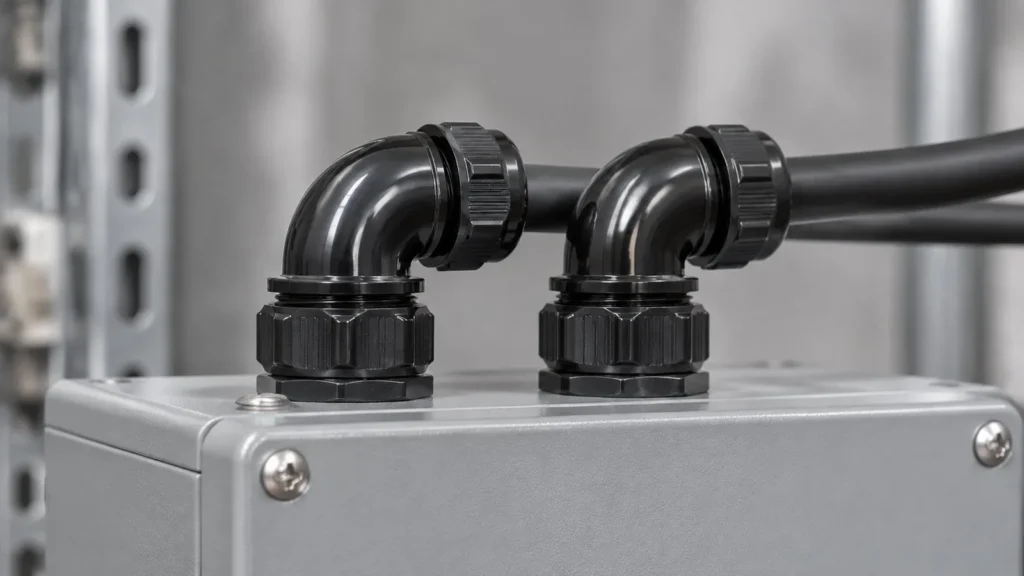
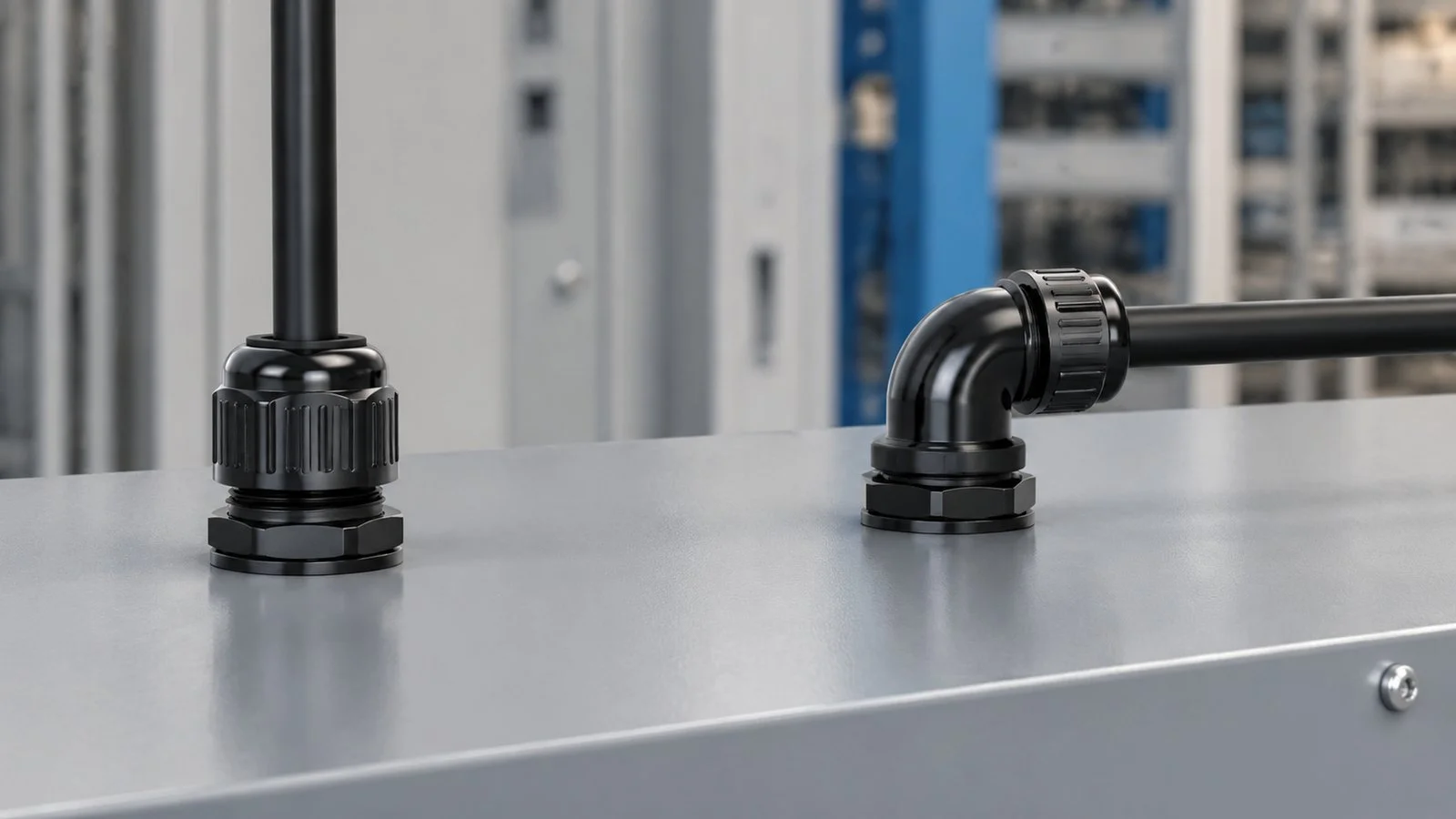
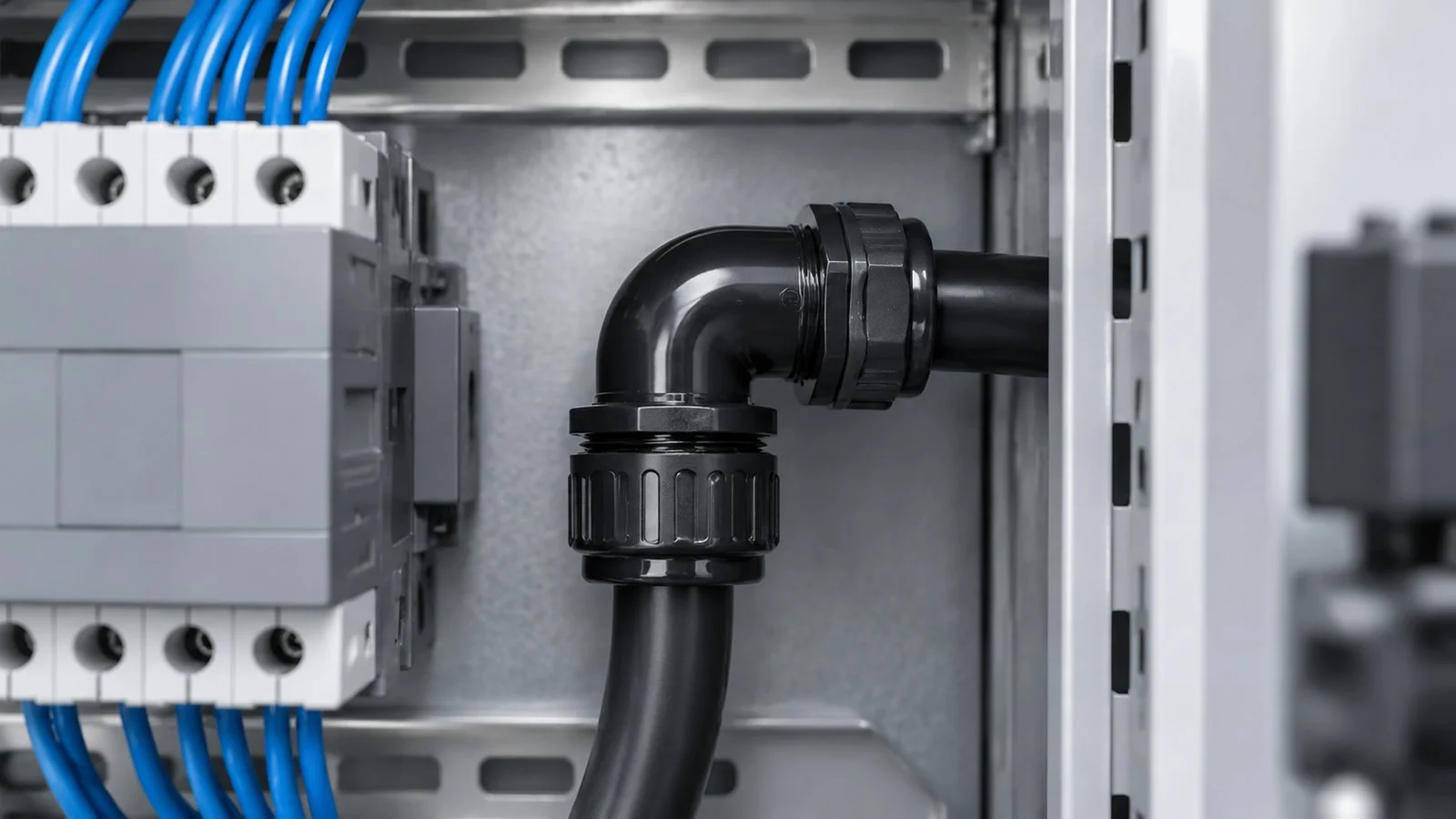
An elbow gland is a straight thread with a moulded right angle body on top. It enters the enclosure like any other gland, seals on the face washer under the locknut, and compresses the sheath with a dome nut at the end of the arm. What it adds is a fixed internal turn: cable arrives vertically and leaves horizontally, in directions the fitting sets rather than the installer.
It does not add sealing or strain relief, and it does not make a tight bend acceptable. It relocates the bend to a place you can measure and a direction you can plan.
The Height You Trade for the Bend
The dimension that decides whether an elbow fits is not the thread, it is the height above the panel face once installed. In this range it runs from 37 mm at the smallest size to 68 mm at the largest, and it grows faster than the thread does.
Size
Cable range
Height above panel
Thread length GL
Spanner
Mounting hole
M16
4 to 8 mm
37 mm
8 mm
19 mm
16 to 16.3 mm
M18
5 to 10 mm
39 mm
8 mm
22 mm
18 to 18.3 mm
M20
6 to 12 mm
43 mm
9 mm
24 mm
20 to 20.3 mm
M22
10 to 14 mm
48 mm
10 mm
27 mm
22 to 22.3 mm
M25
13 to 18 mm
56 mm
11 mm
33 mm
25 to 25.3 mm
M32
18 to 25 mm
68 mm
11 mm
41 / 42 mm
32 to 32.3 mm
Add the height to whatever the cable does next. An elbow pointing up on a cabinet top adds 43 mm at M20 before the cable has gone anywhere. On the underside the same fitting turns that cost into free space, which is why elbows are far more common on bottom and side faces.
Why the Bend Belongs at the Gland
Every cable has a minimum bend radius set by its manufacturer, and no gland changes it. What changes is whether you can see the bend. With a straight gland the first turn happens immediately past the dome nut, in whatever space the enclosure or the wall happens to leave, and the radius is whatever comes out of that. Nobody measures it, and the sheath is under compression on the inside of the bend at the exact point where the insert grips it.
An elbow replaces that improvised geometry with a moulded one. The turn has a defined radius and a defined direction, and the grip point sits upstream of it rather than inside it. The cable still needs its minimum radius after the arm, but by then the sheath is out of the gland and the radius is a cable-tray layout decision rather than a fitting decision.
The visible difference is direction. The invisible one is cable range: at M32 the elbow reaches 25 mm where the straight gland stops at 21 mm.
The Same Size Does Not Carry the Same Cable Range
Thread size does not travel between product families, and this is where most wrong orders start. At M32 the elbow covers 18 to 25 mm while the straight gland of the same thread covers 16 to 21 mm. A 25 mm cable needs an M32 elbow; the M32 straight gland will not grip it at all.
Thread
Elbow cable range
Straight gland cable range
Practical consequence
M20
6 to 12 mm
6 to 12 mm
Interchangeable on cable; only the geometry differs
M22
10 to 14 mm
10 to 14 mm
Interchangeable on cable
M25
13 to 18 mm
13 to 18 mm, or 13 to 15 mm in the shorter body
Check which straight variant is on the drawing
M32
18 to 25 mm
16 to 21 mm
Not interchangeable: the elbow reaches 4 mm higher
Read it as a warning against substitution rather than a table to memorise: switching from straight to elbow at the same thread is safe at M20 and M22 and unsafe at M32. The thread is a hole dimension and the cable range is a seal dimension, set independently by whoever designed that body.
Six Sizes Only, and What to Do Above M32
This elbow range stops at M32, which caps it at a 25 mm cable. There is no M40 elbow and nothing above it. A cable of 30 mm cannot be turned by this fitting at any thread size, and specifying “M40 elbow” on a requisition produces either a substitute or a delay.
The alternatives above M32 are a straight gland plus a bend in the tray or conduit downstream, a flexible gland that allows a gentler sweep, or a metal elbow from a different range if one exists for the duty. Each changes something: the conduit bend adds a joint to seal, the flexible gland gives radius without direction, and a metal elbow changes the material answer for corrosion and for temperature.
The bend has moved outside the panel, which is the point of the fitting. The cable mass now hangs on an arm, and that moment arrives at the locknut rather than along the thread axis.
The Load Is Offset, So the Locknut Works Harder
A straight gland loads its thread in tension along the axis. An elbow loads the same thread with a bending moment, because the cable’s weight and any pull act at the end of an arm rather than on the centre line. That moment arrives at a locknut which was chosen to resist a clamping force, not a lever.
Three things follow. A thin enclosure wall deflects under the moment and the face washer loses compression on one side, which shows up as a leak on the low side of the entry rather than all round. The moulded hole clearance is wider than a machined one, 0.3 mm in this range against 0.2 mm in the metal ranges, so the body can cock in the hole before the nut is fully tight. And the cable should be supported beyond the arm so that the gland is not the last restraint; that point is covered in cable gland strain relief.
Setting the Direction Before It Tightens
The arm can be clocked to any of 360 degrees, but only while the body is still free to rotate. Once the locknut is tight the direction is fixed, so the sequence matters: thread the body in, set the arm to the cable route, hold that position, and only then run the locknut up. Tightening first and correcting afterwards scratches the bearing face and leaves the washer unevenly compressed.
Two checks before the locknut goes on. Confirm the arm clears the cable’s whole route, including the bend after the fitting rather than just the first straight run. And confirm a spanner will fit the dome nut at the end of the arm: at M32 that nut needs 41 to 42 mm of access on a fitting already 68 mm tall.
Where an Elbow Is the Wrong Choice
Sustained vibration is the clearest case against it. A moulded arm carrying cable mass is a cantilever, and a cantilever on a plastic thread is the geometry that loosens fastest; the mechanisms are set out in how to prevent cable glands from loosening. Where the joint will see continuous movement, a straight gland with the cable supported independently is more stable, whatever the routing gain.
Hazardous areas are the second case. An elbow is a different body from the straight item and needs its own certification for the protection concept and the gas group; an assembly cannot be built by swapping a certified straight body for an uncertified elbow on the same thread. If the area is classified, the starting point is selecting cable glands for hazardous areas.
Third, high pressure washdown. An elbow has more joints than a straight gland and each is a sealing path, so confirm the IP rating quoted applies to the elbow body itself and not to the straight item in the same range.
Elbow, Flexible Gland or Conduit Bend?
Option
What it gives you
What it costs
Use it when
90 degree elbow gland
A fixed turn at the entry point
Height above the panel, and a bending moment on the thread
Space is short inside the enclosure and the cable must run along the panel face
Straight gland plus tray bend
Any radius the tray can give
Space downstream, and a longer first run
The enclosure has room and the route is being planned anyway
Flexible gland
A sweep rather than a corner
Sealing depends on an elastomer that also takes the movement
The cable has to move, or the route curves continuously
Conduit or flexible conduit bend
Protection along the run, not just at the wall
An extra joint and an extra interface to seal
The cable is exposed between the enclosure and the next point
Specifying an Elbow Gland
Field
What to state
Why
Thread and size
Metric thread with pitch, for example M25 x 1.5
The bare size does not carry the pitch
Cable range
The measured sheath diameter, one figure
Elbow ranges differ from straight ranges at the same thread
Height budget
The clear space available above the panel
Decides whether the elbow or a straight gland can be used at all
Arm direction
Route direction, or “field adjustable”
Fixed-arm variants exist and cannot be clocked later
Sealing
IP rating and the actual wet condition
Confirm the rating applies to the elbow body, not the straight item
Accessories
Locknut and washer as separate lines
The elbow’s offset load makes the locknut a structural part
Routing a cable along the enclosure face instead of straight out of it. It is chosen when the space inside the cabinet cannot accommodate the cable’s first bend, or when a straight gland would foul a wall, a door or another enclosure immediately outside.
Does an elbow gland reduce the cable’s bend radius?
No. It gives the bend a fixed radius and a fixed direction instead of an improvised one. The cable still has to meet its own minimum bend radius after the arm, and the fitting does not relax that limit.
Is an M32 elbow the same as an M32 straight gland?
Not in cable range. The elbow covers 18 to 25 mm and the straight gland 16 to 21 mm, so a 25 mm cable needs the elbow and an 18 mm cable can use either. Compare the ranges before substituting one for the other.
Can an elbow gland be used in a hazardous area?
Only if that elbow body is itself certified for the protection concept, gas group and temperature class of the location. A certified straight gland cannot be swapped for an uncertified elbow on the same thread and remain compliant.
Why does my elbow gland leak on one side?
Usually because the offset load has cocked the body in the hole and unloaded part of the face washer. Check that the mounting hole is within tolerance, that the panel is stiff enough for the moment, and that the cable is supported beyond the arm.
A VFD cable gland has to bond the cable screen around the full circumference at both the drive and the motor end. How to size one for drive cable, where the bond path breaks, and what a gland cannot fix.
PG13.5 is not 13.5 mm across. The number refers to nominal bore, so the thread measures 20.4 mm and needs a 20.4 to 20.6 mm hole. This guide covers the dimensions, the M20 confusion and how to identify an unknown thread.
Why 316 stainless steel cable glands fail at sea, and what the position of the entry has to do with it. Exposure zones, crevice corrosion, free iron, washdown and installation discipline.
We use cookies to enhance your browsing experience, serve personalised ads or content, and analyse our traffic. By clicking "Accept All", you consent to our use of cookies.