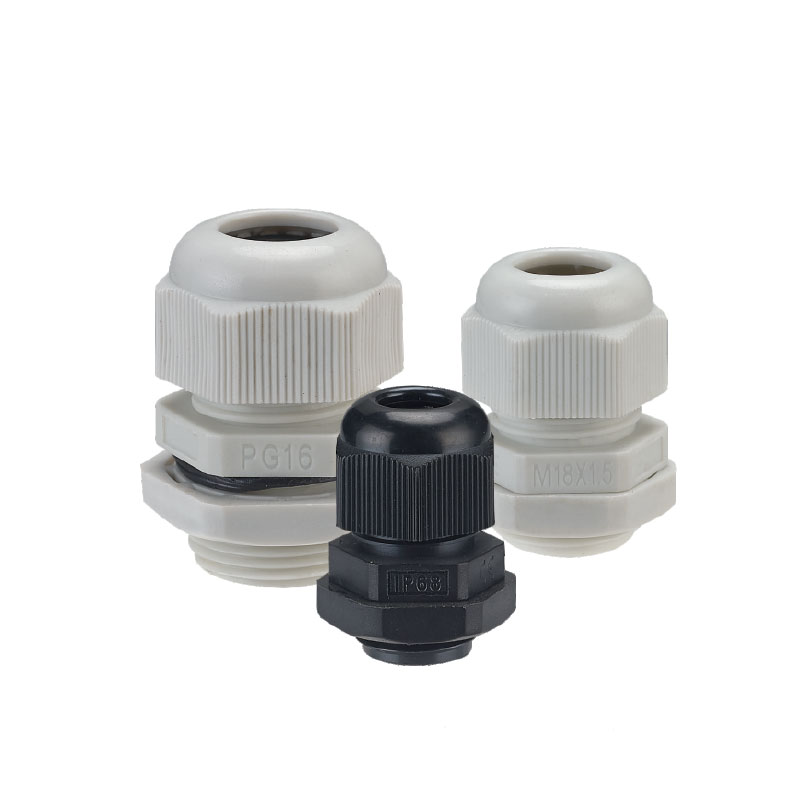
Waterproof Cable Gland
Waterproof Nylon Cable Gland for Industrial Cable Entry
Learn how to choose a waterproof nylon cable gland by thread type, cable range, IP68 sealing, and application needs for OEM, export, and bulk buying.
Read More
A thread size chart answers one narrow question well: for a given thread designation, what is the outside diameter of the thread, what cable will it actually grip, and what hole does it need in the panel. That is three different numbers, and the single biggest cause of wrong orders on this product is treating them as one number.
The chart cannot tell you whether the gland will seal your cable, whether it will hold in your wall thickness, or whether it fits the space next to the terminal block. Those are separate checks. Buyers who read a chart as a shopping list get the thread right and everything else wrong.
Where the hole itself has to be decided — clearance, wall thickness, sealing face and layout — that is covered separately in the cable gland hole size chart.
Below are the full series we manufacture, in the four thread families that cover almost all industrial demand: metric (M), PG, NPT and G (BSPP). Use the tables as reference data, then use the reading method at the end to convert a row into a purchase order.
Metric and PG are both parallel threads sealed at the face of the panel by a gasket. NPT is tapered and seals on the threads. G is parallel like metric but uses a Whitworth thread form with a different flank angle. If that distinction is new to you, the broader explanation lives in our cable gland thread types guide; this page is the numeric companion to it.
| Family | Thread form | Seals on | Typical market | Chart columns you must check |
|---|---|---|---|---|
| Metric (M) | ISO 68-1, 60°, parallel, 1.5 mm pitch | Panel face gasket | Europe, Asia, most new projects | Thread O.D., mounting hole, GL |
| PG | DIN 40430, 80°, parallel | Panel face gasket | Legacy European equipment, older machinery | Thread O.D., mounting hole, GL |
| NPT | ASME B1.20.1, 60°, tapered | The threads themselves | North America, oil and gas | O.D. at large end, thread engagement length |
| G (BSPP) | ISO 228-1, 55°, parallel | Face washer or bonded seal | UK, water treatment, marine, HVAC | Thread O.D., hole, sealing washer face |
All metric glands in this series use a 1.5 mm pitch. Cable range is the clamping range at the sealing insert with the nut fully tightened; the thread outside diameter is what has to pass through the panel; the mounting hole is the drilled or punched opening the gland sits in.
| Model | Thread | Cable range (mm) | Thread O.D. (mm) | Mounting hole (mm) | Thread length GL (mm) | Overall length (mm) | Spanner (mm) |
|---|---|---|---|---|---|---|---|
| M14-NP | M14×1.5 | 4–8 | 14 | 14–14.2 | 7 | 19 | 17 |
| M16-NP | M16×1.5 | 4–8 | 16 | 16–16.2 | 8 | 20 | 18 |
| M18-NP | M18×1.5 | 5–10 | 18 | 18–18.2 | 8 | 21 | 20 |
| M20-NP | M20×1.5 | 6–12 | 20 | 20–20.2 | 8 | 22 | 22 |
| M22-NP | M22×1.5 | 10–14 | 22 | 22–22.2 | 8 | 23 | 24 |
| M24-NP | M24×1.5 | 10–14 | 24 | 24–24.2 | 9 | 25 | 24/27 |
| M25-NP | M25×1.5 | 10–14 | 25 | 25–25.2 | 9 | 25 | 24/27 |
| M28-NP | M28×1.5 | 13–18 | 28 | 28–28.2 | 9 | 27 | 30 |
| M30-NP | M30×1.5 | 13–18 | 30 | 30–30.2 | 9 | 29 | 30/32 |
| M32-NP | M32×1.5 | 15–22 | 32 | 32–32.2 | 10 | 29 | 35 |
| M33-NP | M33×1.5 | 15–22 | 33 | 33–33.2 | 10 | 29 | 35 |
| M36-NP | M36×1.5 | 18–25 | 36 | 36–36.2 | 10 | 31 | 40 |
| M37-NP | M37×1.5 | 18–25 | 37 | 37–37.2 | 10 | 31 | 40 |
| M40-NP | M40×1.5 | 18–25 | 40 | 40–40.2 | 11 | 31 | 40/45 |
| M42-NP | M42×1.5 | 22–30 | 42 | 42–42.2 | 11 | 35 | 45 |
| M48-NP | M48×1.5 | 25–33 | 48 | 48–48.2 | 11 | 37 | 50/52 |
| M50-NP | M50×1.5 | 32–38 | 50 | 50–50.2 | 12 | 37 | 57/55 |
| M63-NP | M63×1.5 | 37–44 | 63 | 63–63.2 | 13 | 38 | 64/68 |
Note that M24 and M25 share the same cable range, and so do M28 and M30. The step between them buys thread strength and wall clearance, not a bigger cable. If a cable sits at the top of a range, moving up one size class usually fixes grip; moving one thread size up usually fixes nothing.
PG sizes are not metric sizes with another name. PG13.5 is not M20, PG16 is not M20, and PG21 is not M25 — the outside diameters are close enough to look interchangeable and different enough to fail. The table below is the reference you need when replacing glands on imported machinery built before metric became the default.
| Model | Thread | Cable range (mm) | Thread O.D. (mm) | Mounting hole (mm) | Thread length GL (mm) | Overall length (mm) | Spanner (mm) |
|---|---|---|---|---|---|---|---|
| PG7-NP | PG7 | 3–6.3 | 12.5 | 12.5–12.7 | 7 | 19 | 14 |
| PG9-NP | PG9 | 4–8 | 15.2 | 15.2–15.4 | 8 | 20 | 18 |
| PG11-NP | PG11 | 5–10 | 18.6 | 18.6–18.8 | 8 | 21 | 20/21 |
| PG13.5-NP | PG13.5 | 6–12 | 20.4 | 20.4–20.6 | 8 | 22 | 22 |
| PG16-NP | PG16 | 10–14 | 22.5 | 22.5–22.7 | 9 | 23 | 24 |
| PG19-NP | PG19 | 10–14 | 25 | 25–25.2 | 9 | 25 | 24/27 |
| PG21-NP | PG21 | 13–18 | 28.3 | 28.3–28.5 | 9 | 27 | 30/32 |
| PG25-NP | PG25 | 15–22 | 32 | 32–32.2 | 10 | 29 | 35 |
| PG29-NP | PG29 | 18–25 | 37 | 37–37.2 | 11 | 31 | 40 |
| PG36-NP | PG36 | 25–33 | 47 | 47–47.2 | 12 | 37 | 50 |
| PG42-NP | PG42 | 32–38 | 54 | 54–54.2 | 13 | 38 | 57 |
| PG48-NP | PG48 | 37–44 | 59.3 | 59.3–59.5 | 14 | 38 | 64 |
| PG63-NP | PG63 | 42–52 | 72 | 72–72.2 | 15 | 42 | 78 |
Both series tables above are our standard brass and stainless steel series. Stainless steel is available in the same size increments; the equivalent PG13.5 body is on the stainless steel PG13.5 product page.
Our standard range is metric and PG. NPT and G glands are quoted to order, so the chart below is the reference data you need to specify them correctly rather than a stock list.
| Thread | O.D. (mm) | Threads per inch | Taper | Reading note |
|---|---|---|---|---|
| 1/4″ NPT | 13.7 | 18 | 1:16 | O.D. measured at the large end |
| 3/8″ NPT | 17.1 | 18 | 1:16 | O.D. at large end |
| 1/2″ NPT | 21.3 | 14 | 1:16 | O.D. at large end; will not enter a 20.2 mm hole |
| 3/4″ NPT | 26.7 | 14 | 1:16 | O.D. at large end |
| 1″ NPT | 33.4 | 11.5 | 1:16 | O.D. at large end |
| 1-1/4″ NPT | 42.2 | 11.5 | 1:16 | O.D. at large end |
| G1/4 | 13.157 | 19 | Parallel | Needs a face washer to seal |
| G3/8 | 16.662 | 19 | Parallel | Face seal |
| G1/2 | 20.955 | 14 | Parallel | Same pitch as 1/2″ NPT, different diameter and no taper |
| G3/4 | 26.441 | 14 | Parallel | Face seal |
| G1 | 33.249 | 11 | Parallel | Face seal |
| G1-1/4 | 41.910 | 11 | Parallel | Face seal |
G1/2 and 1/2″ NPT are the pair that catches people out. Both are 14 threads per inch, both look the same in a photograph, and a G1/2 male will start into a 1/2″ NPT female for a turn or two before it binds. If the drawing says NPT and the box says G, the joint is wrong even though it screws together. The conversion traps for each family are covered separately in our PG vs metric and NPT vs metric comparisons.
The chart exposes something the marketing pages never mention: several metric and PG sizes have an identical outside diameter. When the diameter is the same, the choice comes down to pitch and flank angle, and a part that measures right can still be the wrong part.
| Metric | O.D. (mm) | PG | O.D. (mm) | What happens if you substitute |
|---|---|---|---|---|
| M25×1.5 | 25 | PG19 | 25 | Same diameter, pitch 1.5 vs 1.41 — the gland starts and then jams |
| M32×1.5 | 32 | PG25 | 32 | Identical diameter, different pitch; short thread engagement |
| M37×1.5 | 37 | PG29 | 37 | Identical diameter, different pitch |
| M20×1.5 | 20 | PG13.5 | 20.4 | PG13.5 is larger — it will not enter a metric hole |
| M18×1.5 | 18 | PG11 | 18.6 | PG11 is larger — will not enter |
| M16×1.5 | 16 | PG9 | 15.2 | PG9 is smaller — fits the hole but the gasket cannot cover it |
The failure mode differs by direction. A slightly oversize thread will not enter, which is a visible, immediate problem. A slightly undersize thread drops in and looks correct, then leaks past a gasket that has no material under it. The second case is the expensive one, because it is discovered at commissioning or after the first rain.
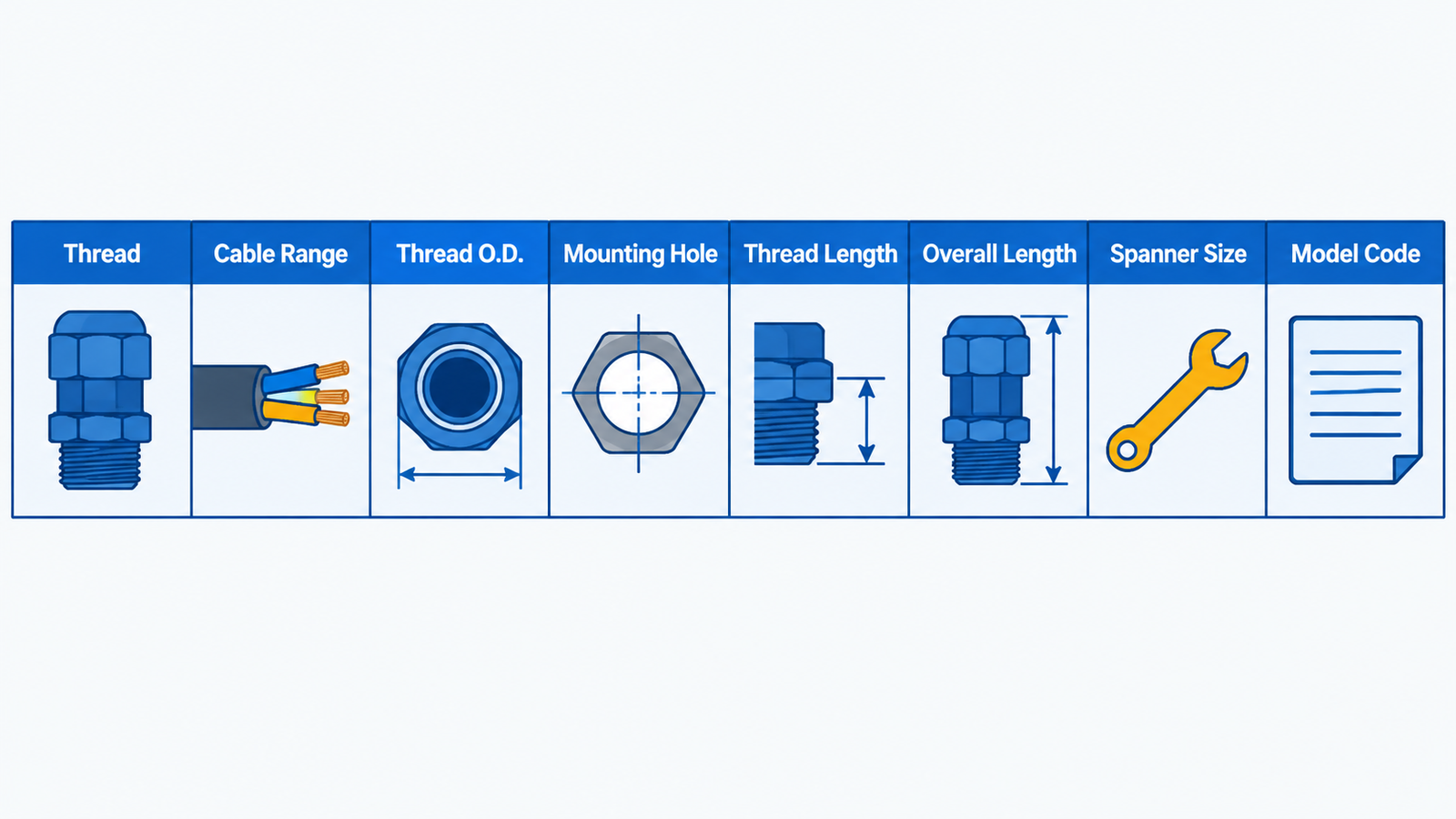
A chart row is not a product description; it is a set of constraints. Read it in this order and most specification errors disappear before the order is placed.
| Column | What it constrains | Check against |
|---|---|---|
| Thread | What the gland screws into | The enclosure entry, not the cable |
| Cable range | What the seal will grip | Measured cable O.D., not the datasheet of the cable |
| Thread O.D. | Whether the body passes through the opening | Existing hole or tapped boss |
| Mounting hole | The opening to cut in the panel | Wall thickness and edge distance |
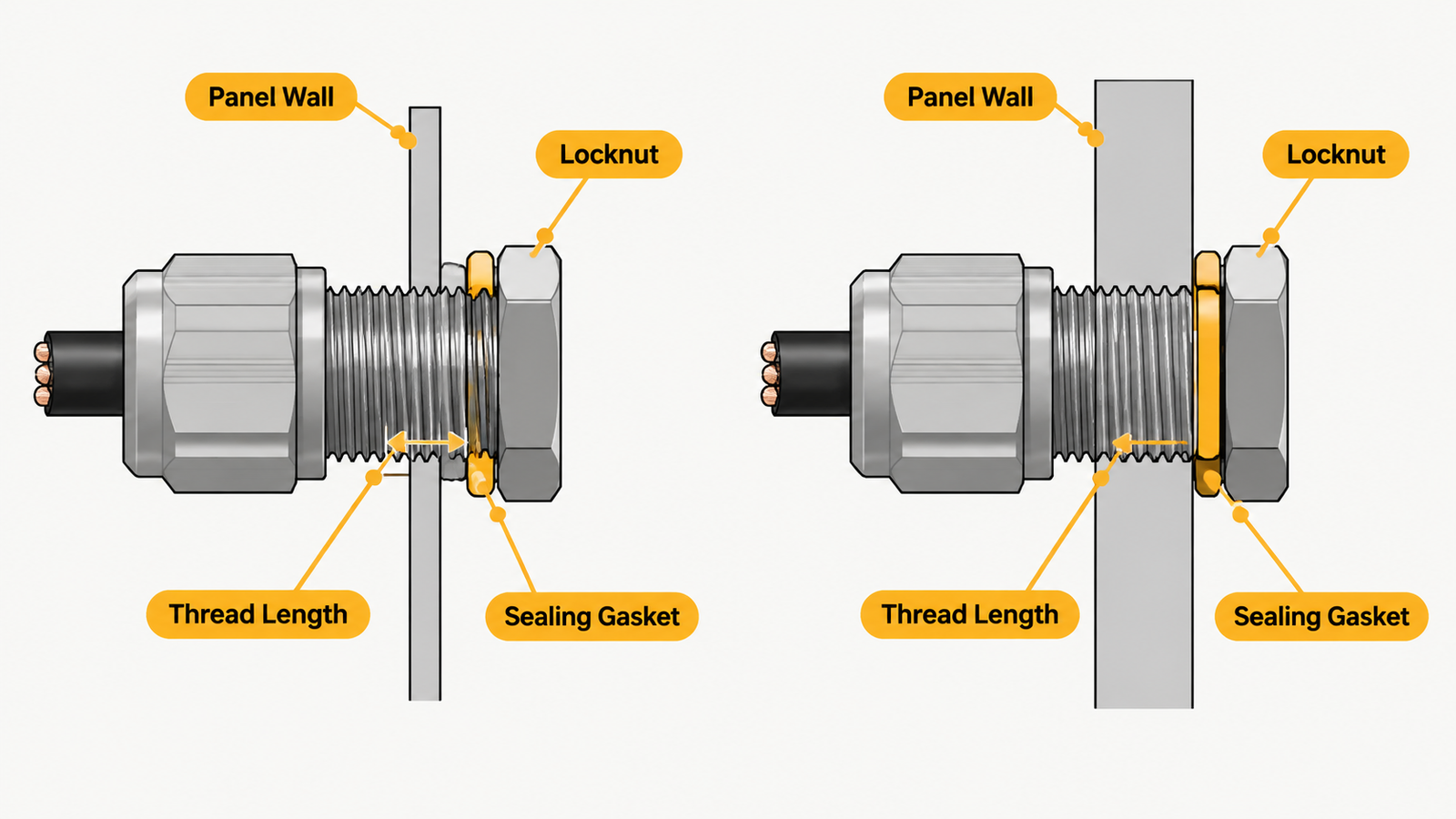
| Thread length GL | How much wall the gland can span | Panel thickness plus locknut or gasket |
| Overall length | Space needed outside the panel | Clearance to doors, ducts, adjacent entries |
| Spanner size | Access for the tightening tool | Gap to neighbouring components |
| Model code | The orderable identity of the part | Must appear on the PO with thread and range |
Thread and cable range get all the attention; the length columns cause the field failures. GL runs from 7 mm on the smallest body to 15 mm on PG63. If a gland is going through a thick wall, GL has to cover the wall plus whatever seals on the far side — a locknut, a gasket, a metal tag. A gland with 8 mm of thread in a 6 mm wall leaves almost nothing to engage, and the result is a part that tightens against the wall surface with two threads carrying the load.
Overall length is the opposite constraint: it is the space the gland occupies on the outside, and it is what decides whether the cable can be dressed without a sharp bend right at the entry. On a densely packed enclosure top plate, the difference between a 22 mm and a 29 mm body is the difference between a straight run and a kink.
Spanner size is the column nobody checks until assembly. A 40 mm across-flats nut next to a 30 mm nut on a 32 mm pitch leaves no room for a wrench, and the fitter resolves it by hand-tightening one of them. That gland is now the one that leaks. If the layout is tight, specify a body with a smaller spanner size or move one entry.
A correct order line contains four things: the thread designation, the cable range, the material, and the quantity per size. Anything less and the supplier has to guess, and a guess on a gland is usually resolved in the supplier’s favour rather than yours.
Write the range, not a single diameter. “M20, 10 mm cable” is not a specification; “M20×1.5, cable range 6–12 mm, nickel plated brass, 1,000 pcs” is. If the cable is at the edge of a range, say so and ask for the next size up as an alternative — the M20 brass gland and the M25 brass gland overlap in nothing but name; their ranges are 6–12 and 10–14 mm.
For a mixed project, order by size and keep one thread family. Mixing PG and metric on the same panel means two sets of spare parts, two sets of drills and a permanent risk of a wrong-size swap during maintenance. Where the existing panel is PG and the new section is metric, the panel is the thing to standardise, not the gland.
No. PG13.5 has a 20.4 mm outside diameter on an 80° thread form; M20 has a 20 mm outside diameter on a 60° form with a 1.5 mm pitch. They cover the same cable range in many ranges, which is where the confusion starts, but they do not interchange in a hole.
20 to 20.2 mm. The chart above gives the mounting hole for every size in the series. Drilling at exactly the thread diameter removes the clearance the gasket needs and makes assembly a press fit.
Metric. It is the default for new European and Asian equipment, the sizes are in 1.5 mm pitch steps, and the global spare-parts supply is deepest. Keep PG only where an installed base forces you to.
You can, and it is sometimes the correct answer for a repair. It adds a joint, adds axial length, and adds a component that nobody records. For new builds, ordering the right thread is cheaper than documenting the conversion.
The thread diameters and mounting holes are the same, because the thread is cut to the same standard. Cable ranges differ, because nylon bodies use different seal geometry — check a nylon-specific table rather than assuming the brass range transfers.
If you are working from a cable list and a panel drawing, send both and we will return a size-by-size recommendation against the tables above. Our brass and stainless steel ranges use the same chart, and the cable gland overview covers which family suits which environment.
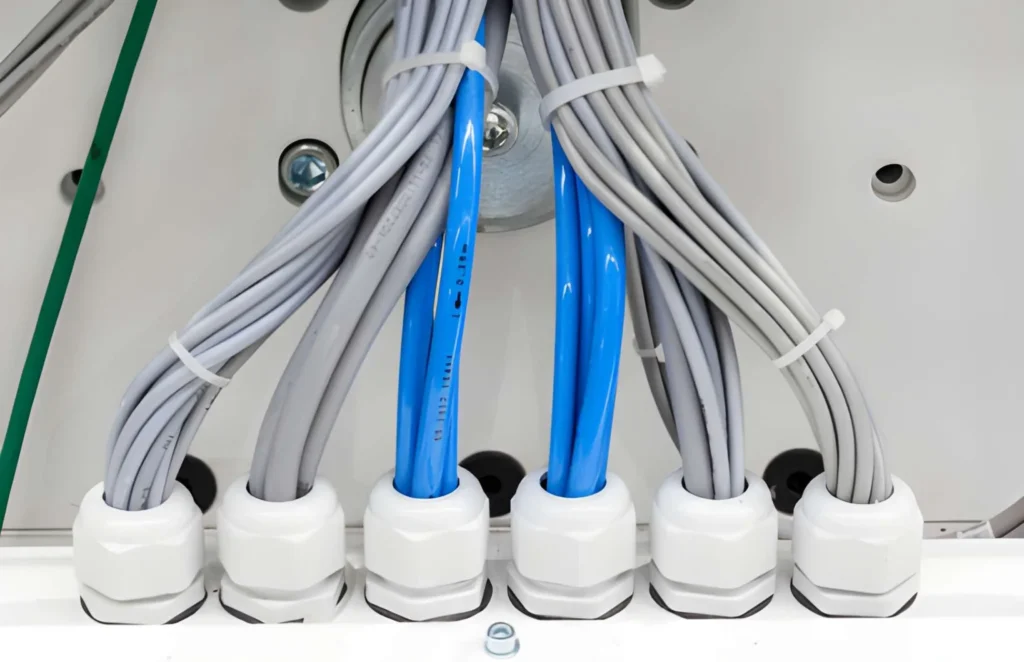
Learn how to choose a waterproof nylon cable gland by thread type, cable range, IP68 sealing, and application needs for OEM, export, and bulk buying.
Read More
When I speak with buyers, I notice the same pattern again and again: everyone asks for a “Waterproof Cable Gland” but what they actually need is a reliable sealing solution that matches cable size, enclosure type, operating environment, and purchasing risk. That is exactly why choosing among waterproof cable gland suppliers is not a small […]
Read More
ATEX and IECEx both point at IEC 60079, but one is mandatory EU law and the other voluntary — and their assessment routes are not equivalent. How to read the certificate number before you order.
Read More