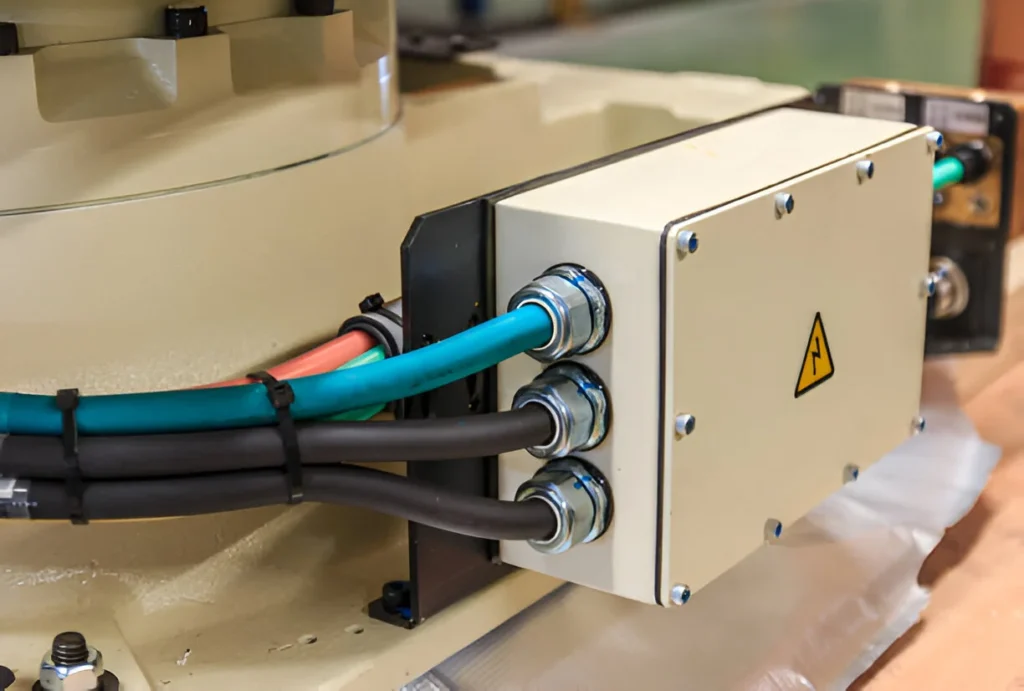
A cable gland arrives with a compliance pack that is usually one PDF of scanned pages, and the pages are not equally strong. Three of them are certificates in the everyday sense: a laboratory tested something and a named person signed for it. Two are the manufacturer declaring its own conformity. One is an audit of a factory’s management system that says nothing about the part in your hand. Buyers who read the pack as a single verdict either reject good goods or accept a document that will not survive their own customer’s audit.
The Pack Has Three Tiers, and They Do Not Stack
Compliance documents fall into three tiers, and a document from a higher tier never substitutes for one from a lower tier. A factory holding ISO 9001 can still ship a gland that fails its own catalogue dimension, and a report proving IP68 says nothing about whether the brass is lead-free.
Tier
Typical document
The question it answers
The question it cannot answer
System
ISO 9001 certificate
Whether the factory runs a controlled, audited process
Whether this batch meets the drawing
Product performance
IP68 test report, ATEX or IECEx certificate
Whether a sample of this design passed a defined test
Whether every unit off the line will pass
Product composition
EN 10204 2.2 or 3.1 material certificate
What the metal in this delivery actually is
What the finished gland measures
Substance
RoHS declaration, REACH statement
Which restricted substances are present, and at what level
Whether the gland seals, clamps or bonds
The most common goods-in failure is not a missing document but a 3.1 requested and a 2.2 delivered, with nothing on either page to tell a receiving clerk which is which.
An IP68 Report Is a Conditional Statement
IEC 60529 defines the two digits separately. The 6 is dust tight. The 8 means continuous immersion, and it is the only water level in the standard where depth and duration are left open, to be agreed between manufacturer and user. Two glands can both be IP68 while one is rated for a rain-soaked junction box and the other for a flooded wet well.
An immersion rating is only meaningful with a depth and a duration attached to it. The gland, the cable and the panel are one assembly in the test, not three parts.
Field on the report
Why it decides the answer
Send it back if
Standard and edition
Labs test to IEC 60529 with its amendments; an undated reference cannot be tied to a method
The number appears only inside a catalogue table, with no report behind it
Depth
Pressure is linear: every 10 m of water adds about 1 bar above atmosphere
8 is claimed with no depth stated
Duration
30 minutes proves a splash line; it does not prove a permanently submerged joint
30 minutes is quoted for a joint that will sit under water for years
Test configuration
The sample must be gland, cable, enclosure wall and tightening torque together
The sample is described as the gland on its own
Laboratory and accreditation
An ISO/IEC 17025 scope covering IEC 60529 makes the result defensible to a third party
There is no laboratory name, or no report number
Date
Inserts, seals and thread forms change; an undated report may describe a superseded design
Nothing on the document carries a date
The immersion levels we test and supply are 1.5 m for 30 minutes, 2 m for 24 hours as the outdoor default, 5 m for 72 hours for marine and tunnel work, and 10 m for 168 hours on request. That is four different products at four price points, all legitimately called IP68.
What the Report’s Sample Does Not Cover
A single immersion report covers a single configuration: one thread size, one clamping insert, one cable outside diameter, one wall thickness, one torque value. Buy the same gland in eleven sizes and you are buying ten extrapolations and one tested part. That is normal practice, provided the series table says which size was tested.
On submersible pumps, marine deck penetrations and tunnel sumps, where the gland is the only barrier, ask whether the report lists your size by name or carries the note “similar performance for other sizes”. If it is the second, request a size-specific report or witness the test.
EN 10204: the Difference Between 2.2 and 3.1 Is Who Signs
EN 10204 defines inspection documents for metallic products and has two axes rather than one: whether the results come from testing the material in your delivery, and who is entitled to validate the page. Buyers assume a bigger number means more testing. It means more independence.
Type
Name
Tested on your delivery?
Validated by
What it can support
2.1
Declaration of compliance
No results at all
The manufacturer
A commercial statement that the order was met
2.2
Test report
No, results come from non-specific inspection
The manufacturer
“This grade generally measures what we say”
3.1
Inspection certificate
Yes, specific inspection of the supplied material
The manufacturer’s inspection representative, independent of production
A field-failure investigation months later
3.2
Inspection certificate, independently validated
Yes, specific inspection
As 3.1, plus the purchaser’s inspector or a designated body
A contract requiring third-party witnessing
A second limitation applies to every gland. Traceability to a heat number is a property of a batch kept separate, not of a part. A brass bar carries its heat number; that bar becomes tens of thousands of bodies that go into a bin, and nothing short of segregating the whole run puts the number back on the individual piece. Part-level traceability must be agreed before production, because it changes how material is handled and it costs money. A supplier who answers “full traceability” without that qualification has told you something that cannot be true.
The Lead in the Brass: Why a RoHS Statement Expires
A heat number belongs to the bar. Once that bar becomes thousands of gland bodies in a bin, the certificate still describes the batch, not the part in your hand.
RoHS limits lead to 0.1 percent by weight in each homogeneous material. Free-cutting brass of the kind used for gland bodies, typically CuZn39Pb3 or CW617N, contains around 3 percent lead by design, because that is what makes the alloy machine cleanly at production speed. The part is legal only through Annex III exemption 6(c), which allows up to 4 percent lead in copper alloy, and under Delegated Directive (EU) 2025/2364 that exemption currently runs to 30 June 2027.
So a declaration reading only “RoHS compliant” is either describing a lead-free alloy or omitting the legal basis for the lead it contains. Ask which. A useful statement names the exemption, and a useful buyer treats the date as a re-approval cycle rather than a permanent permission. Where a design life runs past the current date, the question is what the supplier’s lead-free alternative is, not what the certificate says today.
Lead is also on the REACH Candidate List of substances of very high concern, which it joined in 2018. Above 0.1 percent by weight in an article, the supplier must tell the customer what is present and how to use it safely, and an EU supplier carries a SCIP notification obligation. The two documents arrive in the same envelope and answer different questions: RoHS restricts ten named substances in electrical and electronic equipment, REACH asks about substances of very high concern in any article.
CE Marking Is a Declaration, Not a Test
The EU Declaration of Conformity is signed by the manufacturer under its sole responsibility. No laboratory issues it and it certifies nothing by itself. What makes it usable is detail: the directives cited, the harmonised standards with their versions, identification of the product by type or series, a signature and a date.
For a gland the usual set is the Low Voltage Directive where the assembly sits in a 50 to 1000 volt circuit, the EMC Directive for shielded versions forming part of a bonding path, and RoHS in every case. A declaration that says “CE compliant” and lists no standard versions is a letterhead with a logo on it. Which of them has been withdrawn is covered in our guide to cable gland standards.
Ex Certificates: Read the Schedule, Not the Logo
For explosive atmospheres the document set changes shape. ATEX requires an EU-type examination certificate from a notified body plus a production module, either a quality assurance notification or product verification. IECEx uses a test report, a quality assessment report and a certificate of conformity, and the three are only meaningful together.
The part that decides your order is the schedule, which lists the variants covered and the thread sizes for each. A size added to the catalogue after issue is not covered until the certificate is varied, and a gland shipped outside its schedule is an uncertified gland with a certified logo on the box. In the marking, the four-digit number beside the CE mark belongs to the notified body and appears for categories 1 and 2; category 3 can be self-declared. Our comparison of ATEX and IECEx assessment routes covers how each system reaches its verdict.
ISO 9001 Is a Factory Certificate
ISO 9001 certifies that a quality management system has been audited. It does not certify the gland and is not a substitute for a test report on any characteristic. What it buys is change control: a documented route for revising a drawing, a record of nonconformities, and an audit trail when a dimension drifts between shipments.
A Four-Column Acceptance Check
This is the check we suggest running at goods-in. Most failures here are administrative rather than deceptive.
What you see
What it means
What to do
“IP68” printed in a catalogue table only
A claim, not evidence
Request the report; read depth and duration before anything else
3.1 ordered, 2.2 delivered
The results describe the mill’s general output, not your metal
Reject, or accept with a written deviation and a price adjustment
“RoHS compliant”, no exemption cited
Leaded brass declared without its legal basis
Ask for the exemption reference, or a lead-free alloy statement
Declaration of Conformity with no standard versions
A self-declaration with nothing traceable behind it
Ask for a revised declaration naming standards and editions
Ex schedule without your thread size
Your size is in the catalogue but not in the certification
Request a certificate variation, or buy only scheduled sizes
Every page undated
The documents cannot be tied to the design you bought
Ask for dated copies and file them with the purchase order
The Six Lines That Get the Right Pack First Time
Suppliers send the cheapest document that satisfies the word “certificate” because the request usually contains that word and nothing else. Six lines close the gap: the IP statement format including depth and duration; the EN 10204 type by number; the RoHS exemption citation; a REACH Article 33 statement; the Ex certificate schedule including your sizes; and the laboratory whose report will be supplied. None of it costs a supplier anything to answer, and all of it is checkable on arrival. It changes the quotation too, because a 3.2 certificate and a 2.1 are not the same price, and a 10 m immersion test is not a 2 m one.
Frequently Asked Questions
Is an in-house IP68 test report acceptable?
It is a genuine data record, and it is what most development work runs on. Where the enclosure must pass a client audit, ask for a report from a laboratory accredited to ISO/IEC 17025 for IEC 60529 — that is the one that travels.
Do I need 3.1 or 3.2 for standard brass glands?
3.1 wherever the metal must be identifiable after the fact, which covers most industrial and marine work. 3.2 only where a third party must witness the testing. Specifying 3.2 to be safe adds cost and, more painfully, lead time while the inspector is arranged.
Can a cable gland carry CE marking without a notified body?
Yes for the Low Voltage, EMC and RoHS directives, which are self-declaration. ATEX is different: categories 1 and 2 need a notified body for the type examination, and its four-digit number sits beside the CE mark.
Does a RoHS declaration cover REACH?
No. A supplier who sends one when you asked for the other has not answered you. RoHS restricts ten named substances in electrical equipment; REACH asks which substances of very high concern are present in an article.
My supplier’s IP68 certificate has no depth. What now?
Treat it as an immersion rating with unspecified conditions, which cannot be compared with another supplier’s claim. Ask for depth and duration in writing, and if no answer comes, buy on the lower assumption you can defend.
If you are assembling a documentation pack and need to know which of these we can supply for a given gland, the IP rating selection guide and our brass range are the fastest starting points. A note with your thread size and project standard is enough for us to answer with specifics.
A junction box is a node, not an enclosure. How box function, load path, the IP chain and condensation decide the gland configuration, and why tightening never fixes water inside a box.
Have you ever struggled to choose the right cable gland? Don’t worry-you’re not alone! Cable gland may be small, but they play a key role in ensuring the safety and stability of your electrical systems. Whether you’re in industrial automation, petrochemicals, or marine engineering, choosing the wrong cable gland can lead to water leaks, short […]
We use cookies to enhance your browsing experience, serve personalised ads or content, and analyse our traffic. By clicking "Accept All", you consent to our use of cookies.