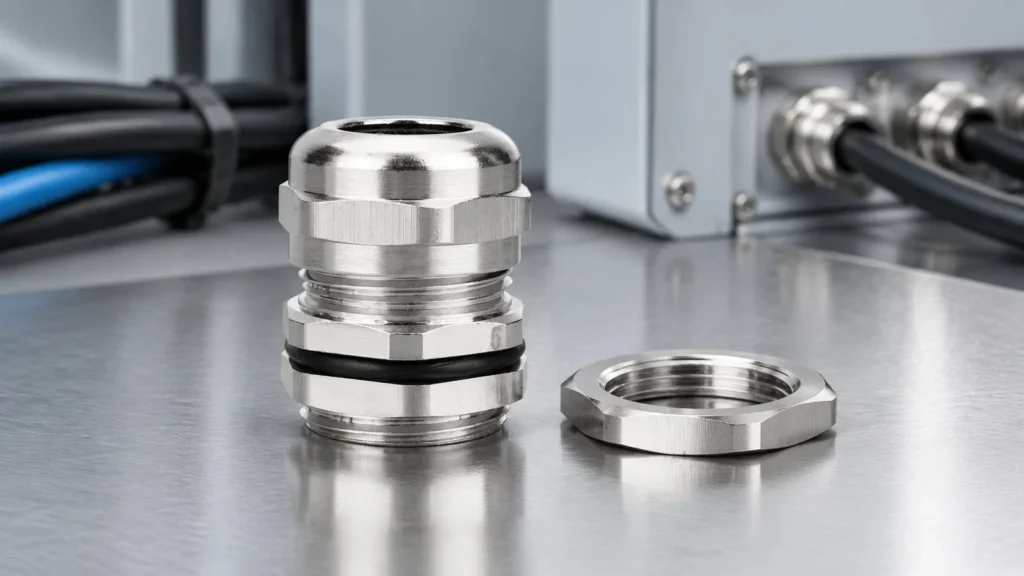
A cable gland price is not a market rate that a supplier either matches or walks away from. Two quotations for the same M20 nickel-plated brass gland, both per 1,000 pieces, both FOB Ningbo, can differ by a third, and both can be honest. The difference sits in the cost stack, and the stack can be read line by line.
This page takes that stack apart in the order the lines actually move, marks where a buyer has leverage and where the only counterparty is the metal market, and sets out what has to be normalised before two numbers can be compared at all. Indicative ranges by gland type are on the cable gland types guide; everything below sits underneath those ranges.
What Is Priced in a Cable Gland Quote
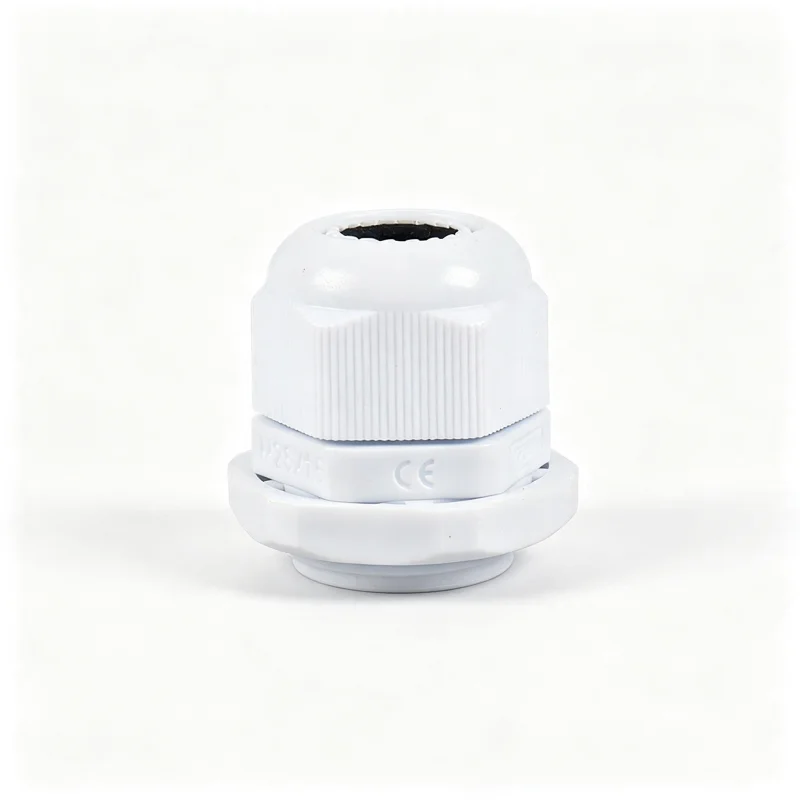
A quoted piece price is a sum of seven lines, and only one of them is a commodity. Metal is the largest line on a brass gland and an absent one on a nylon gland, which is why the same size in two materials can differ by a factor of five without either price being a markup story.
The stack also explains the silences. A line that is not on the quotation is either assumed or excluded, and those are not the same thing by the time the invoice lands.
Cost line
Charged on
Moves with
Buyer leverage
Metal
Blank mass × alloy price
Copper for brass, nickel and molybdenum for stainless
Alloy choice, size mix, metal-basis clause
Machining
Cycle time per piece
Number of features, not the thread size
Standard thread length, no knurl, no second diameter
Plating
Kilograms loaded in the barrel
Deposit thickness and surface area
Specify the finish only where it is doing work
Sealing insert
Pieces
Elastomer grade
Standardise on one compound across sizes
Tooling and setup
Per order, per size
Quantity per size, not total quantity
Consolidate sizes into one call-off
Packing
Carton count and volume
Bulk bag versus bagged per size
State the instruction before quoting
Certification
Per order and per batch
Scheme and traceability depth
Decide the document pack at enquiry
A quotation that states neither the packing instruction nor a plating thickness is not the cheaper one. It is the incomplete one, and the missing lines come back as a surcharge or a rejected lot.
Brass Content and Metal Cost
CuZn39Pb3, the free-cutting brass most bodies are turned from, is roughly 57 to 59 percent copper by weight. The 39 in the designation is the zinc, the 3 is the lead, and copper is the remainder. That single ratio fixes the behaviour of the metal line: a tonne of finished glands carries a little over half a tonne of copper, so the price follows the copper market with a coefficient near 0.6 and a lag of a few weeks.
The consequence is that a supplier is not gouging when the number moves eight percent in a quarter. It is also why each material is exposed to a different index, and why a programme split across three materials does not hedge itself.
Material
Index the price follows
Effect on a long-running order
Nickel-plated brass (CuZn39Pb3)
Copper, at roughly 0.6 of the copper move
Quarterly re-basing is normal; ask for the basis and the date
Stainless steel 304 / 316L
Nickel and molybdenum, plus mill surcharges
316L is the more volatile of the two because of the molybdenum
Polyamide PA66
Benzene to caprolactam and adipic acid chain
Oil-linked and slower to pass through than copper
Corrugated board
Pulp
Usually absorbed; it shows up only when carton count is high
Ask for the metal basis and a validity period on any quotation intended to run for months. A price with no validity is a price with no commitment behind it. The size list that a metal basis is quoted against, including the PG series, is in the brass cable gland range.
Weight per Piece
Metal cost is a product: mass times price per kilogram. That makes mass the first number to establish, and it is the one number most buyers never check, because it is on almost no datasheet.
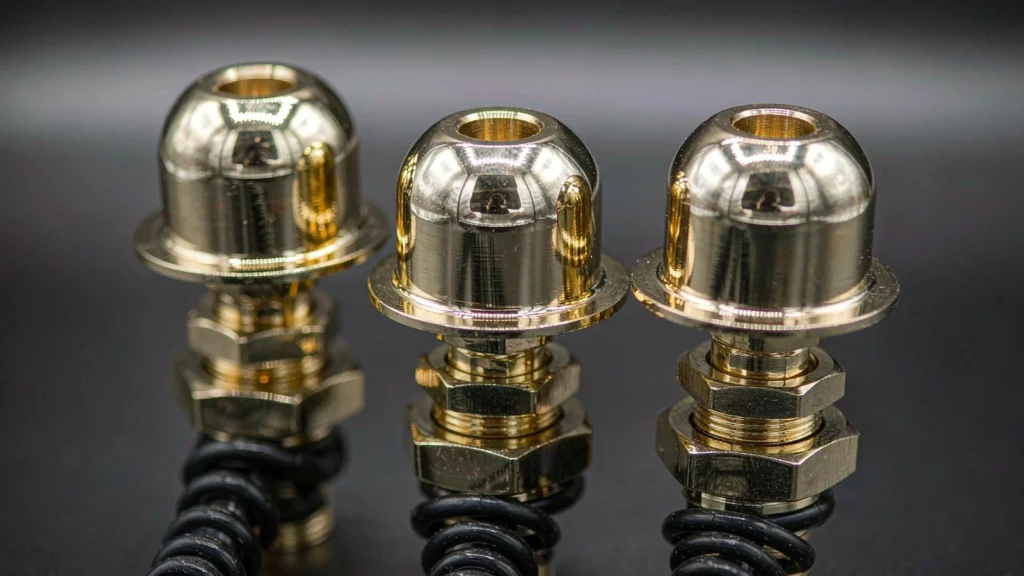
One gland is one set of parts turned from one metal blank — so the piece price is built from mass before it is built from anything else.
Brass bodies are turned from hexagon bar, so the blank is a hexagonal prism whose across-flats equals the body spanner size. Volume is 0.866 × across-flats squared × cut length, and at 8.4 g/cm³ the mass follows without any supplier input. The table below applies that to the standard metric series.
Size
Body across-flats (mm)
Bonding length (mm)
Hex envelope (cm³)
Envelope mass at 8.4 g/cm³ (g)
Relative to M20
M14
17
19
4.76
40
×0.5
M20
22
22
9.22
77
×1.0
M25
24
25
12.47
105
×1.4
M32
35
29
30.77
258
×3.3
M40
40
31
42.95
361
×4.7
M50
57
37
104.10
874
×11.3
M63
64
38
134.80
1132
×14.6
The envelope is a ceiling, not the part mass: the blank ends at the shoulder, so it is shorter than the bonding length, and everything turned away becomes swarf the buyer still pays for. What the table does show is the shape of the price range. Envelope mass rises about 28-fold from M14 to M63, while the standard brass range spans roughly 15-fold — the setup cost being spread over more metal, so a large gland is cheaper per kilogram than a small one. Mass also sets the carton count and the freight per piece, covered on the packing page.
Machining and Bar Stock
Free-cutting brass is chosen for cycle time, not for strength. The lead sits in the alloy as dispersed particles that break the chip, which allows high surface speed and a clean thread flank; the same particles are why the alloy cannot be bent or riveted afterwards.
Cycle time is the second-largest line, and it scales with the number of operations rather than with the size. A longer thread, a knurled collar, a slot for a screwdriver, a reduced second diameter or a cross-drilled hole each add a tool change and a positioning move. Two glands of the same size can differ by half in machining cost on features alone.
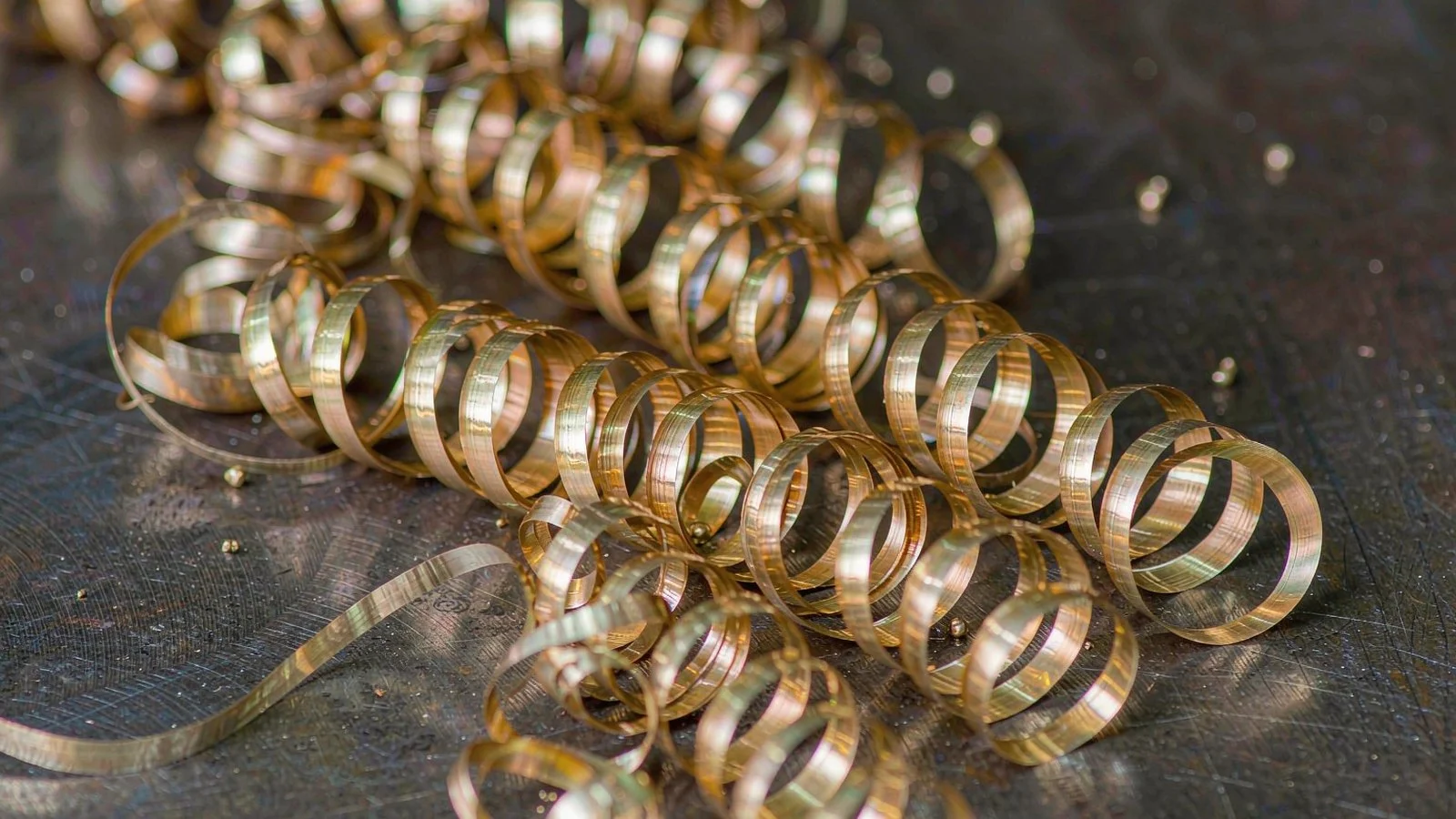
Bar stock sets a floor under the metal line. The hexagon bar has to be the across-flats of the largest hex on the part, so a body turned down from a bigger bar is paying for metal that leaves as chips.
Every coil here was bought at the bar price and never ships. The blank is the billing unit, not the finished part.
Plating and Surface Finish
Nickel plating on brass is barrel work: parts are loaded loose into a perforated drum and charged by the kilogram, not by the piece. The per-piece cost therefore follows mass, which is why plating is a smaller share of a small gland and a noticeable share of an M50.
Deposit thickness is a drawing call rather than a price list item, and it behaves the way electroplating always does — the ampere-hours scale with area times thickness, so doubling the thickness roughly doubles the time in the barrel. Where no plating is required, the line disappears entirely: nylon bodies have no finish, and stainless is supplied bare.
Salt spray hours quoted for a finish should be traceable to a test report on that finish. A number in a price list proves nothing. The nickel plating guide covers what the coating does and does not protect.
Tooling and Setup Amortization
Brass bodies carry no mould, so there is no tooling charge — but there is a setup. Loading the bar, proving the programme and inspecting the first-off piece happen once per size per order, and that fixed cost is what makes the piece price fall as quantity rises even though the metal content has not changed.
Nylon is the opposite case. An injection mould is real capital, and it is amortised across the order; the site’s own basis is 1,000 pieces per size with no tooling charge on standard brass and nylon, trial runs of 100 to 500 at a higher unit price, and 300 pieces per size for stainless and Ex versions because those are machined to order. A new nylon mould takes 25 to 30 days, while laser marking on an existing mould starts with the first production run.
Quantity Breaks
The quantity ladder is not a discount schedule and it is not linear. Each step removes a specific cost; once that cost is gone, the next step has much less to give.
Quantity per size
What is being absorbed
Effect on piece price
What does not move
100–500 (trial)
Setup, first-off inspection, special packing
Highest; the fixed block is spread thin
Metal cost per piece
1,000
Setup spread across a full bar run
The single largest step down
Cycle time, plating time
5,000
Bar purchasing and machine scheduling
Moderate; a buying effect, not a process one
Setup, already gone
20,000 and above
Dedicated runs and copper forward buying
Flat; only the metal line can still move
Everything else
One trap sits in this table. Setup is per size, so a 20,000-piece order split across eight sizes does not reach the bottom row — it is eight small orders sharing a purchase order number, and the price should be built that way.
Stainless Steel and Ex Certified Glands
Two premiums, and they behave completely differently. Stainless is a material and process premium: billet costs more, the alloy work-hardens and machines slowly, and the basis is 300 pieces per size instead of 1,000, so the per-piece price is a multiple rather than a percentage. At small quantities that multiple is dominated by setup, not by the billet — a point worth checking against the brass and stainless comparison before paying for a property nobody will test.
Explosion-proof glands carry a different premium: documentation, batch traceability, compound and liability. The part cannot be substituted, the certificate has to match the entry thread and the enclosure, and the whole lot is traceable to a test record. That is why the number does not track copper.
How to Compare Quotations
Comparisons usually fail on normalisation rather than on price. Six fields decide whether two numbers are the same number.
The cheapest quotation in a stack of five is very often the one with the locknut outside the price. Normalising the six fields takes an hour and routinely moves the ranking.
FAQ
Why is the price per 1,000 pieces lower than the price per 100?
Because the setup block — bar loading, programme proving, first-off inspection — is fixed per size and per order. At 100 pieces it is spread across 100 units; at 1,000 across 1,000. The metal content per piece is identical in both cases.
Is a heavier gland always more expensive?
Within one family, roughly yes, because the metal line and the plating charge both follow mass. Across families it breaks down: a heavy stainless gland and a light Ex gland can cost similar amounts for entirely unrelated reasons, and a large brass gland is cheaper per kilogram than a small one.
How much does nickel plating add?
It is charged by the kilogram loaded into the plating barrel, so it scales with mass rather than with piece count. A single percentage cannot be quoted honestly without knowing the size and the specified thickness; ask for the finish to be priced as its own line.
Why are stainless and Ex glands quoted at 300 pieces and brass at 1,000?
Stainless and Ex parts are machined to order rather than run from stock bar programmes, so the minimum reflects a batch that can be set up economically. Brass and nylon standard sizes ship from 1,000 pieces per size with no tooling charge.
Do prices change with the copper price?
They do, at roughly 0.6 of the copper move, because CuZn39Pb3 is a little under 60 percent copper by weight. A quotation with a stated metal basis and a review period is easier to live with than one that is simply reissued.
Waterproof cable gland play a vital role in modern industries, especially in the B2B sector. They not only ensure the sealing of cable connections, preventing water and dust ingress, but also enhance the overall safety and stability of electrical systems. Did you know that improper installation of cable glands can not only shorten equipment lifespan […]
Single compression uses one elastomer seal to both grip and seal the cable; double compression splits those duties across two seals. Here is where the difference decides an installation.
PG13.5 is not 13.5 mm across. The number refers to nominal bore, so the thread measures 20.4 mm and needs a 20.4 to 20.6 mm hole. This guide covers the dimensions, the M20 confusion and how to identify an unknown thread.
We use cookies to enhance your browsing experience, serve personalised ads or content, and analyse our traffic. By clicking "Accept All", you consent to our use of cookies.