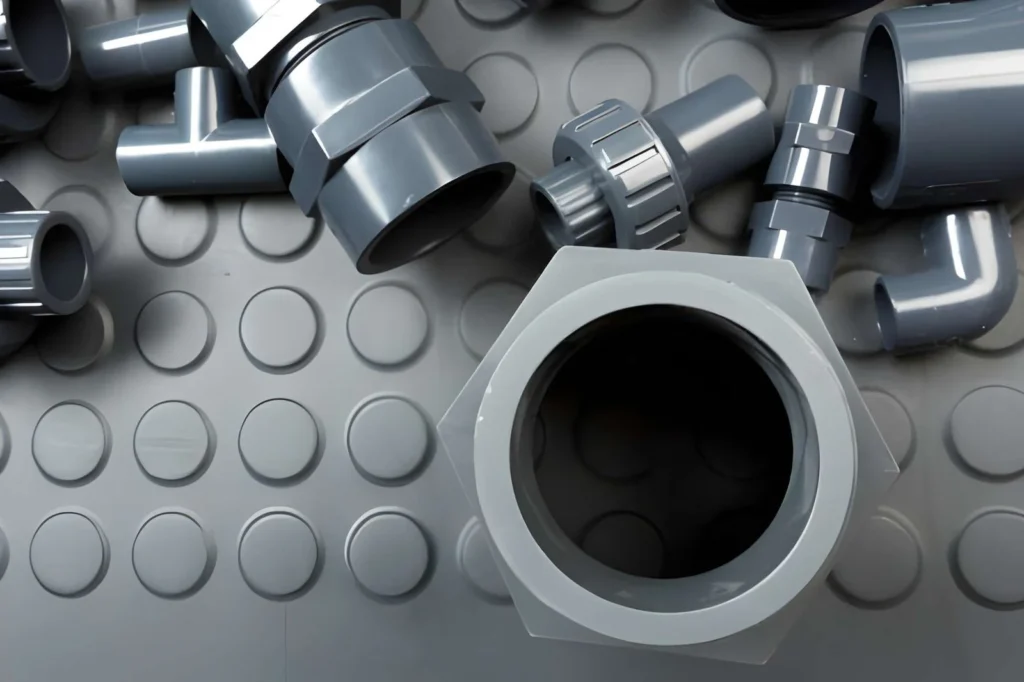
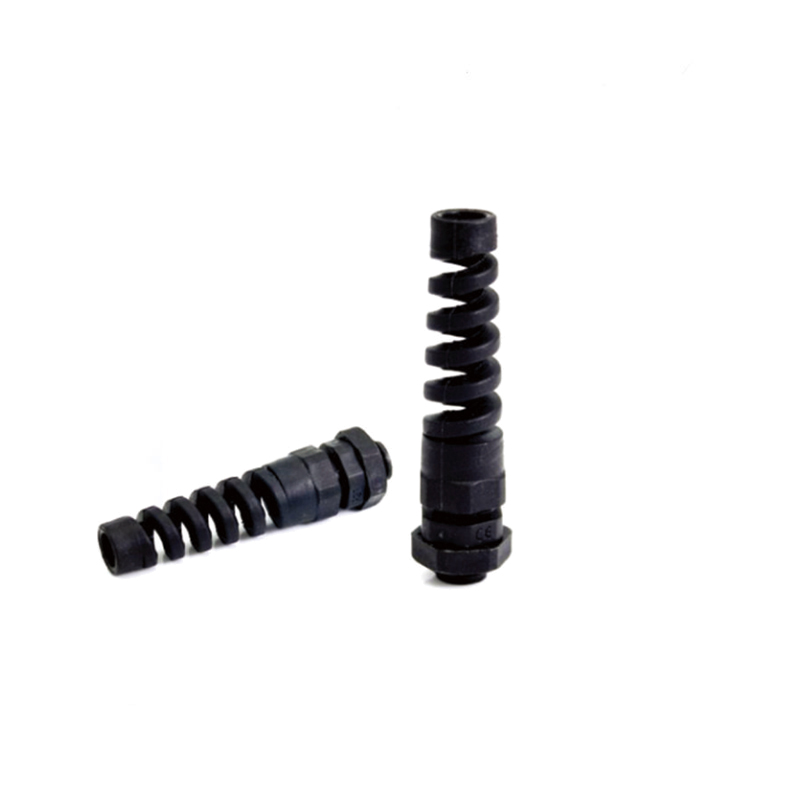
PG29 is where a cable gland stops behaving like a threaded bushing and starts behaving like a structural part. It grips an 18 to 25 mm cable, passes through a hole a fraction over 37 mm, and presents a 40 mm hex to whatever tool is on site. All three are large enough to set the panel layout before anything is ordered.
This page gives the published dimensions, the PG ladder PG29 sits in, and the three metric threads that clamp the same cable into three different holes. For the whole series see the cable gland thread size chart.
What a PG29 Gland Is
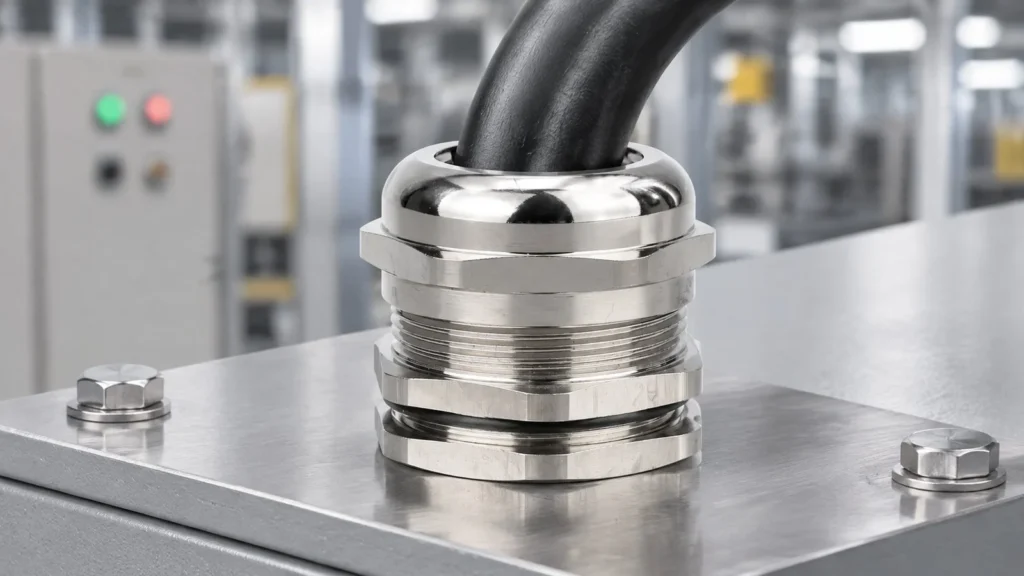
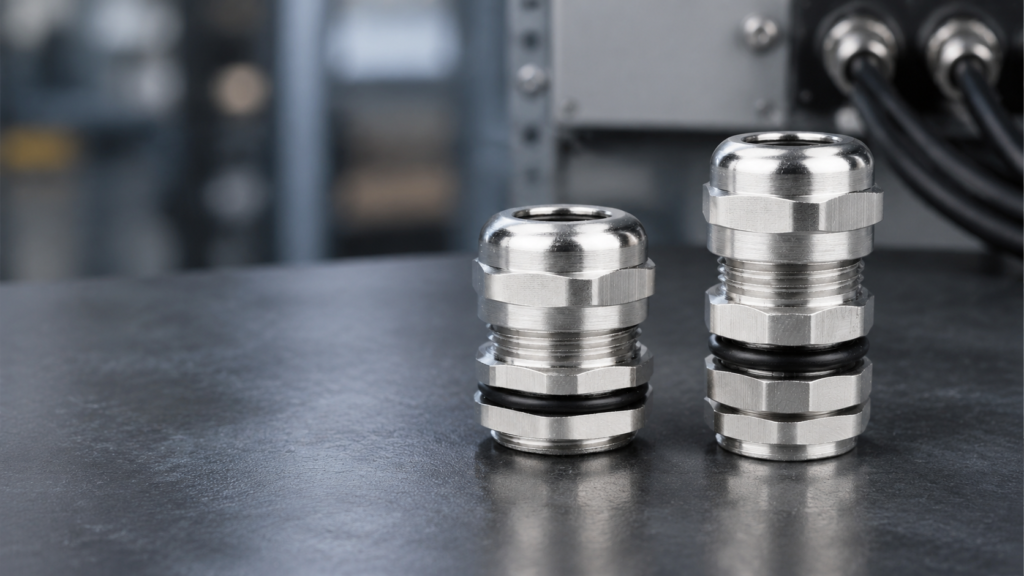
PG29 is a straight entry gland: a rubber insert compressed onto the sheath by a dome nut, and a face washer under a locknut sealing against the enclosure. It exists in nickel-plated brass and in 304 or 316 stainless steel with identical mounting dimensions, so a material change late in a project does not move the hole.
What separates it from the small sizes is proportion. The thread is 37 mm across, the body holds a 31 mm bonding length, and the insert closes onto a sheath stiffer than anything below M25. At this size the questions are about the panel and the tool, not the cable.
The Dimensions That Decide Fit
Parameter
PG29 value
What it decides
Thread
PG29, 80 degree PG form
Not interchangeable with M37 despite the same outside diameter
Cable range
18 to 25 mm
Measured sheath diameter at its largest point, not the nominal size
Thread outside diameter
37 mm
The figure the hole is cut against
Mounting hole
37 to 37.2 mm
Thread outside diameter plus 0.2 mm, as across the range
Thread length GL
11 mm
Must exceed wall plus washer plus locknut plus any tag
Bonding length
31 mm
Insert travel; sets how much sheath ends up inside the body
Spanner size
40 mm
The same wrench as M36, M37 and M40
Where PG29 Sits in the PG Ladder
Above PG21 the PG series gets coarse. The bands do not slide up a millimetre at a time the way the metric series does.
Size
Cable range
Thread O.D.
Mounting hole
GL
Spanner
PG21
13 to 18 mm
28.3 mm
28.3 to 28.5 mm
9 mm
30 / 32 mm
PG25
15 to 22 mm
32 mm
32 to 32.2 mm
10 mm
35 mm
PG29
18 to 25 mm
37 mm
37 to 37.2 mm
11 mm
40 mm
PG36
25 to 33 mm
47 mm
47 to 47.2 mm
12 mm
50 mm
Only one overlap exists in this part of the series: PG25 and PG29 both cover 18 to 22 mm, which is the single place where two glands suit the same cable. Everywhere else the step is hard, and 26 mm belongs to PG36 with no argument.
The hole jumps faster than the cable does. From PG29 to PG36 the thread grows by 10 mm while the bottom of the band stays at 25 mm, so one extra millimetre of cable can cost a new gland plate.
The Same Cable, Four Threads, Three Holes
The 18 to 25 mm band is served by one PG size and three metric ones, and the metric three differ only in the hole you are willing to cut.
Size
Cable range
Thread O.D.
Mounting hole
GL
Spanner
M36 x 1.5
18 to 25 mm
36 mm
36 to 36.2 mm
10 mm
40 mm
M37 x 1.5
18 to 25 mm
37 mm
37 to 37.2 mm
10 mm
40 mm
PG29
18 to 25 mm
37 mm
37 to 37.2 mm
11 mm
40 mm
M40 x 1.5
18 to 25 mm
40 mm
40 to 40.2 mm
11 mm
40 / 45 mm
PG29 and M37 share a mounting hole almost exactly, which helps in one direction only. A plain clearance hole at 37 mm passes either thread, so a PG site and a metric site can use the same drilled pattern with different locknuts. A tapped hole cannot be shared: it was cut to one thread form and the other will not run into it.
Read the hole, not the drawing. A pressed-steel enclosure already punched at 36 mm takes M36 and will not take PG29; one punched at 37 mm by someone who assumed M37 takes PG29 with a locknut, which is often the cheapest way to keep a PG standard on a panel drawn in metric.
Eleven Millimetres of Thread and the Wall Stack
GL on PG29 is 11 mm, about 0.30 of the thread diameter. That is the last size where the ratio reads comfortably: PG36 drops to 0.26 and PG63 to 0.21, and above this point the wall stack starts deciding where a gland can go rather than what size it is.
Wall thickness plus flat washer plus locknut plus any earth tag has to come in under 11 mm. At 37 mm the plate is usually a machined gland plate of several millimetres rather than thin sheet, and a locknut at this size is a thick part, so the sum closes faster than it does at M20. If it is over, the answers are a longer thread, a different entry position or a counterbore, not a stack of washers, which moves the seal off the face it was designed for.
Setting the Hole and the Bearing Face
The hole is 37 to 37.2 mm, and the 0.2 mm is clearance rather than adjustment. A hole at 38 mm will bolt up and still leak, because the washer seals on the face and not in the bore, and the extra clearance lets it extrude instead of compress.
The bearing face is what gets ignored at this diameter. A 37 mm hole saw leaves a breakout burr that a small washer would bridge and this one will not, and a rolled lip or a dished face becomes a leak that returns after every attempt to repair it. Deburr and check the face with a straight edge first.
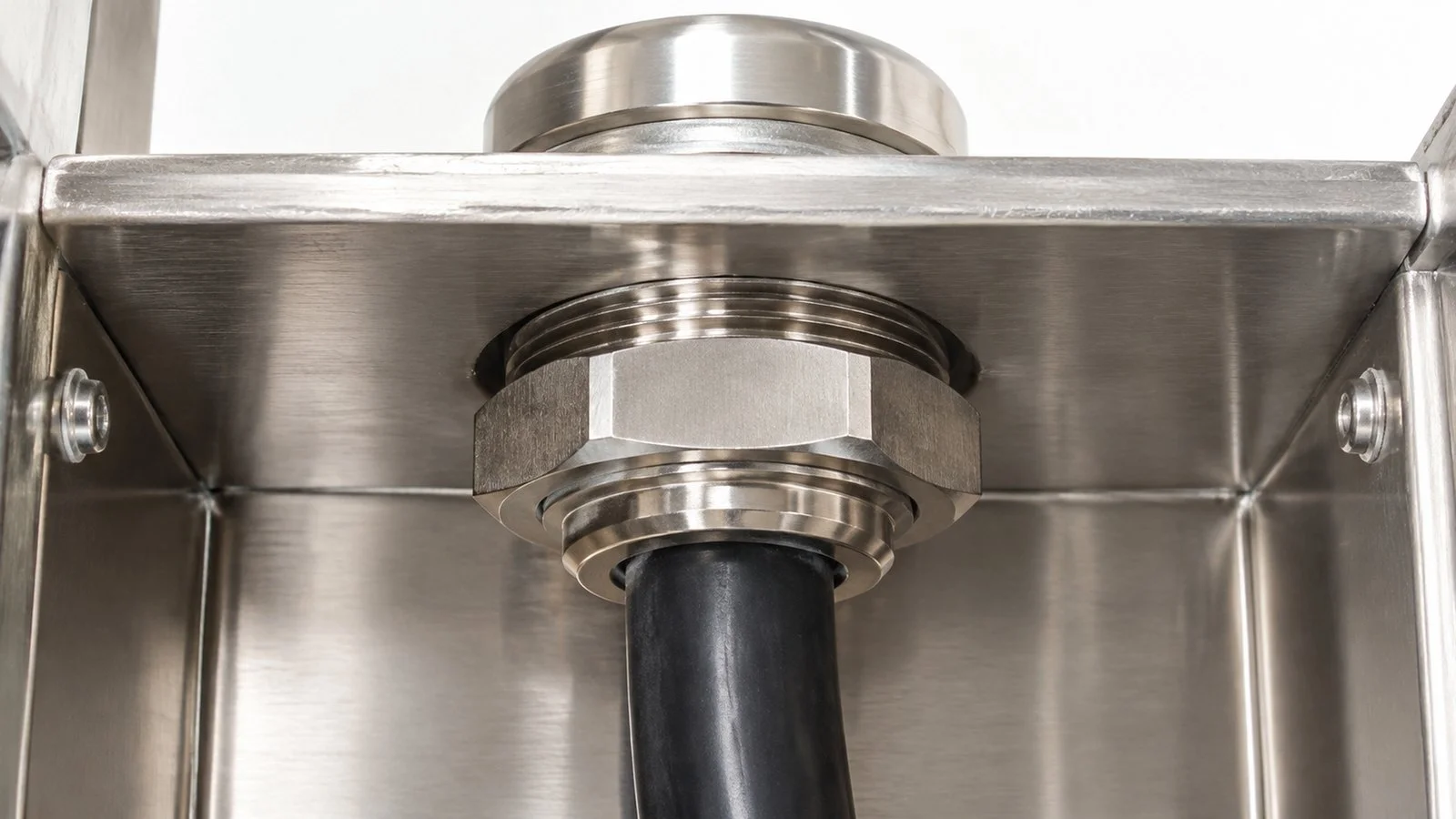
At 37 mm the plate is usually machined rather than folded sheet. The washer seals on the outside face, the locknut clamps from inside, and everything in that stack is taken out of 11 mm of thread.
Spanner 40 and the Clear Swing
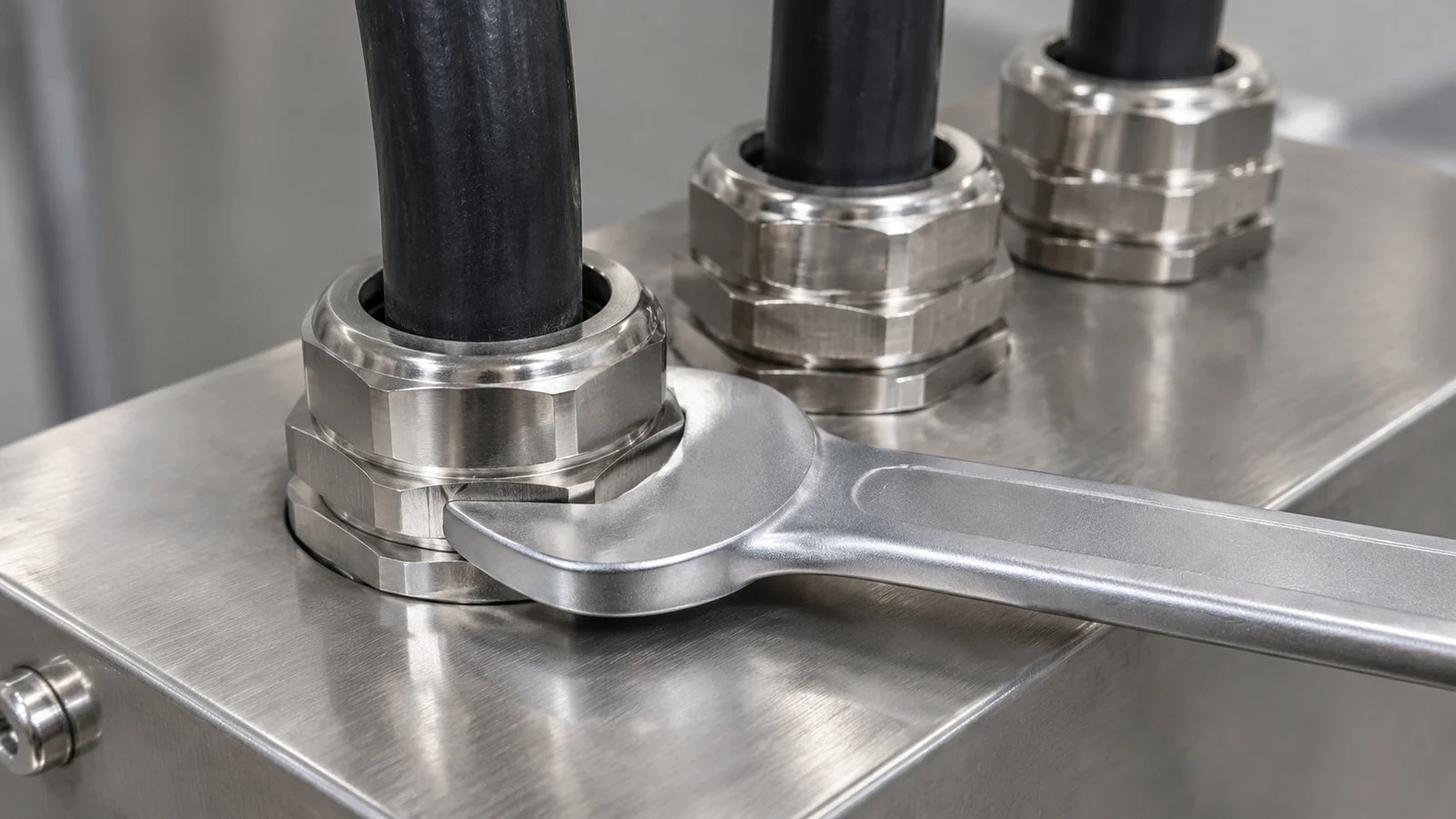
40 mm across flats is the same wrench that fits M36, M37 and M40, a small gain where a plant keeps one kit for a range of entries. The hex is deep enough at this size for a proper open-end wrench; an adjustable one rounds the corners before it turns the nut.
Access is the half of the problem that drawings never show. The wrench needs the hex plus an arc to swing it, and a gland plate with a row of entries is laid out to fit the glands rather than the tools. Where the arc is missing, the practical answer is to assemble gland, locknut and cable on the bench and fit the assembly, which reverses the normal order of work and belongs in the method statement.
A row of entries at this size is decided by the swing of the wrench, not by the pitch of the holes. The gap that looks generous on a drawing is often the one the tool cannot use.
The Cable Is Now a Load
An 18 to 25 mm cable is stiff and heavy, and the insert grips the sheath without carrying weight. That distinction decides whether the entry survives: the gland is a seal and the restraint belongs somewhere else. Support the cable within the run so the gland sees no axial pull, and route the first bend at the cable’s own minimum radius. The split between sealing and load bearing is in cable gland strain relief.
Bending is the other half. Force the cable off its natural line immediately past the dome nut and the washer unloads on one side, so the leak appears on that side only and reads as a faulty gland. It is not one; the cure is a longer first run or a different entry position.
Torque needs care here too. The lever is twice as long as on an M20, so the same hand force gives roughly twice the moment and can compress the insert past the point where it has travel left to follow thermal movement. Use the datasheet figure, or judge by a pull test rather than a nut turned until it stops; the reasoning is in the cable gland torque guide.
Material at 37 mm
Nickel-plated brass covers industrial enclosures and runs from -40 to +120 C. Stainless 304 or 316L goes to +200 C and answers chloride, washdown and coastal air. At 37 mm the couple between a brass gland and a steel enclosure is a large area, and the plating is thinnest where the thread is loaded.
Stainless into stainless brings galling instead, so the assembly needs a lubricant approved for the location. The marine PG29 body is 316 and uses the same hole, so the materials decision can be deferred without moving the pattern.
What to Put on the Purchase Order
Field
What to state
Why it matters
Thread
PG29, and the thread standard it is made to
PG29 and M37 share a diameter and not a thread form
Cable range
The measured sheath outside diameter, one figure
Inside the band is not the same as a good grip
Mounting hole
37 to 37.2 mm, or the plate detail
The hole is a clearance, not a fit
Thread length
GL 11 mm, or the wall stack it must clear
This is the first size where the stack bites
Material
Grade plus certificate, for example 316L with mill cert
Decides both the corrosion answer and the documents
Sealing
IP rating with depth and duration
IP68 on its own is not a specification
Accessories
Locknut, washer, earth tag as separate lines
Items described as “with gland” are often not in the carton
37 to 37.2 mm. The hole is the thread outside diameter plus 0.2 mm, and drilling to the nominal 29 mm will not pass the gland at all.
What cable diameter does PG29 take?
18 to 25 mm sheath diameter. Measure at the largest point on the finished cable, and avoid landing a 25 mm cable at the top of the band where the insert has least travel left.
Is PG29 the same as M37?
The thread outside diameter is identical at 37 mm, so a plain clearance hole suits either. The thread form is not the same, so they cannot share a tapped hole, a locknut or an adapter.
Can I use PG25 instead of PG29 for a 20 mm cable?
Yes, that band is the only overlap in this part of the series. PG25 takes 15 to 22 mm through a 32 mm hole, so the choice is made by which hole suits the panel.
Is PG29 available in stainless steel?
Yes, in 304 and 316 or 316L, with the same thread outside diameter, mounting hole, GL and spanner size as the brass version. Only the temperature range and the corrosion behaviour change.
Among many electrical connection accessories, the Waterproof cable gland plays a crucial role. It not only protects cables penetrating equipment housings from water and dust ingress but also enhances the overall safety and reliability of the system. Understanding the materials and applications of waterproof cable glands helps engineers and buyers in industries like industrial, communication, […]
Single compression uses one elastomer seal to both grip and seal the cable; double compression splits those duties across two seals. Here is where the difference decides an installation.
GHX Cable Gland Overview: Robust, Certified Solutions for Hazardous Areas GHX cable glands deliver superior performance as explosion proof cable glands designed for secure, reliable cable entry in demanding hazardous and industrial environments. Engineered to meet the highest standards, these armoured cable glands ensure exceptional sealing with IP66/IP68 ingress protection ratings, robust armour clamping, and […]
We use cookies to enhance your browsing experience, serve personalised ads or content, and analyse our traffic. By clicking "Accept All", you consent to our use of cookies.