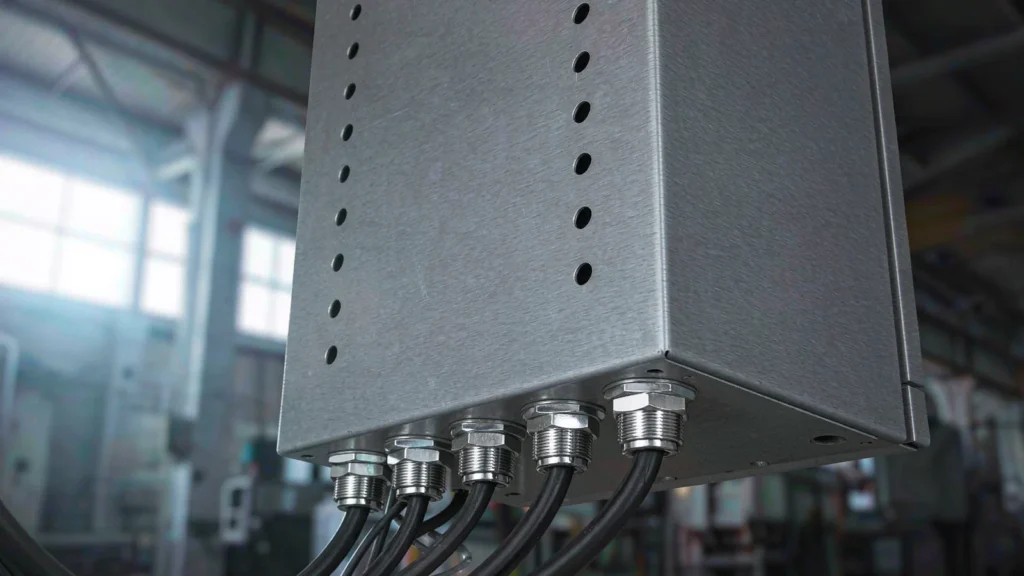
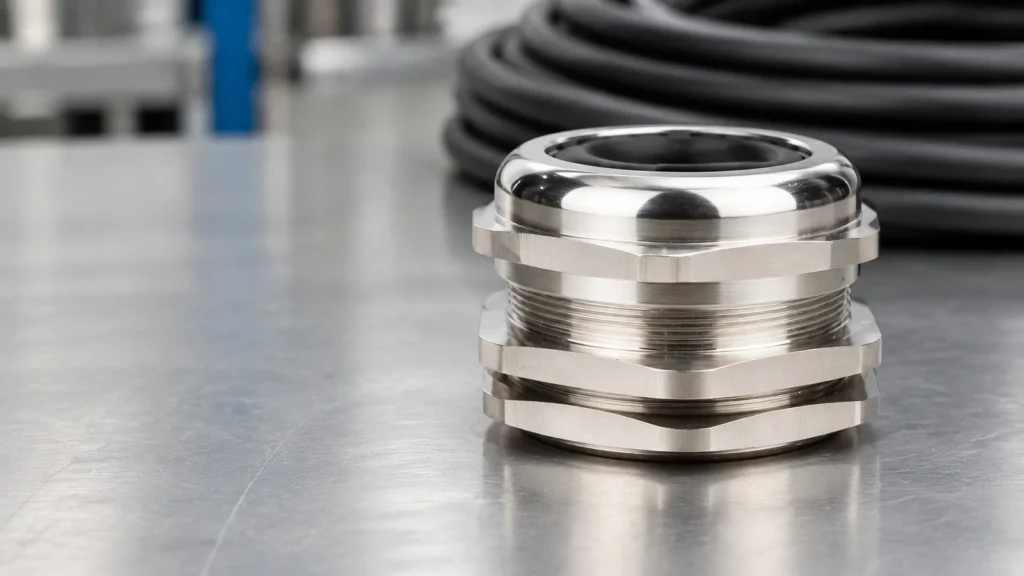
A straight gland seals along one line and then hands the cable back at the exact point where it has to start bending. A flexible gland takes that bend into the body: a compliant neck that lets the cable leave at an angle and keep moving. The trade is rarely stated. The same elastomer that seals the entry is now also the part that moves, and almost everything that costs follows from that sentence: two temperature ratings instead of one, a service life measured in cycles instead of years, and a failure mode that is compression set rather than a cut sheath.
This page covers the three body types, the difference between a flexible gland and the straight item it replaces, and the two limits that decide whether it will last. For the straight range of the same family see the nylon cable gland size chart.
What Changes When the Body Flexes
In a standard gland the insert is compressed once and stays compressed. Nothing moves afterwards, so the seal has one job. Put the same insert inside a neck that deflects and the seal is loaded in a direction that changes with every movement of the cable.
Three consequences follow. The elastomer is worked as well as compressed, so heat and motion combine into permanent deformation. The neck is a thin wall compared with a rigid body, so pressure and impact behave differently. And the body is now part of the load path: whatever the cable weighs arrives at a compliant part rather than a solid one. A flexible gland is therefore not an upgraded straight gland; it is a different component with a smaller envelope of acceptable use.
Three Bodies, and the One This Range Uses
The word flexible covers three different mechanisms, and they do not absorb the same movement.
Body
Movement it absorbs
Where it belongs
How it fails
Spiral
Bending in any direction, repeatedly
The cable changes direction once at the entry, or moves with the machine
The neck fatigues where it meets the hex when the cable hangs unsupported
Corrugated
Short axial travel plus moderate bending
Small offsets between two fixed points
Ribs hold water when the axis points upwards
Elbow
No movement at all, one fixed turn
Geometry that never changes
Not a flex part; the offset load goes into the locknut
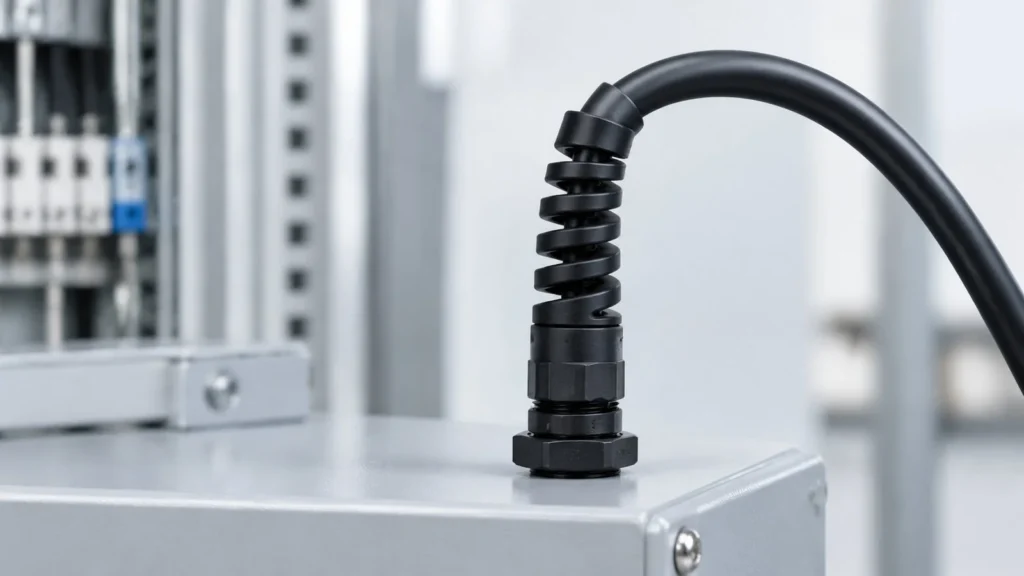
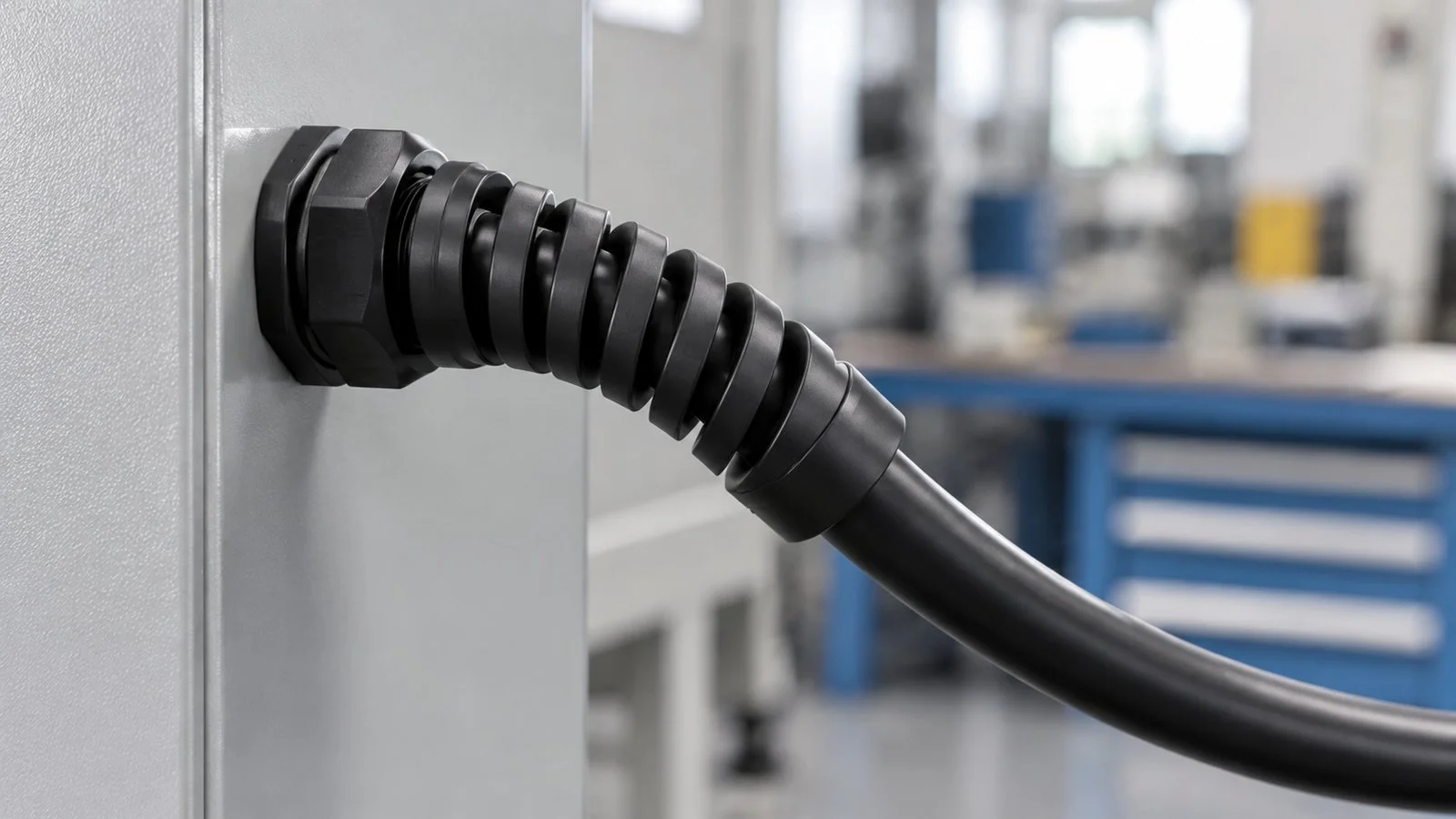
The flexible gland sold in this range is a spiral body: a helical neck moulded in PA66 on a PA66 body, with an NBR or EPDM seal and an IP68 rating once the O-ring is fitted. It spans PG7 to PG21 and M12 to M27. The rest of this page applies to any flexible body, but every figure comes from this one.
Two Temperature Ratings on One Gland
The datasheet for this gland gives -40 to +100 C static, short time to +120 C, and -20 to +80 C dynamic, short time to +100 C. Twenty degrees are lost at each end, and that gap is not a safety margin. It is the price of motion.
Read it as a question to ask of any supplier: does the number you quoted describe the static or the moving state? A gland chosen on the static figure and then used on a cable that moves is running twenty degrees outside its range at both ends, and the first symptom is a seal that weeps in a hot week and is dry in a cool one. Where the duty is dynamic, the seal material matters as much as the housing; the comparison is in cable gland seal materials.
Same Thread, Same Clamp, Bigger Envelope
A flexible gland at a given thread takes exactly the cable the straight one takes. What changes is the space around it.
Thread
Cable range
Straight GL
Flexible GL
Straight spanner
Flexible spanner
M20
6 to 12 mm
8 mm
9 mm
22 mm
24 mm
M25
13 to 18 mm
9 mm
10 mm
24 / 27 mm
33 mm
PG13.5
6 to 12 mm
8 mm
9 mm
22 mm
24 mm
PG16
10 to 14 mm
9 mm
10 mm
24 mm
27 mm
PG21
13 to 18 mm
9 mm
10 mm
30 / 32 mm
33 mm
The hole is unchanged, so nothing on the drawing moves. The clearance around the nut is not: GL grows by a millimetre and the hex grows by up to six. At M25 the flexible nut needs 33 mm where the straight one needed 24 or 27, and that difference decides whether it fits between two neighbouring entries or fouls both. A flexible gland is a drop-in replacement for the thread, not for the layout.
The Range Stops at 18 mm
Model
Thread O.D.
Cable range
GL
Spanner
M12-NFL
12 mm
3 to 6.5 mm
8 mm
16 mm
M16-NFL
16 mm
4 to 8 mm
8 mm
19 mm
M20-NFL
20 mm
6 to 12 mm
9 mm
24 mm
M22-NFL
22 mm
10 to 14 mm
10 mm
27 mm
M25-NFL
25 mm
13 to 18 mm
10 mm
33 mm
PG11-NFL
18.6 mm
5 to 10 mm
8 mm
22 mm
PG13.5-NFL
20.4 mm
6 to 12 mm
9 mm
24 mm
PG16-NFL
22.5 mm
10 to 14 mm
10 mm
27 mm
PG21-NFL
28.3 mm
13 to 18 mm
10 mm
33 mm
Eighteen millimetres is the ceiling, and there is no flexible version above it. The limit is geometric: a neck has to be longer than the deflection it absorbs, and length grows with diameter, so a 37 mm thread with a neck in proportion becomes a part that no cabinet has room for and that puts an unacceptable moment on the entry. Above 18 mm the options are a straight gland with a flexible conduit downstream, or a proper conduit system. Both add a joint to seal, which is the trade this page is about.
Life Is Measured in Cycles
Compression set is the mechanism. An elastomer held in a deformed shape takes a permanent set, stops pushing back, and the seal loses contact pressure without ever being cut or worn. It is the reason a flexible gland that has looked perfect for two years starts weeping, and it is why the calendar is the wrong measure.
Four things set the rate: how far the neck deflects, how often, the temperature at the gland, and how much the dome nut compressed the insert when it was installed. Ask for a cycle life and you will not get one; state the duty instead. The swing angle, the movements per day and the sheath temperature are enough to choose between two candidates, and they distinguish a gland moving five degrees a few times a shift from one held deflected permanently by an unsupported cable, which is the faster failure of the two.
The Gland Is Not the Last Restraint
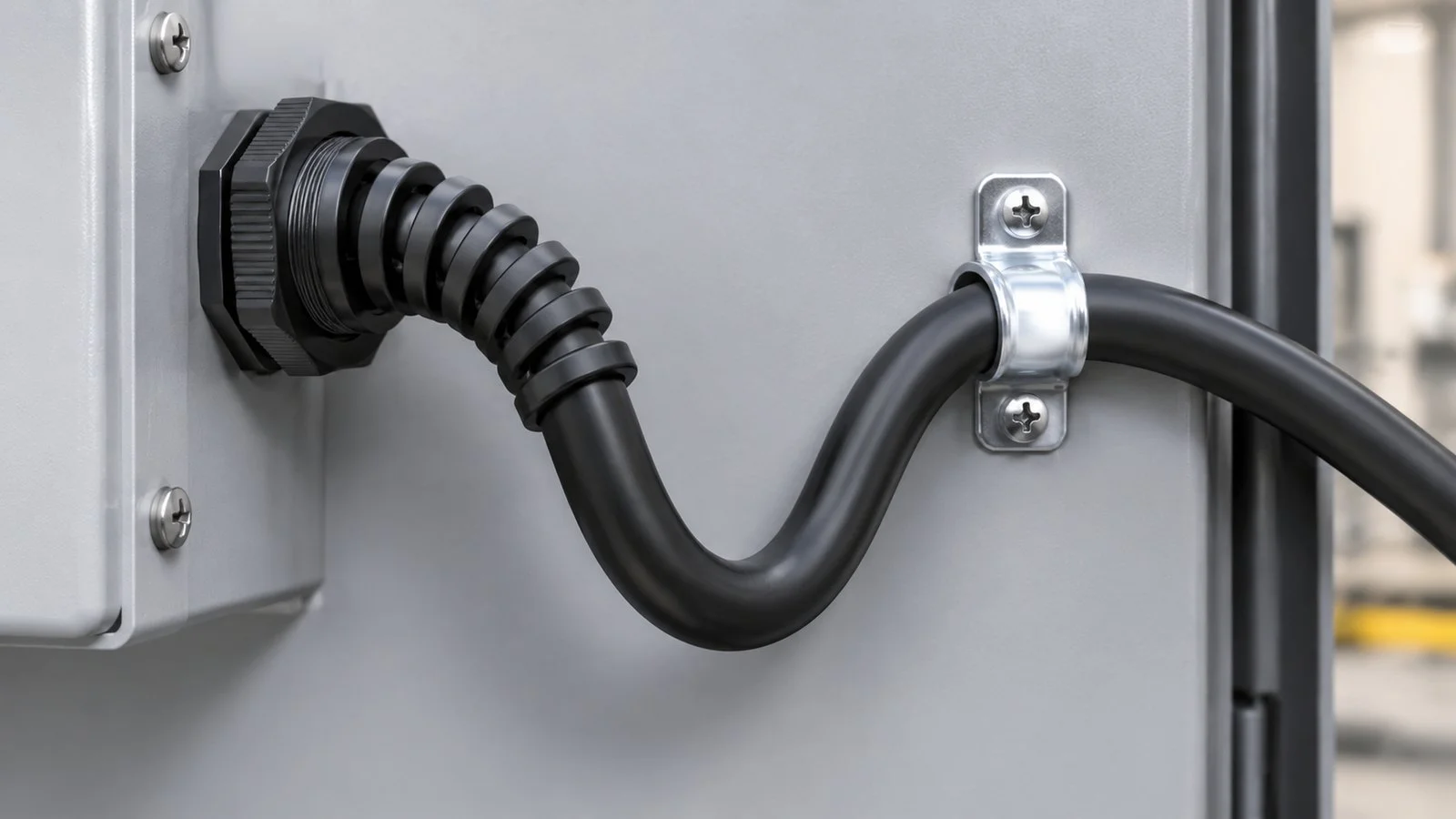
A compliant neck cannot clamp anything. If the cable’s weight or any pull arrives at the gland, the neck sits at a fixed deflection and takes a set, and the leak appears along the top where the seal has unloaded. The restraint belongs on the panel or the tray, not at the entry.
Set the clamp so the cable reaches it along its natural curve. Pulled straight to a distant clip, the neck is loaded the same way an unsupported cable loads it; placed too close, the cable cannot meet its bend radius and the neck is deflected past what it was designed for. The general argument is in cable gland strain relief.
The clamp, not the neck, carries the cable. The loop between them is what keeps the neck inside its working deflection instead of holding a permanent set.
Installing One Without Destroying It
Do not twist the neck to aim it. Twisting puts the seal in shear, which is the one loading it is not designed for, and the set that follows is permanent. Set the direction by rotating the body while the locknut is still loose, hold that position, then tighten the locknut; the sequence is the same as for an elbow, and the reason is in 90 degree and elbow cable glands.
Tighten the dome nut to the low end of the range. Over-compression removes exactly the travel the neck needs, so a gland assembled by feel on the basis that tighter must be better arrives with a seal that cannot follow the cable at all. Where no figure is published, stop at the point where the insert grips and the sheath does not visibly neck down, as set out in the cable gland torque guide. Fit the O-ring and washer in the order the drawing gives, since the IP68 claim assumes both are present, and never use the neck as a handle when pulling cable through.
The neck turns one sharp bend into a continuous sweep. The gain is real, and it depends on the cable being supported beyond the fitting rather than hanging from it.
Where a Flexible Gland Is the Wrong Answer
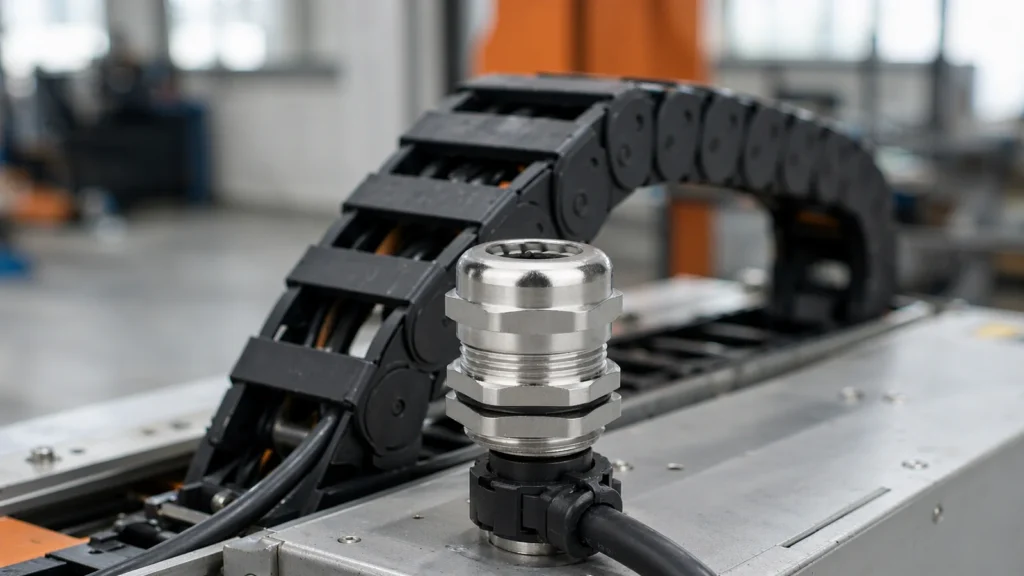
Pressure and vacuum are the clearest case. The neck is a thin wall with a large surface, and a body that is right for a washdown is not a pressure boundary. Hazardous areas are the second: a flexible body needs its own certification for the protection concept and gas group, so a certified straight gland cannot be swapped for one on the same thread. Continuous machine movement is the third, where a cable chain does the job properly and a gland only postpones the failure. High-pressure jets and long exposed runs point to conduit for the same reason: more joints are the wrong direction.
Specifying One
Field
What to state
Why it matters
Thread
System, size and pitch
Decides the hole and every accessory on the same thread
Cable range
Measured sheath diameter, one figure
Identical to the straight item at the same thread
Movement
Swing angle and cycles per day, or “static”
Decides which temperature rating applies
Temperature
Static or dynamic, with the value
The two ratings differ by twenty degrees at each end
An entry where the cable arrives at an angle, changes direction at the fitting, or moves with the machine. It replaces one sharp bend at the gland with a continuous sweep the neck absorbs.
Does a flexible gland seal as well as a straight one?
At the same IP rating, yes, but only within its dynamic limits. The seal is being worked while it seals, so the temperature range and the tightening are both narrower than on a rigid body.
Why does my flexible gland have two temperature ratings?
Because a static seal is only compressed, while a moving one is also flexed. The dynamic figure is twenty degrees lower at each end in this range, and it is the one that applies to any cable that moves.
Can I fit a flexible gland to a 25 mm cable?
Not from this range. The flexible series stops at 18 mm on M27 and PG21, so above that the choice is a straight gland with a flexible conduit downstream or a conduit system.
Why is my flexible gland weeping after two years?
Compression set. The elastomer has taken a permanent deformation, usually because the cable’s weight was left hanging on the neck, and it no longer presses on the sheath. Support the cable beyond the gland and replace the seal.
In an automation cell an industrial cable gland is judged by cycles rather than years. How cyclic flex, vibration and washdown actually break an entry, and where a connector is the better answer than a gland.
The gland is only as good as the hole it sits in. How wall material, thread length, locknuts, knockouts and gland plates decide whether an enclosure stays at its stated IP rating.
PG63 is not a 63 mm gland. The thread is 72 mm, the hole is 72 to 72.2 mm and the cable range is 42 to 52 mm. Dimensions, thread length and the tooling question at this size.
We use cookies to enhance your browsing experience, serve personalised ads or content, and analyse our traffic. By clicking "Accept All", you consent to our use of cookies.