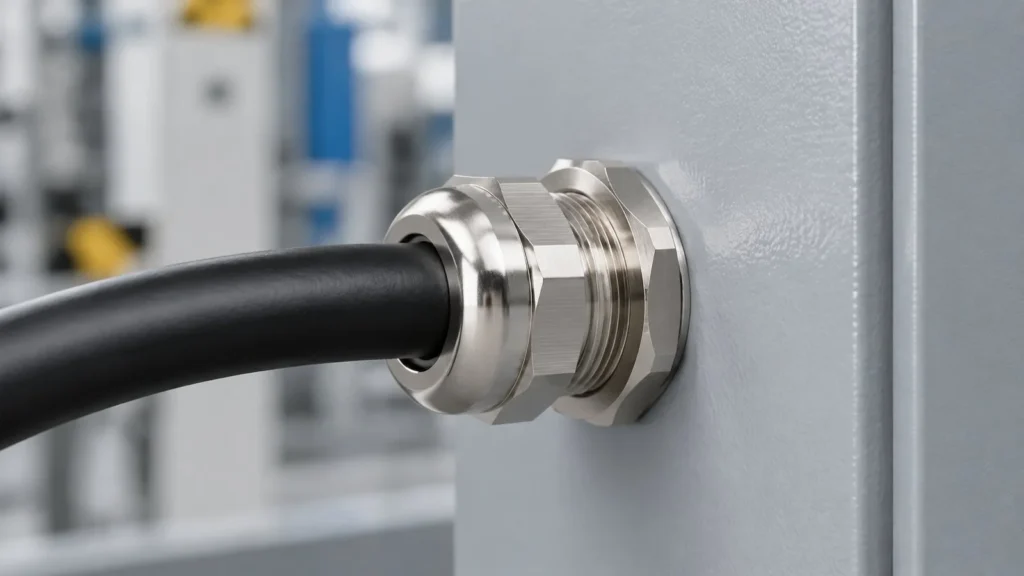
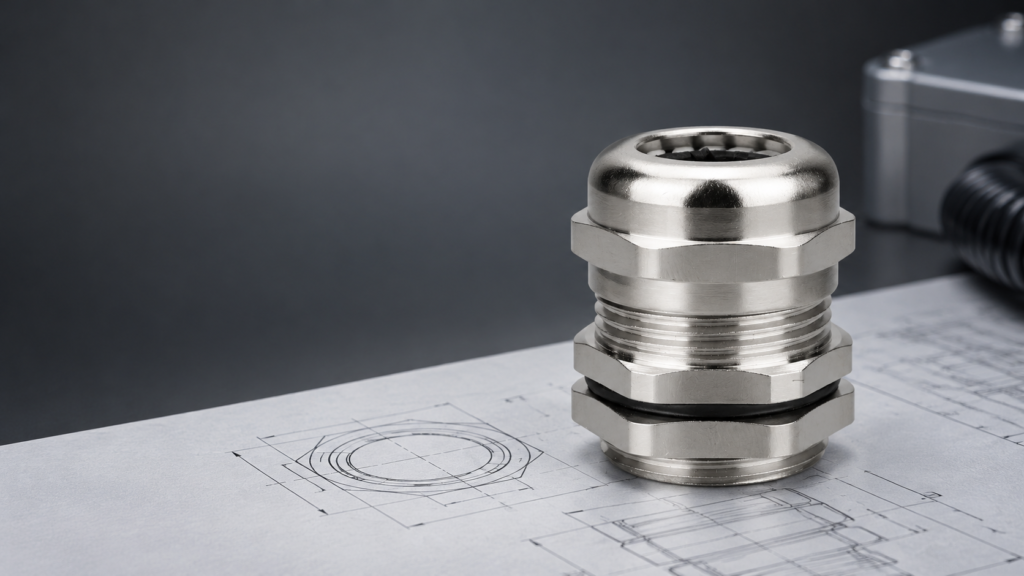
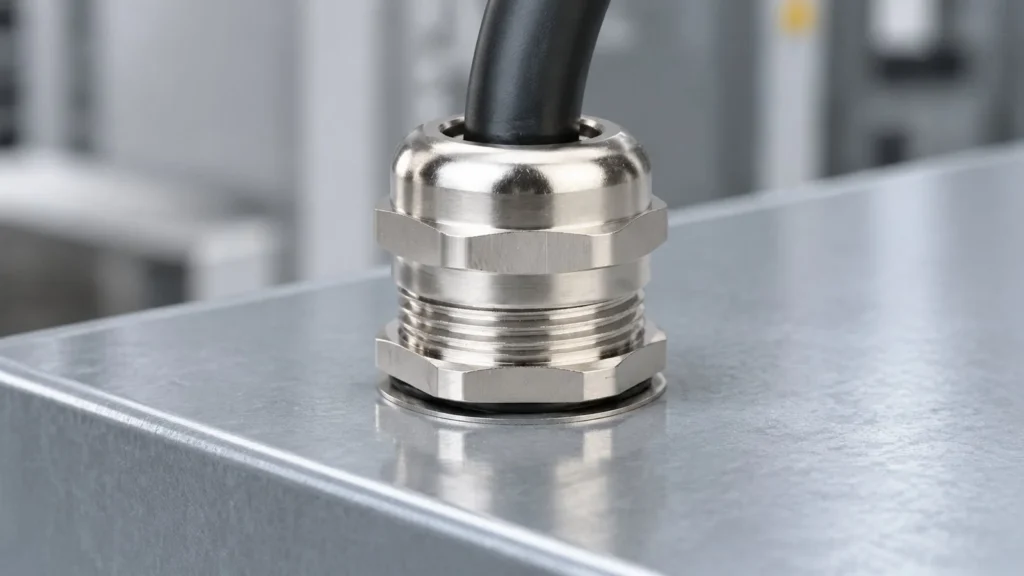
A PG19 cable gland is the clearest case in the whole catalogue of a part that cannot be chosen from its own data sheet. Its thread is 25 mm, it clamps 10 to 14 mm cable, it needs a 25 to 25.2 mm hole, and every one of those figures is identical to the metric M25 gland sold alongside it. Six of the seven columns in the dimensional table match to the tenth of a millimetre.
That is not a printing error. It is the state of the PG series at this size, and it changes what a buyer should be looking at. This page sets out the published numbers, the four neighbours that share the cable band, and the one question that does separate PG19 from M25.
The Numbers That Define a PG19 Gland
Parameter
PG19 standard gland
What it decides at the panel
Thread
PG19, 80 degree thread form
Matches PG locknuts and PG adapters only
Cable range
10 to 14 mm sheath O.D.
Your measured sheath must sit inside the band
Thread outside diameter
25 mm
The figure the hole is derived from
Mounting hole
25 to 25.2 mm
Two tenths of clearance, no more
Thread length GL
9 mm
Must cover panel, washer and locknut together
Bonding length
25 mm
Body length behind the panel
Spanner size
24 and 27 mm across flats
Two hexes, so two wrenches on one assembly
The size designation is a nominal number from the older German system, not a diameter. Nineteen implies nothing you can measure; the thread is 25 mm across. The relationship between the number and the thread is set out in our PG versus metric cable glands guide, and it is worth reading once if you are converting a plant from PG to metric.
PG19 and M25: Six Columns, Same Values
Set the two parts side by side and the comparison collapses to one line. Cable range, thread outside diameter, mounting hole, thread length, bonding length and spanner size are all identical. Only the thread specification differs: PG19 against M25 × 1.5.
Parameter
PG19
M25 × 1.5
Same?
Thread form
PG19, 80 degree
M25 × 1.5, 60 degree
No
Cable range
10 to 14 mm
10 to 14 mm
Yes
Thread O.D.
25 mm
25 mm
Yes
Mounting hole
25 to 25.2 mm
25 to 25.2 mm
Yes
Thread length GL
9 mm
9 mm
Yes
Bonding length
25 mm
25 mm
Yes
Spanner size
24 and 27 mm
24 and 27 mm
Yes
So a data sheet comparison cannot rank these two. Any selection exercise that starts with “compare the specifications” ends in a tie, and a tie is not an answer. What follows from the tie is the useful part: because the hole is identical, a through hole already punched at 25 to 25.2 mm accepts either gland, and swapping one for the other costs nothing but the gland itself.
The exception is a tapped hole. A thread cut into the panel is cut to one thread form, and dimensional overlap does not rescue it. A tapped PG19 entry takes PG19; a tapped M25 entry takes M25.
The Only Rung That Adds Hole and No Cable
PG19 also shares its cable band with PG16, the size below it. That comparison is more revealing than the M25 one, because there the design intent of the size becomes visible.
Parameter
PG16
PG19
Change
Cable range
10 to 14 mm
10 to 14 mm
None
Thread O.D.
22.5 mm
25 mm
+2.5 mm
Mounting hole
22.5 to 22.7 mm
25 to 25.2 mm
+2.5 mm
Thread length GL
9 mm
9 mm
None
Bonding length
23 mm
25 mm
+2 mm
Spanner size
24 mm
24 and 27 mm
+27 mm hex
That makes PG19 a size to step over in a new design and a size to keep in a legacy plant. In a series where each rung normally opens the clamp by three or four millimetres, this one opens the hole by 2.5 mm and the clamp not at all. It exists because a 25 mm entry already exists. If someone specified PG19 for a fresh panel, ask what hole they are matching, because cable diameter will not have been the reason.
Five Glands in One Cable Band
Here is where the size really sits. Between 10 and 14 mm the catalogue carries five parts, and they are not evenly spread.
Part
Thread O.D.
Mounting hole
GL
Bonding length
Spanner
M22 × 1.5
22 mm
22 to 22.2 mm
8 mm
23 mm
24 mm
PG16
22.5 mm
22.5 to 22.7 mm
9 mm
23 mm
24 mm
M24 × 1.5
24 mm
24 to 24.2 mm
9 mm
25 mm
24 and 27 mm
PG19
25 mm
25 to 25.2 mm
9 mm
25 mm
24 and 27 mm
M25 × 1.5
25 mm
25 to 25.2 mm
9 mm
25 mm
24 and 27 mm
Four different holes are offered for one cable band, and two of the five parts share a hole outright. Nowhere else in the range does a pair coincide this completely. It also explains a common frustration: an installer who orders “the 25 mm one” has a fifty per cent chance of receiving a part that will not run onto the locknuts already in the store.
The practical reading is that the 10 to 14 mm band is a stock-keeping problem rather than a technical one. Every part in the table will do the electrical job on a 12 mm cable. What differs is which hole it fits and which accessories it accepts. Our M25 size guide covers the metric side of this band in more detail.
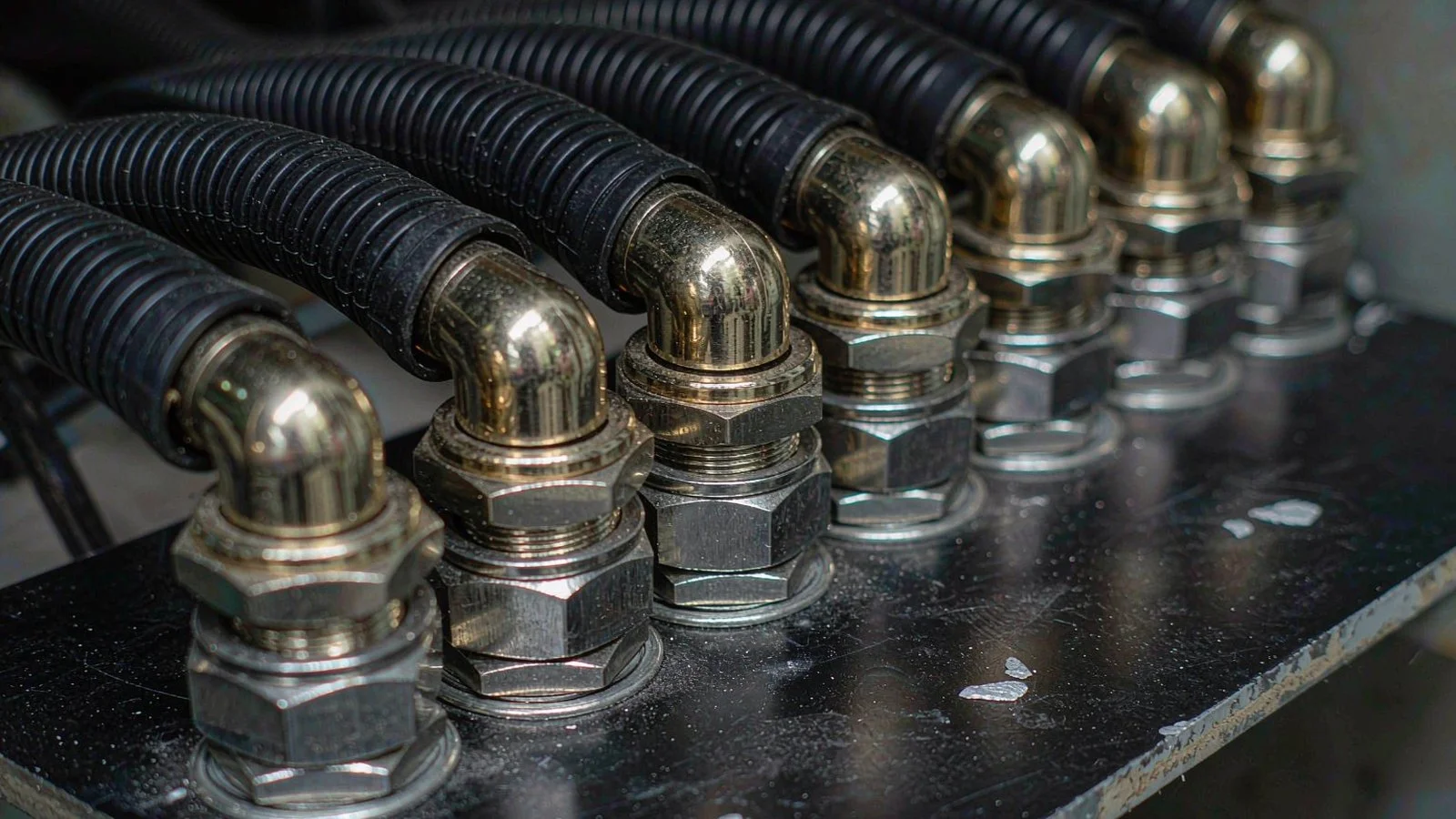
One cable band, four hole specifications, and a plate that was drilled for only one of them.
What Changes When the Thread Form Changes
Two thread forms are involved. PG threads follow DIN 40430 with an 80 degree flank, rounded crests and a coarse pitch; metric cable entry threads follow EN 60423 with a 60 degree flank. Different committees, different eras, and no adapter-free compatibility between them.
That difference propagates through everything attached to the gland. A PG19 locknut will not run onto an M25 thread, a PG-to-metric adapter is a separate purchased item that adds thickness to the panel stack, an earth tag is drilled for one thread’s hardware, and the spanner fits only because these two sizes happen to carry the same hex.
Because the external dimensions coincide, an M25 gland physically passes through a hole drilled for PG19. That is the trap. It goes in, it tightens, and the installation looks correct until someone tries to fit the locknut that came with the panel.
Can an 80 Degree Thread Start in a Metric Hole?
Hand force can engage dissimilar threads for two or three turns. The 80 degree and 60 degree flanks do meet over a narrow band of contact, and with 0.05 mm of radial clearance on a nominal 25 mm pair the crests interfere rather than seat.
This is why “it went on” is not evidence. Two or three turns on a deformed thread produce no preload, no sealing face contact and no reliable earth path. The joint holds until vibration or thermal cycling walks it off, and by then the thread cannot be recovered by tightening.
Judge the fit by the accessory, not by the gland. If the locknut in your hand runs down the full thread by hand, the thread forms match. If it binds after part of a turn, stop and identify both threads before applying a wrench. The thread size chart lists both families side by side for that check.
Nine Millimetres of Thread on a 25 mm Body
GL 9 mm is the working length through the wall, and it has to absorb the panel thickness plus a washer plus a locknut. On a 2 mm sheet with a standard 3 mm nut stack it leaves four millimetres of engagement, which is comfortable. On a 4 mm plate with a heavy nut it leaves almost nothing, and the body stands off the panel with the seal ring making contact on one edge.
The hidden thickness is what catches people. A gland plate bolted over an existing wall, a raised pad on a cast enclosure, or a locknut in a standard rather than thin pattern all add to the stack without appearing on the drawing. When the body will not pull down, the answer is a longer thread variant as its own part number, never a second washer.
The 25 mm body behind the panel is identical to M25 and two millimetres longer than PG16. On a tight box that is the difference between clearing the terminal blocks and pressing a cable against them.
Spanner 24 and 27, Two Wrenches on One Assembly
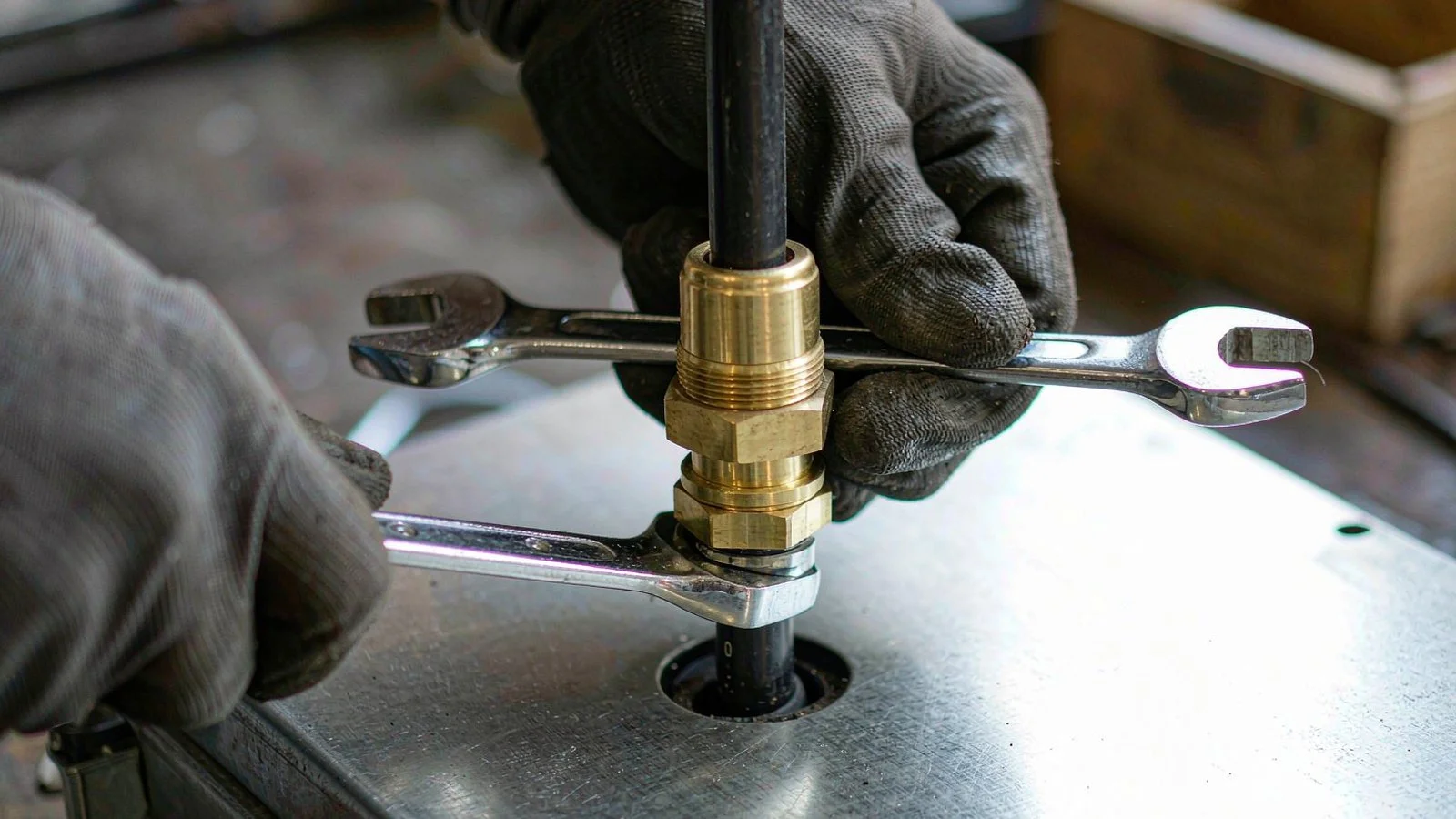
Two spanner values on one line item are not a typo. The assembly has a body hex and a nut hex, and on this size they differ. The installer needs both, and the counter-hold on the body is what stops the gland rotating while the compression nut is pulled down.
The 27 mm hex also sets the minimum entry pitch. Adjacent glands have to be far enough apart for a wrench to swing, and on a dense gland plate that spacing, not the thread diameter, decides how many entries fit. Because PG19 and M25 share this hex as well, mixed stock on one plate produces no spacing surprise, which is one small advantage of the coincidence.
Two hexes on one assembly: the body has to be held while the cap is pulled down.
Buying PG19 When M25 Would Also Fit
The purchasing answer is to specify the thread form explicitly and never the diameter. “25 mm gland” describes two different parts and will eventually deliver the wrong one.
Field to specify
Example for this size
What it prevents
Thread system and size
PG19, not “25 mm”
An M25 supplied against a PG entry
Material and finish
Nickel plated brass, or 316L stainless
Unplated brass into a washdown area
Measured cable range
11 to 13 mm sheath O.D.
A part whose band barely brackets the cable
Existing entry
Through hole or tapped PG19
Discovering the thread form at installation
Accessories
Locknut, washer and earth tag in PG19
Metric hardware that starts and then binds
Thread length
Standard GL 9, or long thread for a 5 mm plate
A body standing off the panel with no seal
Our PG19 cable gland page carries the stainless version with a locknut, which is the variant most often wanted in this size because the entry already exists and the locknut is what the old installation used. The standard M25 brass gland is the metric counterpart for comparison. The full family is in the brass cable gland range and the stainless steel range.
Minimum order quantity for brass is normally 1,000 pieces per size with no tooling charge, and trial orders of 100 to 500 pieces are usually accepted at a slightly higher unit price. Stainless steel starts at 300 pieces per size.
Frequently Asked Questions
What size hole does a PG19 cable gland need?
25 to 25.2 mm. That is the 25 mm thread outside diameter plus about two tenths of a millimetre of clearance, and it is the same hole an M25 gland needs.
What cable does a PG19 gland take?
10 to 14 mm sheath outside diameter. Measure the finished cable, not the conductor bundle, and aim for the middle of the band rather than either limit.
Is PG19 the same as M25?
Dimensionally almost. Cable range, thread outside diameter, hole size, thread length, bonding length and spanner size are all identical. The threads are not: PG19 follows DIN 40430 and M25 follows EN 60423, so locknuts and adapters are not interchangeable.
Will an M25 gland fit a hole drilled for PG19?
Yes, through a 25 to 25.2 mm hole, because the thread outside diameters match. It will not fit a tapped PG19 entry, and the M25 locknut will not run onto a PG19 thread.
Is PG19 available in stainless steel?
Yes, with the same dimensions including the 9 mm thread and the 25 to 25.2 mm hole. It is also available with a locknut fitted, which suits replacement work on existing entries. Stainless is quoted from 300 pieces per size.
A PV cable entry has to survive twenty-five years of sun and thermal cycling with no maintenance access. What that changes about cable sizing, UV stability, material choice and entry geometry.
M14 is the smallest metric cable gland we make, and the only one whose 7 mm thread is shorter than the locknut stack it has to pass through. Here are the five numbers, the 4 to 8 mm band it shares with M16, and why M16 is usually the better buy when the hole is new.
We use cookies to enhance your browsing experience, serve personalised ads or content, and analyse our traffic. By clicking "Accept All", you consent to our use of cookies.