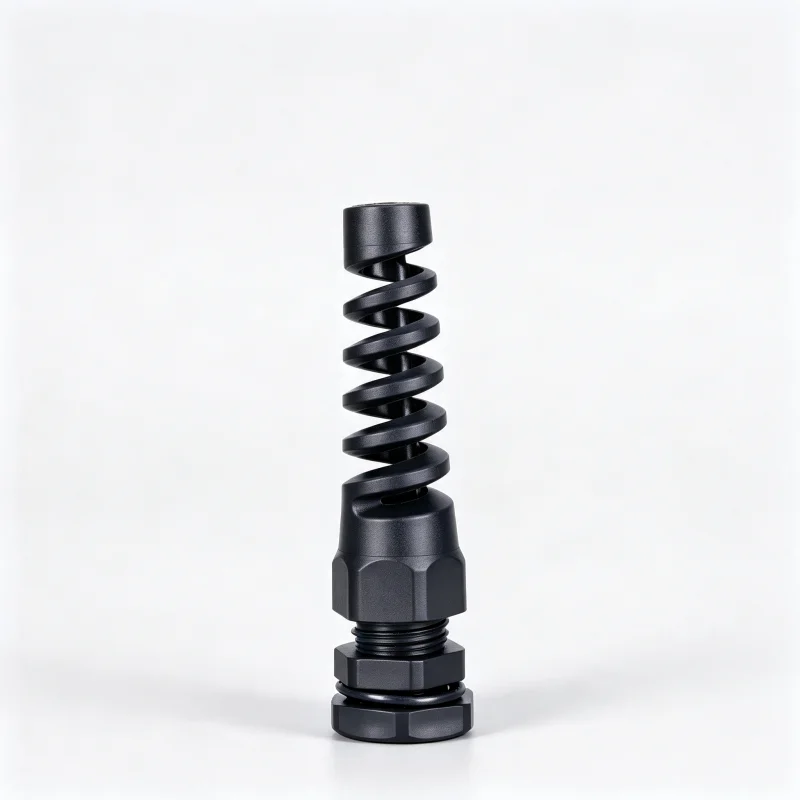
Most nylon cable glands sold today are moulded from PA66, and most quotations simply say “nylon”. That word covers two polyamides with different melting points, different moisture uptake and a 20 to 30 percent price gap on the compound. In an indoor cabinet the difference rarely shows. In a gland rated at +100 °C, on a sun-facing enclosure, or on a thin threaded wall holding preload for ten years, the grade decides whether the seal is still there.
This page separates the two grades on the properties a gland uses — heat, moisture, stiffness and creep. Sizing and clamping range are set by the thread, not the polymer.
Where the Two Grades Come From
PA6 is polymerised from caprolactam, a six-carbon ring that opens and links end to end. PA66 is a condensation product of hexamethylenediamine and adipic acid, and its repeat unit is symmetrical. That symmetry lets the chains pack into a denser crystal lattice, which is the origin of nearly every difference below: higher melting point, higher stiffness, lower moisture uptake.
PA6 has the asymmetric chain, and an asymmetric chain moves more freely: tougher, wider processing window, cheaper monomer. Between the two sits one methylene group, and that group turns into roughly forty degrees of melting point.
Both are polyamides, so both are hygroscopic, and both are sold as “nylon”. The word on a drawing is a family, not a grade — the same problem as calling a brass body “brass” when the material family holds a dozen alloys.
Property Differences That Matter
Six of these numbers matter for a gland, two of them moisture-related. The table uses typical unfilled moulding grades, which is what a gland body is; glass-filled grades are not used for this part.
Property
PA6
PA66
Monomers
Caprolactam
Adipic acid + hexamethylenediamine
Melting peak, DSC (ISO 11357)
215–225 °C
255–265 °C
Heat deflection, 1.8 MPa (ISO 75-A)
50–60 °C
55–70 °C
Tensile modulus, dry (ISO 527)
2,700–3,200 MPa
2,800–3,200 MPa
Tensile modulus, conditioned
900–1,300 MPa
1,200–1,600 MPa
Water absorption at 23 °C / 50 % RH
2.5–3.0 %
2.0–2.5 %
Density (ISO 1183)
1.12–1.15 g/cm³
1.13–1.15 g/cm³
Mould shrinkage
0.8–1.5 %
1.0–2.0 %
Read the dry and conditioned rows together: a datasheet quoting only the dry column describes a part that exists for a week after moulding, not the one in service.
Melting Point and Service Temperature
A gland has three temperature ceilings, routinely confused. Melting is where the crystal structure collapses; it is a margin, not a working limit. Heat deflection at 1.8 MPa is where a loaded part distorts, and for unfilled PA66 it is only 55–70 °C. Continuous service temperature is a third number, set by how long the compound retains its properties in hot air — a function of the stabiliser, not the polymer alone.
Our nylon series is published at −40 to +100 °C continuous, with short excursions to +120 °C. That is a PA66 figure. An unstabilised PA6 body sits at 80–100 °C continuous, so at the top of that range it has no reserve for the excursion and nothing left for the day the panel runs hot. Melting point buys margin against the unexpected; heat-ageing behaviour decides the tenth year.
Moisture Absorption and Thread Fit
Water does not sit in pores. It hydrogen-bonds to the amide groups along the chain and acts as a plasticiser, so the part grows and softens at the same time. PA6 carries more amide groups per unit of chain length and takes up more water: about 2.5–3.0 percent at equilibrium against 2.0–2.5 percent for PA66, with 0.5 to 1.0 percent linear growth between dry and saturated states.
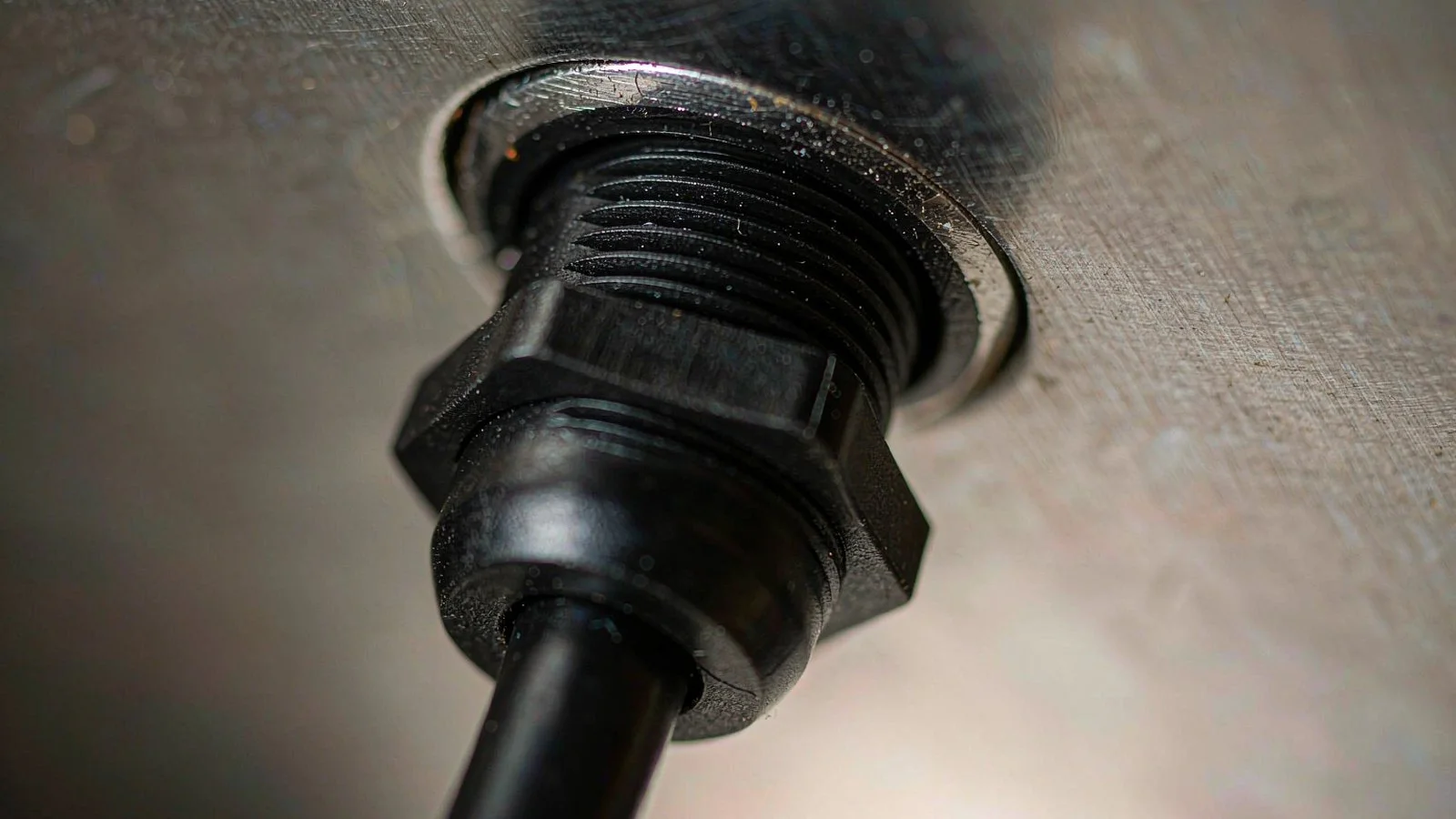
On a cable gland the consequence lands on the thread, because a thread is a controlled clearance. Swelling closes that clearance until the crest interferes, and the body is constrained by a steel panel that does not grow with it, so the polymer absorbs the interference as hoop strain in the thinnest section it has — the wall under the thread root. Body and dome nut are normally the same grade, so the pair does not free itself; what changes is the preload and the compression left in the insert.
The reverse case is the one that gets misdiagnosed. A warm, dry cabinet drives moisture back out, the part shrinks, preload relaxes, and the leak appears after a dry winter rather than during a wet one. Ask for conditioned properties to ISO 1110 when the application is cyclic.
A moulded thread is a controlled clearance against a steel panel that does not grow with it, so moisture movement has to go somewhere.
Stiffness, Creep and Clamp Load
A gland is two springs with a seal between them. The dome nut compresses the insert onto the cable, and the body holds the gasket against the panel. Both preloads last the life of the installation, and polyamide creeps under sustained load, faster as temperature and moisture rise.
Conditioned modulus is where the grades separate in a way that matters: 1,200–1,600 MPa for PA66 against 900–1,300 MPa for PA6. Lower stiffness plus higher moisture means more creep, less clamp force, and a seal that was correct on the day of installation and marginal four years later. The instinct is to add torque, and torque is the wrong lever — a nylon dome nut that is over-tightened splits at the corner of the hex or takes a permanent set, and both failures look like a torque problem when they are a creep problem. A locking feature or a thicker wall solves what a bigger spanner cannot.
Why PA66, and When PA6 Fits
The reasons glands are mostly PA66 are partly physical and partly commercial. Physically, forty degrees of melting margin, the higher conditioned modulus and the lower moisture swing all point one way for a part expected to hold preload outdoors. Commercially, a supplier running M12 to M114 and PG7 to PG63 from one compound has one drying regime, one melt profile and one set of process parameters; two grades across that range doubles the risk of a mixed box, and a mixed box is a warranty claim.
PA6 is right in narrower cases: indoor cabinets, static cable, ambient well below 80 °C, and cost-driven programmes where the wider processing window helps — thin split bodies and colour-matched parts mould more easily in PA6. Its impact toughness is an advantage on knock-prone equipment. The boundary is the temperature line: once the RFQ asks for +100 °C continuous, the saving comes out of the margin, and nylon’s role across general applications is mostly indoor and light-duty, which is why the substitution goes unnoticed until the site is hot.
What the Compound Adds
Unfilled PA66 is not a cable gland material on its own. What reaches the moulding machine is a compound, and the additives decide whether a gland survives five summers on a roof or chalks and cracks in two. Black parts usually carry carbon black, which doubles as the UV screen; other colours need a hindered amine light stabiliser instead. Parts that see the +120 °C excursion need a heat stabiliser, because unstabilised polyamide oxidises and embrittles long before it melts.
Write this on the PO
Why it matters
How it is checked
Grade, e.g. PA66 (ISO 1874-1 naming)
Sets melting point, modulus and moisture swing
Batch certificate plus DSC if disputed
UV stabilisation, or “outdoor grade”
Prevents chalking and embrittlement in sunlight
Compound datasheet; black colour is not proof
Heat stabilised, if above 100 °C
Retains properties through the excursion
Compound datasheet, heat-ageing data
Virgin material, no regrind
Regrind lowers molecular weight and impact strength
Supplier declaration; not visible on the part
Colour and surface
Identifies the batch and the cavity on site
Visual against the approved sample
Regrind is the quiet one. Grinding sprues back into the hopper is normal and a modest percentage is usually harmless, but molecular weight drops each time and impact strength with it. Nothing on the part shows it, so if the gland will be knocked, write the clause.
How to Verify the Grade
You cannot tell the two grades apart in your hand. Both are black, both take the same matt finish, and both can carry a moulded “PA66” that is a claim by the moulder rather than a result. Density does not help either, because the ranges overlap at about 1.13 to 1.15 g/cm³.
Method
What it proves
What it does not prove
Moulded marking
What the moulder chose to print
Anything about the compound
Density (ISO 1183)
That the part is polyamide, roughly
PA6 against PA66; ranges overlap
Burn and smell
Polyamide family
Grade, stabiliser, regrind content
DSC melting peak (ISO 11357)
215–225 °C means PA6; 255–265 °C means PA66
Additive package or regrind level
FTIR
Polyamide, and some fillers
Grade, unless run against reference spectra
DSC is the practical answer. It needs milligrams of material, takes minutes, and separates the two grades with a gap no additive can close. Ask for it with the datasheet when the temperature rating is why the part was chosen.
What the Grade Does Not Change
Nothing about the geometry moves. Thread size and pitch, mounting hole, clamping range, thread length, spanner size and IP rating are fixed by the design, and the sealing insert is a separate elastomer — NBR or silicone — whose chemistry comes from another table entirely. A PA66 body with a PA6 dome nut is technically possible, and multi-part sourcing makes it more likely than buyers assume: the same trap as a brass body assembled from four different bars. Every size and its geometry is on the nylon size chart, identical for both grades.
Parameter
What sets it
Effect of the grade
Thread size and hole
Thread standard; nylon carries +0.3 mm on thread OD
One geometry, two possible grades: thread, hole and clamping range are fixed by the size, and the polymer only decides how long they hold.
FAQ
Is PA66 better than PA6 for cable glands?
For anything above about 80 °C, outdoors, or under sustained preload, yes. PA66 melts about 40 °C higher, holds a higher conditioned modulus and absorbs less water — which is why it is the default for a gland that must stay tight for a decade.
Can I tell PA6 from PA66 by looking at the gland?
No. Same colour, same finish, overlapping density, and a moulded grade marking is only a claim. A DSC melting peak or a batch certificate of analysis is the only reliable answer.
Why do nylon glands crack in cold weather?
Usually not because of the cold. Unstabilised or heavily reground polyamide embrittles after UV and heat ageing, and the crack appears the first time the part is shocked at low temperature. An over-tightened dome nut splits at the hex corner in the same season. Both look like a cold-weather failure; neither is a −40 °C limit problem.
Does PA66 resist UV on its own?
No. Polyamide needs either carbon black, which is why outdoor glands are normally black, or a hindered amine light stabiliser. An unstabilised natural or coloured part chalks, then cracks. The black colour is a by-product of the UV package, not a guarantee of it.
Is a PA6 gland cheaper, and where does the saving go?
The compound runs 20 to 30 percent cheaper per kilogram, but on a small gland the moulding cycle and wall thickness dominate the piece price, so the saving is a few percent. Trade it against a temperature margin only when service temperature genuinely stays low.
NPT and metric cable glands seal in different places. Tapered versus parallel threads, hole preparation, the locknut problem, sealant rules and North American hazardous area entries.
A shroud fails to fit for one reason: the bore is compared with the thread or the cable instead of the hex across its corners. Sizing, materials, heat-shrink versus push-on, and when a boot makes an entry worse.
EN 50262, IEC 62444 and IEC 60529 answer three different questions, and one of them has been withdrawn. What each standard covers, where its scope stops, and what a spec needs.
We use cookies to enhance your browsing experience, serve personalised ads or content, and analyse our traffic. By clicking "Accept All", you consent to our use of cookies.