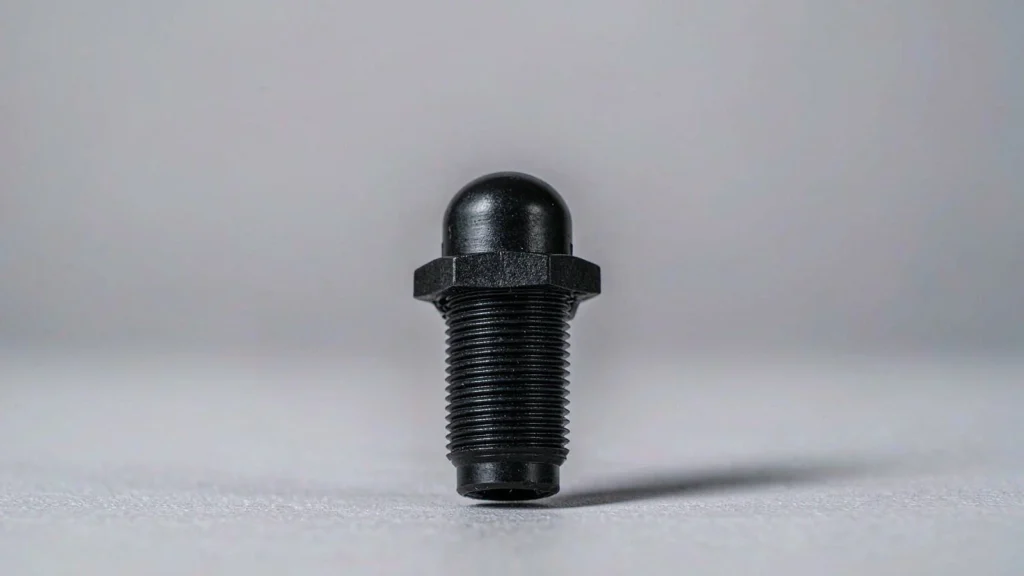
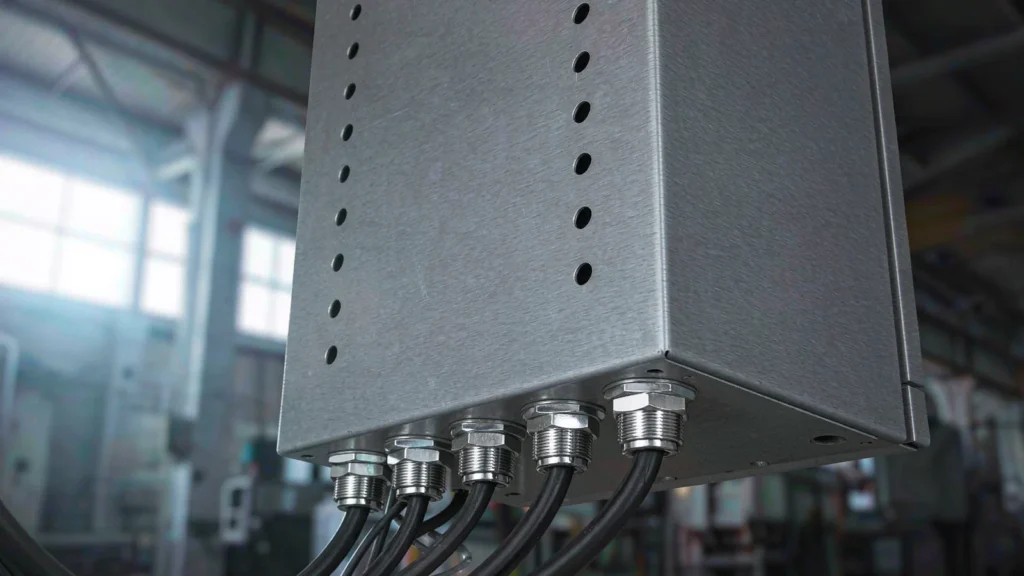
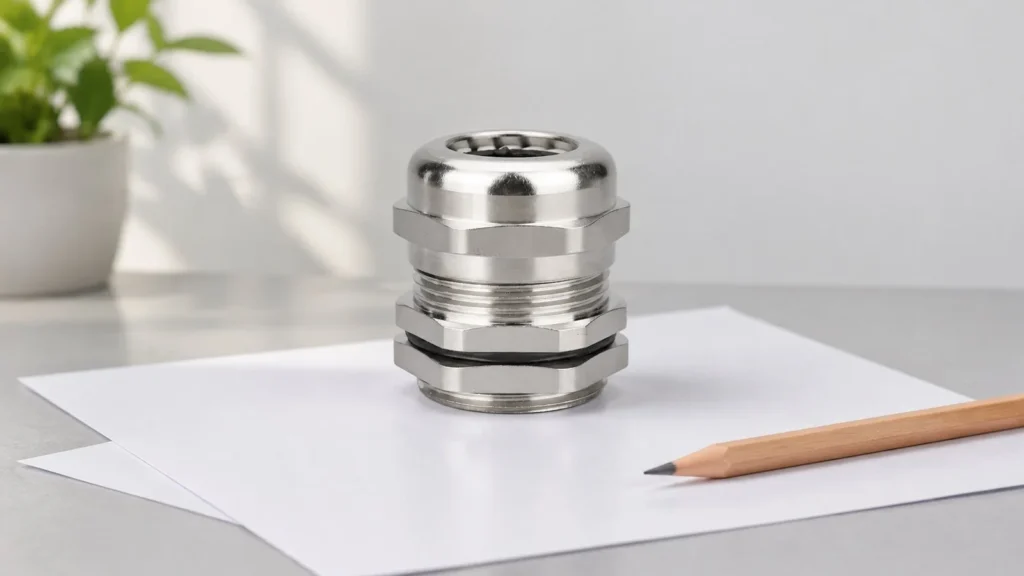
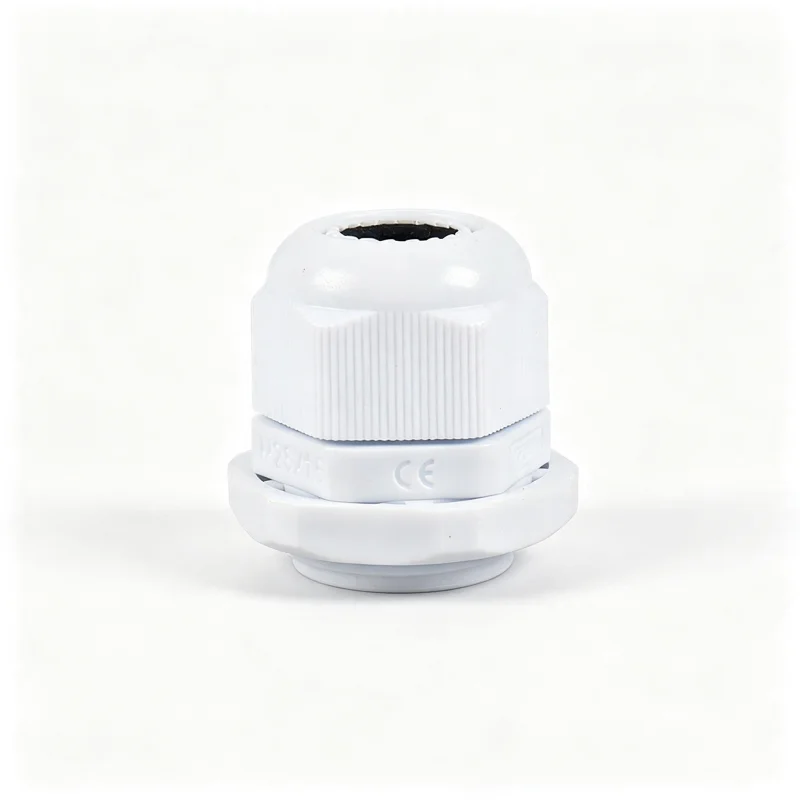
A long thread cable gland exists for one job: to pass through a wall thick enough that a standard entry runs out of thread before the locknut is properly seated. That sounds narrow until you count how little thread there is to begin with. On our brass range the thread length runs from 7 mm at M14 and PG7 to 13 mm at M63; on the nylon cable gland range it starts at 9 mm at M12. A 10 mm insulated panel consumes all of the first figure and more than half of the second before a washer or locknut is counted.
This guide treats thread length as a budget rather than one number to compare against wall thickness: the four items that spend it, the two joint types that spend it differently, what the longer thread variant returns size by size, and the four routes when the budget will not close.
What GL Measures
GL is the usable threaded length, from the underside of the shoulder to the end of the thread. It excludes the hex body above the shoulder, which is why a gland that looks long in a photograph can still have a short thread. Two features eat into it before anything is installed: the run-out at each end, roughly one pitch of incomplete thread no nut should rely on, and the leading chamfer. Treat GL as nominal and subtract a pitch before you trust it.
The pitch is the useful conversion. Metric sizes M12 to M63 on this range are all 1.5 mm pitch, so two full threads is 3 mm; M72 and above switch to 2 mm, and PG sits at 1.41 mm. That number turns “two threads proud” from a vague instruction into millimetres you can add up.
The Four Items in the Thread Budget
Every installation has the same four consumers. Only the first one is normally written on a drawing.
Line item
What it takes from the thread
Where the figure comes from
Finished panel thickness
The wall at that specific hole
Measured on the part, not taken from the enclosure drawing
Sealing washer or gasket
Its full uncompressed thickness
Datasheet. It cannot be squeezed to zero, and a bonded washer is thicker than a flat one
Shop practice for a nut that is fully engaged, not a standard
Run the arithmetic on two brass sizes and the shape of the problem appears. M20 has 8 mm of GL: a 6 mm nut plus 3 mm of exposed thread already comes to 9 mm, so the washer and the wall are being fitted out of a deficit. PG63 has 15 mm, and the same deduction leaves about 6 mm of wall. That is the whole range: 7 to 15 mm, most of it committed before the panel is mentioned.
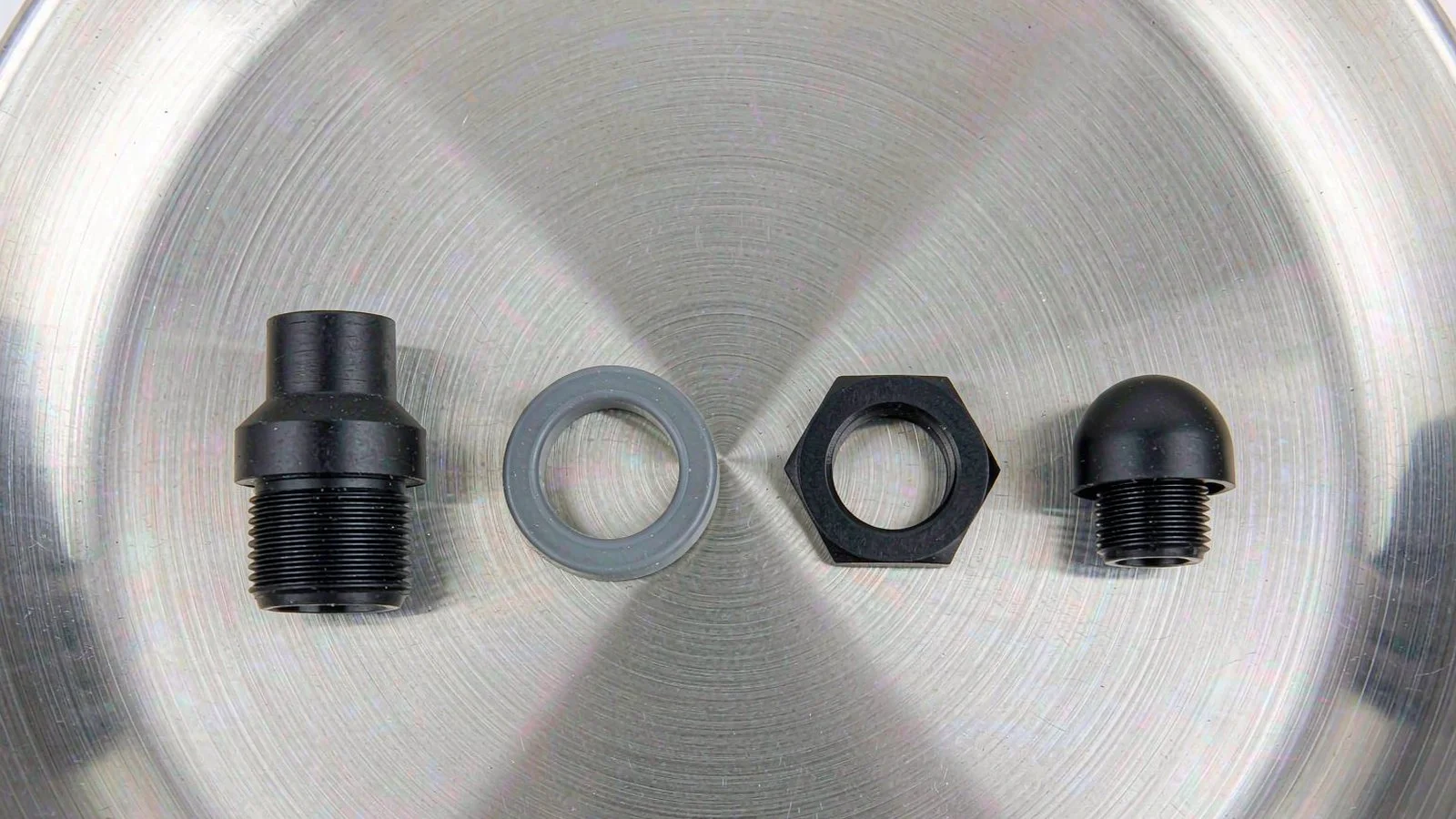
The parts that share the thread: body with dome nut, sealing washer and locknut. The thread has to cover all of them and the panel, not just the panel.
Panel Thickness Measurement Errors
The enclosure drawing gives a nominal wall. The hole gives you something else, and the gap is where most thick-panel orders are lost.
Coating and paint. Powder coat, galvanising and marine paint each add thickness per face. The washer seats on the coating, and the coating is not structural.
Insulation behind the sheet. A cold-room wall may be 2 mm of steel with 30 mm of foam bonded to it. The washer must sit on the outer skin, never on foam, which has no compression set to hold.
Cast bosses and weld seams. A cast aluminium box varies across a single face, and a seam under the hole adds metal where you cannot afford it.
Double-skin, cladding and tapped bosses. Two sheets with a gap behave as neither sheet alone. On a threaded entry the limit is thread depth, not metal thickness.
Through-Hole and Tapped Entries
The two joints look similar from outside and are calculated differently, which is the second most common reason a longer thread is ordered in the wrong length.
Through-hole with locknut
Tapped or threaded entry
Seals on
Washer compressed between shoulder and panel face
Shoulder or O-ring seat on a machined face
Consumes
Wall + washer + nut + exposed thread
Wall thickness only, with no nut in the stack
Typical failure
Nut seats on the last partial thread and loosens
Thread bottoms out before the shoulder touches
Does a long thread help?
Yes — that is what it is for
Usually not. It adds travel in the wrong direction
On a tapped entry the gland can be too long rather than too short. The thread reaches the bottom of a blind boss, the body stops turning, and the shoulder never comes down onto the face — the assembly feels tight and leaks, because the washer was never compressed. If the entry is tapped, measure the thread depth and order the standard length.
What the Long Thread Variant Adds
The longer thread nylon gland is the standard body with an extended thread. The return is not uniform, which catches people out.
Size
Standard GL
Longer thread GL
Extra length gained
Body height, standard to longer
M12
9 mm
15 mm
+6 mm
3 mm to 10 mm
M16
9 mm
15 mm
+6 mm
3 mm to 10 mm
M18
9 mm
15 mm
+6 mm
3 mm to 10 mm
M20
9 mm
15 mm
+6 mm
5 mm to 11 mm
M22
10 mm
15 mm
+5 mm
5 mm to 11 mm
M25
10 mm or 12 mm
15 mm
+5 mm or +3 mm
5 mm to 11 mm
M32
12 mm
15 mm
+3 mm
6 mm to 11 mm
At the small end the longer thread nearly doubles the engagement. At M32 it returns 3 mm — two thread turns, enough to rescue a marginal stack and not enough to rescue a thick one. The body grows 5 to 7 mm as well, so the part stands further off the panel: on a dense plate that matters, because the dome nut needs spanner clearance. Cable range, hole, seal and IP rating are identical to the standard nylon gland.
Fifteen millimetres at a 1.5 mm pitch is ten turns. The run-out at each end is not usable, so count from the shoulder.
Four Routes When the Budget Fails
When the total exceeds GL there are four sensible moves, and they are not interchangeable.
Route
What it buys
Where it breaks down
Longer thread variant
3 to 6 mm, with no change to cable range, hole or seal
Stops at M32 on our nylon range; body grows with it
Thin locknut
Around 3 mm against a standard nut
A one-time gain, and it reduces the clamping face that holds the body square
Panel-side change
Whatever is needed — spotface the coating, fit a gland plate, move the entry
Fabrication cost, coating repair, and the hole has to be re-sealed afterwards
One size up
One or two millimetres of thread
The cable range moves up with the size, and the cable may no longer be gripped
A thread adapter is the fifth option people reach for and the one to avoid. It adds a second joint to seal, moves the bearing face off the wall so the washer no longer sits where the enclosure was designed for it, and changes overall length in a way rarely checked against the drawing. It is a repair for an existing panel, not a specification choice.
Why the Size-Up Route Fails
Moving from M20 to M25 on the brass range gains 1 mm of thread — GL 8 to 9 — and shifts the cable range from 6–12 mm to 10–14 mm. An 8 mm cable that was correct in the M20 cannot be clamped by the M25 at all, because it sits below the seal’s working range. M32 has 10 mm of GL against M40’s 11 mm: again 1 mm, again with the cable range pushed upwards. The hole also enlarges, so the washer has to cover a bigger opening on the same wall. Since the size is fixed by the cable and the thread by the gland, a thread problem can only be solved on the thread side.
Cases Where Long Thread Fails
Four situations where more thread does not help.
The cable is already terminated. A gland has to slide over the end, so a pre-made cable with a connector cannot pass through any body. The answer is a split body gland, and its thread length has to be confirmed against the wall at the same time — the two decisions are made together.
The wall is thicker than the longest thread made. Beyond the top of the range the answer is a gland plate, a bulkhead fitting or a relocated entry, not a longer part.
The entry is a blind tapped boss. Extra length bottoms out and prevents the shoulder from seating.
The entry is certified for a hazardous area. On an Ex d or Ex e enclosure the thread engagement is part of the certification, and the permitted combination of gland, entry and length is fixed. A longer body changes the assembly that was assessed, so the question goes to the certificate, not the catalogue.
Ordering and Incoming Checks
Order with the stack, not the wall. “M20, longer thread, 15 mm GL” is ambiguous; “M20 longer thread, 3 mm panel plus 12 mm insulation behind, standard locknut and flat washer” is a specification someone can check. Give the thread system and material too, because the same size exists in brass, stainless steel and polyamide with different GL values.
On receipt, measure GL from the shoulder instead of trusting the label, then divide by the pitch to count usable turns — 15 mm at 1.5 mm pitch is ten, minus the run-out at each end. Check the shoulder is square to the thread and the thread start is not rolled over. During the fit, confirm three things in order: the washer lies flat on the panel skin, the locknut sits at full height on thread, and two threads remain visible past it. If any fails, the budget was wrong and tightening will not fix it. The hole size chart gives the matching hole per thread; on nylon add 0.3 mm rather than the 0.2 mm used on metal.
FAQ
Is a long thread gland the same as a thick panel gland?
The terms describe the same part, but “thick panel” describes the job and “long thread” the dimension. What matters is whether the thread covers the actual stack at the hole. A thick panel with a tapped entry may need the standard length, and a thin panel with an insulated lining may need the long one.
How much thread engagement is enough?
The nut at full height plus two visible threads beyond it, with the washer fully compressed. A certified entry overrides that with a stated minimum. Two threads at 1.5 mm pitch is 3 mm, the figure to add to the budget.
Can I use a thread adapter instead of a long thread gland?
Only as a repair on an existing panel. An adapter adds a second joint to seal and moves the sealing face off the wall. On a certified hazardous-area entry it is not permitted unless it is part of the approved assembly.
Does a longer thread change the IP rating?
No. The seal is at the panel face and around the cable, and neither changes with thread length. The rating is lost when the washer is not compressed — exactly what happens when a short thread leaves the nut hanging on a partial turn.
Why does my M32 long thread give less extra length than my M20?
Because the variant is a fixed 15 mm across the range while the standard thread already grows with size. At M12 the standard is 9 mm so the gain is 6 mm; at M32 it is 12 mm so the gain is 3 mm. Above M32 the variant does not exist and a different solution is needed.
When it comes to ensuring the safety, durability, and efficiency of electrical installations, the humble Cable Gland plays a critical role. Whether you’re working in industrial automation, oil and gas, telecommunications, or renewable energy, choosing the right cable gland can make all the difference in the performance and longevity of your systems. In this article, we’ll explore […]
The gland is only as good as the hole it sits in. How wall material, thread length, locknuts, knockouts and gland plates decide whether an enclosure stays at its stated IP rating.
EN 50262, IEC 62444 and IEC 60529 answer three different questions, and one of them has been withdrawn. What each standard covers, where its scope stops, and what a spec needs.
We use cookies to enhance your browsing experience, serve personalised ads or content, and analyse our traffic. By clicking "Accept All", you consent to our use of cookies.