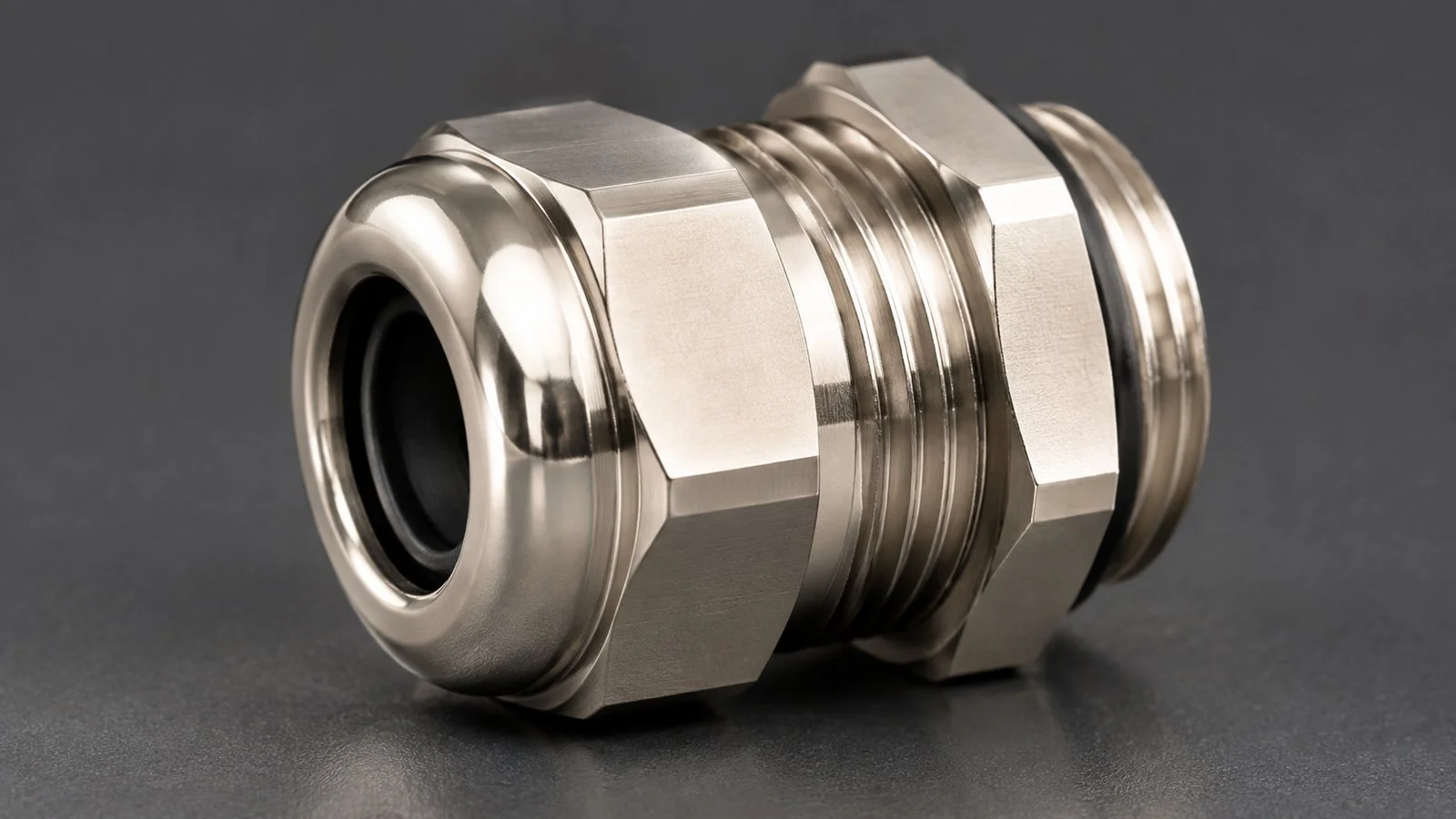
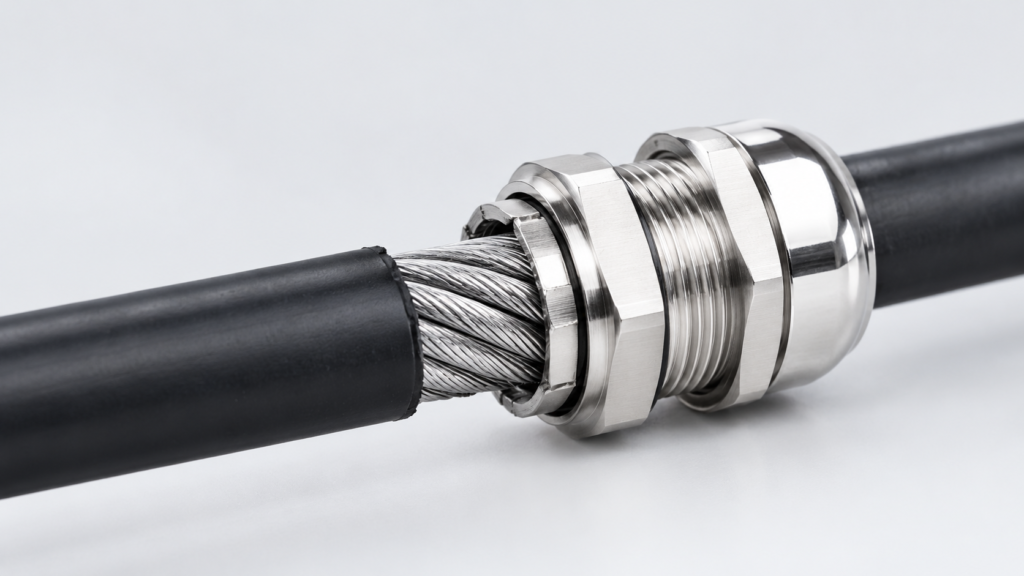
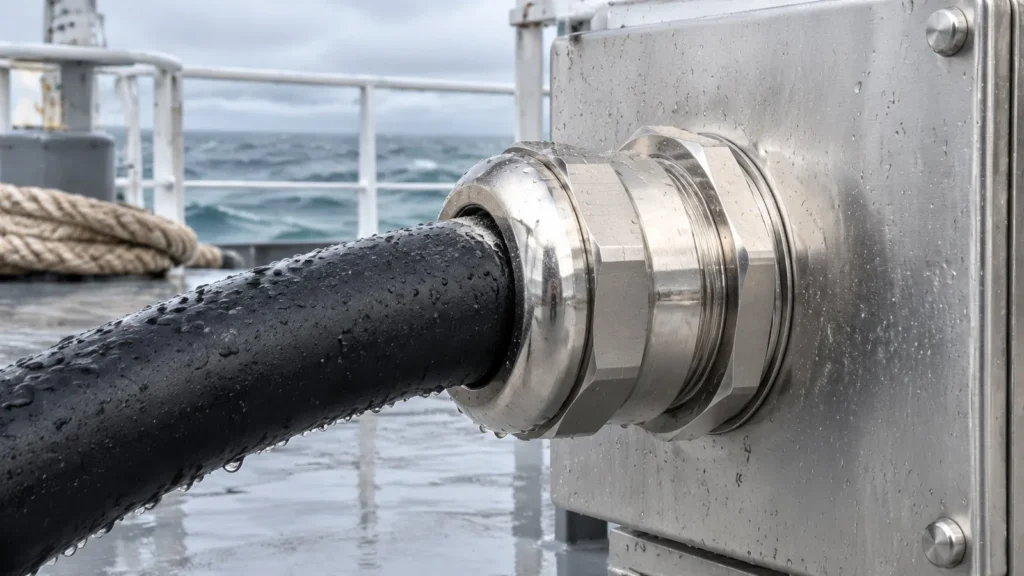
M14 is the smallest metric cable gland we make, and the only one whose thread is shorter than the hardware it has to pass through. Seven millimetres of thread is the whole personality of this size. Everything else, the 4 to 8 mm cable range, the 14 mm thread, the 17 mm hex, is shared with neighbours.
That matters because M14 is usually reached for by someone with a small cable, a small box and a 14 mm hole already punched. The cable is rarely the problem. The thread length is, and it fails quietly: the body stands off the panel, the seal is never compressed, and the entry looks installed until the first wet week.
The Five Numbers That Define an M14 Gland
Five published values decide whether an M14 gland works on a given enclosure. They come from our own dimensional table for the standard nickel plated brass part.
Parameter
M14 standard gland
What it decides at the panel
Thread
M14 × 1.5
Pitch must match every locknut, adapter and tapped boss on the site
Cable range
4 to 8 mm sheath O.D.
Your measured sheath must sit inside the band, not on its edge
Thread outside diameter
14 mm
Sets the hole: 14 to 14.2 mm
Thread length GL
7 mm
Must cover panel thickness plus washer plus locknut
Bonding length
19 mm
Body length behind the panel, which sets how deep the entry reaches
Spanner size
17 mm across flats
The smallest hex in the metric range, and the least forgiving
The hole figure is the thread outside diameter plus about two tenths of a millimetre. That allowance is clearance for the thread to enter without being forced, not a tolerance you can spend: smaller and the gland will not start, larger and the sealing washer loses the land it seals against. The relationship is set out size by size in our cable gland hole size chart.
GL 7 mm: The Shortest Thread in the Metric Range
Thread length rises steadily through the metric series. M14 carries 7 mm, every size from M16 to M22 carries 8 mm, M24 to M30 carry 9 mm, M32 to M48 carry 10 or 11 mm, and the series ends at 13 mm on M63. M14 is the only metric gland at 7 mm; the only other part in the catalogue with that thread length is PG7, a different thread system altogether.
This is a design fact, not a cost saving. A short thread is what lets a small gland sit flush on thin sheet, and the sizes above were lengthened as their couplers and locknut stacks grew. M14 kept the short body because the boxes it serves are thin walled by nature: terminal boxes, sensor housings, small control stations. The thread is full form, so 7 mm is short, not weak.
Why the Locknut Costs More Thread Than the Panel Does
Almost every M14 sizing enquiry mentions wall thickness. Almost none mentions the locknut, and the locknut is usually the larger consumer. The table below uses an illustrative four millimetre combined washer and locknut stack so the arithmetic is visible; substitute the real thicknesses from your own datasheets, because locknuts are sold in thin and standard patterns.
Panel thickness
Thread left on M14 (GL 7)
Thread left on M16 (GL 8)
Result
1.0 mm
2.0 mm
3.0 mm
Both work, M14 is tight
1.5 mm
1.5 mm
2.5 mm
M14 works only with a thin locknut
2.0 mm
1.0 mm
2.0 mm
M14 marginal, M16 comfortable
3.0 mm
0 mm
1.0 mm
M14 cannot close, M16 is at its limit
Read the last row again. On a three millimetre plate with a locknut, an M14 body never reaches the panel face. The seal is uncompressed and tightening cannot fix it because the thread has run out. This is the most common M14 failure, and it is invisible in a photograph.
Where GL 7 Works, and Where It Stops Dead
The shortest thread is the right answer in one configuration: a tapped hole. With an M14 × 1.5 thread cut into a boss there is no locknut to count, so a 3 mm boss leaves 4 mm of thread and a 5 mm boss still leaves 2 mm. That is what M14 was drawn for. It also works on thin sheet with a thin nut, which small terminal boxes use.
Where it stops dead is anywhere the wall is thick, the panel is a gland plate bolted over a wall, or the entry sits on a cast boss. Cast aluminium boxes are the usual offenders, since their bosses are four to six millimetres deep before the wall is counted.
There are three honest ways out. Order the long thread variant of the same size, a separate part number rather than a modified standard part; our M14 brass cable gland page lists short, long and extended thread options for this reason. Tap the hole and delete the locknut, which changes the sealing face and should be a decision rather than a workaround. Or move to M16. What must not happen is a thinned nut or a body signed off with two threads engaged.
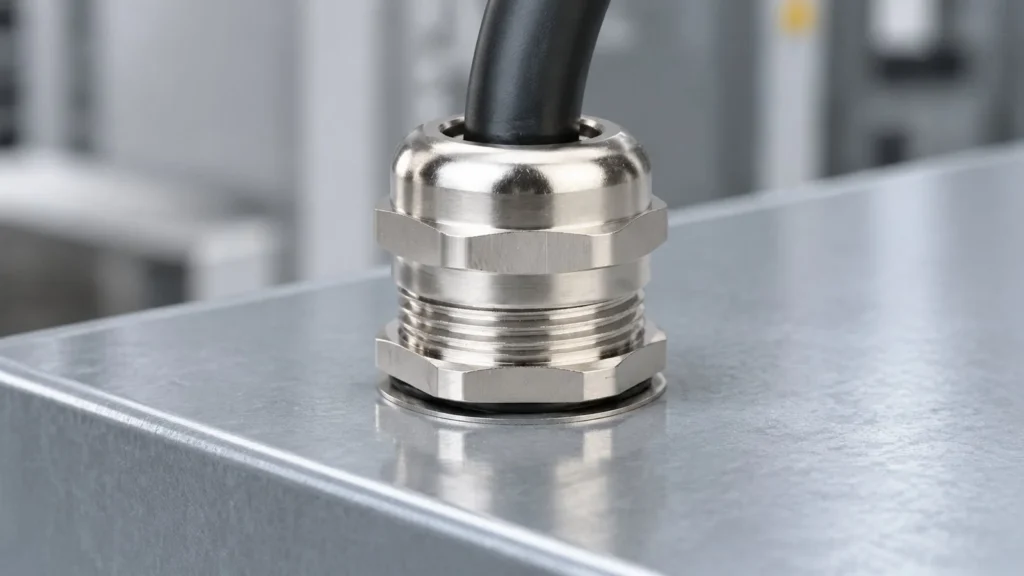
Small brass glands on thin sheet metal: the panel takes 1.5 mm of a 7 mm thread, the locknut and washer take the rest.
M14 Against M16: One Millimetre of Thread, Two of Hole
M14 and M16 clamp exactly the same cable. The range is 4 to 8 mm on both, and PG9 clamps that band too, so the choice is not a cable decision at all. That is the part buyers find hardest to accept.
Size
Cable range
Mounting hole
GL
Bonding length
Spanner
PG7
3 to 6.3 mm
12.5 to 12.7 mm
7 mm
19 mm
14 mm
M14 × 1.5
4 to 8 mm
14 to 14.2 mm
7 mm
19 mm
17 mm
PG9
4 to 8 mm
15.2 to 15.4 mm
8 mm
20 mm
18 mm
M16 × 1.5
4 to 8 mm
16 to 16.2 mm
8 mm
20 mm
18 mm
M18 × 1.5
5 to 10 mm
18 to 18.2 mm
8 mm
21 mm
20 mm
Our view, stated plainly: if you are drilling a new hole, choose M16. It grips the same cable and gives one more millimetre of thread, hex and body for the same money. M14 earns its place when the hole already exists at 14 mm, or when a boss is tapped M14. The four-way version of this comparison is in our PG9 cable gland size guide, and the next size up in the M20 guide.
Below M14: No Brass Metric Gland, and a 4 mm Edge
Two structural facts make the bottom of this ladder awkward. The brass metric series starts at M14, so there is no M12 brass gland at all. And the nylon series skips M14: it runs N-M12 and then jumps to N-M16. A 14 mm hole in a plastic enclosure therefore has no nylon option unless you drill it out to 16.2 mm.
Part
Thread
Cable range
Mounting hole
GL
Materials
PG7
PG7
3 to 6.3 mm
12.5 to 12.7 mm
7 mm
Nickel plated brass, stainless
N-M12
M12 × 1.5
3 to 6.5 mm
12.2 to 12.5 mm
9 mm
Polyamide
M14
M14 × 1.5
4 to 8 mm
14 to 14.2 mm
7 mm
Nickel plated brass, stainless
N-M16
M16 × 1.5
4 to 8 mm
16.2 to 16.5 mm
9 mm
Polyamide
Note that PG7 is physically smaller than M14: 12.5 mm of thread against 14 mm. If your cable is under four millimetres the metric brass ladder has nothing, and PG7 is the part that fits. The nylon alternative is N-M12; the whole ladder is in our nylon cable gland size chart.
The other edge is inside the range. At 4.0 to 4.5 mm the insert is at the bottom of its travel, so seal contact and pull-out resistance are both at their weakest while the gland still meets its stated range. A caliper reading of four millimetres should send you to PG7 or N-M12. The mirror problem is at 8 mm, where no compression is left for thermal movement.
Spanner 17: Smallest Flats, Thinnest Wall
Seventeen millimetres across flats is the smallest hex in the metric range and the third smallest in the catalogue, after PG7 at 14 mm. The advantage is that a 17 mm open end wrench is in every toolbox, so tooling is never why an M14 entry goes untightened. The risk is that the hex is small, the wall between hex and thread is thin, and a habit formed on M20 will distort it.
Over-torque at this size does not announce itself as a leak. It announces itself as a rounded hex, and by then the insert has been compressed beyond recovery. That is how a gland tight in March becomes a gland weeping in November. There is no universal torque figure for this or any other size, because the correct value depends on seal hardness, body material and whether there is a metal to metal stop; our cable gland torque guide explains what to check instead. Clearance matters too: terminal boxes pitch entries at 20 to 25 mm, which suits an open end wrench and rules out a socket.
Two Materials, One Footprint
M14 exists in nickel plated brass and in stainless steel, drawn from the same table, so hole, thread and 7 mm GL are identical. The choice is environment, not fit. Brass is the default and carries the bonding path through its thread; stainless is the answer where chloride or washdown would strip a plating. Our stainless steel cable gland range carries the same sizes in 304 and 316L.
Neither substitutes for the other in a bonded installation. A stainless body in an aluminium enclosure changes the galvanic pair, and a brass body in a chloride environment changes how fast the entry disappears.
A 17 mm hex is easy to find a wrench for and easy to round off. The wall between hex and thread is thin at this size.
Ordering an M14 Gland Without Ambiguity
A requisition that says “M14 gland, 6 mm cable” leaves four of the six numbers undecided, and one of them causes failures.
Field to specify
Example for this size
What it prevents
Thread and pitch
M14 × 1.5
A coarse or fine pitch that fits nothing on site
Material and finish
Nickel plated brass, or 316L stainless
Unplated brass supplied into a washdown area
Measured cable range
5 to 7 mm sheath O.D.
A part whose range barely brackets the cable
Thread length
Standard GL 7, or long thread for 3 mm plate
A body standing off the panel with no seal
Hole and wall
14 to 14.2 mm hole in 1.5 mm sheet
An oversized hole with no sealing land
Accessories
Locknut, washer and shroud in M14 × 1.5
A mismatched stack that cross-threads
Minimum order quantity for brass is normally 1,000 pieces per size with no tooling charge, and trial orders of 100 to 500 pieces are usually accepted at a slightly higher unit price. Stainless starts at 300 pieces. Because M14 is the smallest metric size it is the cheapest point in the brass cable gland range per piece, which makes it the obvious part for consolidating many small entries.
Frequently Asked Questions
What size hole do I drill for an M14 cable gland?
Fourteen to fourteen point two millimetres. That is the thread outside diameter plus about two tenths, and it applies to the brass and stainless versions alike.
What cable does an M14 gland take?
A sheath outside diameter between four and eight millimetres. Measure the finished cable, not the conductor nominal, and work in the middle of the band.
Can I use a PG9 gland in a 14 mm hole?
No. PG9 has a 15.2 mm thread and needs a 15.2 to 15.4 mm hole, so it will not enter. Both clamp the same 4 to 8 mm cables, which is why they are so often confused.
Will an M14 gland fit a 3 mm panel?
Not with a locknut on a standard 7 mm thread, because the thread runs out before the body reaches the panel. Tap the hole and delete the locknut, or order the long thread variant.
Is there a nylon M14 cable gland?
No. The nylon series runs N-M12 and then N-M16, so a 14 mm hole in a plastic enclosure needs brass or stainless, or drilling out to 16.2 mm.
If you ever typed “are cable glands waterproof” into Google, you not alone. It one of those procurement-and-engineering questions that sounds simple, but it hides a bigger issue: “waterproof” is not a precise engineering specification. In real projects—outdoor telecom cabinets, marine sensors, washdown food lines, rooftop PV combiner boxes—what you really need is a cable […]
An armoured cable gland must grip the armour, bond it to earth and seal the sheath. This guide covers armour types, BW / CW / E1W sealing stages, and how two cable diameters set the gland size.
PG48 covers 37 mm to 44 mm cable on a 59.3 mm thread, the same band as M63 on a 63 mm thread. Why 3.7 mm decides the panel, and how 14 mm of thread leaves 9.5 mm of usable wall.
We use cookies to enhance your browsing experience, serve personalised ads or content, and analyse our traffic. By clicking "Accept All", you consent to our use of cookies.