Waterproof Cable Gland
How to Install an SWA Cable Gland
Step-by-step SWA cable gland installation: the three strip lengths that decide the job, component order before the first cut, armour cutting, cone seating and the checks that matter.
Read More
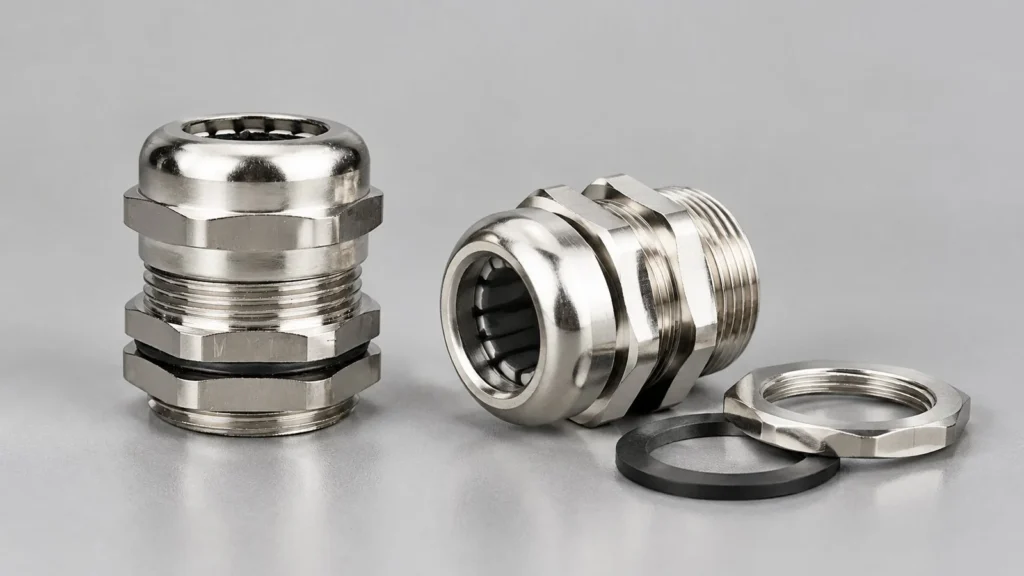
Nobody starts a project with M25. They arrive at it, usually after a thirteen millimetre cable was specified against an M20 entry and the first gland was found to be at the very top of its range. M25 is the size that fixes that problem, and it brings its own set of decisions, because the twenty-five millimetre thread is not one size in practice.
The values on this page are the published dimensions for our standard nickel plated brass M25 gland, not approximations. If you are still choosing between M20 and M25, our M20 cable gland size guide sets out the smaller size in the same format.
The most common route is a cable range failure at the top end. A twelve or thirteen millimetre sheath clamped in an M20 gland is technically inside the range, but there is almost no insert compression left, and the seal loses its tolerance for thermal movement and eccentricity within the first season. The fix is to move up a size and land in the middle of the new range, which is exactly what M25 offers for cables in the twelve to thirteen millimetre band.
The second route is a strand of oversized cable added late in a project, or a change from a single-core to a multi-core construction of the same nominal area. The third is a panel built to a template that assumed M25, where matching the template is cheaper than re-drilling.
This is the detail that surprises buyers. The ten to fourteen millimetre cable band is served by four different thread sizes in our range, and they are not interchangeable because the hole is different in every case.
| Size | Cable range | Thread O.D. | Mounting hole | GL | Spanner |
|---|---|---|---|---|---|
| M22 x 1.5 | 10 to 14 mm | 22 mm | 22 to 22.2 mm | 8 mm | 24 mm |
| M24 x 1.5 | 10 to 14 mm | 24 mm | 24 to 24.2 mm | 9 mm | 24 / 27 mm |
| M25 x 1.5 | 10 to 14 mm | 25 mm | 25 to 25.2 mm | 9 mm | 24 / 27 mm |
| PG19 | 10 to 14 mm | 25 mm | 25 to 25.2 mm | 9 mm | 24 / 27 mm |
What separates them is therefore not the cable at all. It is the hole you can drill, the bearing area the body presents to the panel, and which thread system the rest of the site uses. M22 exists because some enclosures simply cannot take a twenty-five millimetre hole. PG19 exists because legacy panels are threaded PG. M24 and M25 are both twenty-first-century metric choices that differ by a single millimetre of thread diameter and a resulting difference in wall thickness at the thread root.
That last point is practical: when a gland is going into a thin pressed-steel enclosure rather than a cast box, the extra millimetre of body material matters more than the cable range does.
| Parameter | M25 standard gland | What to check before ordering |
|---|---|---|
| Thread | M25 x 1.5 | Pitch must match the locknut and any tapped hole |
| Cable range | 10 to 14 mm sheath diameter | Measured sheath OD, at three points, maximum value |
| Thread outside diameter | 25 mm | Hole needs to be 25 to 25.2 mm |
| Thread length GL | 9 mm | Must exceed wall plus locknut plus washer |
| Spanner size | 24 or 27 mm across flats | Body and nut may differ; confirm which is which |
Because M25 starts at ten millimetres, it overlaps the top of the M20 range. That overlap is a trap in the opposite direction: a ten millimetre cable in an M25 gland is at the bottom of its range and relies on the insert closing down a long way, which reduces grip and distorts the seal.
When the measured diameter is ten or eleven millimetres, M20 is the better gland and the better hole, because the cable then sits in the middle of a range that was designed around it. Use M25 from about twelve millimetres upward. Between twelve and fourteen it is the natural home, and above fourteen it is the wrong size entirely, since the next step is M32 rather than a longer M25.
Two values appear for this size because the body and the nut are not always the same across flats. The practical consequence is that your tool kit needs both, and that clearance calculations have to use the larger of the two.
For a row of entries, the rule that matters is the swing room around the larger dimension, not the pitch of the holes. Panels are often laid out so the glands just fit and the wrenches do not, and the result is a row of glands tightened with pliers and a seal that never reached its designed compression. Our cable gland hole size chart covers layout and drilling, and the cable gland torque guide explains how to establish the right tightening value when the datasheet gives one.
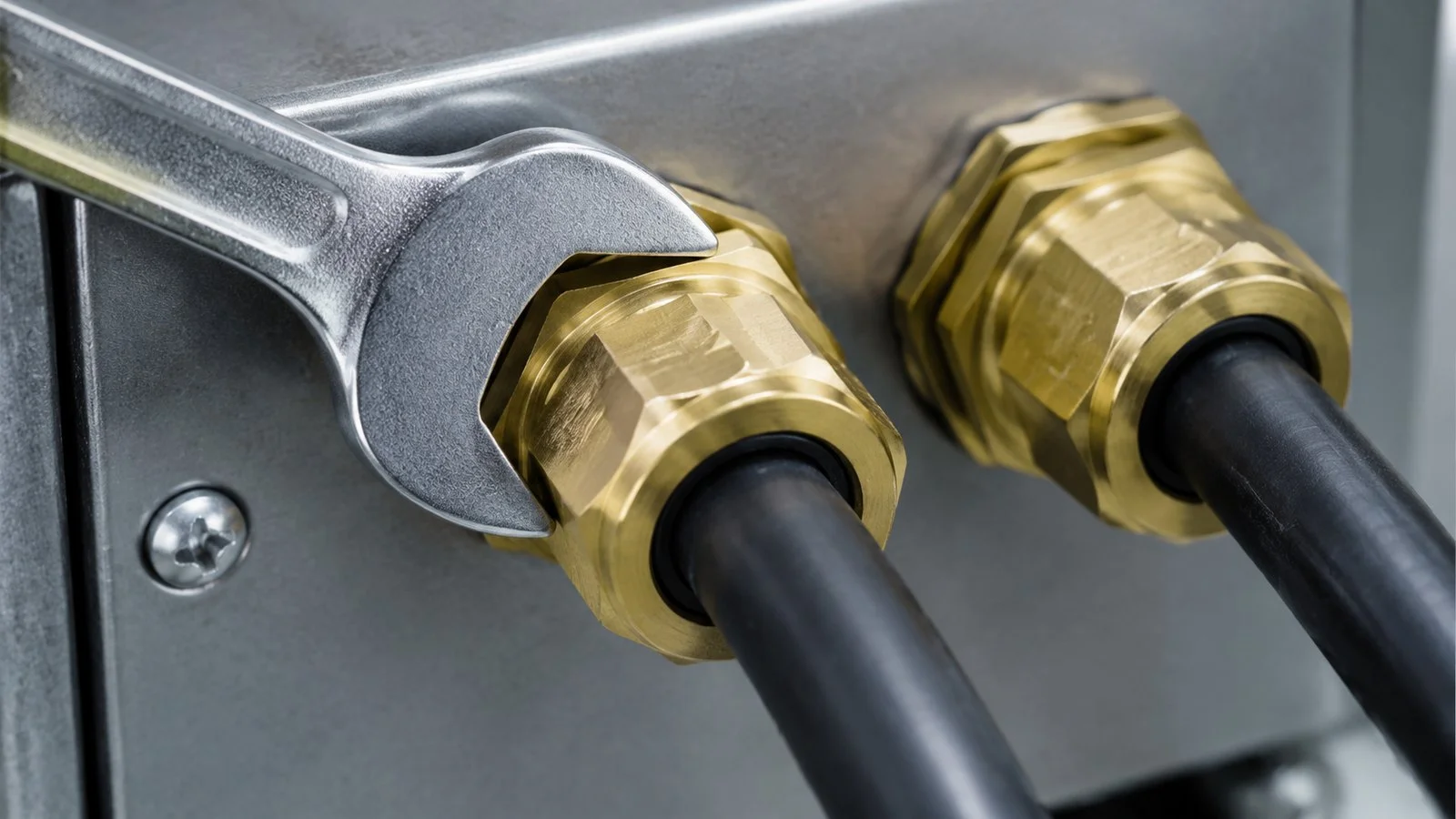
The extra millimetre of thread length over M20 is not a rounding artefact; it is what allows M25 to sit on slightly thicker walls. It is still only nine millimetres, and the arithmetic has not changed: plate thickness plus locknut plus washer has to leave enough thread for the body to pull down flat on the sealing face.
On a two millimetre sheet with a standard locknut this is comfortable. On a five millimetre gland plate, or through a wall plus an added plate, it is not, and a long-thread variant is the correct answer rather than a thicker washer stack. Using washers to take up slack is a common field habit and it is wrong, because it moves the seal away from the surface it was designed to seal against.
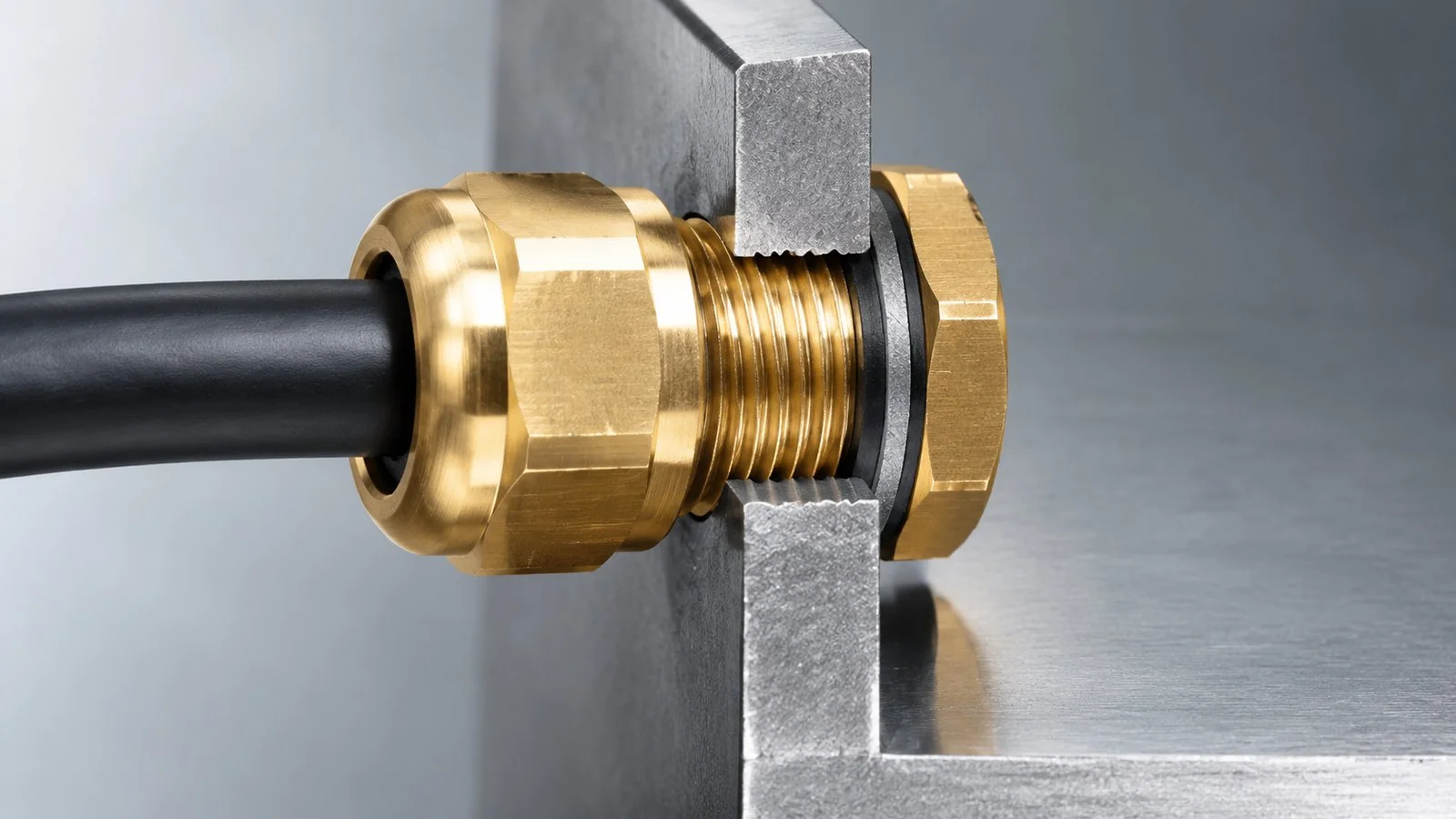
The panel itself is the other half of that stack. At twenty-five millimetres the body presents a larger face than M20 does, and that face is what resists being pulled off-axis when the cable is loaded. On a cast enclosure the face is flat and rigid. On thin pressed steel it sits on a panel that deflects under torque, so the washer follows the panel instead of compressing evenly. The correction is a backing washer or a reinforced plate, never a tighter gland: if the panel dishes while you tighten, the sealing face is already lost.
M25 x 1.5 is available in nickel plated brass, in stainless steel and in nylon, and only the thread and hole are guaranteed to match. Cable range, thread length and temperature limits can differ between materials, so a substitution made on the basis of “same M25” is not a like-for-like replacement.
The usual rule holds: nylon for plastic enclosures and light duty, brass as the industrial default, stainless where chloride or washdown would destroy a plating. If the site is coastal or chemical, the material decision is more consequential than the size decision, and our stainless steel corrosion resistance guide is the right next read.
If the cable carries steel wire armour or a braid that must be clamped and bonded, size selection is not a matter of picking the thread that fits the sheath. The gland construction changes: the armour needs a cone and a clamping ring, and the entry dimension that matters is the diameter over the bedding rather than over the sheath.
In that case, start from our guides to armoured cable glands and SWA gland selection, then come back to the thread table above. A larger M25 will not solve an armour-clamping problem, and buying one is how projects end up with the right hole and the wrong gland.
| Field | What to write | Why |
|---|---|---|
| Thread and pitch | M25 x 1.5 | Distinguishes it from PG19 in a mixed-thread plant |
| Cable range required | 12 to 13 mm measured sheath OD | Keeps the cable in the middle, not at an edge |
| Material and finish | Nickel plated brass, or 316L | Prevents unplated brass arriving at a washdown area |
| Thread length | Standard GL, or long thread for the plate | Avoids a body standing off the panel |
| Accessories | Locknut, washer, shroud in M25 x 1.5 | A PG19 locknut will start and then cross-thread |
| IP rating with conditions | IP68, 2 m for 24 h | Makes the claim testable |
Our M25 metric brass cable gland is the reference part for this size, and the brass cable gland range carries the neighbouring sizes in the same thread system, so the whole entry plan can be checked from one dimensional source.
Twenty-five to twenty-five point two millimetres. The thread outside diameter is twenty-five millimetres and the clearance allowance is about two tenths.
Either clamps a ten to fourteen millimetre cable. Choose by hole size and thread system: M25 gives a slightly stronger body, while M24 suits enclosures where a twenty-five millimetre hole is too large.
Only if the hole is being re-drilled or re-tapped. Both use the same twenty-five millimetre outside diameter, but the thread form differs, so a PG19 locknut will not run on an M25 thread.
Fourteen millimetres sheath diameter. Above that the correct move is M32, which covers the twenty-two to fifteen millimetre band in ascending terms.
Yes, as a separate part number. Confirm the GL you need against your wall thickness plus locknut and washer before ordering, rather than adding washers on site.
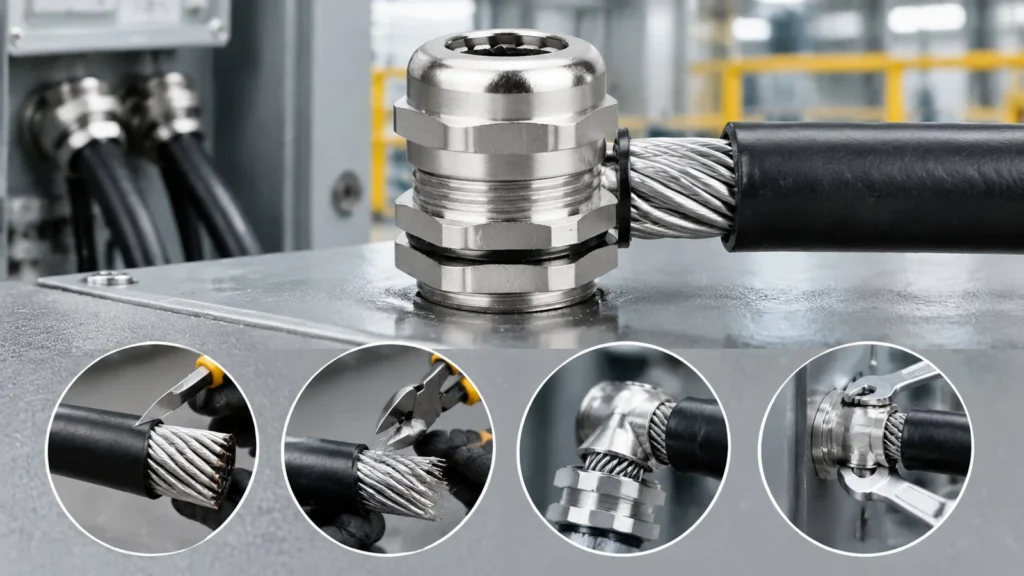
Step-by-step SWA cable gland installation: the three strip lengths that decide the job, component order before the first cut, armour cutting, cone seating and the checks that matter.
Read More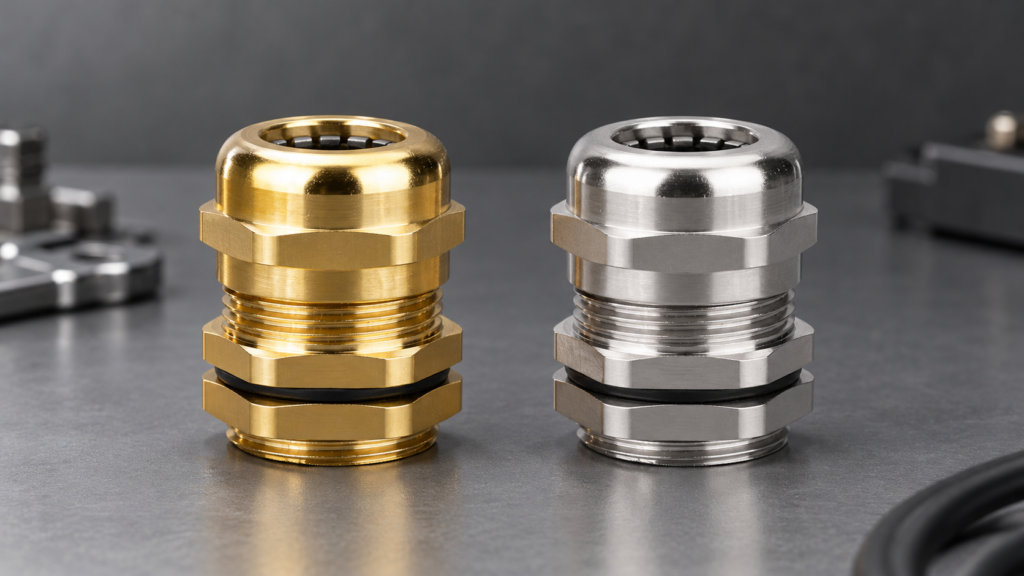
Brass and stainless steel cable glands compared size for size: weight, conductivity, temperature, galling, chloride failure mode, galvanic coupling and what the price gap actually buys.
Read More
An explosion proof cable gland protects the one part of a flameproof enclosure that cannot be welded shut. How it works, why IP68 is not Ex, and the four compatibility checks that decide whether a correctly fitted gland is still the wrong one.
Read More


