Earthing gives fault current a path to the source so that protection operates. Bonding keeps accessible metal at the same potential so that no dangerous voltage appears between two parts a person can touch at once. A cable gland is usually involved in both, and the requirements are different: an earth path has to carry fault current for the time the protection takes to clear, while a bond has to keep two surfaces at equal potential in normal operation and under fault.
That distinction decides the hardware. A gland that makes a good EMC bond — thin, low-impedance, high-frequency — is not automatically a good protective earth path, and a gland that carries fault current well may still leave a painted enclosure panel isolated from the gland body. The two jobs are frequently confused in specifications, which is why bonding hardware gets left off orders.
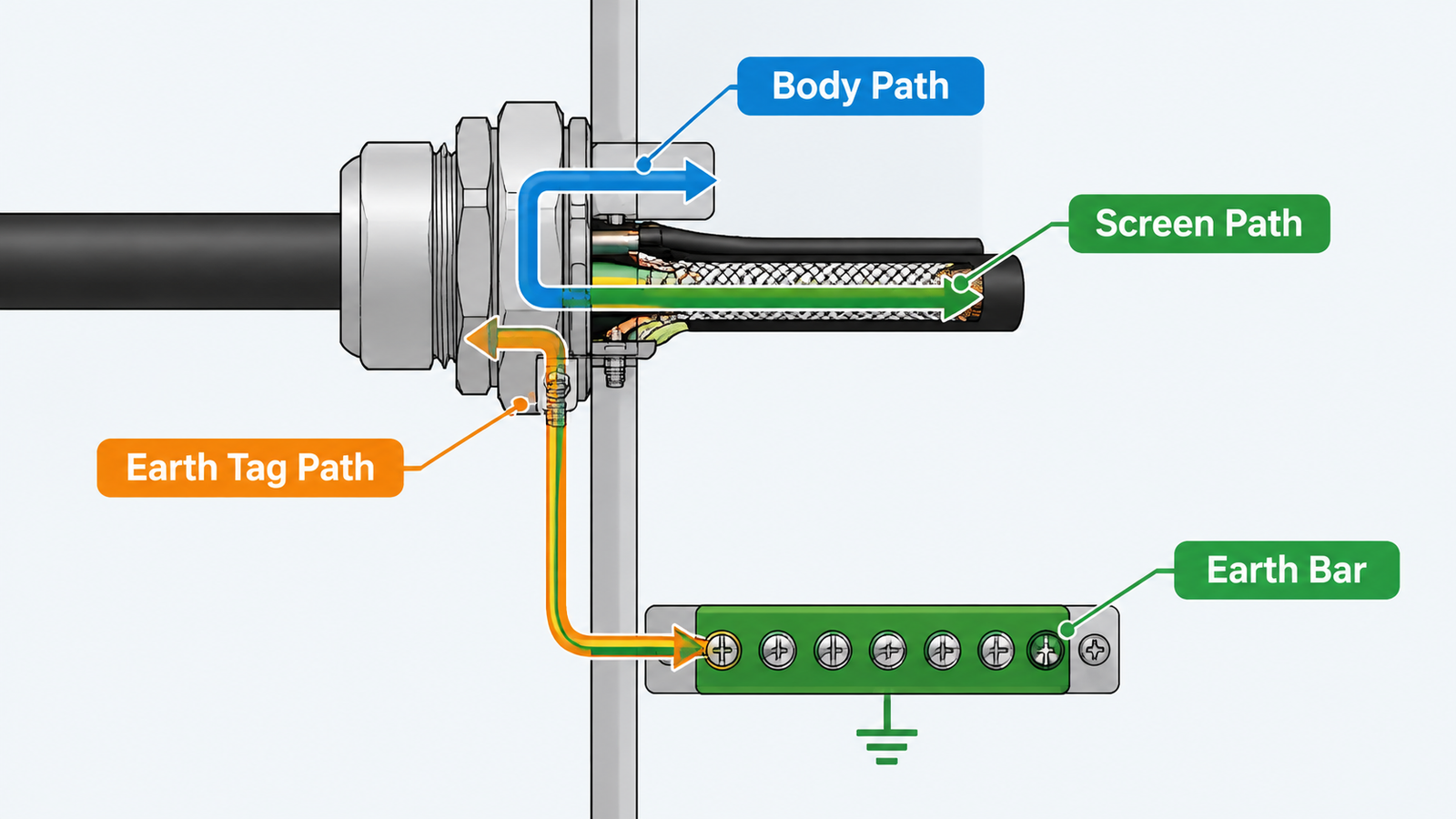
Three Return Paths a Gland Can Provide
Metallic glands can contribute a return path in three ways, and they are not interchangeable.
Path
How it works
Carries fault current
Carries EMC bond
Through the gland body into the enclosure
Thread engagement into a metal wall or a metal locknut
Only if every interface is metal to metal
Yes, if the interfaces are clean and tight
Through an earth tag under the locknut
A tab clamped between gland and enclosure, connected to a separate conductor
Yes, by design
Poorly — the tab is a single-point, inductive path
Through the cable’s own screen or armour
The clamping element contacts the metallic screen, armour or drain wire
Only for the metallic layer, not the conductors
Yes, and this is the path that matters for EMC
Most installations rely on a combination. The mistake is assuming the first path exists when the enclosure is powder coated, the gland has a sealing washer in the way, or the thread was assembled with a sealant that is an insulator. Each of those breaks a path that nobody documented.
What Stops a Gland From Being a Conductor
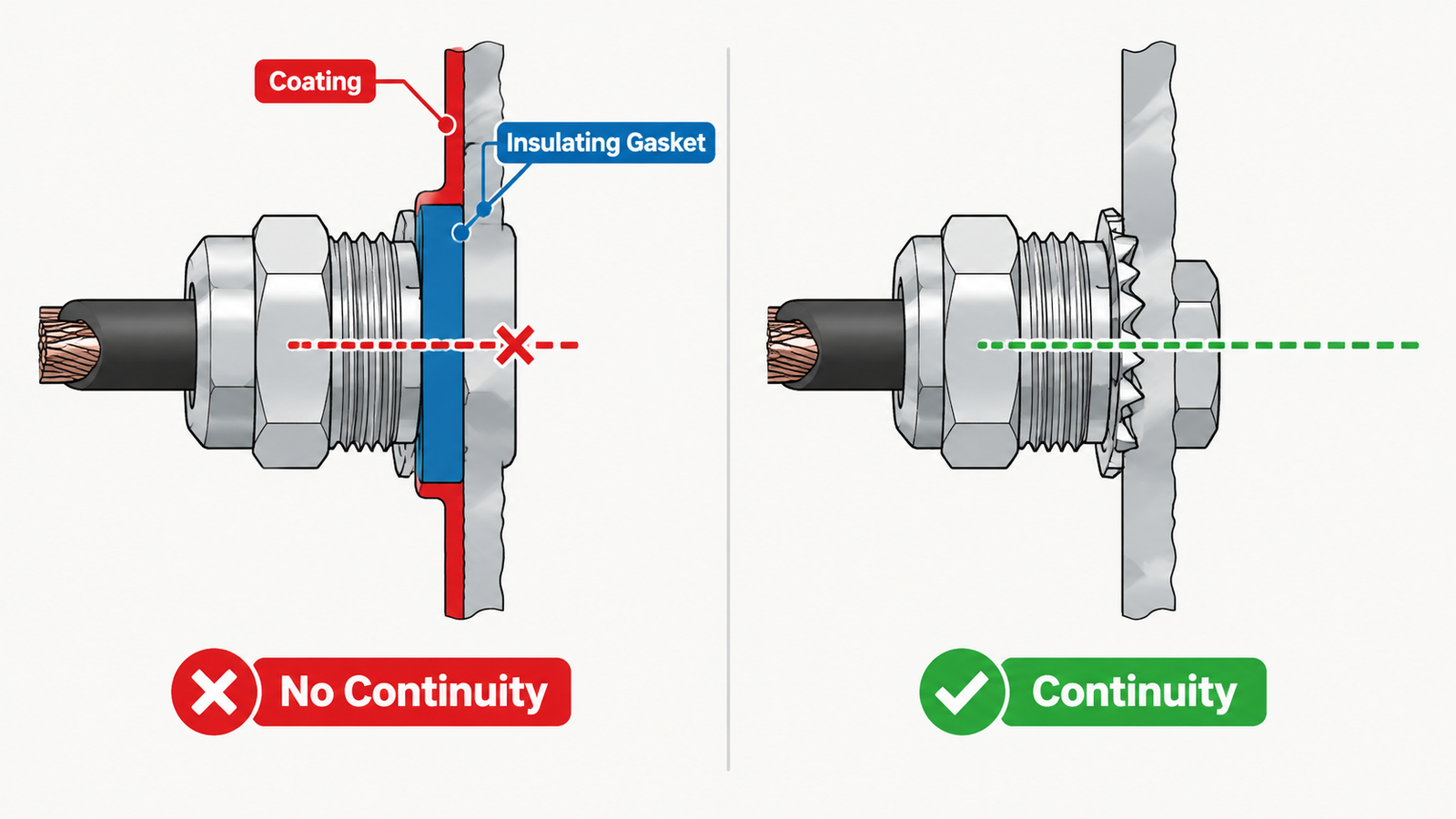
Continuity is decided at the interfaces, not in the body. Seven interruptions account for almost every continuity failure we see on site.
Mask the entry area before coating, or use a toothed washer that bites through
Panel gasket
An insulating gasket between gland and enclosure
Use an earth tag to bridge, or a conductive gasket where one exists
Thread
PTFE tape, thread sealant, grease, oxide film
Keep sealant off earthing threads; clean and dry the contact faces
Locknut face
Coated or painted locknut
Bare-metal locknut, or a star washer between nut and panel
Coating on the gland itself
Plating over the contact area
Verify that the earth contact area is left unplated or is masked
Aluminium enclosure
Instant oxide layer on bare aluminium
Abrade and assemble immediately; oxide re-forms in minutes
Corrosion at the joint
Galvanic attack in a wet environment
Select the material pair for the environment, not for the price
The aluminium case is the one people underestimate. Bare aluminium oxidises within minutes of being abraded, and the oxide is an insulator. A joint that measured perfectly on the bench can be open by the time the enclosure is closed. The answer is to abrade, apply a contact compound intended for the purpose, and assemble in one operation.
Three parallel paths. The body path is the one everyone assumes and the one most often broken by coating or a gasket.
Earth Tags, Washers and Locknuts
Three small parts decide whether the earthing claim on the drawing is true in the field.
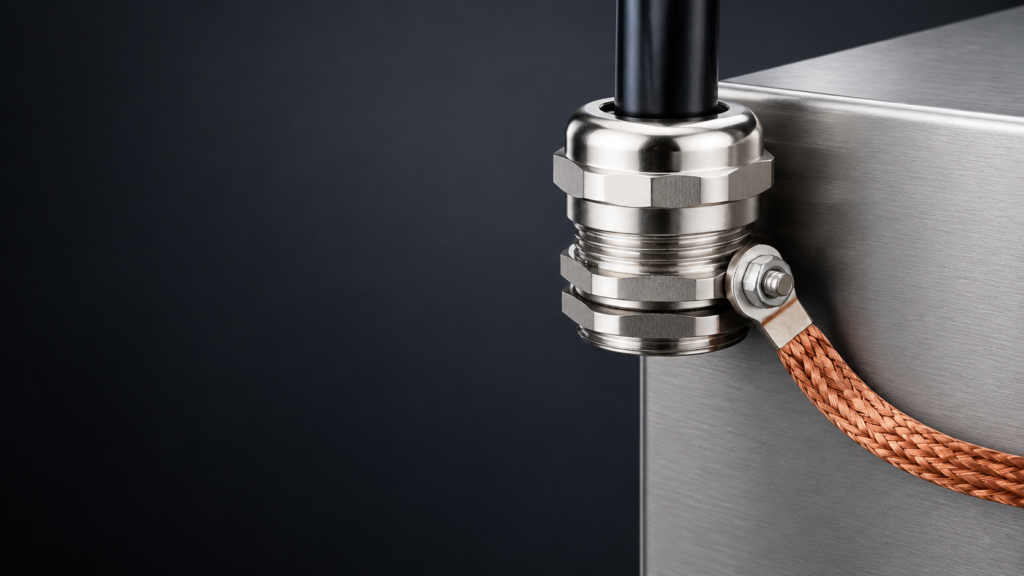
An earth tag is a metal tab that is clamped between the gland and the enclosure and carries a separate earth conductor. It exists precisely because the body path cannot be guaranteed — through a painted panel, a gasket, or a non-metallic enclosure. When a gland is fitted to a plastic enclosure, the tag is the only path there is, and the conductor has to go somewhere that is actually bonded.
A serrated or toothed washer cuts through coating to reach metal. It is effective and it is also a corrosion site, because it removes the protective layer in a ring and leaves bare metal exposed. In a wet or marine environment, the place to solve the coating problem is the coating process, not the washer.
A locknut is the reaction point for tightening, and often the only metal-to-metal contact on the far side of a wall. A painted locknut on a painted panel gives a joint that tightens correctly and conducts nothing. Specify bare or plated locknuts where continuity is required, and record it — this is exactly the kind of line item that gets substituted during procurement without anyone noticing.
The Gland as a Protective Conductor
Whether a gland may serve as a protective conductor depends on the installation rules that apply to the enclosure, not on the gland’s conductivity. The general position is that a gland can be part of the earth path where the standard permits it and where the fault current and duration are within what the assembly can carry; it is not a substitute for a properly sized protective conductor where one is required.
Three practical consequences. The thread engagement becomes part of the electrical path, so a gland that is barely engaged is also an unreliable earth. Repeated disassembly degrades the joint, so anything that comes apart for maintenance needs a separate conductor rather than relying on the thread. And on armoured cable the armour itself is a conductor with a defined cross-section, which is why using it as a combined protective conductor is a conditional decision rather than a default — the conditions are set out in the armoured cable gland guide.
Nickel Plating, Brass and Stainless Steel Compared
All three conduct. They differ in how well they keep conducting after a few years in the environment, and in how the joint behaves when it is taken apart.
Material
Conductivity
Contact behaviour
Where it fits
Brass, natural
High
Good contact, but tarnishes; oxide is resistive
Indoor, dry, where the joint is not disturbed
Nickel plated brass
High, through the plating
Stable contact, resists tarnish; plating must not sit between contact faces
General industrial, outdoor
Stainless steel 304 / 316
Low compared with brass
Stable and corrosion resistant, but higher resistance and prone to galling on disassembly
Marine, chemical, food, washdown
Nylon
None
No electrical path at all
Non-metallic enclosures; needs a separate tag and conductor
The material comparison article covers the conductivity gap in more detail — the practical summary is that stainless steel is an acceptable earth path but a poor high-frequency bond, which is why a stainless EMC gland needs a dedicated contact spring rather than relying on the body. That trade-off is set out in brass vs stainless steel.
Bonding for EMC Is a Different Requirement
A safety bond can be a single conductor bolted at one point. An EMC bond cannot, because at high frequency the impedance of a long thin conductor is dominated by its inductance, and a single-point connection becomes a high-impedance path exactly where it is needed most.
That is why EMC glands use a 360° contact spring or a conductive clamp that contacts the screen around its full circumference, and why the bond has to be short and wide rather than long and thin. The principles are covered in the EMC cable gland guide; the part that belongs here is that an EMC bond and a safety earth are usually two paths on the same gland, and neither one substitutes for the other.
The same gland, two interfaces. A coating or gasket between the parts turns a conductor into an insulator without changing anything visible.
Testing Continuity on Site
The test is simple and it is skipped because it requires access after assembly. A low-resistance ohmmeter or a dedicated bond tester between the gland body, the enclosure and the earth bar, at each entry, is the whole procedure.
Test after assembly, not before. The interfaces that break continuity are created when the gland is installed.
Test through the coating. Probe the gland body and the bare metal of the enclosure, not the painted surface.
Test each entry separately. A good reading on one entry says nothing about the next, and a single bonded entry can mask an unbonded enclosure in a spot check.
Record the values. The number matters less than the comparison with the next inspection — a joint that has doubled is a joint that is corroding.
Re-test after maintenance. Every disassembly is an opportunity to lose the contact, and thread lubricant applied afterwards is an insulator.
Bonding in Hazardous Areas
In a hazardous area, bonding is not only a shock protection measure — it is part of avoiding ignition sources, and the requirements come from the installation standard and the certification documents rather than from the gland catalogue. Two points are consistently underestimated: the enclosure entry is part of the certified assembly, so an added washer or a substituted locknut can take the installation outside its tested configuration; and equipotential bonding between metallic parts has to be maintained after every intervention, including a simple gland replacement.
The selection logic for these installations is in the explosion proof cable gland guide. For the earthing question specifically, the rule is that the bonding arrangement must be the one the certification assumes — if the certificate or the installation drawing calls for a bonding conductor, the gland body alone does not satisfy it.
FAQ
Does a cable gland earth the cable?
It can provide a path from a metallic screen, armour or the gland body to the enclosure, but only where every interface in that path is metal to metal. It does not earth the conductors; that is the protective conductor’s job.
Is a plastic cable gland suitable for earthing?
No. A nylon gland provides no electrical path. Where a metallic screen or armour has to be bonded through a plastic gland, a separate earth tag and conductor are required.
Why does my gland show continuity on the bench but not in the panel?
Almost always the enclosure coating, a gasket, or thread sealant. The bench joint is bare metal; the installed joint has a layer in it.
Can I rely on the thread for earthing?
For a fixed installation with clean metal interfaces, often yes. For anything that is disassembled, painted, or installed with sealant, use an earth tag so the path does not depend on the thread.
Do I need an earth tag on a stainless steel gland?
Only if the enclosure surface or gasket breaks the path. Stainless conducts, so the tag is about the interface rather than the material.
If you send the enclosure specification with the cable list, we will mark which entries need an earth tag, which need a bare locknut, and where a separate bonding conductor is the only reliable option. The brass and stainless steel ranges both accept earth tags, and the shielded cable gland article covers the screen side of the same question.
If you work in shipbuilding, port equipment, offshore systems, or coastal control cabinets, you already know one truth: water always wants in. Salt fog, vibration, UV, washdown, and tight panel space turn a simple cable entry into a surprisingly expensive weak point. That is why marine waterproof cable glands matter so much in real projects. […]
In industrial and construction projects, Waterproof Cable Gland are essential components that ensure the safety and stable operation of cables. Whether facing rain and dust in outdoor environments or dealing with explosive hazards in dangerous areas, choosing the right cable gland is crucial. Today, let’s explore two common types of cable glands—waterproof cable glands and […]
Strain relief keeps load off the terminals, not off the cable. The three mechanisms, what determines pull-out resistance, and when a gland is not enough.
We use cookies to enhance your browsing experience, serve personalised ads or content, and analyse our traffic. By clicking "Accept All", you consent to our use of cookies.