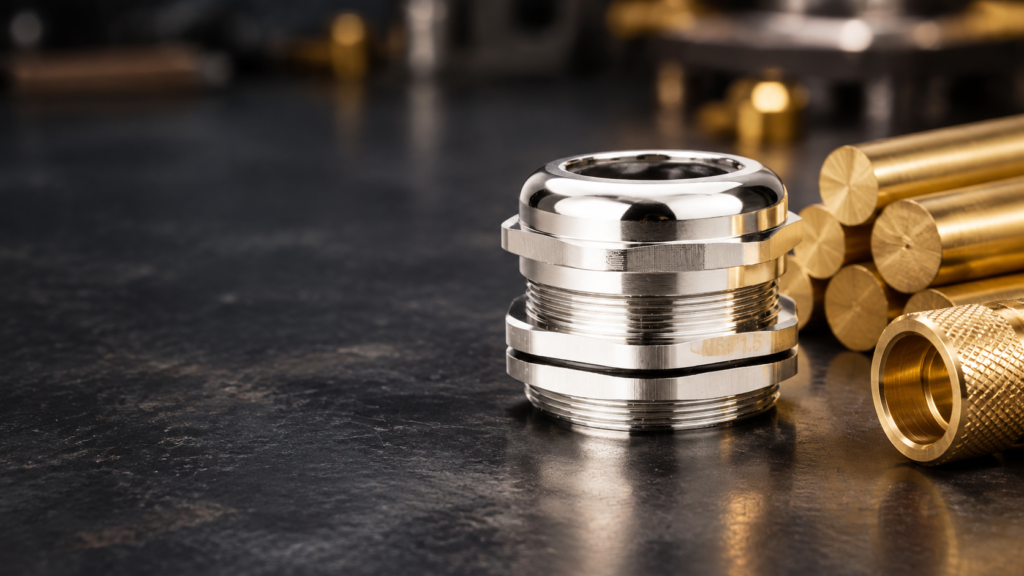
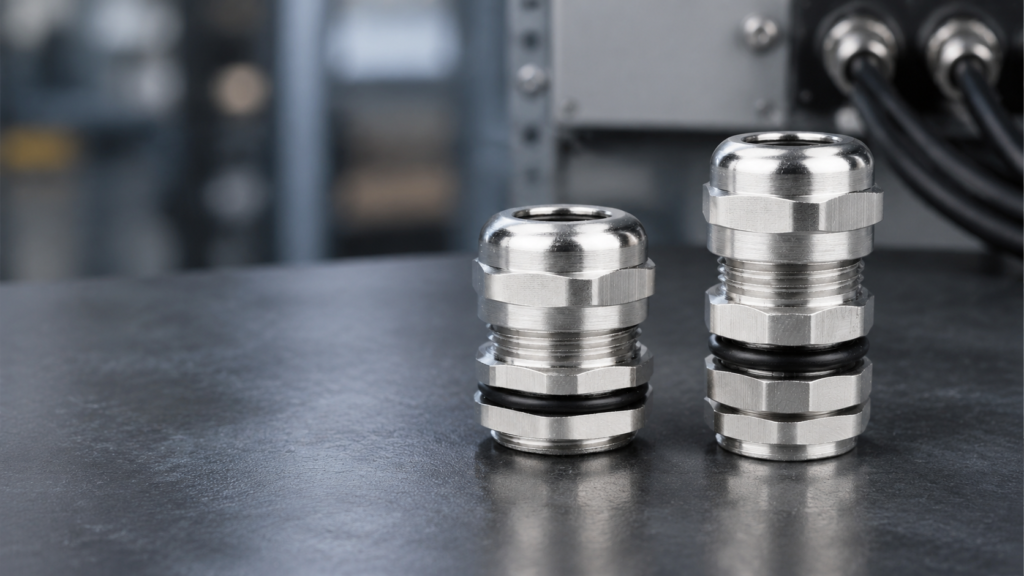
A brass cable gland is a cable entry device with a brass body that clamps a cable and seals the point where it passes through an enclosure wall. The brass is usually hot forged or machined from a copper-zinc alloy, and the sealing element is a separate elastomer insert. Most brass glands are sold either bare or nickel plated, and that choice is a corrosion decision rather than a cosmetic one.
The material is the reason the product exists in the shape it does. Brass machines and forges cleanly, holds a precise thread, takes load without cracking and conducts well enough to act as part of the bonding path. Those properties are why brass became the default body material for industrial cable entry, and why it still is on most projects.
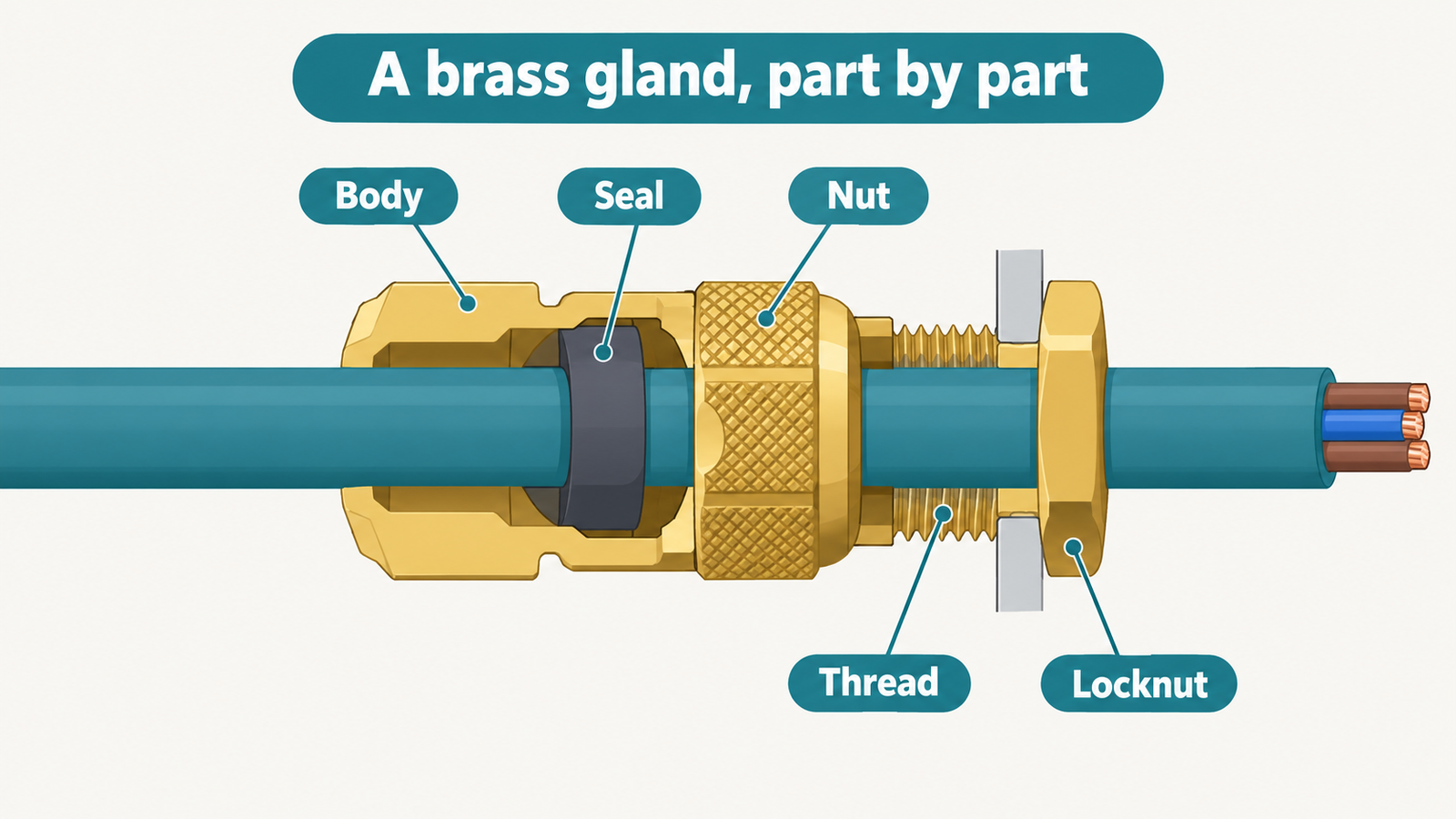
Construction is simpler than it looks. A forged or machined body carries the entry thread on one side and the compression thread on the other; an elastomer insert sits inside the nut and is squeezed as the nut advances; a locknut and earth tag complete the installation. There are no adjusters and no orientation requirements, which is why a brass gland can be fitted by any competent electrician without special tooling. That simplicity is also why most installation failures are user errors rather than product faults.
A brass gland is a small number of parts, each with one job.
Why Brass and Not Steel, Plastic or Aluminium
Every alternative wins somewhere, and knowing where brass loses is more useful than a list of its advantages.
Материал
Where it wins
Where it loses
Латунь
Strength, thread precision, temperature range, bonding, machined finish
Chlorides and ammonia attack it; heavier than nylon
Nickel plated brass
Same as brass with a harder, more corrosion resistant surface
Plating can be damaged at threads and wrench marks
Нержавеющая сталь
Chlorides, washdown, marine, higher temperatures
Cost, galling risk, harder to machine fine threads
Нейлон
Cost, weight, insulation, high entry density
Lower temperature ceiling, lower mechanical strength, no bonding
Aluminium
Light weight in large sizes
Corrosion in wet and chloride atmospheres, soft threads
Two of those losses deserve attention because they cause field failures rather than merely higher cost. Brass under continuous chloride exposure can dezincify: the zinc leaches out and leaves a porous copper-rich structure that looks intact until it crumbles. That is not surface tarnishing, and it is not fixed by cleaning. The second is that nylon, being an insulator, cannot contribute to a bonding path at all, which rules it out wherever the gland is part of the earth continuity arrangement.
There is a third property that rarely appears on a datasheet and matters on site: brass threads do not gall the way stainless threads do. Stainless against stainless can seize under torque, especially on large sizes and in damp conditions, and a seized gland has to be cut off. Brass run onto a steel or brass enclosure thread turns freely and repeatedly, which makes it the easier material for maintenance work and for anything that will be opened more than once.
The Four Functional Families
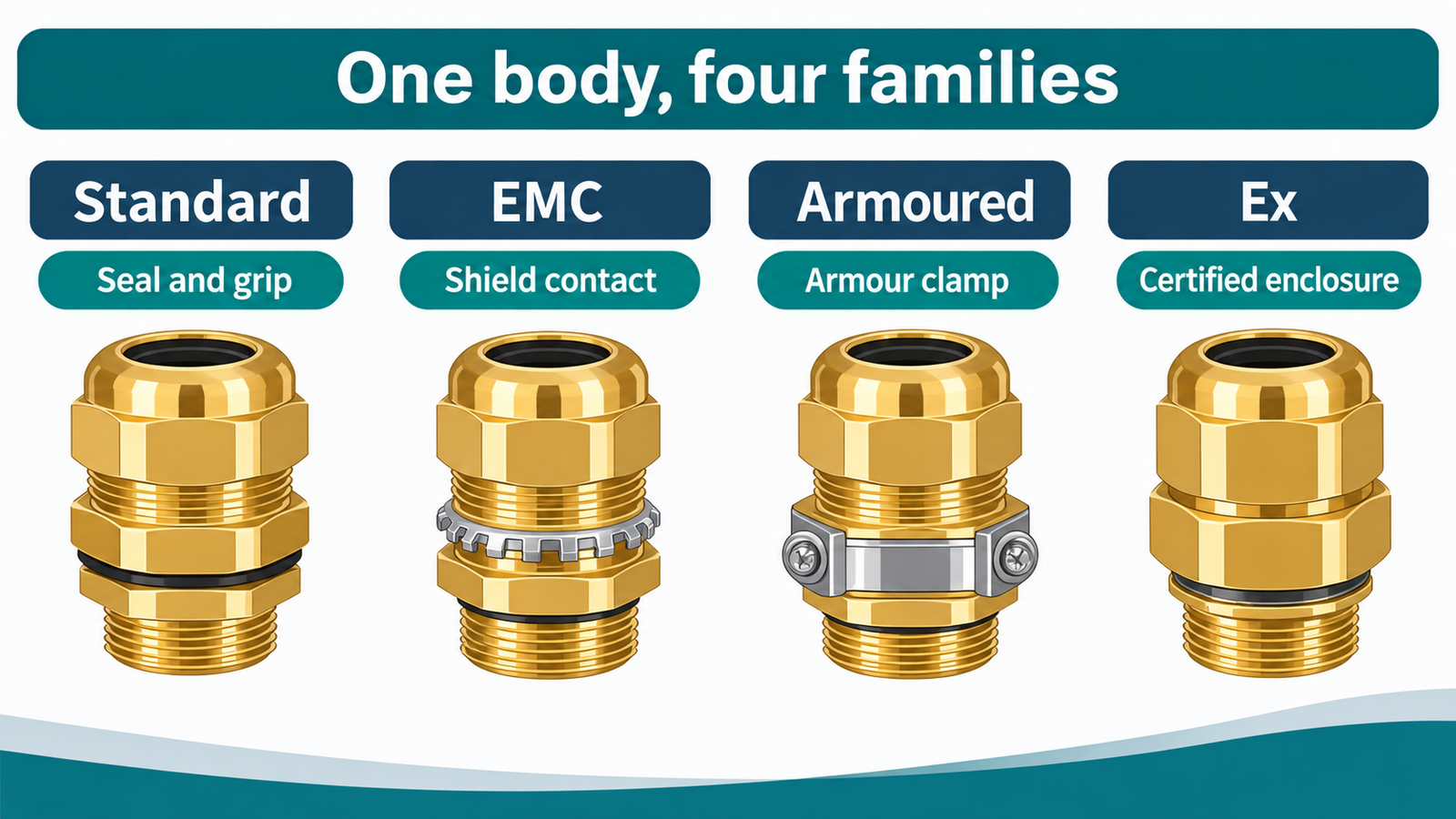
Brass glands are commonly grouped by what they add beyond sealing and gripping. The body material is shared; the internal parts and the certification are not.
One body material, four different jobs.
Family
What it adds
Typical use
Standard compression
Seal and strain relief on unarmoured cable
Panels, junction boxes, general industrial
EMC
360° contact to a cable screen, bonded to the enclosure
VFD motor feeds, instrumentation, screened cable
Armoured
Armour clamp and bond, with one or two seals
SWA and STA cable, outdoor and buried runs
Ex
Certified construction for a hazardous area, with a declared protection concept
Oil and gas, chemical, dust environments
Most specifications are really a choice between these four, with the thread and size settled afterwards. Getting the family wrong is more expensive than getting the size wrong, because a standard gland cannot be made into an EMC or armoured one after delivery. The armoured family in particular has its own clamping anatomy and sizing logic, covered in what an armoured cable gland does and the SWA selection guide.
Plated or Unplated: What Nickel Actually Changes
Nickel plating puts a harder, more chemically resistant layer over the brass. It improves appearance retention, resists mild chemical splash and reduces the chance of a decorative or functional failure on visible outdoor equipment. It does not turn brass into stainless steel, and it does not survive damage to the coating.
The practical rule is to specify plating where the entry is visible and moderately exposed, and to move to stainless where the exposure is severe or continuous. The full comparison, including how plating fails and what to ask for on a purchase order, is in the nickel plated brass guide.
Threads, and Why the Wrong One Is the Costliest Mistake
Brass glands are made in four thread families, and they are not interchangeable even when the nominal size looks close. A gland that does not match the enclosure entry cannot be adapted in the field without a certified reducer, and an uncertified reducer is itself a defect.
Нить
Common on
What to watch
Метрическая (M)
European and Asian equipment, most new panels
Thread pitch is standard but thread length varies by maker
PG
Older European equipment, legacy machinery
Not dimensionally equivalent to metric, despite similar sizes
NPT
North American equipment
Taper thread; sealing depends on engagement, not on a gasket
G (BSP)
Process and instrumentation equipment
Straight thread with a sealing washer; not interchangeable with NPT
Сайт thread types guide covers the dimension tables and the conversion traps in detail. The short version is that the enclosure entry is the fixed constraint and the gland follows it, not the reverse.
Temperature and Environment Limits
Standard brass glands with elastomer seals are generally rated from about −40 °C to +120 °C. That covers most industrial work and comfortably exceeds what nylon can take, which is roughly −40 °C to +100 °C with a short-term excursion above that.
The temperature limit is rarely set by the brass. It is set by the elastomer, so a gland quoted for a higher temperature usually means a different seal material rather than a different body. If an application runs hot, ask which seal compound is fitted and what the resulting rating is, rather than assuming the body material defines the number.
Selecting in Five Steps
Шаг
Question
Decides
1
What cable construction is it?
Family: standard, EMC, armoured or Ex
2
What thread does the enclosure have?
Thread form and size
3
What is the measured cable diameter?
Gland size within the family
4
What is the environment?
Brass, nickel plated brass or stainless; IP class
5
What must be in the kit?
Locknut, earth tag, shroud, sealing washer
The order matters. Sizing before choosing the family produces a part number that fits the cable and cannot do the job. Sizing before confirming the thread produces the opposite problem. Doing steps one and two first makes the remaining three quick.
One habit worth breaking is sizing from a cable drum label or from the diameter in a bill of materials. Both are nominal, and both are frequently a size off what the installed cable actually measures. Measure the cable, including any tape or bedding that sits under the compression, and choose the gland whose range contains that measurement with margin at each end rather than sitting on a limit. The same measurements feed the thread types guide when the enclosure entry and the gland do not obviously correspond.
Where Brass Is the Wrong Choice
Brass is the default, not the universal answer. Four situations should push the specification elsewhere.
Continuous chloride or ammonia exposure — dezincification risk, and no plating thickness fixes a chemical incompatibility.
Marine and offshore atmospheres — stainless steel is the practical answer, and 316L rather than 304 where chlorides are present.
Washdown with caustic or acidic cleaners — the cleaner attacks the body, not just the finish.
Sustained temperatures above the elastomer rating — the body survives; the seal does not.
In each case the honest recommendation is to change material rather than to add a coating. The stainless steel range covers the sizes and thread forms that replace brass directly.
Price, MOQ and What Drives the Cost
Brass gland pricing is driven by size, family, plating and certification, in roughly that order. Small standard sizes in high volume are commodity items; certified Ex products are not.
Тип
Specification
Typical application
Indicative FOB price
Standard brass
Metric and PG, IP68, nickel plated option
Panels, junction boxes, general industrial
US$0.08–1.20
EMC brass
360° contact spring, shielded cable
VFD feeds, instrumentation
US$0.90–6.50
Armoured brass
Armour clamp, single or double seal
SWA and STA cable
US$1.20–7.50
Ex brass
Certified, declared protection concept
Hazardous areas
US$2.50–14.00
Indicative FOB Ningbo or Shanghai, based on 1,000 pieces per size for brass and 300 pieces per size for Ex, with Ex quantities also quoted at 300 pieces. Actual pricing depends on size mix, plating and order quantity.
Minimum order quantity for brass is normally 1,000 pieces per size with no tooling charge, and trial orders of 100 to 500 pieces are usually accepted at a slightly higher unit price. Stainless and Ex products start at 300 pieces per size. Plating adds cost per piece rather than per order, so it is worth deciding early rather than switching after the quotation.
What to Ask Any Supplier
Which alloy, and is the body forged or machined?
Is the plating thickness stated, and to which standard?
Which seal compound is fitted, and what temperature range does that give?
Which IP class is the assembled gland tested to, and under what conditions?
What exactly is in the kit, and what is quoted separately?
Which certificates accompany the shipment?
These six questions separate a catalogue item from a specified component, and the answers are usually enough to tell whether the supplier understands the product. For the wider picture of how brass compares with the other body materials, the brass gland range and the cable gland overview are the natural next reads.
Вы когда-нибудь задумывались, как эти, казалось бы, незначительные маленькие устройства обеспечивают сохранность и надежность кабелей во влажной или суровой среде? В этом и заключается секрет водонепроницаемого кабельного ввода. Выступая в роли "привратника" для кабелей, входящих и выходящих из оборудования, он не только обеспечивает надежное соединение, но и защищает кабели от влаги, пыли и [...]...
A brass waterproof cable gland helps protect cable entries from water, dust, and strain in industrial and marine installations. Learn how to choose the right model, size, and supplier.
Single compression uses one elastomer seal to both grip and seal the cable; double compression splits those duties across two seals. Here is where the difference decides an installation.
Мы используем файлы cookie для улучшения вашего восприятия, предоставления персонализированной рекламы или контента, а также для анализа нашего трафика. Нажав кнопку "Принять все", вы соглашаетесь с использованием нами файлов cookie.