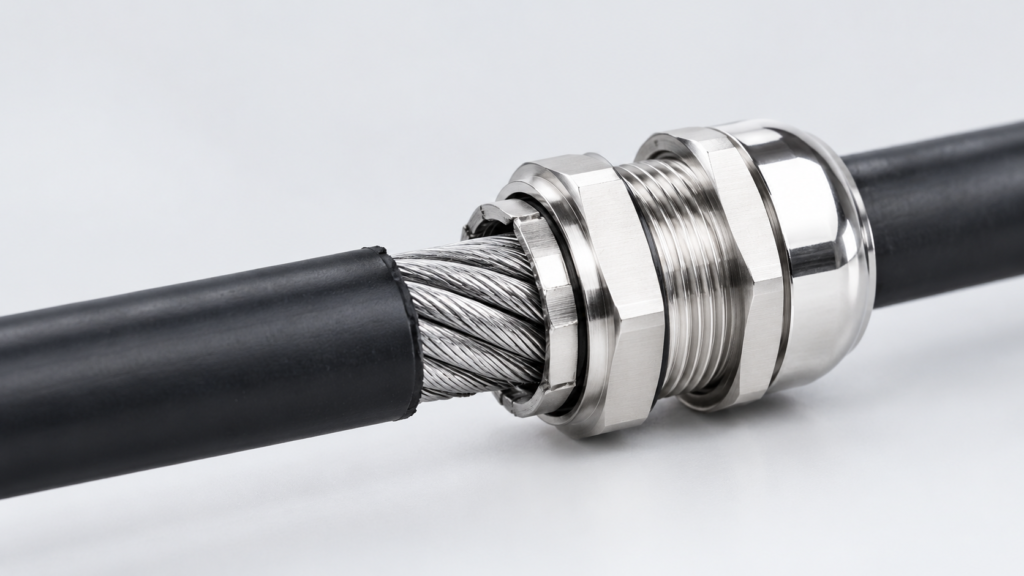
An armoured cable gland is a cable entry device that terminates a cable with metallic armour — steel wire, aluminium wire or steel tape — by gripping that armour, bonding it to the enclosure earth and sealing the cable where it enters the box. That combination separates it from a standard compression gland, which cannot substitute for it even when the thread and diameter match.
Three duties define the product, and every selection question comes back to them:
Mechanical retention — the armour is clamped, so pulling or vibration loads the enclosure, not the terminals.
Electrical bonding — the armour is a conductive path to earth, and the gland closes that path.
Environmental sealing — the sheath, and on some types the bedding as well, is sealed so water cannot track inside the armour.
Why a Standard Cable Gland Cannot Terminate Armoured Cable
A standard gland seals around one round surface — the outer sheath. An armoured cable has an extra metallic layer between the bedding and the sheath, so a standard gland has nothing to grip and nothing to bond. Three failures follow, usually years apart:
The armour is left floating. The wires are neither fixed nor earthed, so the fault path through the armour does not exist.
Non-compliance at handover. Wiring rules such as IEC 60364 and BS 7671 require the armour, where it acts as a protective conductor, to be bonded at the gland. Earthing clamps and tape wraps do not achieve this.
Slow cable damage. Loose wires move with vibration and can pierce the bedding from the inside.
A fourth failure is less visible: water entering an unsealed outdoor entry wicks along the wire cage to the enclosure, which is why wet terminal boxes are often a gland problem. The basic кабельный ввод principles are unchanged; what is added is a clamping and bonding stage.
What Is Inside an Armoured Cable Gland
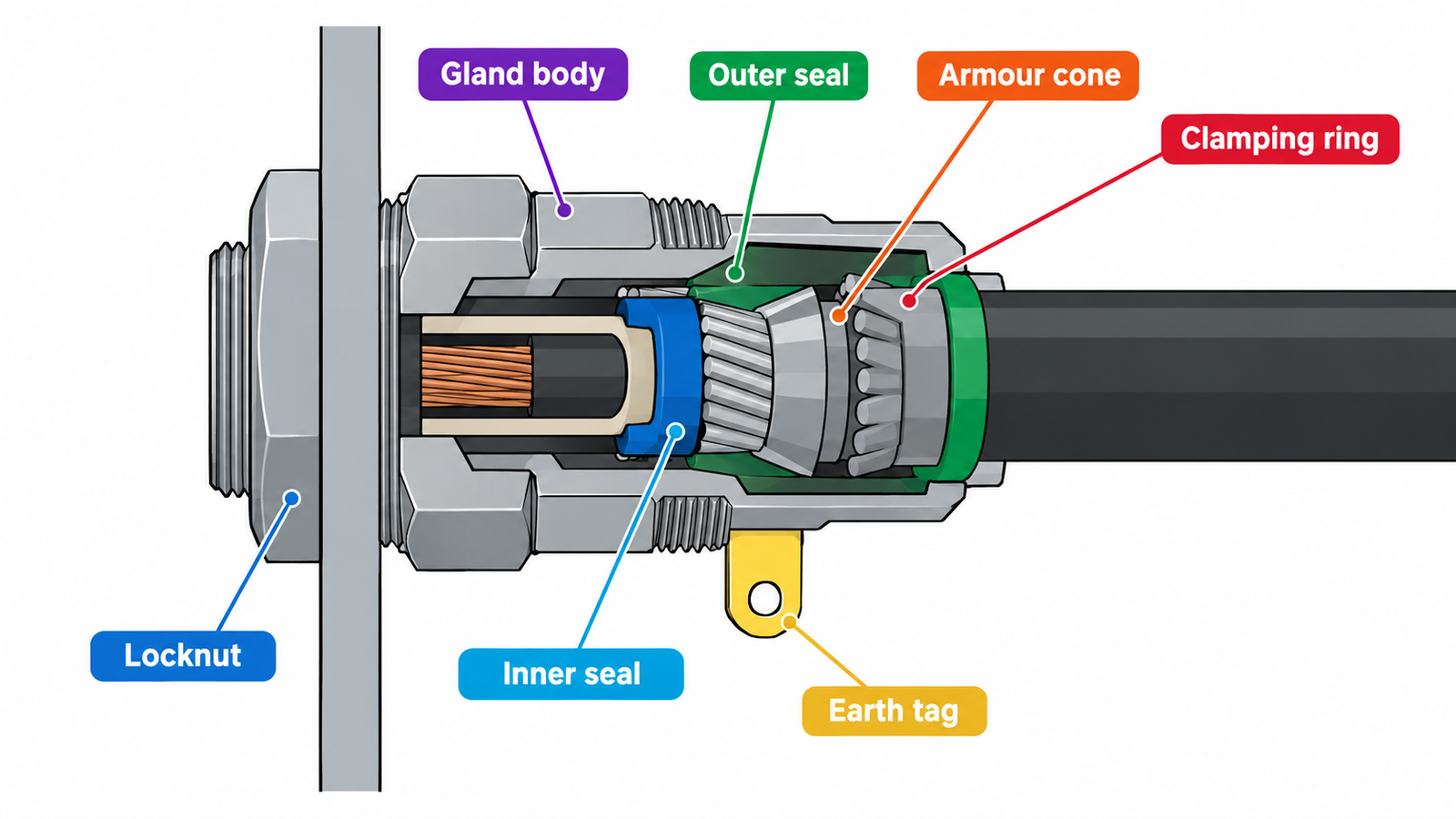
Most armoured glands use the same stack of parts. Names vary between manufacturers — the brass range calls them armour cone, clamping ring and outer seal — but the function of each part does not.
What each part of an armoured cable gland does.
Part
What it does
Symptom when it is wrong
Gland body
Carries the entry thread and holds the assembly together
Thread mismatch with the enclosure entry
Armour cone
Wedges between or under the armour wires or tape
Armour slips; no pull-out resistance
Clamping ring / nut
Applies radial force that locks the armour onto the cone
Over-tightening crushes the bedding
Inner seal
Seals against the bedding under the armour
Leak path inside the armour; water reaches the box
Outer seal
Seals against the outer sheath over the armour
Entry is not weatherproof
Контргайка
Fixes the body to the enclosure wall
Gland rotates when the cable is dressed
Earth tag / banjo
Bonds the armour to the enclosure earth bar
Armour continuity fails at the enclosure
Shroud
Mechanical and moisture protection over the assembly
Must be fitted onto the cable before the body
The seals and the cone touch the cable, so they decide compatibility: a gland matching the thread but not the cone geometry will tighten correctly and still fail.
Armour Type Comes First: SWA, AWA, STA and Braided
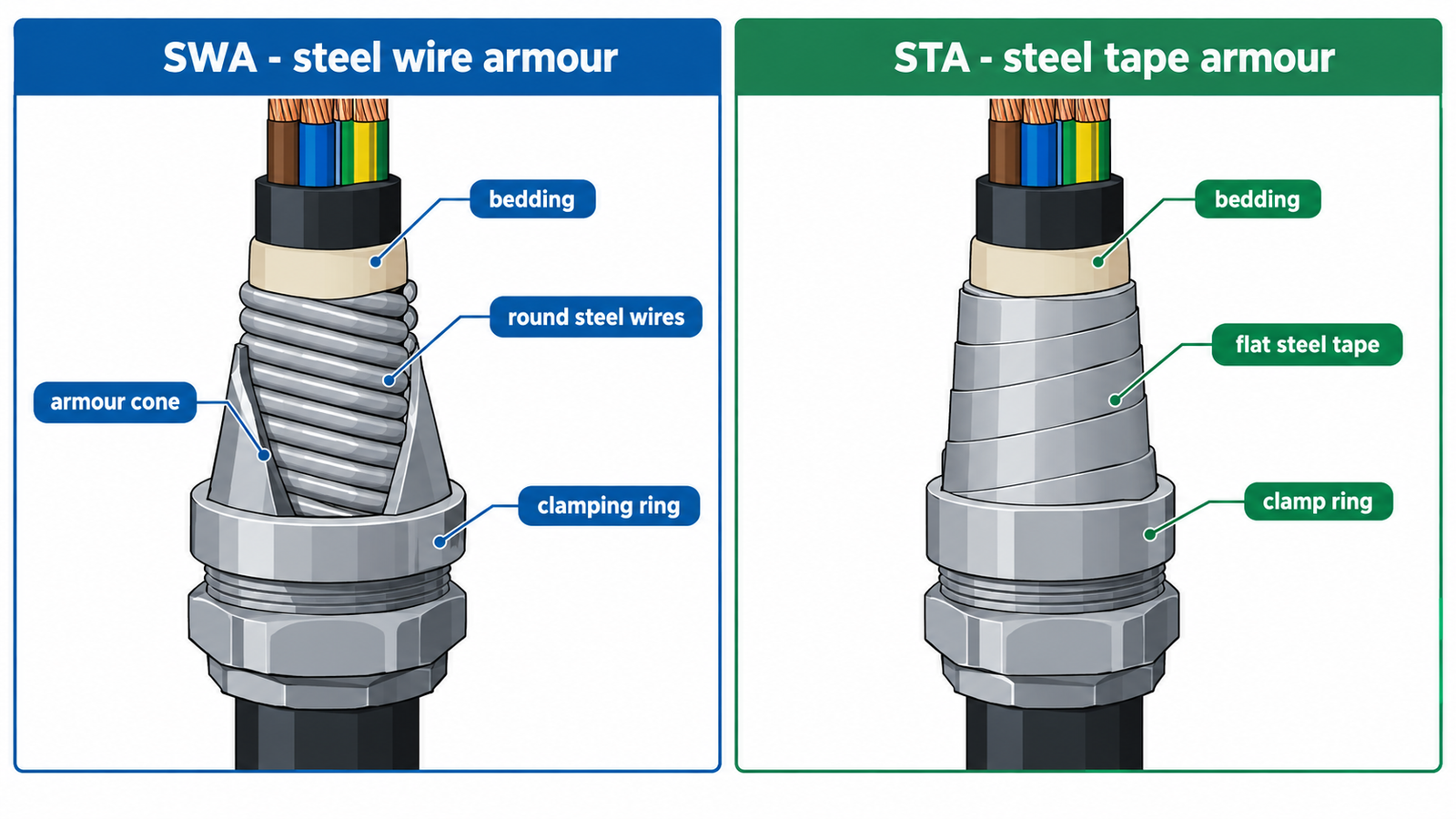
Before gland sizes, confirm the armour under the sheath. Strip back the outer sheath and the answer is visible: round wires wound helically, flat tape wrapped circumferentially, or a woven braid. Armour geometry sets the clamping geometry, and glands are not interchangeable between armour types.
SWA wire armour is gripped by a cone; STA tape armour by a flat clamp ring.
Armour type
What you see after stripping
How the gland clamps it
Typical use
SWA — steel wire armoured
Round steel wires wound helically over the bedding
A cone that wedges between individual wires, closed by a clamping ring
Buried runs, building sub-mains, motor feeders
AWA — aluminium wire armoured
Round aluminium wires, the same lay as SWA
Wire-armour geometry, specified for aluminium to avoid galvanic corrosion at the joint
Lightweight power and control runs
STA — steel tape armoured
Flat metallic tape wrapped circumferentially
A flat clamp ring that compresses the tape against the body
Indoor trays and ducts, tighter bend radii
Braided / screened
Woven metallic braid over the bedding
A braid trap or ferrule that folds the braid onto a contact surface
Instrumentation and signal cables
Buy against the cable’s construction, not its part number: a SWA gland on an STA cable is a correct thread with the wrong gripping mechanism.
What the Gland Type Letters Actually Mean
The letter codes — BW, CW, E1W — are usually described as indoor and outdoor types, but that is a side effect. They tell you which surfaces the gland seals and which it only grips, which is what matters on a wet or heavy-duty site.
Тип
Armour clamping
Sealing stage
Where it belongs
BW
Да
No outer sheath seal; shroud only
Dry indoor entries, panels and cabinets
CW
Да
Outer sheath seal
Outdoor, dusty or damp entries
E1W
Yes, with retention
Inner and outer seal
Exposed, heavy-duty and vibrating entries
Double compression
Yes, dual stage
Armour grip plus inner and outer compression
Large cables, hazardous areas, high vibration
Barrier / certified
Да
Sealing plus a certified protection concept
Hazardous areas, where the gland carries its own ATEX or IECEx documentation
So BW and CW both clamp armour, but only CW seals the outer sheath, and E1W adds a bedding seal. Where a gland must preserve an enclosure’s protection concept, the same logic applies inside the certificate: a CMP-style certified gland is not a CW body with a different label. Body material follows the environment, not the armour: a кабельный ввод из нержавеющей стали suits chloride, offshore and washdown exposure. Markings follow EN 50262 and IEC 62444.
Two Diameters Decide the Gland Size
Most armoured gland selections go wrong here. A gland is sized against two cable diameters: the diameter over the bedding, which the inner seal and inner compression stage act on, and the overall diameter over the outer sheath, which the outer seal grips.
A datasheet lists a bedding range, an overall range and an armour range for every size. Select on overall diameter alone and you can land on a size whose inner seal cannot close on the bedding: the gland threads in, the outer nut tightens, and the assembly still leaks at the inner stage.
What the datasheet lists
What it matches on the cable
If you ignore it
Cable bedding diameter range
The diameter under the armour
Inner seal cannot close; leak path along the armour
Overall cable diameter range
The diameter over the outer sheath
Outer seal over- or under-compresses
Armour range
Wire diameter or tape thickness and lay
Cone cannot grip; no retention or continuity
Measure both with a caliper on a cut sample rather than a nominal figure. Bedding diameter changes with core count at the same conductor size, so gland size is a cable property before it is a thread property.
Bonding the Armour: Both Ends, and When the Armour Is Not the CPC
Armour is a conductor, not a shield, and that decides how it is bonded. A screen is bonded to manage interference, and single-end bonding can be a legitimate EMC choice, as explained for shielded cable gland installations. Armour carries fault current, so the default is bonding at both ends and at every gland, with an earth tag or banjo under the locknut and a tail to the enclosure earth bar.
Two qualifications belong on the spec sheet:
Armour as protective conductor is conditional. Where national wiring rules allow this, the permission depends on the armour’s cross-section meeting the fault-current requirement for the circuit. Below that threshold a separate core is required, terminated inside the enclosure rather than on the gland.
Continuity is an assembly property, not a product property. A certified gland on a loose cone, painted mating faces or a deformed bedding does not deliver the earth path it was tested with. Verify continuity with a low-resistance measurement after tightening.
Motor feeders sit at that intersection: an armoured motor cable needs armour bonding for safety and correct screen termination for drive compatibility, covered in the VFD cable gland guidance.
Common Mistakes and Honest Limits
The recurring problems are selection and assembly errors, not product defects:
Fitting the shroud after the gland body — on most designs it can only go onto the cable first.
Over-tightening the clamping ring to stop a leak, which deforms the bedding and destroys the inner seal.
Using a BW body outdoors and expecting a weatherproof entry; that type does not seal the outer sheath.
Substituting a fibre indoor washer for a neoprene outdoor washer.
Treating the earth tag as optional where the armour is the protective conductor.
What an armoured gland will not do matters just as much. It cannot upgrade undersized armour into a compliant protective conductor, cannot correct a damaged bedding, and will not deliver the enclosure’s ingress protection if the entry thread is unsealed — the finished Степень защиты IP is set by the gland, the washer and the enclosure together. Nor does it make a hazardous-area installation compliant unless the gland is certified. Tightening values come from the datasheet, not from feel; where none is published, the criteria are that the cone grips the armour without crushing it, the cable neither rotates nor pulls out, and continuity is verified.
How to Specify an Armoured Cable Gland for a Project
An enquiry carrying these lines can be quoted without clarification. Read them from the datasheet and a cut sample, not the drum label.
#
Data required
Where it comes from
1
Armour type (SWA, AWA, STA, braided)
Cut sample; cable datasheet
2
Diameter over the bedding
Caliper on a cut sample
3
Overall diameter over the sheath
Caliper on a cut sample
4
Armour wire diameter or tape thickness
Cut sample; cable datasheet
5
Entry thread type and size
Enclosure drawing
6
Sealing stage required (BW / CW / E1W)
Environment and IP requirement
7
Body material and finish
Corrosion exposure
8
Certification needed, if hazardous area
Area classification and enclosure certificate
Brass armoured glands are normally quoted with a minimum order quantity per size; stainless steel and certified types are quoted at a lower minimum because they are built to order. The figures below are indicative for budgeting.
Тип
Specification
Typical application
Indicative FOB price
BW / CW brass armoured gland
Armour clamping; outer sheath seal on CW
SWA and STA entries, indoor to outdoor
US$1.20 – 4.80
E1W brass armoured gland
Inner and outer sealing, double compression
Exposed, heavy-duty and vibrating entries
US$2.40 – 7.50
Stainless steel 316L armoured gland
Same function set in an SS316L body
Offshore, chemical and washdown entries
Quoted per size
Indicative FOB Ningbo / Shanghai for nickel-plated brass at 1,000 pcs per size. Stainless steel and certified hazardous-area types are quoted from 300 pcs per size and are confirmed against a live quotation.
The takeaway: an armoured cable gland is a three-function part — grip the armour, bond the armour, seal the sheath — and every question resolves to which the site needs. Confirm the armour construction and both cable diameters first, choose the sealing stage that matches the environment, then match the entry thread to the enclosure. Where a project mixes SWA and STA cables, or indoor and outdoor entries on one board, treat them as separate line items with their own type codes. On certified work, start from a hazardous area selection review rather than a product list.
Часто задаваемые вопросы
What is the difference between an armoured cable gland and a standard cable gland?
A standard gland grips and seals the outer sheath only. An armoured gland adds a clamping stage that holds the steel wire or tape mechanically and bonds it to the enclosure earth.
Can I use a standard gland on SWA cable if the thread and diameter match?
No. The armour would be left unclamped and unearthed, removing both the mechanical retention and the earth path. A matching thread and diameter does not create a way to grip the armour.
Does armoured cable armour have to be earthed at both ends?
Where the armour acts as the circuit protective conductor, the default is bonding at every gland at both ends of the run, because it carries fault current rather than managing interference. Single-end bonding belongs to screens and shields.
How do I know whether I need BW, CW or E1W?
Read the letters as sealing stages. BW clamps armour but does not seal the outer sheath, so it suits dry indoor entries. CW adds an outer sheath seal for outdoor and damp locations. E1W adds an inner seal on the bedding, which exposed and heavy-duty entries usually require.
Are armoured cable glands available in stainless steel?
Yes. The armour clamping geometry is the same, but an SS316L body is specified where chlorides, offshore atmospheres or washdown would attack a plated brass body. Stainless steel types are quoted per size rather than held in stock.
When I speak with buyers, I notice the same pattern again and again: everyone asks for a “Waterproof Cable Gland” but what they actually need is a reliable sealing solution that matches cable size, enclosure type, operating environment, and purchasing risk. That is exactly why choosing among waterproof cable gland suppliers is not a small […]
Узнайте, как установить водонепроницаемые кабельные вводы с помощью пошаговых руководств для обеспечения герметичности IP68 с использованием нейлоновых латунных или нержавеющих стальных вводов от GHX.
Выбор правильного водонепроницаемого кабельного ввода имеет решающее значение для обеспечения безопасности и долговечности ваших электрических и промышленных установок. Эти маленькие, но мощные компоненты защищают кабели от воды, пыли и вредного воздействия окружающей среды, что делает их незаменимыми во многих отраслях - от телекоммуникаций до морской и тяжелой промышленности. Но как выбрать правильный уровень защиты и [...].
Мы используем файлы cookie для улучшения вашего восприятия, предоставления персонализированной рекламы или контента, а также для анализа нашего трафика. Нажав кнопку "Принять все", вы соглашаетесь с использованием нами файлов cookie.