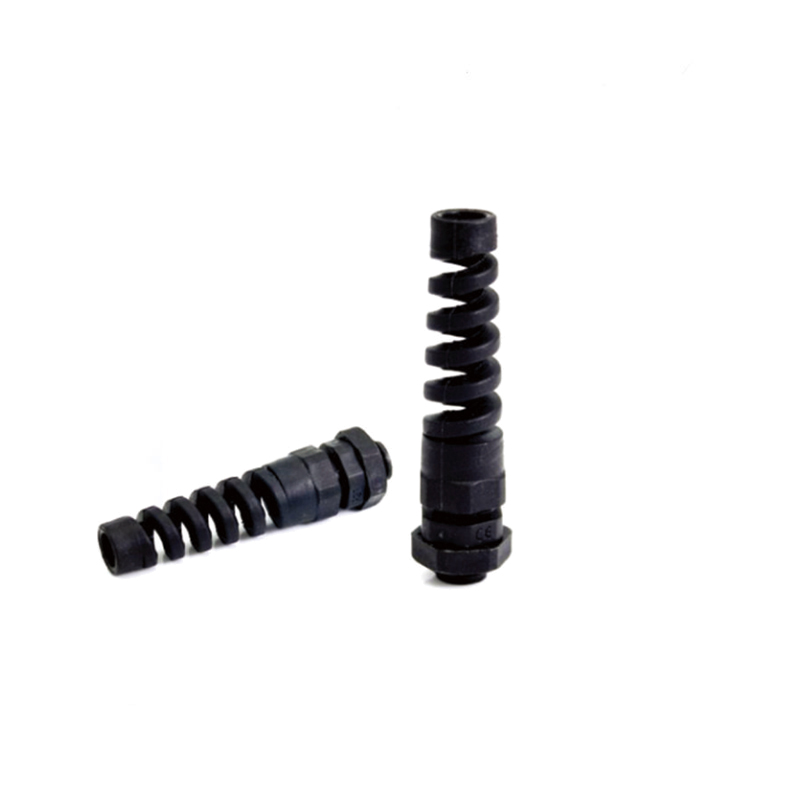
Presse-étoupe étanche
Cable Gland Earthing and Bonding Guide
Earthing and bonding do different jobs. The three return paths a gland can provide, the seven interfaces that break continuity, and how to test them on site.
Lire la suite

Presse-étoupe étanche jouent un rôle indispensable dans les équipements électriques industriels et commerciaux modernes. Non seulement ils protègent les entrées de câbles de la poussière et de l'humidité, mais ils garantissent également la sécurité de l'équipement et prolongent sa durée de vie. Le choix du bon indice IP pour un presse-étoupe étanche permet d'éviter efficacement les pannes électriques ou les incidents de sécurité causés par des environnements difficiles.
Si vous avez déjà hésité sur l'indice IP à choisir ou si vous ne savez pas comment décider en fonction de votre environnement d'application, cet article est fait pour vous. Voyons comment juger et sélectionner le presse-étoupe étanche le mieux adapté à votre projet.
Protégez vos câbles "de manière stable et sûre" - en commençant par le bon choix de l'indice IP !
L'indice IP (Ingress Protection) est défini par la norme internationale EN 60529 et mesure la capacité d'un produit à résister aux objets solides et aux liquides. Il se compose de deux chiffres :
| Code IP | Protection contre les solides | Protection contre les liquides |
|---|---|---|
| IP65 | Totalement étanche à la poussière | Protégé contre les jets d'eau |
| IP66 | Totalement étanche à la poussière | Protégé contre les jets d'eau puissants |
| IP67 | Totalement étanche à la poussière | Protégé contre l'immersion temporaire (1m, 30 mins) |
| IP68 | Totalement étanche à la poussière | Protégé contre l'immersion continue |
L'indice IP indique le niveau de protection contre la poussière et l'eau qu'offre un presse-étoupe étanche, ce qui constitue une référence essentielle pour la sélection.

Les différents indices IP correspondent à différents niveaux de protection et environnements d'utilisation prévus :
| Indice IP | Aperçu de la protection | Cas d'utilisation typiques |
|---|---|---|
| IP65 | Résistant à la poussière et aux jets d'eau | Utilisation générale en extérieur, jardins, éclairage public |
| IP66 | Résistant à la poussière et aux jets d'eau puissants | Sites industriels extérieurs, environnements soumis à de fortes pluies, machines |
| IP67 | Résistant à la poussière et à l'immersion temporaire | Accumulation temporaire d'eau, zones sujettes aux inondations |
| IP68 | Résistant à la poussière et à l'immersion continue | Équipements sous-marins, plates-formes offshore, conduits souterrains |
Imaginez que vous deviez installer des entrées de câbles exposées aux vents et aux vagues du bord de mer ; un IP65 ordinaire ne suffira pas. Des presse-étoupes IP66 ou IP67 seraient plus appropriés. Si votre projet nécessite une utilisation sous-marine à long terme, vous devez opter pour un presse-étoupe IP68.
An IP code is not a marketing claim — it is the outcome of a defined laboratory procedure in IEC / EN 60529. Knowing what happens inside the test chamber explains why two glands both printed “IP68” can behave very differently once installed.
What each water test actually involves
| Test code | Test method | Key test parameters |
|---|---|---|
| IPX4 | Splashing water from any direction | Oscillating tube or spray nozzle; 10 L/min; 10 minutes |
| IPX5 | Water jet | 6.3 mm nozzle; 12.5 L/min; 3 m distance; at least 3 minutes |
| IPX6 | Powerful water jet | 12.5 mm nozzle; 100 L/min; 3 m distance; at least 3 minutes |
| IPX7 | Immersion temporaire | Lowest point 1,000 mm below the water surface and highest point 150 mm below it; 30 minutes |
| IPX8 | Continuous immersion | Depth and duration agreed between manufacturer and buyer; must be more severe than IPX7 |
The IPX8 detail most buyers miss. IPX8 is the only water level in IEC 60529 where the standard leaves the numbers open. Depth and duration are “subject to agreement between manufacturer and user”, with one condition: the test must be more severe than IPX7. So 1.5 m for 30 minutes and 10 m for a week are both fully compliant, and a datasheet that says only “IP68” tells you very little. Ask for the declared depth and time in writing before you approve the drawing.
We therefore publish IP68 in three written grades rather than one vague label: IP68 – 1.5 m / 30 min, IP68 – 2 m / 24 h (the default for standard nickel-plated brass, nylon and stainless steel glands), and IP68 – 5 m / 72 h for offshore, tunnel and subsea-adjacent projects, with 10 m / 168 h available on request. When a project specifies only “IP68”, we confirm which grade is actually needed — the sealing geometry, O-ring squeeze and thread length all change with the pressure the gland has to hold.
Why an IPX7 / IPX8 sample is warmed before immersion. Immersion tests are never run on a cold, dry gland. Following IEC 60529, the assembled sample is conditioned to at least 5 °C above the temperature of the test water and immersed immediately. The cooling creates a slight negative pressure inside the enclosure — the same effect that draws water past a seal when a hot outdoor enclosure is hit by rain. A gland that survives a cold static soak can still fail this thermal-shock immersion, so we run it as part of every IP68 type test.
The first digit is tested separately. For IP6X (dust-tight) the gland is mounted on a test enclosure inside a chamber of circulating talcum powder for up to 8 hours, with a slight vacuum drawn on the enclosure so the powder is actively pulled towards the seal. “Dust-tight” means no powder is found inside at the end of the run.
The rating belongs to the assembly, not the gland alone. Every type test uses a cable — or calibrated mandrel — of the correct diameter, with the sealing nut at the specified torque. Fit an undersized or oval cable, over-tighten the nut until the seal deforms, or mount the gland on a painted enclosure face, and the tested IP68 becomes theoretical. We air-pressure decay test 100 % of production and supply the third-party IP68 immersion report with the first order, so you can compare declared test conditions against your project requirement instead of two identical-looking labels.
Le choix de la bonne classification IP ne se limite pas à la compréhension du code IP. Il faut tenir compte des facteurs clés suivants :
Suivez les étapes suivantes pour faire le bon choix :
1️⃣Évaluer les besoins environnementaux
Pensez aux défis auxquels la glande sera confrontée : pluie, brouillard, poussière, accumulation temporaire d'eau ou immersion continue ?
2️⃣Correspondre à l'indice IP approprié
| Environnement de l'application | Indice de protection IP recommandé |
|---|---|
| Intérieur général ou zones légèrement humides | IP54/IP55 |
| Protection ordinaire contre la pluie et la poussière en extérieur | IP65 |
| Jets pour environnements dangereux ou fortes pluies | IP66 |
| Formation de flaques d'eau ou inondations temporaires | IP67 |
| Utilisation continue sous l'eau | IP68 |
3️⃣Confirmer la compatibilité des matériaux et des tailles
4️⃣Prendre en compte les exigences supplémentaires
Le choix varie en fonction des besoins de l'industrie. Voici quelques cas d'utilisation typiques et les indices IP recommandés :
| L'industrie | Application typique | Indice de protection IP recommandé et matériau |
|---|---|---|
| Automatisation industrielle | Machines, panneaux de contrôle | IP66/IP67, laiton ou acier inoxydable |
| Marine et construction navale | Câbles de navires, capteurs sous-marins | IP68, acier inoxydable |
| Énergie solaire | Panneaux photovoltaïques extérieurs | IP65/IP66, plastique ou laiton |
| Communications | Stations de base extérieures, protection des câbles | IP67, plastique |
Ces exemples montrent que le choix n'est pas unique mais doit tenir compte de l'environnement d'utilisation, de la fréquence et du budget.
Choisir le bon indice de protection IP pour un presse-étoupe étanche est un processus prudent mais simple. Il a une incidence directe sur la sécurité et la stabilité des entrées de câbles et sur la fiabilité à long terme de votre équipement.
Clarifiez d'abord votre environnement d'installation et vos besoins, puis combinez l'indice IP, le matériau et la taille du câble pour prendre la meilleure décision. N'oubliez pas qu'un indice IP plus élevé n'est pas toujours meilleur - ce qui compte le plus, c'est l'adéquation.
Si vous avez besoin d'une aide rapide et précise pour trouver le bon presse-étoupe étanche, n'hésitez pas à nous contacter. Nous fournissons des conseils professionnels pour que votre projet se déroule de manière sûre et efficace.
An IP68 gland keeps its rating only while the seal is intact. Thermal cycling, UV exposure and vibration slowly harden and compress the sealing ring, so what is declared on the datasheet and what is measured at the enclosure drift apart over time. The schedule below is what we recommend to clients for waterproof cable gland installation on control panels, ducts and outdoor enclosures.
| Maintenance item | Interval | What to check and why |
|---|---|---|
| Sealing ring and O-ring inspection | Tous les 6 mois | Cracks, hardening and permanent compression set — a hardened ring can no longer follow cable movement |
| Re-torque the sealing nut and locknut | Tous les 3 mois | Thermal cycling relaxes the joint; a loose nut is the most common reason a gland only drips in heavy rain |
| Cleaning the mounting face and thread | Monthly in dusty or oily areas | Dust and oil film stop the seal seating, and hide corrosion at the enclosure thread |
| Sealing insert replacement | At every re-termination or cable change | A new insert restores the tested geometry; re-using the old one invalidates the original type test |
| Enclosure-level re-inspection | After flooding, jet-washing or impact | Check gland, gasket and enclosure face together — the rating belongs to the assembly, not to the gland alone |
Two rules matter more than the intervals themselves. First, inspect on the short side of each range where the gland sees salt spray, solvent vapour or continuous heat, and on the long side inside a dry control cabinet. Second, once a cable has been re-terminated the assembly that passed the type test no longer exists, so replace the sealing insert instead of re-tightening the old one — and record which IP68 grade the enclosure was tested to (1.5 m / 30 min, 2 m / 24 h or 5 m / 72 h) so the next inspection knows what it is protecting.
Si l'indice IP68 offre la protection la plus élevée, il est plus coûteux et nécessite une installation plus stricte. Si une immersion continue n'est pas nécessaire, les indices IP65 ou IP67 offrent une protection économique et fiable.
Choisir en fonction du diamètre maximal du câble, afin d'assurer une bonne étanchéité. Les fabricants fournissent des tableaux de dimensionnement pour faciliter l'adaptation.
Veillez à ce que la surface de montage soit propre, serrez le presse-étoupe correctement sans trop serrer et évitez d'endommager la bague d'étanchéité.
Yes — the sealing ring ages with UV, heat and chemical exposure, so an IP68 gland stays IP68 only while that ring is intact. Inspect it every 6 months and replace any hardened, cracked or permanently flattened insert. A gland that passed an IP68 immersion test in the factory is not automatically still IP68 after five years of outdoor service.
Yes. Fibre-optic and other pre-terminated cables normally use a split or slotted sealing insert so the connector can pass through without being cut off, while flat or oval cables use a profiled insert rather than a round one. Send the cable type, its outer dimensions and whether the connector has to pass through the gland, and the insert is matched to that instead of to a nominal diameter.

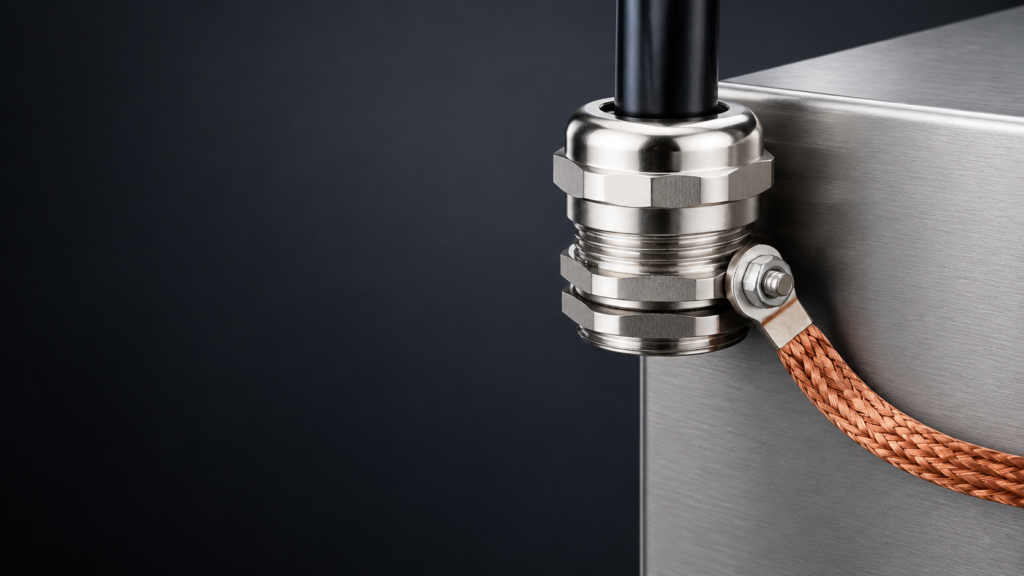
Earthing and bonding do different jobs. The three return paths a gland can provide, the seven interfaces that break continuity, and how to test them on site.
Lire la suite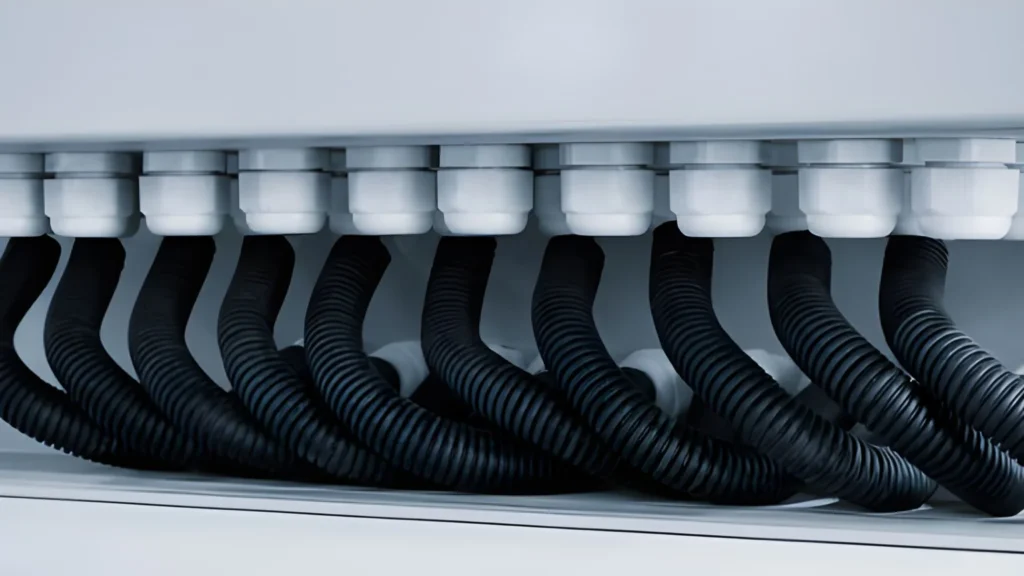
If you work in shipbuilding, port equipment, offshore systems, or coastal control cabinets, you already know one truth: water always wants in. Salt fog, vibration, UV, washdown, and tight panel space turn a simple cable entry into a surprisingly expensive weak point. That is why marine waterproof cable glands matter so much in real projects. […]
Lire la suite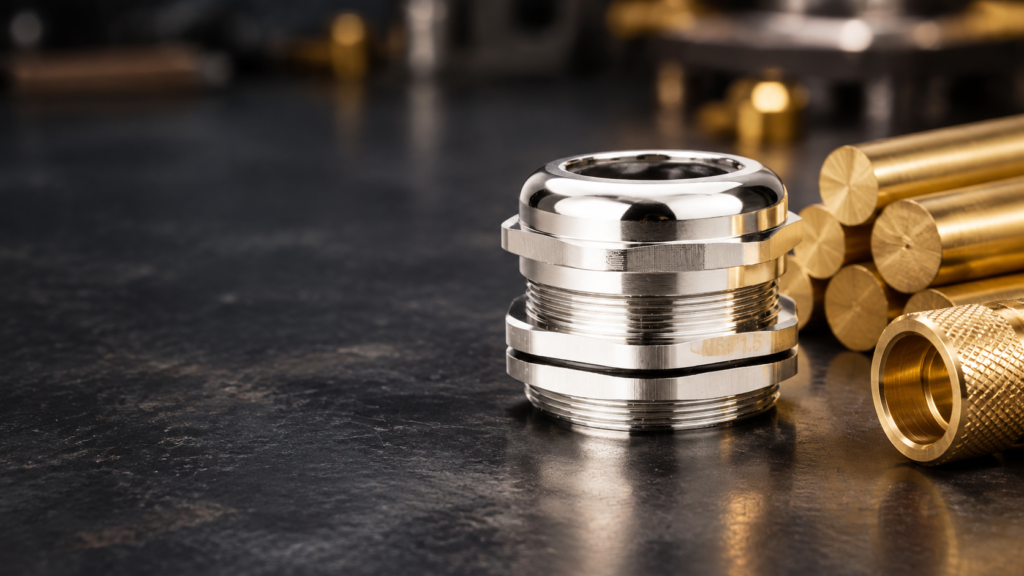
Brass is the default body material for industrial cable entry, but it is not the universal answer. What brass does well, the four functional families, how to select in five steps, and where brass is the wrong choice.
Lire la suite