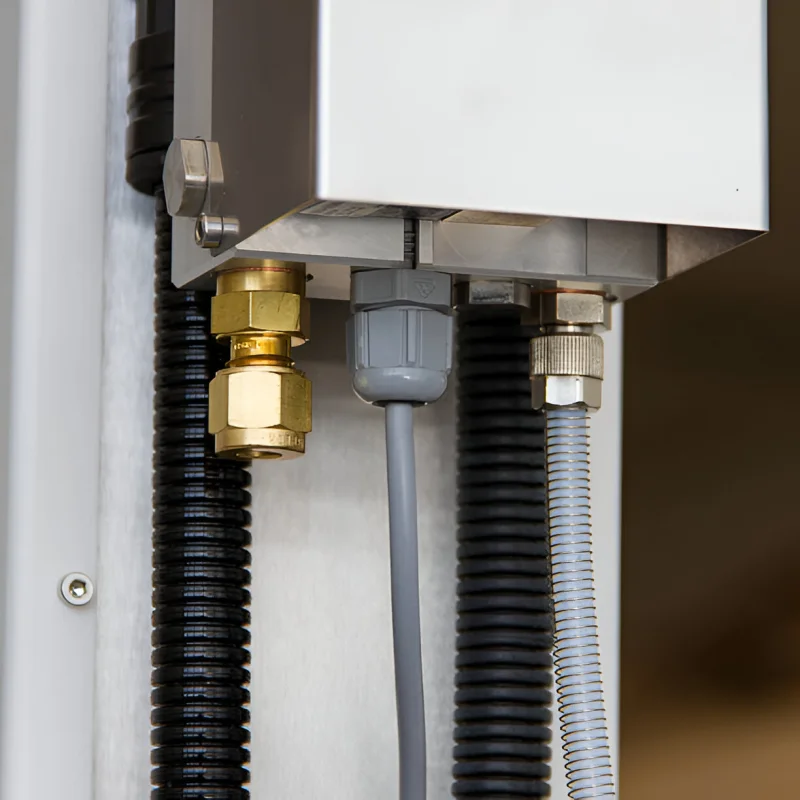
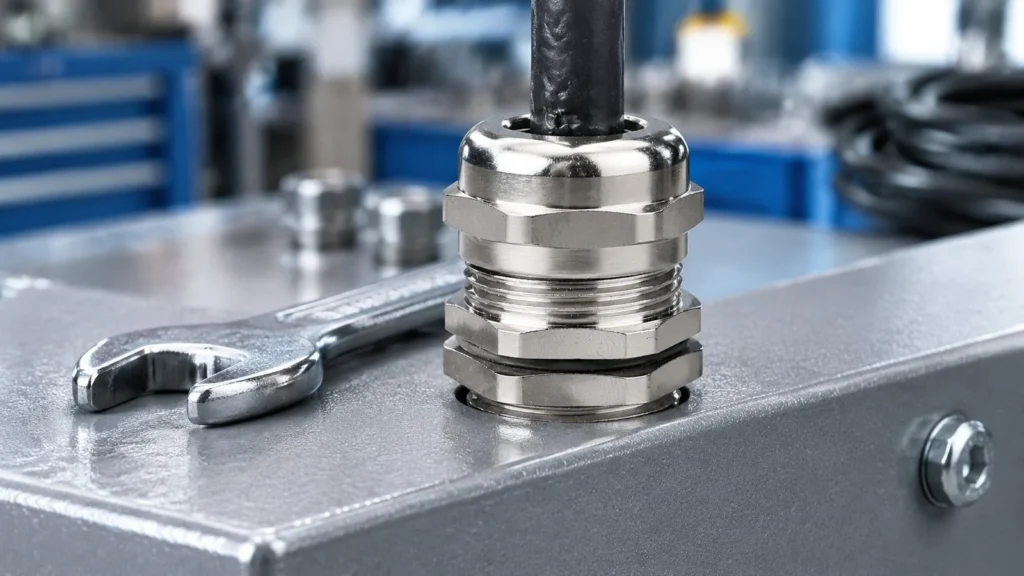
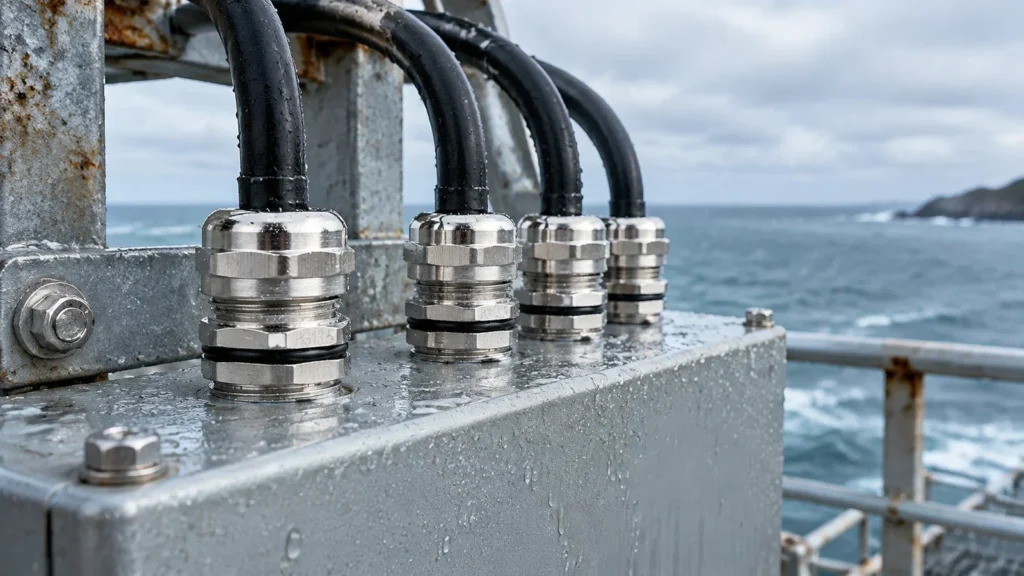
Prensa-cabos à prova d'água desempenham um papel indispensável nos modernos equipamentos elétricos industriais e comerciais. Eles não apenas protegem as entradas de cabos contra poeira e umidade, mas também garantem a segurança do equipamento e prolongam a vida útil. A escolha da classificação IP correta para um prensa-cabo à prova d'água pode evitar efetivamente falhas elétricas ou incidentes de segurança causados por ambientes adversos.
Se você já hesitou sobre qual classificação de IP escolher ou não tem certeza de como decidir com base no ambiente de sua aplicação, este artigo é para você. Vamos explorar como julgar e selecionar o prensa-cabo à prova d'água mais adequado para seu projeto.
Proteja seus cabos "de forma estável e segura", começando com a escolha da classificação IP correta!
Prensa-cabos à prova d'água Índice de proteção IP
A classificação IP, que significa Ingress Protection (proteção contra ingresso), é definida pela norma internacional EN 60529 e mede a capacidade de um produto de resistir a objetos sólidos e líquidos. Ela consiste em dois dígitos:
O primeiro dígito indica proteção contra objetos sólidos (como poeira).
O segundo dígito indica proteção contra líquidos (como água).
Código IP
Proteção contra sólidos
Proteção contra líquidos
IP65
Totalmente à prova de poeira
Protegido contra jatos de água
IP66
Totalmente à prova de poeira
Protegido contra jatos de água potentes
IP67
Totalmente à prova de poeira
Protegido contra imersão temporária (1 m, 30 min)
IP68
Totalmente à prova de poeira
Protegido contra imersão contínua
A classificação IP informa o nível de proteção contra poeira e água que um prensa-cabo à prova d'água oferece, o que é uma referência crucial para a seleção.
Explicação das classificações IP comuns de prensa-cabos à prova d'água
Diferentes classificações de IP correspondem a diferentes níveis de proteção e ambientes de uso pretendido:
Classificação IP
Visão geral da proteção
Casos de uso típicos
IP65
À prova de poeira e de jatos de água
Uso geral ao ar livre, jardins, iluminação pública
IP66
À prova de poeira e de jatos de água potentes
Locais industriais ao ar livre, ambientes com chuva forte, maquinário
IP67
À prova de poeira e de imersão temporária
Acúmulo temporário de água, áreas propensas a inundações
Imagine que você precise instalar entradas de cabos expostas a ventos e ondas do mar; o IP65 comum não será suficiente. Os prensa-cabos IP66 ou IP67 seriam mais adequados. Se o seu projeto exigir uso subaquático de longo prazo, você deverá optar por um prensa-cabo com classificação IP68.
How Cable Gland IP Ratings Are Actually Tested
An IP code is not a marketing claim — it is the outcome of a defined laboratory procedure in IEC / EN 60529. Knowing what happens inside the test chamber explains why two glands both printed “IP68” can behave very differently once installed.
What each water test actually involves
Test code
Test method
Key test parameters
IPX4
Splashing water from any direction
Oscillating tube or spray nozzle; 10 L/min; 10 minutes
IPX5
Water jet
6.3 mm nozzle; 12.5 L/min; 3 m distance; at least 3 minutes
IPX6
Powerful water jet
12.5 mm nozzle; 100 L/min; 3 m distance; at least 3 minutes
IPX7
Imersão temporária
Lowest point 1,000 mm below the water surface and highest point 150 mm below it; 30 minutes
IPX8
Continuous immersion
Depth and duration agreed between manufacturer and buyer; must be more severe than IPX7
The IPX8 detail most buyers miss. IPX8 is the only water level in IEC 60529 where the standard leaves the numbers open. Depth and duration are “subject to agreement between manufacturer and user”, with one condition: the test must be more severe than IPX7. So 1.5 m for 30 minutes and 10 m for a week are both fully compliant, and a datasheet that says only “IP68” tells you very little. Ask for the declared depth and time in writing before you approve the drawing.
We therefore publish IP68 in three written grades rather than one vague label: IP68 – 1.5 m / 30 min, IP68 – 2 m / 24 h (the default for standard nickel-plated brass, nylon and stainless steel glands), and IP68 – 5 m / 72 h for offshore, tunnel and subsea-adjacent projects, with 10 m / 168 h available on request. When a project specifies only “IP68”, we confirm which grade is actually needed — the sealing geometry, O-ring squeeze and thread length all change with the pressure the gland has to hold.
Why an IPX7 / IPX8 sample is warmed before immersion. Immersion tests are never run on a cold, dry gland. Following IEC 60529, the assembled sample is conditioned to at least 5 °C above the temperature of the test water and immersed immediately. The cooling creates a slight negative pressure inside the enclosure — the same effect that draws water past a seal when a hot outdoor enclosure is hit by rain. A gland that survives a cold static soak can still fail this thermal-shock immersion, so we run it as part of every IP68 type test.
The first digit is tested separately. For IP6X (dust-tight) the gland is mounted on a test enclosure inside a chamber of circulating talcum powder for up to 8 hours, with a slight vacuum drawn on the enclosure so the powder is actively pulled towards the seal. “Dust-tight” means no powder is found inside at the end of the run.
The rating belongs to the assembly, not the gland alone. Every type test uses a cable — or calibrated mandrel — of the correct diameter, with the sealing nut at the specified torque. Fit an undersized or oval cable, over-tighten the nut until the seal deforms, or mount the gland on a painted enclosure face, and the tested IP68 becomes theoretical. We air-pressure decay test 100 % of production and supply the third-party IP68 immersion report with the first order, so you can compare declared test conditions against your project requirement instead of two identical-looking labels.
Principais fatores que afetam a seleção da classificação IP do prensa-cabo
A escolha da classificação IP correta envolve mais do que entender o código IP. Considere estes fatores-chave:
Ambiente de instalação
Interno vs. externo
Níveis de umidade (seco, úmido, submerso)
Presença de poeira, óleo, produtos químicos
Condições adversas, como ambientes marinhos ou subterrâneos
Tipo e tamanho do cabo
Correspondência entre o diâmetro do cabo e o tamanho do prensa-cabo para garantir a vedação adequada
Vários núcleos e diferentes materiais de revestimento afetam a seleção
Escolha do material
Plástico (leve, resistente a produtos químicos, bom para cargas leves)
Latão (durável, resistente à corrosão, ideal para uso industrial)
Aço inoxidável (alta resistência, alta temperatura e resistência à corrosão, para ambientes extremos)
Temperatura e pressão de operação
As altas temperaturas exigem materiais resistentes ao calor
Ambientes com alta pressão de água ou impacto precisam de materiais mais resistentes
Requisitos à prova de explosão
Ambientes especiais (petróleo, fábricas de produtos químicos) precisam de prensa-cabos com certificação contra explosão
Etapas e sugestões para escolher o prensa-cabo à prova d'água com classificação IP correta
Siga estas etapas para fazer a escolha certa:
1️⃣Avaliar as necessidades ambientais
Pense nos desafios que a glândula enfrentará: chuva, neblina, poeira, acúmulo temporário de água ou imersão contínua?
2️⃣Corresponder à classificação IP apropriada
Ambiente do aplicativo
Classificação de IP recomendada
Áreas gerais internas ou levemente úmidas
IP54/IP55
Proteção comum para ambientes externos, chuva e poeira
IP65
Ambiente perigoso ou jatos de chuva forte
IP66
Acúmulo temporário de água ou inundação
IP67
Uso contínuo embaixo d'água
IP68
3️⃣Confirmar compatibilidade de material e tamanho
Verifique se o diâmetro do cabo corresponde ao tamanho da entrada do prensa-cabo
Escolha o material adequado com base no ambiente e no orçamento
4️⃣Considere os requisitos adicionais
Certificação à prova de explosão
Resistência a UV, resistência a óleo, resistência a produtos químicos, etc.
Estudos de caso de aplicação do setor de prensa-cabos à prova d'água
A seleção varia de acordo com as necessidades do setor. Veja a seguir alguns casos de uso típicos e as classificações de IP recomendadas:
Setor
Aplicação típica
Classificação de IP e material recomendados
Automação industrial
Máquinas, painéis de controle
IP66/IP67, latão ou aço inoxidável
Marinha e construção naval
Cabos de navios, sensores subaquáticos
IP68, aço inoxidável
Energia solar
Painéis fotovoltaicos externos
IP65/IP66, plástico ou latão
Comunicações
Estações base externas, proteção de cabos
IP67, plástico
Esses exemplos mostram que a seleção não é única, mas deve considerar o ambiente de uso, a frequência e o orçamento.
Escolhendo a classificação IP correta para um prensa-cabos à prova d'água é um processo cuidadoso, mas simples. Ele afeta diretamente a segurança e a estabilidade das entradas de cabos e a confiabilidade de longo prazo do seu equipamento.
Esclareça primeiro o ambiente e as necessidades de sua instalação e, em seguida, combine a classificação IP, o material e o tamanho do cabo para tomar a melhor decisão. Lembre-se de que um IP mais alto nem sempre é melhor - o que mais importa é a adequação.
Se quiser ajuda rápida e precisa para encontrar o prensa-cabo à prova d'água certo, entre em contato conosco. Fornecemos orientação profissional para garantir que seu projeto seja executado com segurança e eficiência.
Keeping the IP Rating After Installation: Maintenance and Inspection
An IP68 gland keeps its rating only while the seal is intact. Thermal cycling, UV exposure and vibration slowly harden and compress the sealing ring, so what is declared on the datasheet and what is measured at the enclosure drift apart over time. The schedule below is what we recommend to clients for waterproof cable gland installation on control panels, ducts and outdoor enclosures.
Maintenance item
Interval
What to check and why
Sealing ring and O-ring inspection
A cada 6 meses
Cracks, hardening and permanent compression set — a hardened ring can no longer follow cable movement
Re-torque the sealing nut and locknut
A cada 3 meses
Thermal cycling relaxes the joint; a loose nut is the most common reason a gland only drips in heavy rain
Cleaning the mounting face and thread
Monthly in dusty or oily areas
Dust and oil film stop the seal seating, and hide corrosion at the enclosure thread
Sealing insert replacement
At every re-termination or cable change
A new insert restores the tested geometry; re-using the old one invalidates the original type test
Enclosure-level re-inspection
After flooding, jet-washing or impact
Check gland, gasket and enclosure face together — the rating belongs to the assembly, not to the gland alone
Recommended inspection schedule for glands in service. Intervals follow the service environment — shorten them for coastal, chemical and high-temperature installations.
Two rules matter more than the intervals themselves. First, inspect on the short side of each range where the gland sees salt spray, solvent vapour or continuous heat, and on the long side inside a dry control cabinet. Second, once a cable has been re-terminated the assembly that passed the type test no longer exists, so replace the sealing insert instead of re-tightening the old one — and record which IP68 grade the enclosure was tested to (1.5 m / 30 min, 2 m / 24 h or 5 m / 72 h) so the next inspection knows what it is protecting.
PERGUNTAS FREQUENTES
P1: O IP68 é sempre a melhor opção?
Embora o IP68 ofereça a mais alta proteção, ele é mais caro e exige uma instalação mais rigorosa. Se a submersão contínua não for necessária, o IP65 ou o IP67 oferecem proteção econômica e confiável.
P2: Como selecionar um prensa-cabos para cabos com vários núcleos?
Escolha com base no diâmetro máximo do cabo, garantindo a vedação adequada. Os fabricantes fornecem tabelas de dimensionamento para ajudar na correspondência.
P3: Em que devo prestar atenção durante a instalação?
Certifique-se de que a superfície de montagem esteja limpa, aperte o prensa-cabos adequadamente, sem apertar demais, e evite danificar o anel de vedação.
Q4: Do waterproof cable glands lose their IP rating over time?
Yes — the sealing ring ages with UV, heat and chemical exposure, so an IP68 gland stays IP68 only while that ring is intact. Inspect it every 6 months and replace any hardened, cracked or permanently flattened insert. A gland that passed an IP68 immersion test in the factory is not automatically still IP68 after five years of outdoor service.
Q5: Are there glands for special cables such as fibre optic or flat cables?
Yes. Fibre-optic and other pre-terminated cables normally use a split or slotted sealing insert so the connector can pass through without being cut off, while flat or oval cables use a profiled insert rather than a round one. Send the cable type, its outer dimensions and whether the connector has to pass through the gland, and the insert is matched to that instead of to a nominal diameter.
Se quiser ajuda rápida e precisa para encontrar o prensa-cabo à prova d'água certo, entre em contato conosco.
Descubra os prensa-cabos bipartidos à prova d'água com classificações IP66 IP68, opções de latão de náilon e aço inoxidável, ideais para instalações de cabos pré-terminados e retrofit.
Loosening has four mechanisms, not one: transverse vibration, thermal cycling, plastic creep and assembly error. Each needs a different fix, and in a hazardous area some fixes are not allowed at all.
Salt spray hours are a screening figure, not a service life. This guide explains what the tests actually prove, how to read a pitting resistance equivalent, and the surface and geometry factors that decide whether a stainless gland survives.
Usamos cookies para aprimorar sua experiência de navegação, veicular anúncios ou conteúdos personalizados e analisar nosso tráfego. Ao clicar em "Aceitar tudo", você concorda com o nosso uso de cookies.