Most outdoor solar gland failures are not caused by a bad gland. They are caused by a gland that was correct for a rooftop in a temperate climate being installed at a coastal ground-mount site, or on a tracker, or in a desert where the enclosure runs far hotter than the air. Outdoor solar cable gland selection is a site problem before it is a product problem.
This guide works from the site inward: what each class of installation actually stresses, how the IP rating should be read as a failure mode rather than a score, and where position and service access change the answer. The range itself is covered separately, starting with the nylon cable gland range that most distributed PV projects use.
Why Outdoor Solar Is a Different Specification From Weatherproof
A weatherproof gland is asked to keep rain out for a season. An outdoor solar gland is asked to remain sealed for the life of the asset, which the industry treats as twenty-five years or more, while sitting in the one place on the site with no shade, no maintenance access and no redundancy. There is no second gland behind it.
What makes this harder than general outdoor duty is the combination. The array is exposed by design, so ultraviolet exposure is at its maximum. The equipment runs hot in sun and cold at night, so the joint cycles daily. Ground-mount and floating sites add water at the entry itself. And nothing on a solar site gets serviced, because the labour cost of reaching a combiner box in row forty exceeds the cost of the gland several times over. Selection has to assume zero maintenance.
The Site Class Decides More Than the Datasheet
Site class
Dominant stress at the entry
What that changes
Rooftop, ventilated
UV plus daily thermal cycling
UV-stabilised body; seal that tolerates compression set
Rooftop, under-panel or ballasted
Heat build-up, restricted access
Higher temperature material; specify for no maintenance
Ground mount, open field
UV, dust, driving rain, occasional standing water
IP68 with the test conditions stated; downward-facing entries
Coastal or offshore
Chloride plus humidity plus UV
316 stainless or plated brass; no unplated brass
Floating or flood-risk
Continuous humidity, partial immersion
IP68 at the deepest stated condition; EPDM seals
Tracker or single-axis mount
Movement and vibration, plus UV
Strain relief first; locking hardware second
The point of the table is that four of those six rows would be satisfied by the same part number, and two would not. Coastal and floating sites are the ones where the standard nylon gland, however well stabilised, is the wrong answer for reasons that have nothing to do with sunlight.
UV Is a Dose, Not a Label
Photodegradation is cumulative. What matters is the total radiant exposure over twenty-five years, which depends on latitude, altitude, orientation and whether the surface faces the sky or the ground. A gland on the north face of a combiner box in a temperate climate and one on a tracker in an equatorial desert do not receive comparable doses, even though both are described as outdoor.
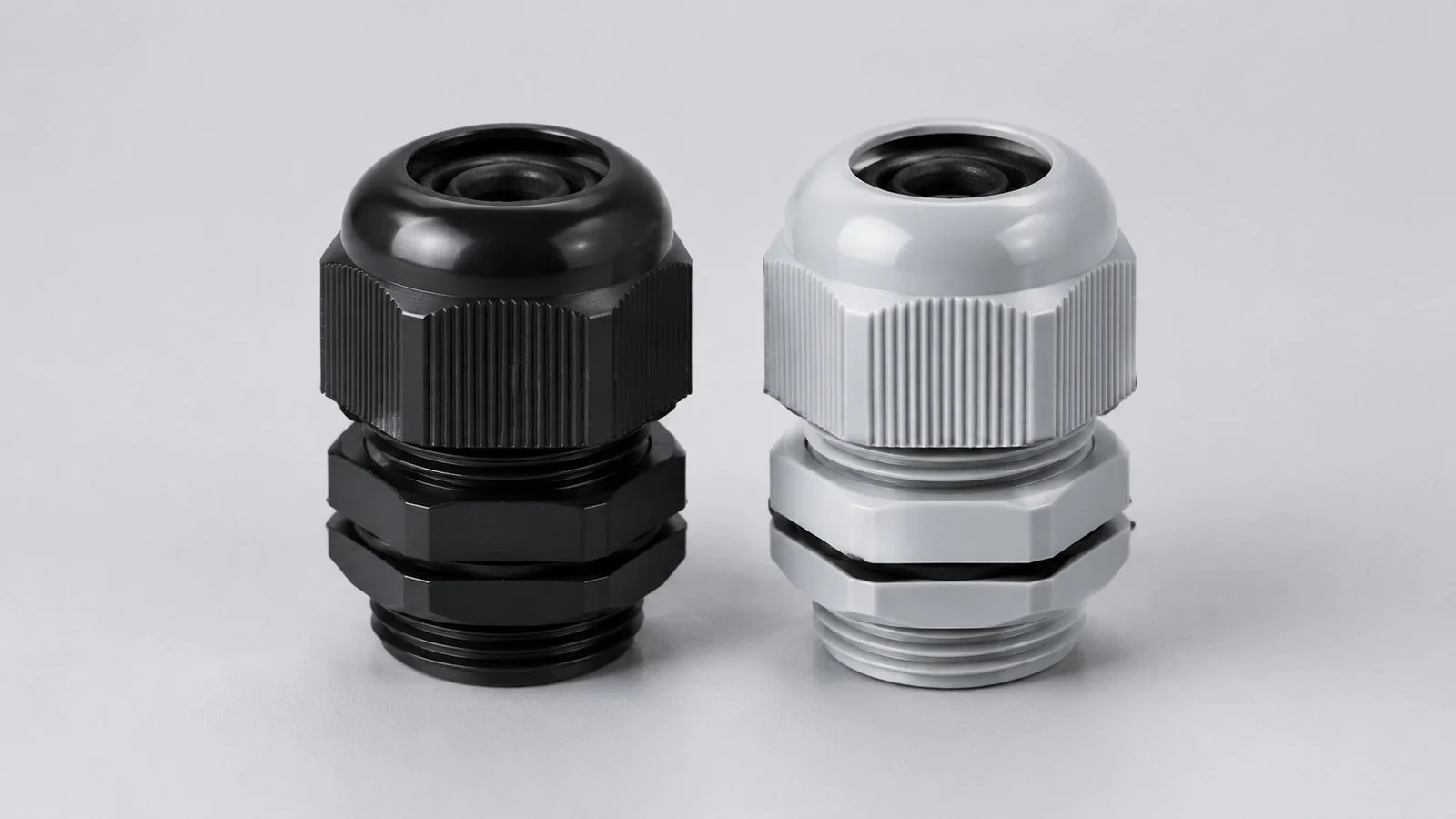
The same gland in black and in light grey is not the same outdoor part, because the pigment is part of the UV protection.
This is why “UV resistant” on a datasheet is close to meaningless as a purchase criterion. It has no defined test behind it in most catalogues, and two suppliers can apply it to materials with very different stabiliser packages. What can be checked is the material grade, whether the compound is stated as UV-stabilised, and whether the supplier can name an accelerated weathering test the part has been through. Black bodies are the usual choice not for aesthetics but because carbon black is an effective UV screen, which is why the same gland in grey and in black are not equivalent outdoors.
A related trap is assuming a metal gland removes the problem. It removes the polymer from the sun, but it introduces a hot, conductive body and a galvanic pair with whatever the enclosure is made of, so the failure mode moves rather than disappears.
The Box Is Hotter Than the Air Around It
An enclosure in direct sun runs well above ambient, and a combiner box with dark walls runs hotter still. The gland sits on that wall, so the temperature that matters is the wall temperature, not the site’s design ambient. This is the number that decides whether a nylon gland stays inside its window, and it is routinely under-estimated because the project specification quotes ambient.
The seal fails before the body does. Elastomer compression set accelerates with temperature, and a seal that has taken a permanent set no longer follows the cable when the assembly cools and contracts at night. That is the mechanism behind the familiar pattern of a gland that passes its commissioning test and leaks in year three. Our guide to seal materials covers the elastomer side; the high temperature selection guide covers where the material window itself is the constraint.
IP66 or IP68: Pick the Failure Mode You Can Live With
Рейтинг
What it actually proves
Where it is the right call
IP66
Dust-tight, resistant to powerful water jets
Sheltered rooftop entries that never stand in water
IP67
Temporary immersion at a stated depth and time
Low-lying boxes with occasional pooling
IP68, 2 m for 24 h
Continuous immersion at the stated conditions
Ground mount, flood risk, buried ducts
IP68, 5 m for 72 h
Deeper or longer immersion, stated condition
Marine, floating, tunnel and culvert entries
IP68 is not a single rating. It is a placeholder for conditions agreed between buyer and maker, so a claim without depth and duration cannot be compared with another claim, and cannot be tested against anything. Ask for the condition in writing and treat a bare “IP68” as incomplete information rather than a high score.
Also read the rating as a statement about one direction. Both IP66 and IP68 describe water arriving from outside. Neither says anything about water that condenses inside the box, which is a separate problem covered below.
Water Needs a Way Out
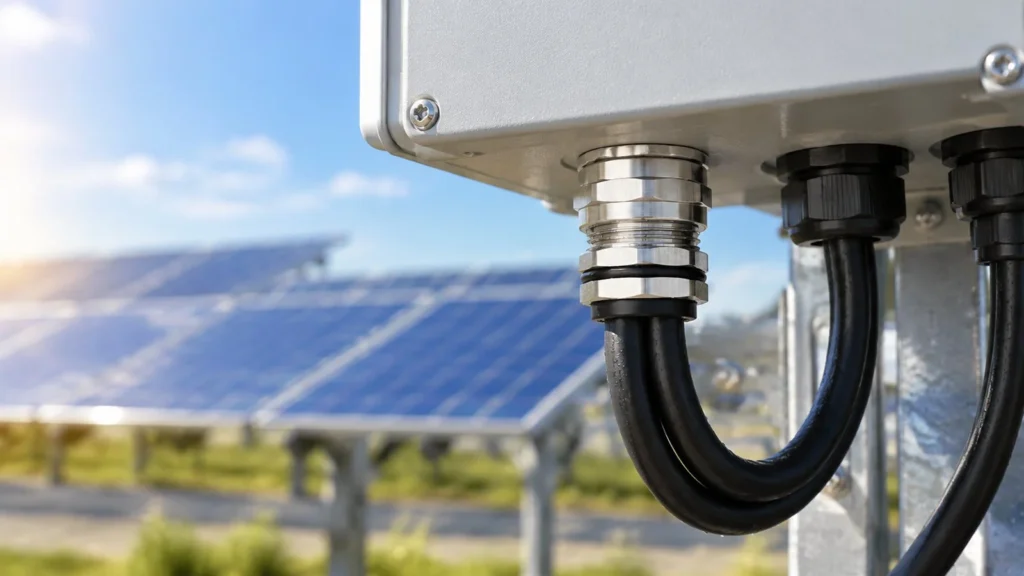
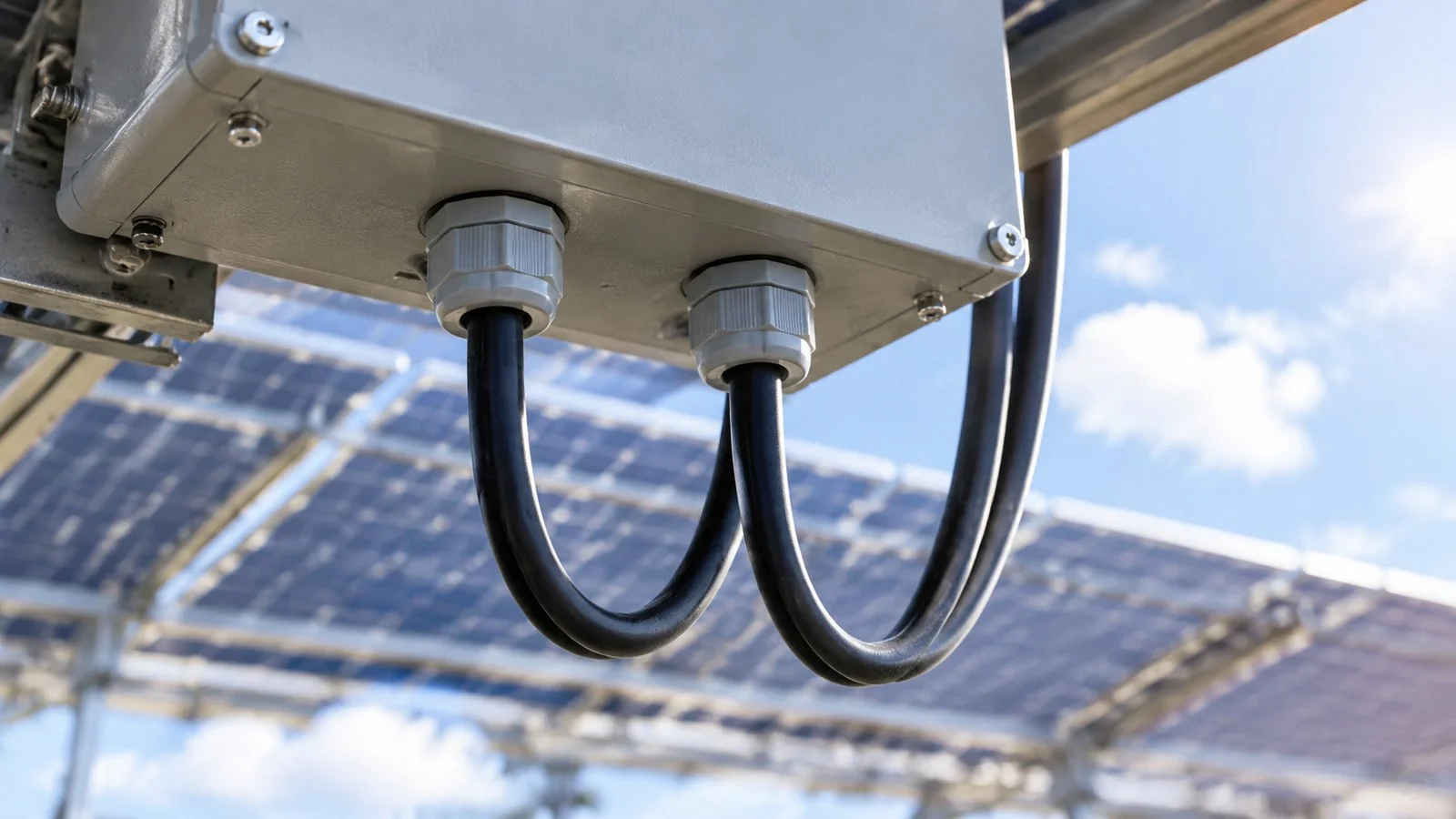
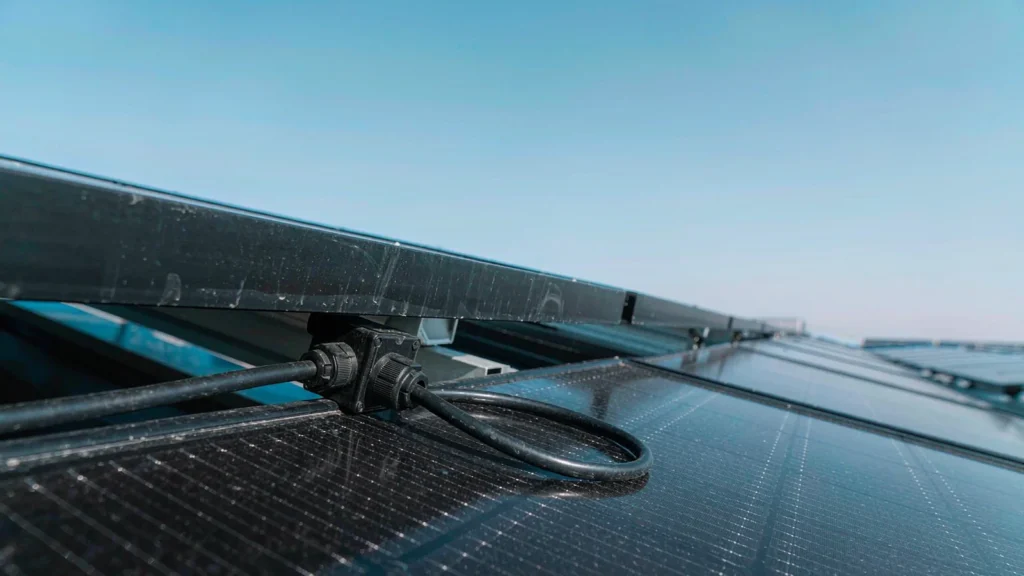
The most reliable outdoor detail is not a better seal, it is geometry that stops water ever reaching the seal under pressure. Entries should face down or sideways rather than up, so that rain runs off the body instead of pooling on the dome nut. Cables should approach from below the entry and form a low point before rising to the gland, so that water running along the sheath drips off rather than being delivered to the insert.
Downward-facing entries and a drip loop keep water off the seal without any change to the gland itself.
That single rule removes most of the water load, and it costs nothing. What it does not remove is condensation, which forms inside a sealed box every time the sun heats the air within it and the night cools the walls. A breather element or a drain valve handles it; a tighter gland does not, and chasing it by tightening is how threads get damaged.
Material Follows the Site, Not the Price List
Nylon suits most distributed and utility PV because it is non-conductive, light, immune to galvanic effects and, in a stabilised grade, adequate against sunlight. Plated brass is the choice where mechanical strength and earth continuity matter, and where a metal body will not be attacked by chlorides. Stainless is for coastal, marine and chemical exposure, and for the small number of sites where a replacement visit is genuinely impossible.
The material also sets the temperature window, and that is often the deciding factor rather than cost. Where the enclosure wall runs above the plastic range, no amount of UV stabiliser helps. Our standard nylon cable gland covers the common distributed-PV sizes, and the material comparison in the solar cable gland guide sets out where each family belongs.
Position, Reach and Replacement
On a solar site the entry position determines whether the gland can ever be serviced. An entry on the underside of a box mounted close to the rail cannot be reached with a spanner, so a joint that needs re-torque becomes a joint that gets ignored. Position the box so that every entry has tool clearance, and orient entries so the wrench swing is not blocked by the structure.
Reach also decides the spare strategy. If a box holds two strings and both entries are occupied, adding a string later means either a larger box or a second entry drilled on site, which is where most post-commissioning leaks begin. Specifying one spare way per box with a blanking plug costs almost nothing at the factory and avoids a field modification later. The entry-planning method in our combiner box gland guide applies directly here.
Writing the Specification
Field
What to write
Why it matters outdoors
Measured cable OD
Actual sheath diameter range, not conductor size
PV sheath is thick and varies by maker
Thread and size
Metric or PG, matched to the enclosure knockout
A correctly sized gland still will not thread
Material and grade
UV-stabilised PA66, plated brass, or 316
The only part of “UV resistant” you can verify
IP rating with conditions
IP68, stated depth and duration
Makes the claim testable and comparable
Seal elastomer
EPDM for wet and coastal duty
The seal, not the body, does the work
Accessories
Locknut, blanking plugs, shroud in the same thread
Mixed threads are found on site, not in the office
Six lines is enough to remove the ambiguity that causes most outdoor PV entry failures, and it fits on a purchase order. The IP rating selection guide covers the reasoning behind the fourth line if the project needs to justify it to a client.
Часто задаваемые вопросы
Do solar installations need IP68 cable glands?
Ground-mount, flood-risk, buried-duct and floating entries do. A sheltered rooftop entry that never stands in water is adequately served by IP66 or IP67, and the money is better spent on UV-stable material and correct geometry.
Is a metal gland better than nylon outdoors?
Not automatically. Metal brings strength and earth continuity but also a hot conductive body and a galvanic pair with the enclosure. Nylon in a stabilised grade is the better default for distributed PV; metal wins where chlorides, impact or bonding decide it.
Why do solar glands leak after a few years if they passed testing?
Because the test happens cold and new. The usual cause is compression set in the seal after thousands of thermal cycles, which a commissioning leak test cannot detect. EPDM and a downward-facing entry delay it; nothing eliminates it.
Can I use a standard waterproof gland for solar?
Only if it is UV-stabilised and rated for the wall temperature. A general-purpose gland may be perfectly sealed and still crack at the dome nut within a few seasons, because the polymer was never specified for continuous sunlight.
What cable size does a solar gland take?
Size from the measured sheath diameter of the actual cable, which for common PV cable is thicker than the conductor size suggests. Confirm against the gland’s clamping range and keep the cable mid-range rather than at the top.
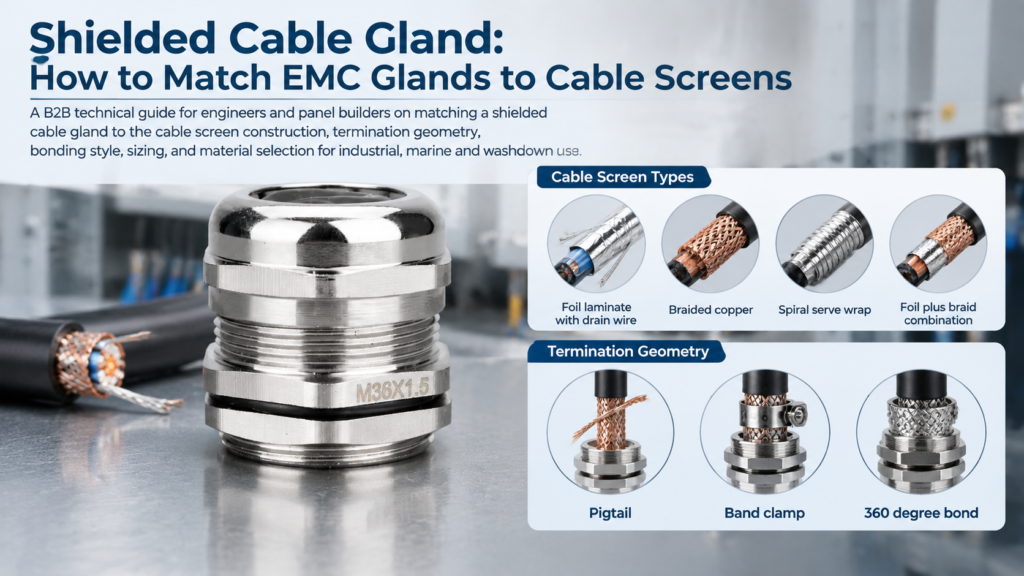
Match an EMC cable gland to the cable screen: foil, braid, spiral and combination constructions, termination geometry, bonding rules and sizing on jacket OD.
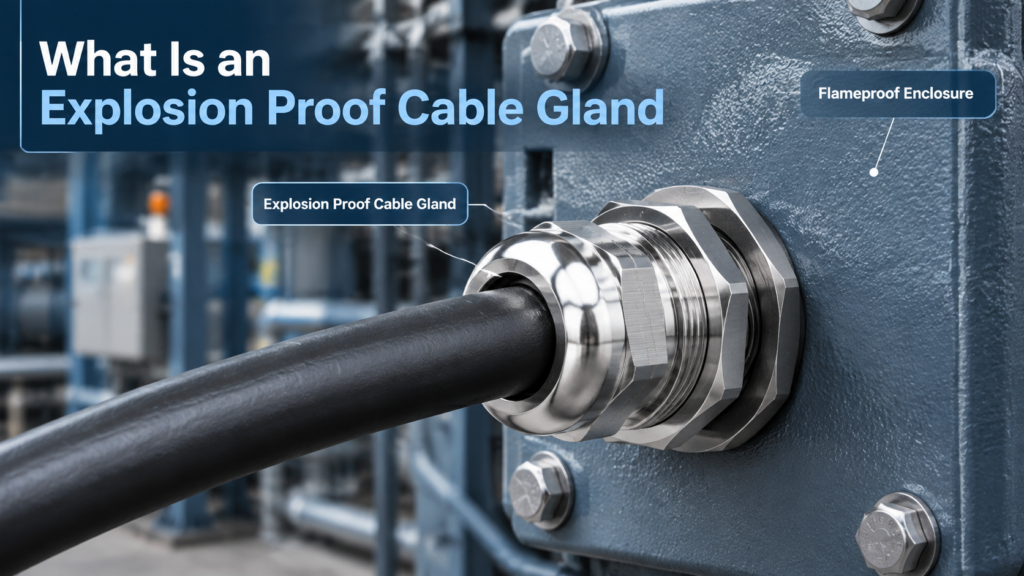
An explosion proof cable gland protects the one part of a flameproof enclosure that cannot be welded shut. How it works, why IP68 is not Ex, and the four compatibility checks that decide whether a correctly fitted gland is still the wrong one.
A PV cable entry has to survive twenty-five years of sun and thermal cycling with no maintenance access. What that changes about cable sizing, UV stability, material choice and entry geometry.
Мы используем файлы cookie для улучшения вашего восприятия, предоставления персонализированной рекламы или контента, а также для анализа нашего трафика. Нажав кнопку "Принять все", вы соглашаетесь с использованием нами файлов cookie.