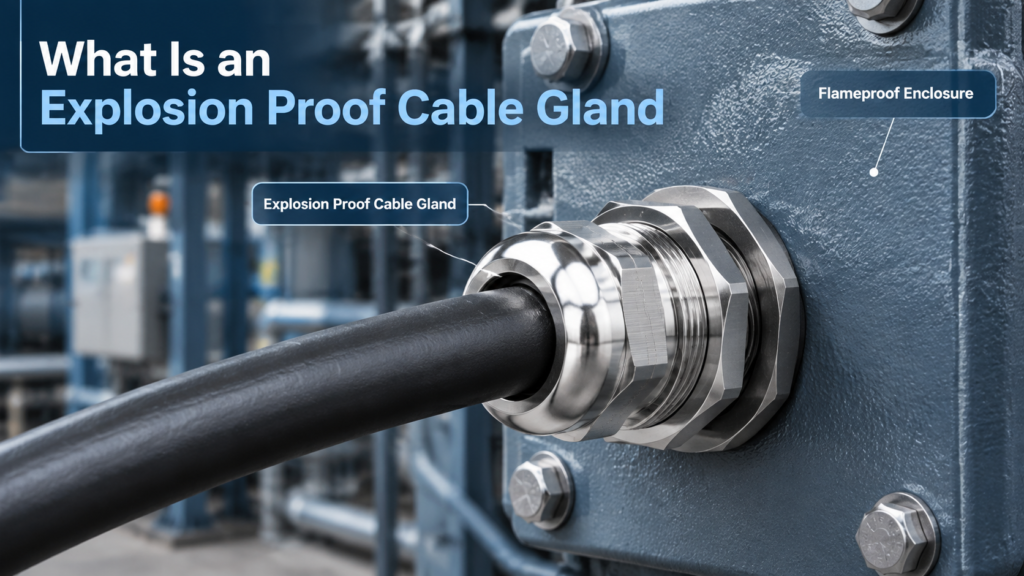
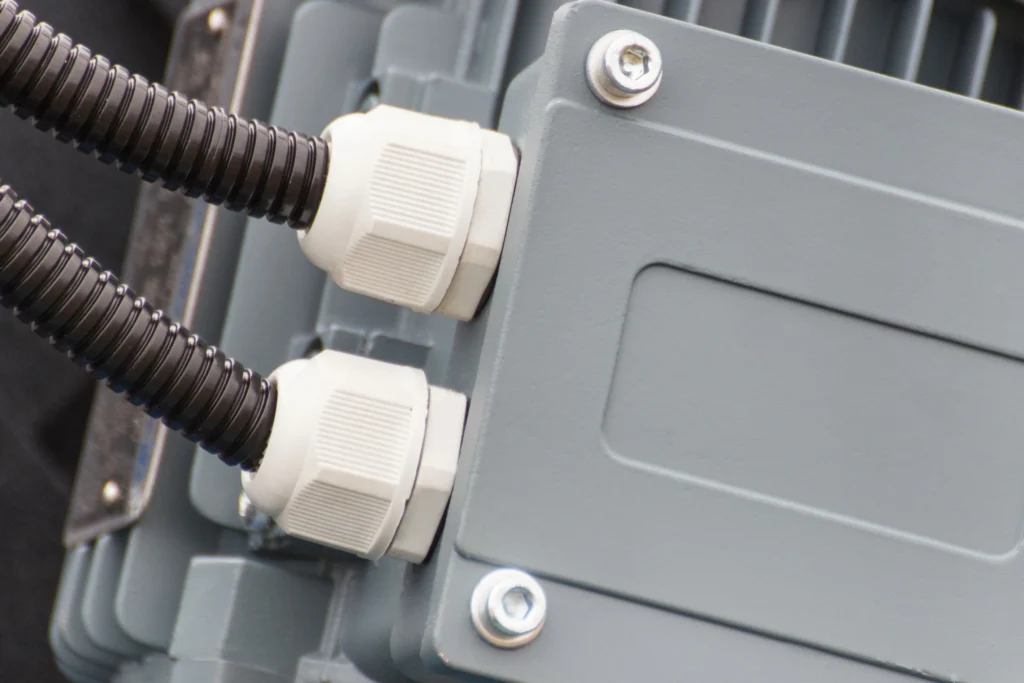
An explosion proof cable gland protects the one part of a flameproof enclosure that cannot be welded shut. Every other joint on the box is machined and sealed at the factory. The cable entry is opened on site, by an installer, with a spanner — and if that entry does not carry the same protection concept as the enclosure, the certificate stops at the wall.
This guide covers what an explosion proof gland actually does, why IP68 and “explosion proof” are two unrelated claims, and the four compatibility checks that decide whether a correctly installed gland is still the wrong one. For the wider family of cable entries, start with our cable gland hub.
What an Explosion Proof Cable Gland Actually Does
An explosion proof gland does not prevent an explosion. It is not indestructible, and it is not a filter. It closes the last opening in an enclosure that is already designed to be sealed, and it does that in three separate ways:
It contains an internal ignition. Flameproof design assumes fuel will get inside the enclosure and an arc will light it. Once the pressure wave starts, the flame has one place to go — the cable entry. The gland is built so the only route out is a long, narrow, machined gap.
It keeps the fuel out. The same gland seals the entry against gas, vapour and dust, so the atmosphere never reaches the ignition source. Containment and exclusion are separate functions on separate surfaces.
It holds the cable still. A gland that allows the cable to move under vibration will eventually wear its own seal open.
The flame path is worth understanding in one sentence: hot gases forced through a long, narrow gap lose heat to the surrounding metal and leave below the auto-ignition temperature of the gas outside. The width and length of that gap are set by gas group, which is why a gland certified for a mild gas group is not interchangeable with one certified for hydrogen. Our GHX CMP explosion proof gland range shows how those components are arranged in practice.
Two Different Jobs, Two Different Certificates
Most specification errors in hazardous areas begin by treating two certificates as one. They are not related, and one does not imply the other.
Степень защиты IP
Ex protection concept
Governed by
IEC 60529 / EN 60529
IEC 60079 series
Answers the question
Can water and dust get in?
Can this entry be used in a hazardous area?
Tested against
Ingress of water and solid particles
Flame containment, gas group, surface temperature, EPL
Typical markings
IP66, IP67, IP68
Ex db, Ex eb, Ex nR, Ex ta, IIC, T6, Gb
Can it exist alone?
Yes — most industrial glands are IP68 with no Ex marking
Yes — many Ex e glands are only IP66
A gland can carry IP68 and hold no Ex certification whatsoever. That is the ordinary case for a standard waterproof gland. The reverse is just as normal: an increased safety gland rated IP66 is perfectly compliant, because Ex e protects by sealing and mechanical integrity rather than by flame containment.
The practical consequence: an IP68 line on a datasheet tells you the gland will survive washdown, flooding and hose-down cleaning. It tells you nothing about gas group, temperature class or equipment protection level. If the enquiry only says IP68, the gland that arrives may not be permitted in the zone at all. Sizing an IP rating correctly is a separate exercise, covered in how to choose the right IP rating.
What Is Inside the Gland
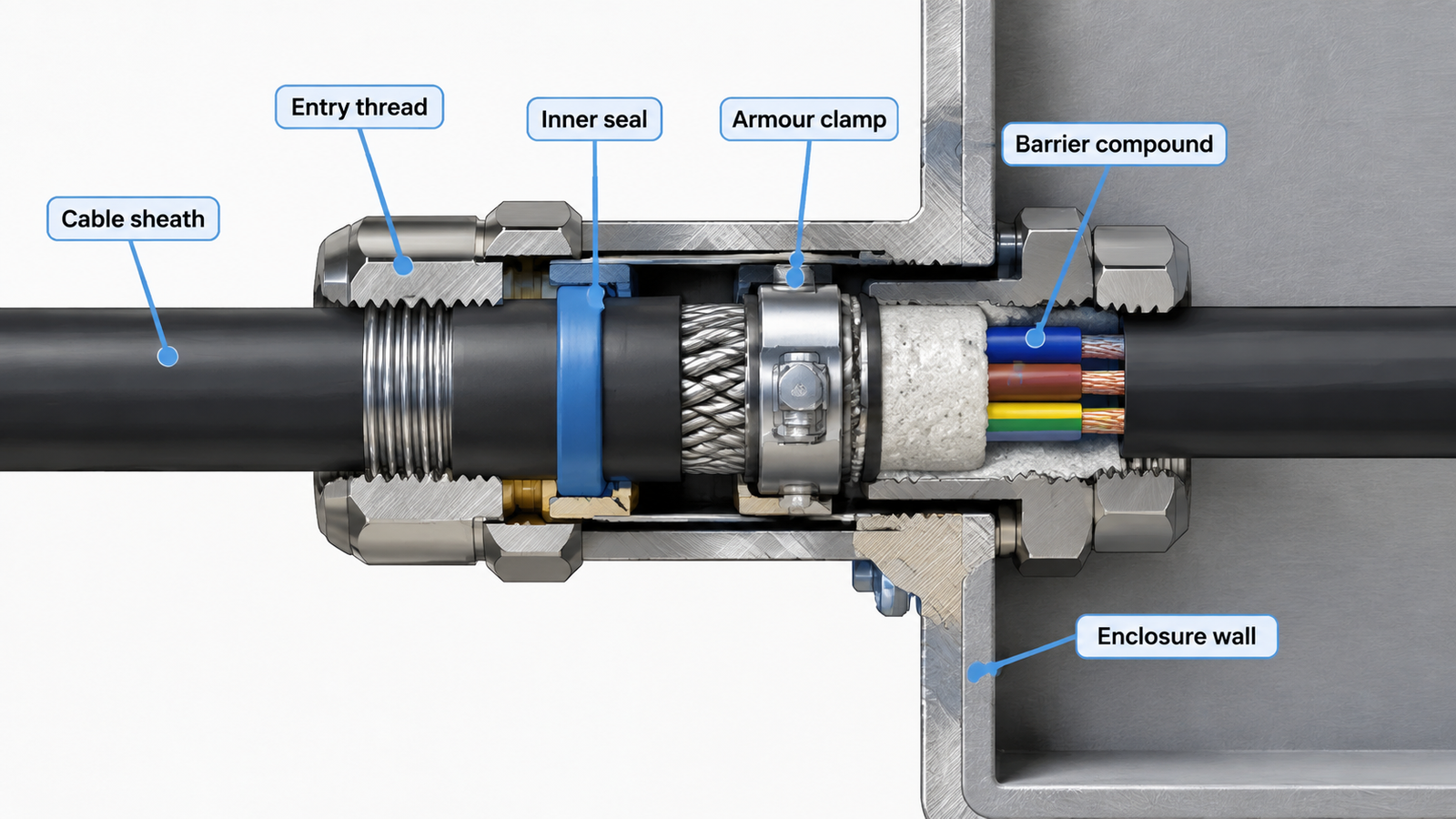
Four surfaces carry the entire job. Lose any one of them and the other three do not compensate.
Surface
What it seals or grips
How it fails in the field
Inner seal
Compresses onto the cable’s inner sheath or oversheath
Cable measured over the armour instead of the sheath; seal sits on the wrong surface
Armour clamp
Grips wire armour or braid and bonds it to the enclosure
Armour strands cut short or splayed unevenly, so the bond depends on a few wires
Entry thread
Screws the gland body into the enclosure wall
Thread engagement too short, wrong thread form, or a sealing washer omitted
Barrier compound
Fills the voids between cores so gas cannot migrate along the cable
Barrier-type gland fitted without the compound — it becomes an ordinary gland
Four surfaces carry the job: inner seal, armour clamp, entry thread and barrier compound.
Sizing sits on top of all four. The most common field error is a gland chosen for the wrong cable diameter range, then tightened until it “feels” sealed. Compression seals have a working range for a reason. Outside it, the seal either crushes and splits or never contacts the sheath — and neither condition is visible after assembly.
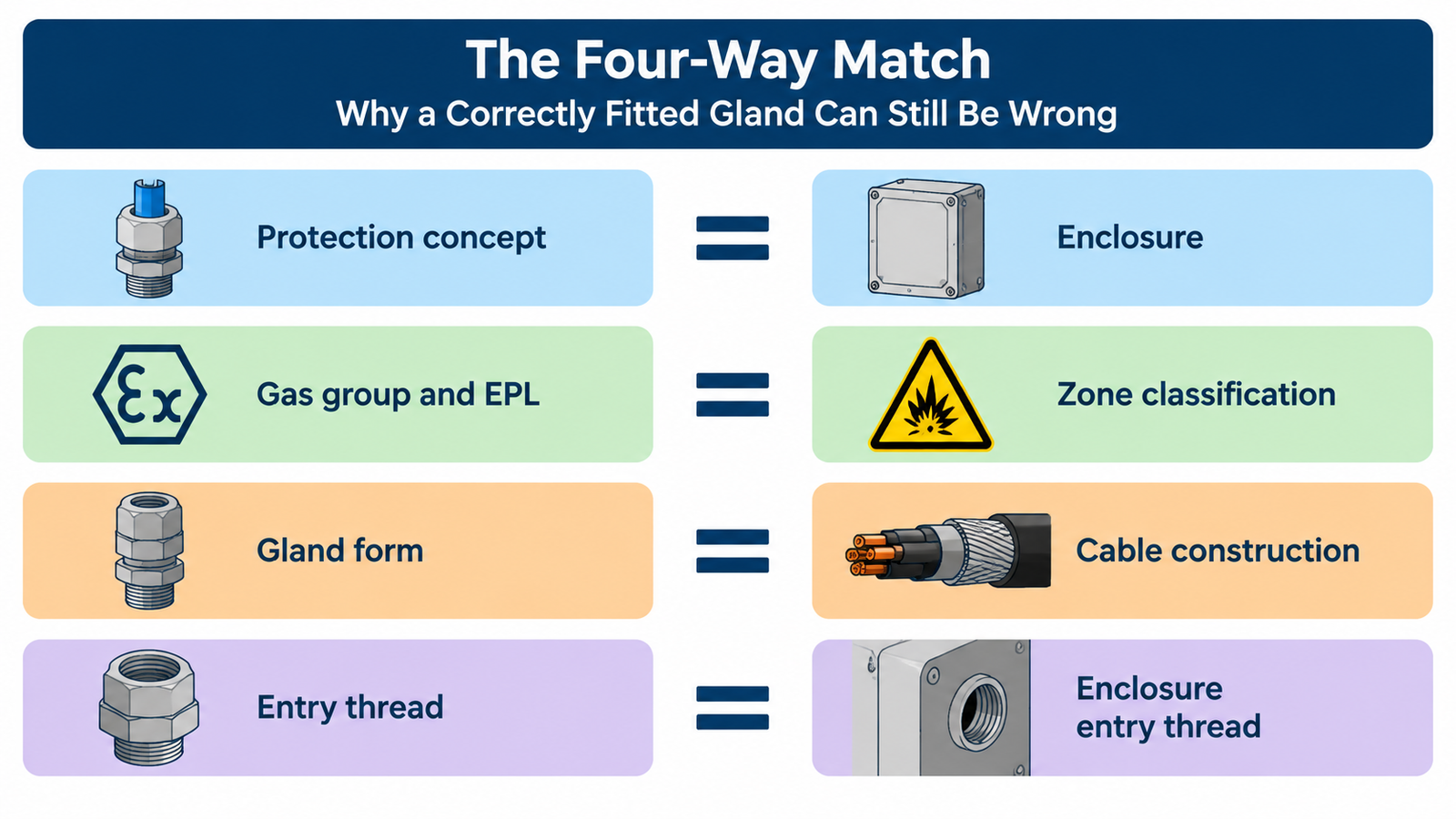
The Four-Way Match: Why a Correctly Fitted Gland Can Still Be Wrong
An installation can be mechanically perfect and still be non-compliant, because Ex compliance is a match between four pairs of properties rather than a property of the gland itself. Check all four before ordering.
Check
Must agree with
If it does not
Gland protection concept
Enclosure protection concept
An Ex e gland on a flameproof enclosure breaks the flameproof barrier
Gland gas group and EPL
Zone classification and site gas group
Certification is invalid for the atmosphere present
Gland form
Cable construction — armoured or not, barrier required or not
Armour cannot be clamped, or gas migrates through the cable core
Entry thread
Enclosure entry thread, form and size
Thread does not fully engage; the flame path is never closed
Ex compliance is a match between four pairs of properties, not a property of the gland alone.
The third row is the one most often missed. A gland that is certified, correctly sized and correctly torqued is still the wrong gland if it is a compression type where the cable construction and enclosure volume call for a barrier type. Thread forms matter for the same reason — a tapered NPT thread and a parallel metric thread are not interchangeable, and the guide to cable gland thread types sets out which form goes where.
Protection Concepts and How to Read the Marking
Four concepts cover most cable entries. Each is a different way of achieving safety, not a quality grade.
Concept
How it protects
Typical use
Ex d — flameproof
Contains an internal ignition and cools gases through a flame path
Motors, junction boxes and switchgear in gas zones
Ex e — increased safety
No arcs or sparks by design, plus a high-integrity seal
Terminal boxes and enclosures with no switching devices
Ex nR — restricted breathing
Limits gas ingress so an internal explosive atmosphere cannot form
Zone 2 equipment
Ex ta / Ex tb — dust
Protection by enclosure against combustible dust
Grain, feed, coal and powder handling
Whatever is stamped on the body decodes the same way, field by field:
Field
Looks like
What it tells you
Atmosphere
G or D
Gas or dust application
Protection concept
db, eb, nR, tb
How the entry achieves safety
Gas or dust group
IIA, IIB, IIC / IIIA, IIIB, IIIC
The most demanding atmosphere it is certified for
Equipment protection level
Ga, Gb, Gc / Da, Db, Dc
Where in a zone it may be installed
Temperature class
T1 to T6
The highest surface temperature the equipment may reach
Ambient range
Ta
The ambient temperatures the certificate allows
A marking such as Ex db IIC Gb carries all of that in six characters. A gland with no marking on the body has no certification to claim, however good the datasheet looks.
Temperature Class and Ambient Range Are Not the Same Number
These two figures get quoted interchangeably and they should not be. Temperature class is a ceiling on surface temperature, set by the gas: T6 caps it at 85 °C, T4 at 135 °C, T1 at 450 °C. The gas ignites above its auto-ignition temperature, so the equipment must stay below that ceiling in service.
Ambient range is a different constraint entirely. It is what the certificate permits for the environment the gland sits in, and it comes from the materials and seal elastomers rather than from the gas. A gland certified for a narrow ambient band does not become acceptable because the site gas group is easy. When an installation sits outside the certified band — offshore platforms in winter, or a foundry roof in summer — it needs a gland certified for that band, not a warmer or colder version of the same part number.
Materials and Where Ex Glands Are Used
Material choice is a corrosion decision first and a strength decision second, and it should be led by the site environment rather than by price.
Материал
Where it fits
Watch for
Никелированная латунь
Indoor plant, control rooms, general petrochemical
Ammonia and chlorides attack the plating
Stainless steel 316L
Offshore, marine, chemical, washdown, buried
Higher cost per unit; thread galling without a suitable lubricant
Aluminium
Lightweight and large-frame entries
Not for aggressive chemical exposure
Explosion proof glands are specified wherever an enclosure sits inside a classified area: oil and gas processing, refineries, chemical and pharmaceutical plant, coal handling with firedamp risk, grain and powder handling, and offshore or marine installations. Our stainless steel cable gland range carries the marine and offshore variants, including the PG63 gland for marine environments, and the brass cable gland range covers the general industrial cases.
Indicative Pricing and MOQ
Ex-rated glands cost more than standard glands because of the certification and the machining tolerances, not the metal.
Тип
Specification
Typical application
Indicative FOB price
Ex-rated, nickel-plated brass
Ex db / Ex eb, IIC, Gb, IP66–IP68
Gas zones 1 and 2, general plant
US$2.50–9.00 / pc
Ex-rated, stainless steel 316L
Ex db / Ex eb, IIC, Gb, IP68
Offshore, marine, chemical
US$6.00–14.00 / pc
Dust-rated, stainless steel
Ex tb, IIIC, Db, IP68
Dust zones 21 and 22
US$4.00–12.00 / pc
FOB Ningbo or Shanghai, based on 300 pcs per size. Indicative only — final price depends on thread type, size and certification package.
The minimum order for Ex-rated glands is 300 pcs per size, against 1,000 pcs per size for standard brass and nylon ranges. Trial quantities from 100 pcs are possible on standard items; Ex items are not tooled, so that flexibility does not apply to them. Add the certification package to the order — ATEX and IECEx certificates, the IP68 immersion report to IEC 60529, and the material certificates for the brass or stainless steel used.
ЧАСТО ЗАДАВАЕМЫЕ ВОПРОСЫ
Is an explosion proof cable gland the same as a waterproof one?
No. Waterproof refers to an IP rating and nothing else. An explosion proof gland adds a protection concept, a gas group, an EPL and a temperature class. A standard IP68 gland is not permitted in a hazardous area.
What is the difference between Ex d and Ex e cable glands?
Ex d contains an internal explosion and cools the escaping gases through a flame path. Ex e prevents ignition by design and seals with high integrity. They are not interchangeable, and the gland must match the protection concept of the enclosure it enters.
Can a standard gland be used on an Ex enclosure?
No. Doing so voids the enclosure certification at the cable entry, which is the only opening not sealed at the factory. The enclosure and the gland are one system for certification purposes.
How do I choose the right size?
Measure the cable over the surface the inner seal actually grips, then select the gland whose certified range contains that figure. Never tighten a gland outside its range to make it fit.
Next Step
Send us the enclosure protection concept, the zone and gas group, the cable construction with its measured diameter, and the entry thread. We will come back with the matching gland, the certification documents and an FOB price for your quantity — see the full selection guide to cable gland types for the wider picture.
A brass waterproof cable gland helps protect cable entries from water, dust, and strain in industrial and marine installations. Learn how to choose the right model, size, and supplier.
Откройте для себя прочные водонепроницаемые кабельные вводы со степенью защиты IP68, изготовленные из нейлоновой латуни или нержавеющей стали для безопасного использования на открытом воздухе и в море.
Водонепроницаемые кабельные вводы играют незаменимую роль в современном промышленном и коммерческом электрооборудовании. Они не только защищают кабельные вводы от пыли и влаги, но и обеспечивают безопасность оборудования и продлевают срок его службы. Правильный выбор степени защиты IP для водонепроницаемого кабельного ввода может эффективно предотвратить сбои в работе электрооборудования или инциденты с безопасностью, вызванные неблагоприятными условиями окружающей среды. [...]
Мы используем файлы cookie для улучшения вашего восприятия, предоставления персонализированной рекламы или контента, а также для анализа нашего трафика. Нажав кнопку "Принять все", вы соглашаетесь с использованием нами файлов cookie.