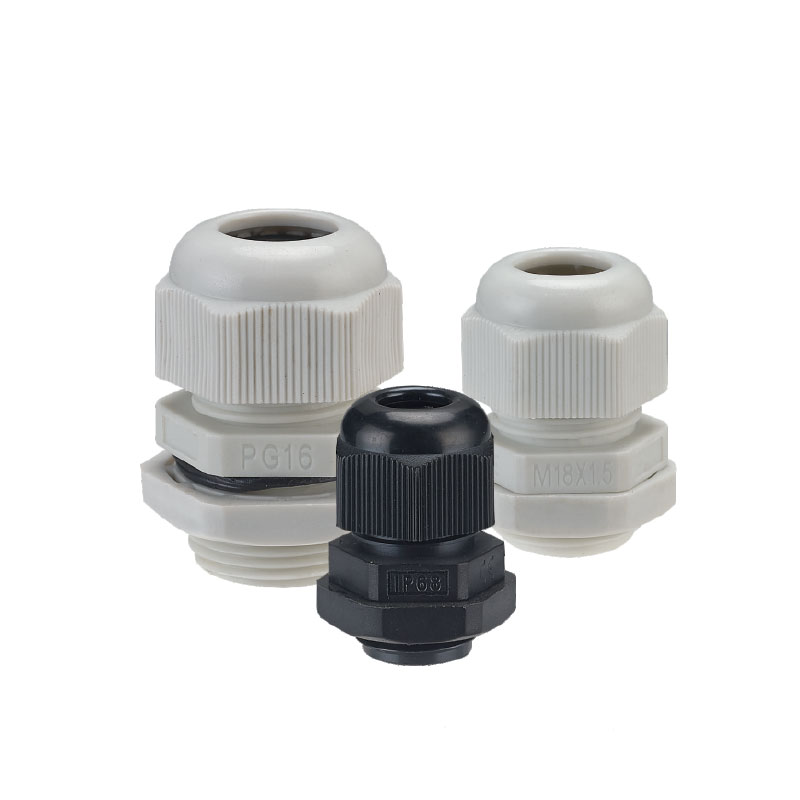
When I speak with buyers, I notice the same pattern again and again: everyone asks for a “Водонепроницаемый кабельный ввод” but what they actually need is a reliable sealing solution that matches cable size, enclosure type, operating environment, and purchasing risk. That is exactly why choosing among waterproof cable gland suppliers is not a small sourcing task; it is a product-performance decision that can affect downtime, warranty claims, and your customer’s opinion of your brand.
In industrial purchasing, nobody throws a party because a cable gland worked exactly as expected. Still, if it leaks, loosens, corrodes, or cracks, suddenly everybody becomes a detective. So in this article, I will stay close to real buying questions: what to choose, where each material fits, how marine waterproof cable glands differ from standard versions, what a cable entry gland waterproof design should actually achieve, how waterproof cable gland connectors are specified, when a waterproof double cable entry gland makes sense, and what buyers really mean when they ask how to install waterproof cable glands.
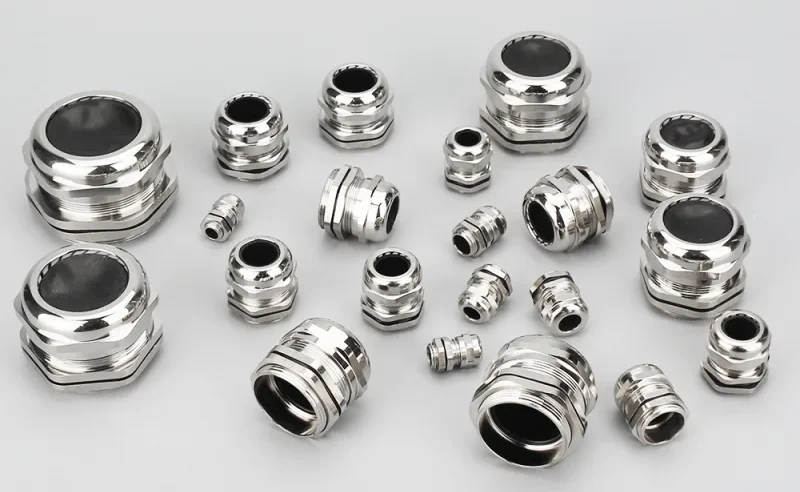
A dependable supplier is not just selling a small fitting; they are selling sealing consistency, dimensional accuracy, and less trouble for your assembly team. In the market, waterproof cable glands are commonly offered in brass, stainless steel, and nylon, and they usually combine a body, sealing element, locknut, and related accessories, which means product quality depends on how well those parts work together rather than on the catalog photo alone.
For wet or exposed installations, many buyers use IP68 as the practical baseline because waterproof cable glands are typically specified to withstand dust ingress and water immersion conditions associated with that rating. At the same time, the market also includes single-cable, multi-cable, straight-entry, and side-entry designs, so comparing suppliers only by price is a bit like choosing a raincoat by zipper color—technically possible, strategically risky.
Supplier checkpoint
What a buyer should verify
Why it matters
Protection level
IP68 is a common requirement for waterproof cable glands in wet or submerged conditions
It helps screen out products that look similar but do not seal to the same level.
Product range
The market includes single and multi-cable pass-through formats, plus straight and side-entry options
A broader range usually means easier matching to actual project layouts.
Material options
Brass, stainless steel, and nylon are common cable gland materials in industrial supply
Material flexibility reduces redesign when the environment changes.
Size coverage
Waterproof cable gland connectors are commonly offered from PG7 to PG63 in some product ranges
Wider size coverage helps standardize sourcing across projects.
Quality system and certifications
IP68 immersion report to IEC 60529, CE and RoHS declarations, and material certificates for the body
Certificates show the rating was tested rather than claimed, which is what an inspector will ask for
Customisation capability
Changed thread lengths, alternative sealing inserts, colours, OEM labelling and packaging
Custom work is where landed-cost surprises appear if it is not quoted carefully
Lead time, MOQ and shipping terms
Quoted MOQ per size, production lead time and Incoterms in writing before the PO
Prevents partial shipments and re-quotes after the order is placed
Technical support after the order
Who answers installation and sealing questions, and within what response time
A wrong seal discovered on site costs far more than the glands themselves
A good B2B buyer also asks questions that go beyond the drawing. Can the supplier support OEM labeling? Are thread standards available in Metric, PG, or NPT? Can the same supplier support control cabinets, outdoor boxes, marine panels, and solar cable entry under one purchasing framework? Those questions matter because the best supplier is often the one who reduces your internal coordination cost, not just your unit cost.
Many procurement teams are not merely searching waterproof cable gland suppliers; they are really looking for an IP68 waterproof cable gland manufacturer, an OEM waterproof cable gland supplier, a bulk cable gland supplier for control panels, or a marine cable gland manufacturer that can support repeat orders with stable quality. Different phrase, same pressure from the purchasing department.
If you are unsure what type of waterproof cable gland your project requires, please feel free to связаться с нами.
Material selection that works
Material choice is where practical engineering and purchasing discipline finally shake hands. If the application is general industrial indoor equipment, Нейлоновый кабельный ввод often gives a strong balance of cost, corrosion resistance, and easy installation; if the application involves mechanical robustness or premium appearance, Латунный кабельный ввод is often preferred; and if you are dealing with aggressive washdown, salinity, or corrosion-heavy conditions, Кабельный ввод из нержавеющей стали usually moves to the front of the line.
The marine segment makes this even clearer. Suppliers in that space emphasize moisture, salinity, corrosion resistance, and long-term sealing performance because shipboard and offshore environments punish weak materials very quickly. In other words, marine waterproof cable glands are not just regular glands with a brave face.
Some nylon cable glands on the market are specified for temperatures from -40°C to 105°C, with short-term performance up to 160°C, although exact ratings vary by product and supplier. Metal waterproof cable glands, meanwhile, are commonly available in brass and stainless steel constructions, and some suppliers advertise designs reaching IP68 or even IP69K depending on structure and sealing design.
Материал
Typical strengths
Best-fit applications
Commercial note
Латунь
Strong mechanical body, widely used in industrial metal cable glands
Control cabinets, machinery, outdoor equipment with moderate corrosion exposure
A solid all-rounder when buyers want durability without jumping straight to stainless steel.
Нержавеющая сталь
High corrosion resistance and strong fit for harsh marine or chemical conditions
Usually the premium choice when failure cost is higher than initial purchase cost.
Нейлон
Common industrial option with good corrosion resistance and broad use in electrical equipment
Distribution boxes, electronics enclosures, telecom, solar, lighter-duty outdoor use
Often the best value choice for high-volume projects.
When I advise buyers, I usually frame the decision this way: brass is the sensible workhorse, stainless steel is the insurance policy, and nylon is the efficiency champion. That is not poetry, but it does save meetings.
It also helps to evaluate the total assembly environment, not only the gland itself. If the box is plastic, the cable is flexible, and the installation is indoors, a nylon solution may be perfect. If the enclosure is stainless, the site is coastal, and the maintenance team hates surprises, stainless steel may be the smarter long-term purchase even if finance raises one eyebrow at first.
Matching the product to the application
This is the part many articles keep too abstract, so let me make it concrete. A cable entry gland waterproof design must do three jobs at the same time: hold the cable, seal against water and dust, and maintain stable entry into the enclosure. If one of those jobs fails, the nice catalog claim becomes an expensive field lesson.
For standard enclosure entry, waterproof cable gland connectors are widely used as panel or box joints and are commonly available in brass, stainless steel, plastic, and nylon versions; some published ranges cover PG7 to PG63 sizes for different cable diameters and applications. That makes them suitable for industrial control boxes, outdoor lighting cabinets, junction boxes, telecom equipment, and machine interfaces where the cable must enter cleanly and stay sealed.
Supplier claims of this kind are worth checking against the maker rather than the seller: ask what the factory itself controls — moulding or machining, insert sourcing, in-house IP testing — and see our plant and quality profile for the parts we hold in house.
A waterproof double cable entry gland becomes useful when two cables must pass through one surface opening while maintaining a watertight seal. Published product examples show double-entry designs for twin 3–7 mm cables used on boats, vehicles, buildings, and solar installations, especially where a low-profile surface entry is preferred. That is a practical answer for buyers trying to simplify rooftop, deck, or panel layouts without adding extra holes.
Приложение
What usually matters most
Suitable choice
Why buyers choose it
Marine equipment
Corrosion resistance, moisture sealing, salt exposure
Stainless steel or marine-grade metal options
Lower risk in coastal and offshore service.
Standard control enclosure
Cable sealing, strain relief, easy assembly
Brass or nylon waterproof cable gland connectors
Good balance of cost and performance.
Solar or twin-cable routing
Two cables through one opening, low-profile entry
Waterproof double cable entry gland
Cleaner layout and fewer entry points.
Outdoor electronics
IP68 sealing for exposed wet conditions
Nylon or metal depending on impact and corrosion risk
Flexible choice based on budget and environment.
Here is a useful purchasing example. If your customer is routing two PV cables through a visible roof or deck surface, a waterproof double cable entry gland is often more elegant and more practical than two separate standard glands because it reduces the number of penetrations and keeps the external finish neater. A common example in the market is twin 3–7 mm cable routing for boats or buildings, which shows exactly how application-specific these products can be.
And if your project is in shipbuilding, port equipment, or offshore auxiliary systems, marine waterproof cable glands deserve separate attention rather than being treated as a generic accessory. In those environments, the sealing story is only half the story; material survival under salt and humidity matters just as much.
Installation quality and purchasing details
Now let’s talk about the question that shows up in search terms all the time: how to install waterproof cable glands. Buyers ask it as if installation is a side issue, but in real projects, poor assembly can ruin a perfectly good product. Industry instructions from multiple sources follow a similar sequence: disassemble the gland, pass the cable through the parts, secure the gland body to the enclosure, position the sealing element correctly, and tighten the nut evenly without over-compressing the cable.
That sequence sounds simple because it is simple. The catch, of course, is that simple things are exactly what people rush. If the cable outer diameter does not match the sealing range, if the thread does not match the panel opening, or if the nut is overtightened, the result is not “extra safe”; it is often a distorted seal, damaged sheath, or inconsistent ingress protection.
This is why serious buyers do not just ask for part numbers. They ask for clamping range, thread standard, panel thickness compatibility, seal material, locknut availability, and whether the assembly team will be using hand tools or torque-controlled tools. That is how you prevent the classic moment when someone says, “The gland is fine, the installer is fine, the drawing is fine,” while the enclosure politely fills with water.
Procurement detail
What to confirm before ordering
Why it saves trouble
Cable OD range
Match the seal to the actual cable outside diameter
A wrong range causes poor sealing or cable damage.
Thread type
Metric, PG, and other thread options are available in the market
Avoids panel mismatch and rework.
Entry style
Straight, side-entry, single, or multi-cable formats exist
The wrong format can force a layout redesign.
Installation method
Standard practice is to assemble parts in sequence and tighten evenly, not excessively
Good installation protects actual field performance.
For B2B teams, installation quality should be translated into RFQ language. Ask for dimensional drawings, sealing range charts, material certificates where needed, and a clear recommendation for indoor, outdoor, or marine use. If you are sourcing at volume, it is also smart to ask for sample validation on your actual cable and enclosure combination before approving bulk production.
And yes, one small commercial truth deserves to be said out loud: a low unit price is not a bargain if your production line needs to stop and sort mixed tolerances. If you are currently comparing Waterproof Cable Gland Suppliers, this is the moment to send an inquiry with your cable diameter, thread requirement, enclosure material, and project environment. Good Waterproof Cable Gland Suppliers can move fast when the input is precise.
One question I hear often is whether nylon is “cheap” and stainless steel is “professional.” I would not put it that way. Nylon can be the most efficient and fully correct choice for many boxes and cabinets, while stainless steel becomes the better answer when corrosion exposure, cleaning chemicals, or marine duty raise the risk profile.
Another common question is whether IP68 alone is enough. Usually, IP68 is a strong starting point for wet conditions, but procurement should still check material, sealing range, thread compatibility, and the actual environment because a perfect rating on paper does not automatically solve a bad application match.
The smartest buying decision is usually the least dramatic one: select the right material, match the cable range accurately, respect the application environment, and work with Manufacturer that can support repeatability instead of excuses. When buyers approach waterproof cable gland suppliers with that mindset, they stop purchasing a small accessory and start securing the whole cable entry system.
ЧАСТО ЗАДАВАЕМЫЕ ВОПРОСЫ
Are all waterproof cable glands suitable for marine use?
No. Marine applications place extra emphasis on corrosion resistance and long-term performance under salinity and humidity, so marine waterproof cable glands should be evaluated separately from standard indoor or light outdoor products
What materials are most common?
Brass, stainless steel, and nylon are among the most common cable gland materials in industrial supply
Are waterproof cable gland connectors only for one cable?
No. The market includes single-cable and multi-cable pass-through designs, as well as straight and side-entry options
When is a waterproof double cable entry gland useful?
It is especially practical when two cables must pass through one surface opening, such as twin 3–7 mm cables on boats, vehicles, buildings, or solar installations
What should I check before installation?
Check cable diameter, thread type, enclosure opening, and tightening practice, because published installation guidance stresses correct sequencing and avoiding over-tightening
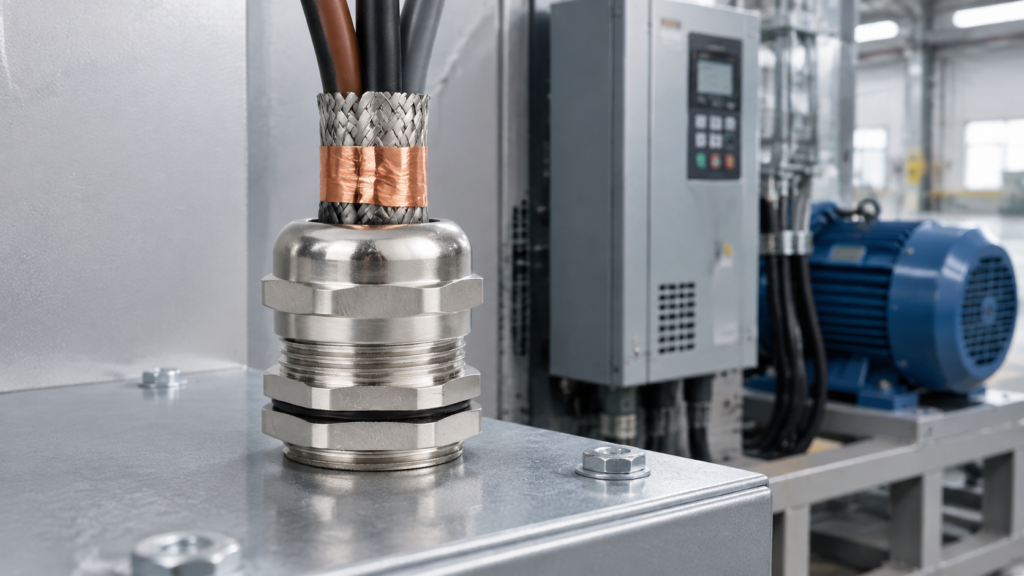
A VFD cable gland has to bond the cable screen around the full circumference at both the drive and the motor end. How to size one for drive cable, where the bond path breaks, and what a gland cannot fix.
Водонепроницаемые кабельные вводы играют незаменимую роль в современном промышленном и коммерческом электрооборудовании. Они не только защищают кабельные вводы от пыли и влаги, но и обеспечивают безопасность оборудования и продлевают срок его службы. Правильный выбор степени защиты IP для водонепроницаемого кабельного ввода может эффективно предотвратить сбои в работе электрооборудования или инциденты с безопасностью, вызванные неблагоприятными условиями окружающей среды. [...]
Среди множества аксессуаров для электрических соединений водонепроницаемый кабельный сальник играет важнейшую роль. Он не только защищает кабели, проникающие в корпуса оборудования, от попадания воды и пыли, но и повышает общую безопасность и надежность системы. Понимание материалов и областей применения водонепроницаемых кабельных вводов помогает инженерам и покупателям в таких отраслях, как промышленность, связь, [...]...
Мы используем файлы cookie для улучшения вашего восприятия, предоставления персонализированной рекламы или контента, а также для анализа нашего трафика. Нажав кнопку "Принять все", вы соглашаетесь с использованием нами файлов cookie.