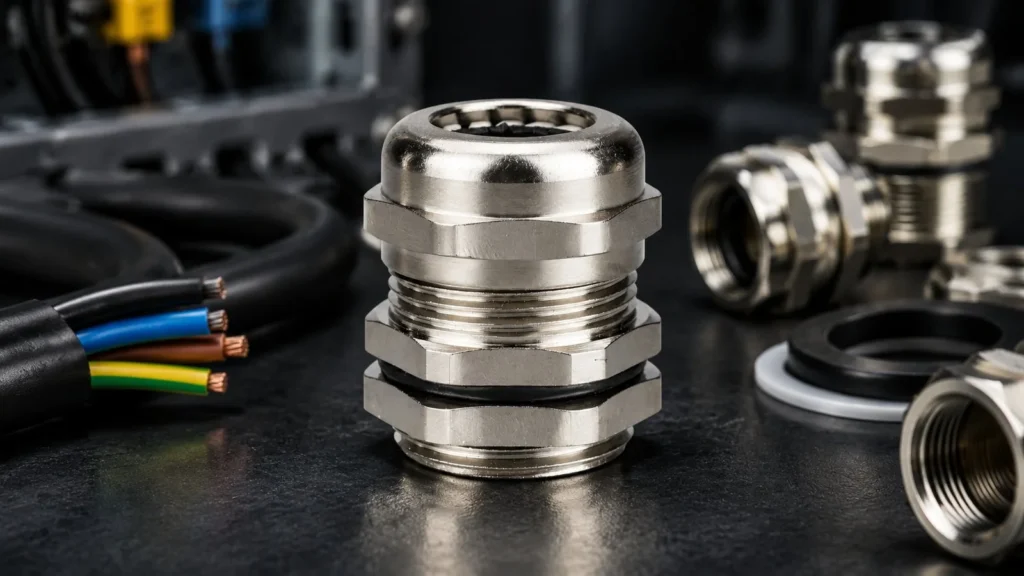
Ask what thread a brass cable gland has and the answer is usually a size: M20, PG13.5, 1/2″ NPT. That is a designation, not an engineering answer. The thread is a machined feature in a relatively soft alloy, it carries the gland’s mechanical load, it is where the seal to the enclosure either works or does not, and it is the part most often damaged at installation.
This guide looks at threads from the brass side: which forms are actually produced in brass, how brass threads are cut or rolled, what happens when brass engages steel, aluminium or plastic, how sealing differs between families, and what can and cannot be repaired. Thread geometry comparisons between families live in the thread types guide.
Brass is a threaded component, not just a body
Brass is chosen for gland bodies partly because it machines cleanly. That matters more at the thread than anywhere else: a clean thread form gives full flank contact, seals predictably against a washer, and resists stripping when a maintenance fitter tightens it for the fifth time.
It also means the thread is the weakest structural feature in the assembly. Brass yields before steel does, so the thread — not the body — is what fails when a gland is over-tightened or cross-threaded.
Which thread families are actually produced in brass
Three families cover almost all brass gland supply. Availability differs, and that is a purchasing constraint before it is a technical one.
Family
Standard reference
Typical brass availability
Market driver
Métrique (M)
IEC 62444 / EN 50262, 60° thread form
Full range, M14 to M63, the default production series
IEC-based projects, new equipment, most export markets
PG
DIN 40430, 80° thread form
Full range, PG7 to PG63, widely held in stock
Legacy European equipment and older panel designs
NPT
ANSI/ASME B1.20.1, tapered
Made to order in most sizes
North American equipment with listed entries
G (BSP)
ISO 228, parallel
Limited; usually supplied as an adaptor rather than a gland
Process equipment, instrumentation, some water industry
The practical consequence: if a project specifies NPT or G on a brass gland, expect a longer lead time and a minimum quantity than the same size in metric or PG. Ordering early is cheaper than paying for an adaptor later.
Brass thread sizes: metric and PG reference
Dimensions below are from our standard brass series. Cable ranges are shown ascending; hole sizes follow the usual rule of thread diameter plus 0.2 mm.
Fil
Cable range (mm)
Diamètre extérieur du filetage (mm)
Mounting hole (mm)
GL (mm)
M14×1.5
4-8
14
14–14.2
7
M16×1.5
4-8
16
16–16.2
8
M20×1.5
6-12
20
20–20.2
8
M25×1.5
10–14
25
25–25.2
9
M32×1.5
15–22
32
32–32.2
10
M40×1.5
18–25
40
40–40.2
11
M50×1.5
32–38
50
50–50.2
12
M63×1.5
37–44
63
63–63.2
13
PG7
3–6.3
12.5
12.5–12.7
7
PG9
4-8
15.2
15.2–15.4
8
PG13.5
6-12
20.4
20.4–20.6
8
PG16
10–14
22.5
22.5–22.7
9
PG21
13–18
28.3
28.3–28.5
9
PG29
18–25
37
37–37.2
11
PG36
25–33
47
47–47.2
12
PG48
37–44
59.3
59.3–59.5
14
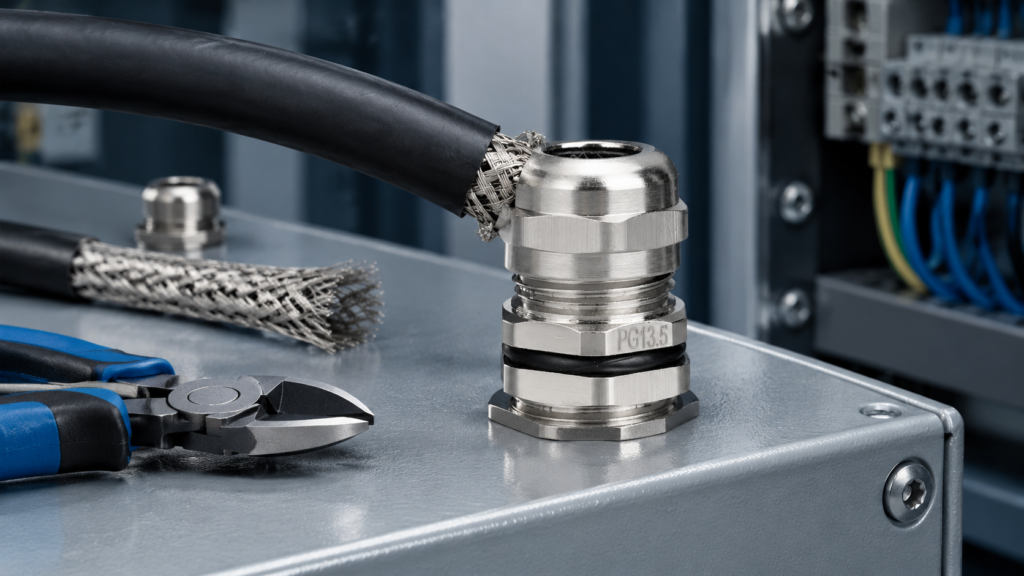
Two rows are worth memorising because they cause recurring mistakes: PG13.5 has a 20.4 mm thread outside diameter and will not enter a 20 mm hole, and PG29 at 37 mm shares its diameter with M37. Diameters alone do not identify a thread.
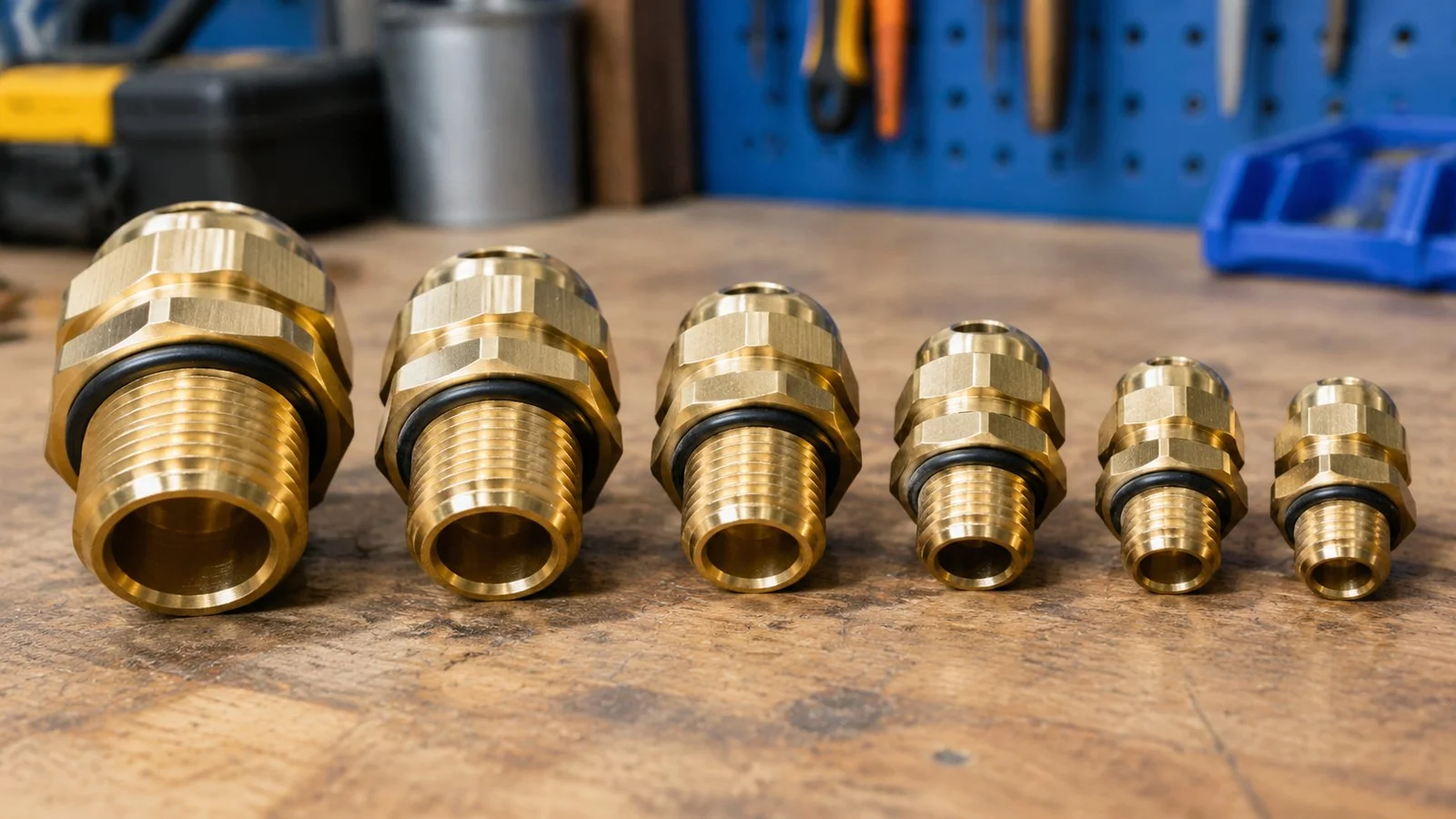
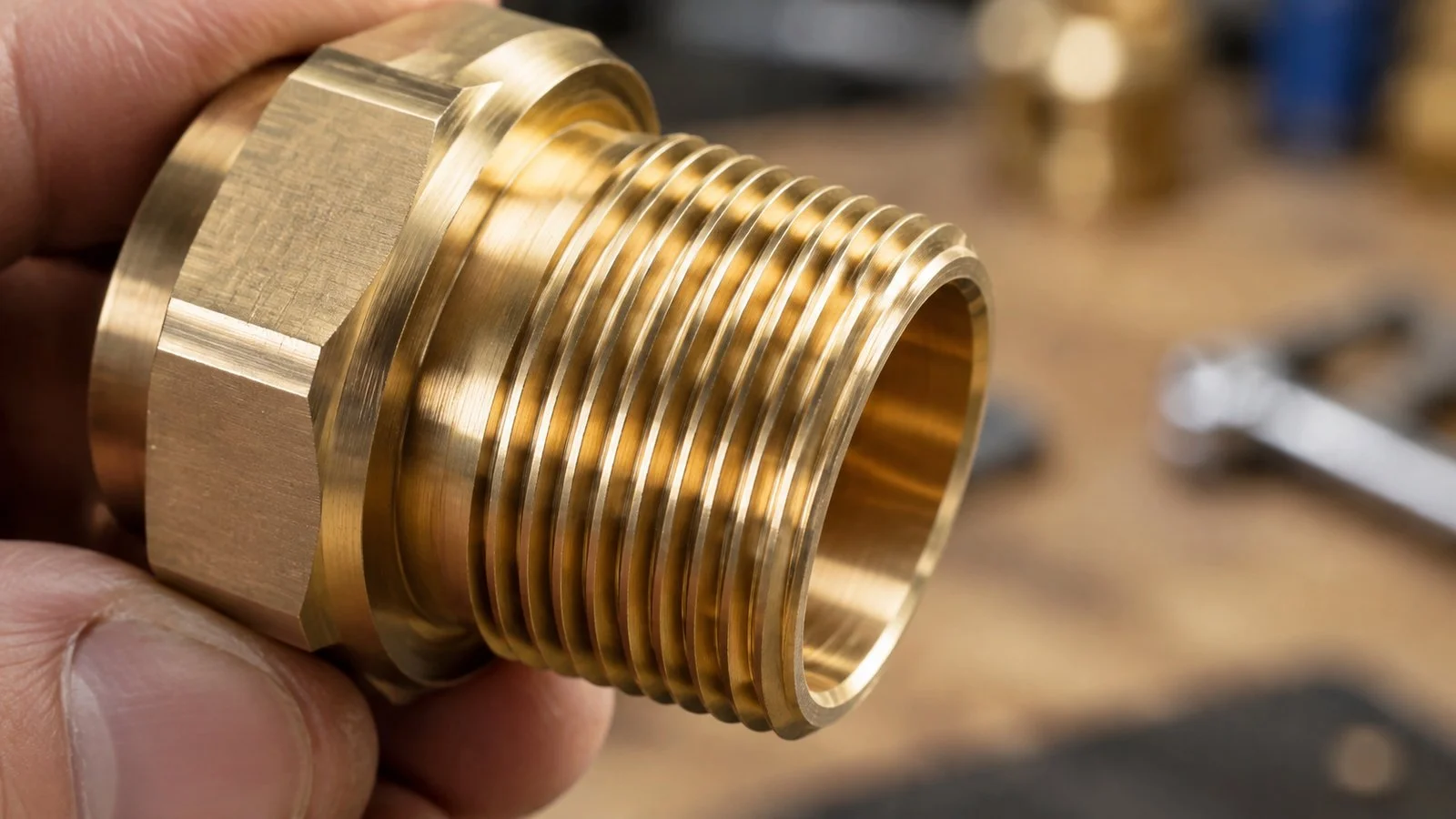
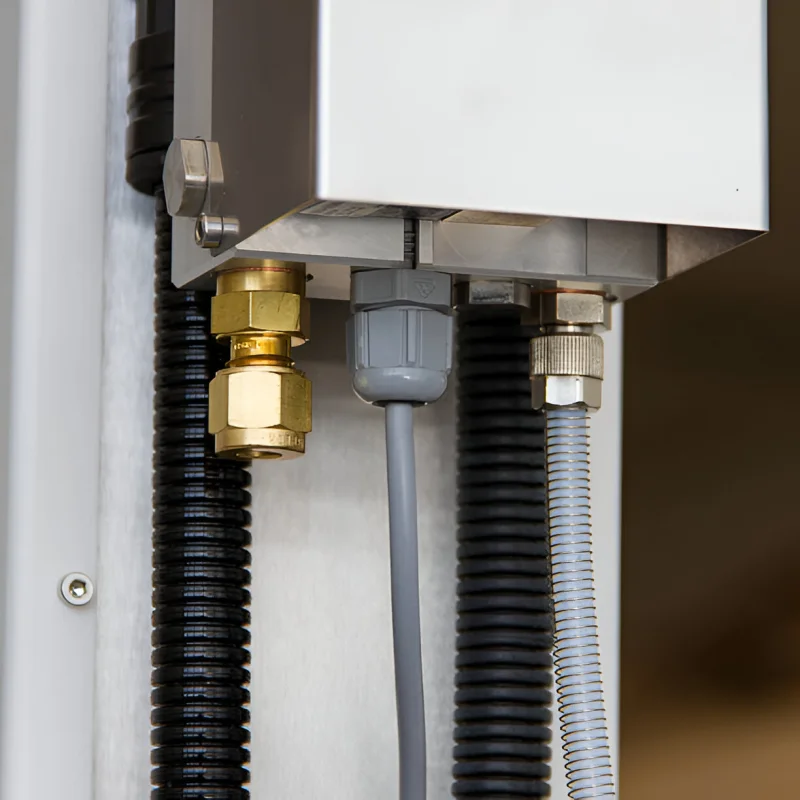
Brass glands of different thread families laid out side by side, showing that similar diameters do not imply interchangeable threads. The thread form, not the measurement across the crests, decides what fits.A close view of a machined brass gland thread on a workshop bench, with the parallel flanks and clean crests that distinguish a well-cut thread from a damaged one.
Cut or rolled thread: how the brass thread is made
Most buyers never ask this question, and it changes fatigue life, burr condition and cost.
Aspect
Cut thread
Rolled thread
How it is formed
Material removed by a die or single-point tool
Material displaced by pressure, grain flows along the profile
Thread root
Sharp, with a machined surface
Rounded and work-hardened
Burrs
Possible at the start and end of the thread
Minimal, no chips
Fatigue and stripping resistance
Adequate for hand tightening
Better under repeated assembly and vibration
Coût
Plus bas
Higher, and better suited to volume
For a gland that is installed once and never touched, cut thread is fine. For entries opened at every maintenance interval, or on equipment with vibration, rolled thread is the better specification — and it is a legitimate question to put to a supplier, because the answer distinguishes a production line from a workshop.
Ask the question in a way that gets a verifiable answer. Request the thread manufacturing method in writing on the drawing, and check a sample under a magnifier: a rolled thread shows a continuous surface with no chip marks and a rounded root, while a cut thread shows fine tool marks and a sharper root. Both pass a go/no-go gauge, so the gauge alone will not tell you which you received — and neither will the price, since the difference is a few percent at volume.
Full dimension tables for every size, including the collisions between families at similar diameters, are in the cable gland thread size chart.
What happens when brass meets steel, aluminium or plastic
The gland thread is rarely the only thread in the joint. What it engages determines both the failure mode and the maintenance difficulty.
Brass into steel. The brass thread deforms first. Over-tightening strips the gland, not the enclosure, which is the cheaper failure — but it also means the gland must be replaced after a cross-threading incident.
Brass into aluminium. Aluminium is softer still and galvanically active against brass. The joint can seize and the enclosure thread can be damaged on removal. Use a sealing washer and avoid repeated disassembly.
Brass into brass. The most predictable joint, with the lowest risk of seizure, provided both threads are clean and neither is plated with a thick, uneven layer.
Brass into plastic. The plastic thread carries far less load and creeps under sustained preload. Hand tight plus a locknut on a flat face is safer than relying on thread engagement alone.
Brass into stainless. No galling concern in this direction — the problem belongs to stainless-on-stainless pairs — but the stainless entry is usually part of a more expensive enclosure, so protect it from over-tightening.
Where the two are different metals, keep the couple dry and inspect it; the corrosion mechanics are the same ones that apply to any brass-to-steel interface.
Sealing is different on each thread family
The thread form decides where the seal lives, and fitting the wrong sealing method turns a good thread into a leak.
Metric and PG are parallel threads. They seal at the shoulder, on a washer or bonded seal, not in the thread. Adding thread tape does nothing useful and changes friction, which changes how tight the gland ends up.
NPT is tapered and seals in the thread. It needs a thread sealant and it does not use a shoulder washer in the same way. Applying metric practice to an NPT entry leaves it leaking; the seal-point difference is set out in NPT vs metric cable glands.
G (BSP) is parallel despite looking like NPT, and seals on a washer or an O-ring face. It is the family most often confused with NPT at a glance.
For hole dimensions and drilling practice rather than thread data, use the hole size chart.
Thread length, wall thickness and separate part numbers
Thread length, usually given as GL, must cover the wall thickness at the entry plus the locknut, with enough engagement left for the certified or specified minimum. On a thick wall or a gland plate the standard GL is not enough, and the answer is a long-thread variant — a different part number, not a modification.
Cutting a brass gland’s thread shorter to fit is a bad trade. It removes the plated or machined start, leaves a burr that will not seal, and destroys any certification on the part. Order the long-thread version or move the entry.
Damaged threads: what can be repaired and what cannot
Symptom
Cause
Repair position
Bruised or flattened crest on a few threads
Handling, spanner contact, drop
Chase with a thread file or die if no material is removed from the flank; otherwise replace
Cross-threaded start
Assembly at an angle
Replace the gland. Enclosure thread must be inspected before a new gland goes in
Plating worn off the crests
Abrasion or repeated tightening
No re-plating in the field; keep the part dry and schedule replacement
Thread seized in an aluminium entry
Galvanic action or over-tightening
Penetrating oil and patience; heat and force usually damages the enclosure
Thread stripped inside the enclosure
Over-tightening a soft entry
Enclosure repair or a larger entry; not a gland problem
What to put on the order
Five lines remove most thread-related errors: thread family and size written in full (M20×1.5, PG13.5, 1/2″ NPT); the cable range the batch must cover, measured; GL or the wall thickness it must pass through; material and plating; and whether the thread needs to be rolled rather than cut.
Our brass series covers M14 to M63 and PG7 to PG63 as standard, with NPT to order. If you are replacing legacy PG entries with metric on a new panel and need adaptor guidance, the comparison in PG vs metric cable glands is the place to start. Send us the entry schedule with thread, wall thickness and measured cable diameters and we will return a matched list.
Frequently asked questions
Is brass a good material for a threaded cable gland?
Yes. Brass machines a clean, accurate thread at low cost and does not gall the way stainless can. Its limitation is strength: a brass thread deforms before a steel one, so over-tightening strips the gland rather than the enclosure.
Can I use a metric brass gland in a PG hole?
No, even where the diameters are close. PG13.5 at 20.4 mm will not enter a 20 mm metric hole, and a metric thread started in a PG hole contacts on the crests rather than the flanks. Use the correct thread or a proper adaptor.
Do brass cable glands need thread tape?
Not on metric or PG threads, which seal at the shoulder on a washer. Tape changes the friction and therefore the achieved tightness. NPT is the exception, because it seals in the thread and requires a suitable sealant.
Does nickel plating affect the thread fit?
It can, slightly. Plating adds thickness on the flanks and is thinnest at the thread crests, so a heavily plated thread may feel tighter. Controlled plating thickness is one of the reasons to specify a minimum rather than accept “plated” as a description.
Should I order rolled thread instead of cut thread?
For entries opened regularly or on vibrating equipment, yes — rolled threads have a work-hardened, rounded root and resist repeated assembly better. For glands fitted once and left alone, cut thread is adequate and cheaper.
Les presse-étoupes étanches jouent un rôle indispensable dans les équipements électriques industriels et commerciaux modernes. Ils protègent non seulement les entrées de câbles de la poussière et de l'humidité, mais assurent également la sécurité de l'équipement et prolongent sa durée de vie. Le choix du bon indice IP pour un presse-étoupe étanche permet d'éviter efficacement les pannes électriques ou les incidents de sécurité causés par des environnements difficiles. [...]
Eight-step field procedure for EMC cable gland installation: screen exposure, braid fold-over, torque, enclosure bonding and the continuity check that proves the shield is bonded.
Découvrez les presse-étoupes divisés étanches avec des classements IP66 IP68 en nylon, laiton et acier inoxydable, idéaux pour les installations de câbles préterminés et les réaménagements.
Nous répondrons à votre demande dans les 24 heures
Nous accordons de l'importance à votre vie privée
Nous utilisons des cookies pour améliorer votre expérience de navigation, vous proposer des publicités ou des contenus personnalisés et analyser notre trafic. En cliquant sur "Tout accepter", vous consentez à notre utilisation des cookies.