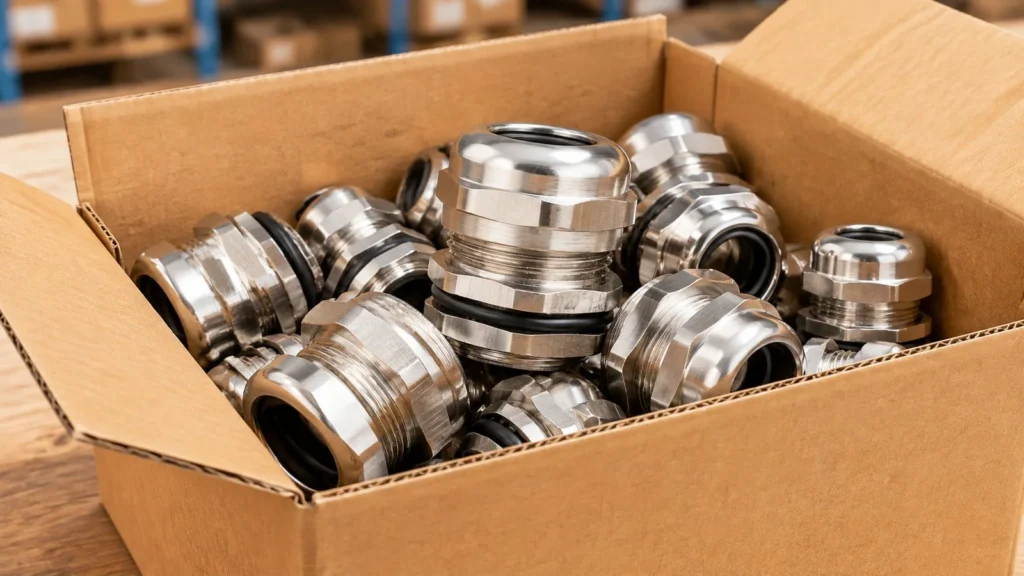
Put an M20 gland beside a PG13.5 gland and compare the columns. Cable range 6 to 12 mm on both. Thread outside diameter 20 and 20.4. Mounting hole 20 to 20.2 and 20.4 to 20.6. Thread length 8 on both, bonding length 22 on both, spanner 22 on both. Six numbers, one difference: the thread form. One is a 60 degree metric thread, the other an 80 degree PG thread, and neither will enter the other’s tapped hole.
That pair is the argument of this page. A part number is a key to one supplier’s price list, not a description of a part, and the letters that look most technical often carry the least engineering.
A Part Number Is a House Code
No international standard defines a cable gland part number. IEC 62444 defines what a gland must survive. The thread standards define what M20×1.5 means. Nothing defines what the letters after the dash mean, so every manufacturer invents them, and the same string can mean different things in two catalogues.
Our own pages make the point faster than any argument. The suffix -NP, which stands for nickel plated, also appears on stainless tables where nothing is plated. The same M16 thread is sold as M16-NC13, M16-NC13L and M16-NC15.8, three parts with three bores. One nylon table lists an M25 as “M25 -NFL”, with a space no string comparison will forgive. A code is a label a factory applied to a drawing, and labels drift.
The Five Blocks of a Gland Code
Almost every gland code on the market can be split into five blocks, even when the supplier would not describe it that way. Reading in this order stops the most common mistake, which is treating the size block as a description of the whole part.
Block
Example from our catalogue
What it tells you
What it cannot tell you
Vendor prefix
JX-NLM8-UN
Which factory’s list the rest of the code indexes
Anything about the part
Family letters
NLM, NLWM, N-, NC
Body construction: straight, elbow, divided, long thread
Any dimension
Thread size
M20, PG13.5, M8
The nominal thread, and therefore the hole
The cable it accepts
Pitch
×1.5, ×1.25
Threads per unit length, and interchangeability
Thread angle
Variant suffix
-NP, -EMC, -NFL, -L, -DS
Finish, shielding, body length, split construction
How much thread you actually get
Block One: the Thread, and the Number That Is Not the Cable
The number in M20 is the thread outside diameter, not the cable size and not quite the hole either: the hole runs 20 to 20.2 mm, two tenths above the thread, and the seal does the sealing. A 20 mm cable is something else entirely. On this series M20 stops at 12 mm, so the answer to a 20 mm cable is a larger gland, not a longer thread.
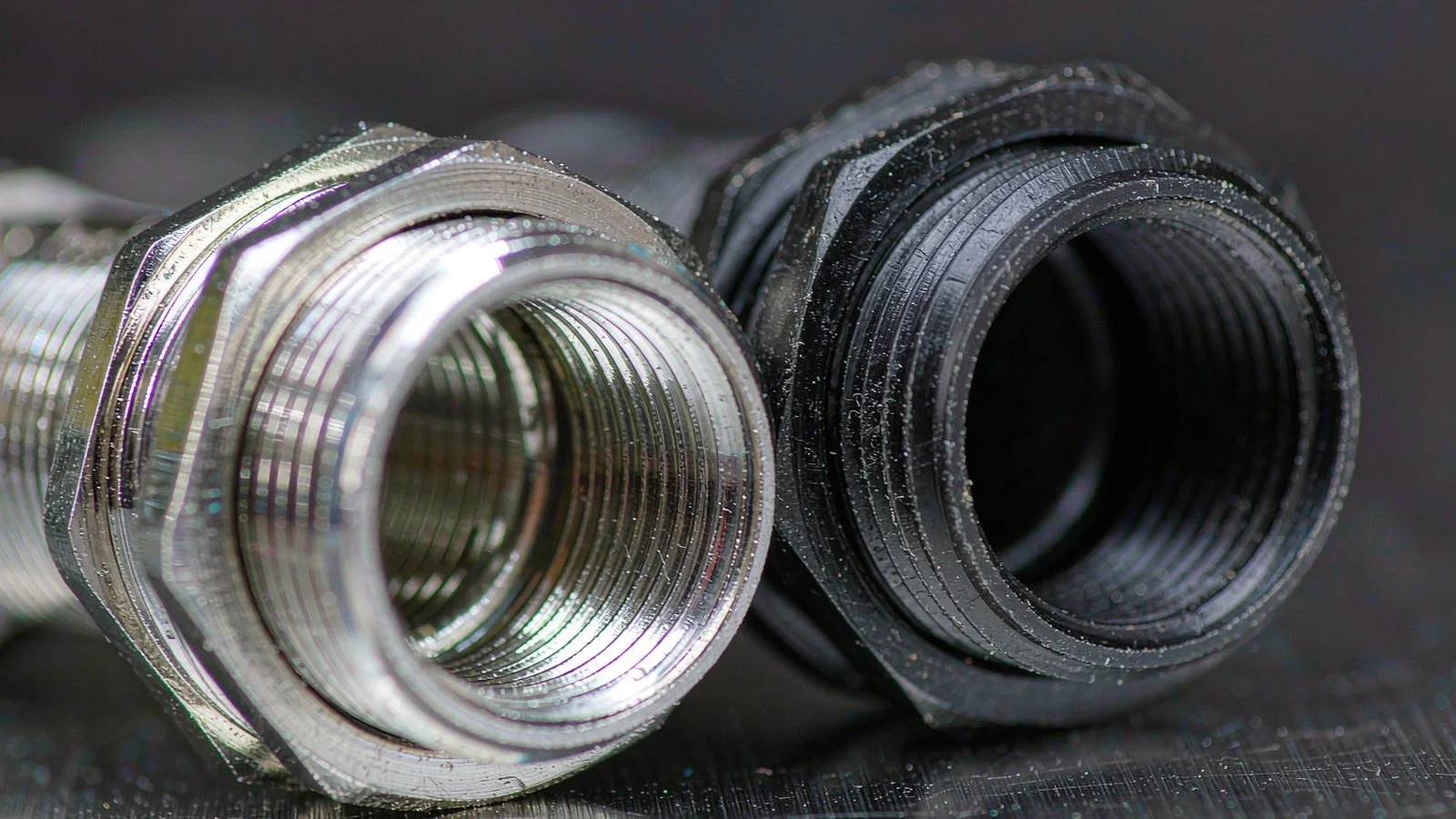
Four thread systems appear on our nylon range in one line: metric, PG, G (PF) and NPT. They are not variants of each other. Metric is a 60 degree thread to EN 60423. PG is an 80 degree form whose numbers are neither the diameter nor the hole, as our PG and metric comparison sets out. G, or PF, is a parallel pipe thread that seals on a face or an O-ring rather than on the thread. NPT is tapered at 1:16 and seals on the threads themselves. A PG13.5 code and an M20 code describe parts that will not interchange, and the dimensional tables will not warn you, because on the numbers they are the same size.
Two threads of the same nominal size, one 60 degree metric and one 80 degree PG. The part number records the difference; the dimensional table does not.
Block Two: the Family Letters
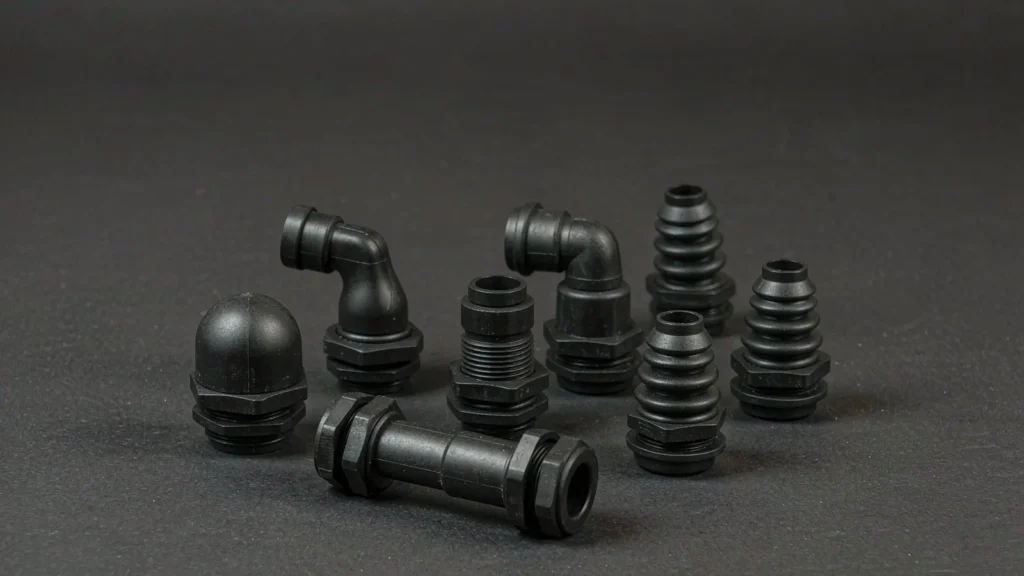
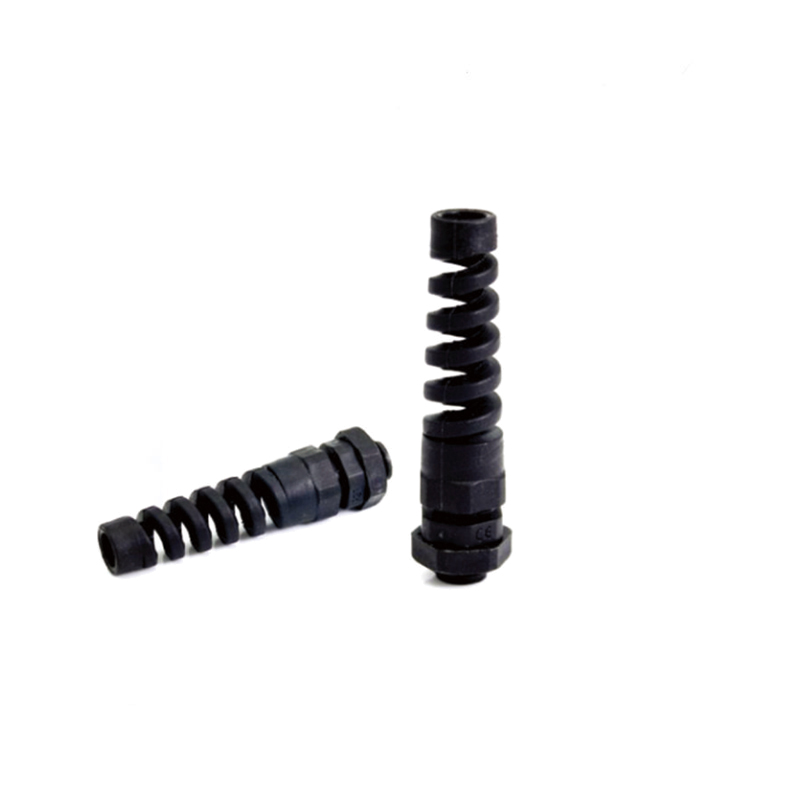
The letters in front of the size are the part of the code most often skipped and the part that changes what the object is. On our pages, N- marks the standard nylon gland, NLM a split or unified nylon body, NLWM the 90 degree elbow, L a long thread, NFL a flexible nylon gland, and NC a watertight conduit fitting. The brass series carries no family letters, because there is only one body shape.
The elbow is the clearest case. NLWM20×1.5 and M20-NP share a thread, a hole and a cable range, and they are not interchangeable, because the elbow adds 43 mm of height above the panel that has to clear whatever sits beside it. A code without the W would tell a buyer everything except the one dimension that decides the installation.
Block Three: the Suffix Is Where the Part Lives
Two glands with the same thread, hole and cable range can differ by six millimetres of thread length, by a contact spring, or by a split body that fits over a terminated cable. All of that lives in the suffix, which deserves more attention than the size.
Код
Нить
Family
What the code still leaves out
M20-NP
M20×1.5
Brass or stainless standard
Material: the same suffix appears on stainless pages
PG13.5-NP
PG13.5
Brass or stainless PG
That this is an 80 degree thread, not a metric one
M20-EMC
M20×1.5
Shielded, 360 degree contact spring
The shield diameter, which the cable range never describes
N-M12
M12×1.5
Nylon standard
Hole 12.2 to 12.5, GL 9, cable 3 to 6.5
M12-L
M12×1.5
Nylon long thread
GL 15 instead of 9, and a 10 mm body
M25-NFL
M25×1.5
Nylon flexible
That the flexible body is a different moulding
NLWM20×1.5
M20×1.5
Nylon 90 degree elbow
The 43 mm height above the panel
NLM12A-DS
M12×1.5
Nylon divided body
That A and B are different body variants in the same size
JX-NLM8-UN
M8×1.25
Nylon unified body
A 1.25 pitch, not the 1.5 used further up the range
M16-NC13
M16×1.5
Watertight conduit fitting
That NC13L is the long body and NC15.8 the wider one
The long-thread case is worth holding on to. N-M12 gives a thread length of 9 mm and M12-L gives 15 mm, on the same thread, the same hole and the same cable range. If your panel plus washer plus locknut stack needs 12 mm, the standard part cannot be made to work by tightening it harder, and the -L is the whole difference between an assembly and a leak.
The Pitch Everyone Drops
The pitch is the one part of the code that is routinely omitted, because 1.5 mm is the default across most of the metric range and habit fills in the gap. It is not universal. M8 uses 1.25 on our nylon series, and G and NPT threads are specified on entirely different conventions, NPT in threads per inch rather than millimetres. A supplier receiving an order for M8 without a pitch will supply their default, which will usually be right and occasionally will not.
Two threads of the same diameter and different pitch look identical at arm’s length and will start to engage, which makes the error expensive: it survives a visual check and fails at the first pressure test.
Same Code, Different Gland
This is where the code does real commercial damage. An M20-NP from one factory and an M20-NP from another can differ in every dimension that matters while both being honestly described. The drilling is the same, so both will fit the panel. Nothing else is guaranteed.
What can differ under an identical code
What it changes on site
What to put in the order line
Cable range
6 to 12 mm against 10 to 14 mm: the same code accepts different cables
The sheath diameter you need to clamp, in millimetres
Thread length GL
Two or three millimetres decide whether a locknut fits on a thick wall
The stack: wall plus washer plus locknut
Sealing insert material
NBR against EPDM or silicone changes the temperature and chemical limits
The elastomer, if the environment is not benign
Accessories in the bag
“With gland” sometimes means the gland alone
Whether a locknut, washer or shroud is included
IP claim and depth
IP68 at 1.5 m for 30 minutes is not IP68 at 10 m for 168 hours
The IP code with depth and duration
Plating thickness
Decides how long the finish survives in salt air
The service environment, and the corrosion class if specified
A second-order test catches most of these before they reach a panel: does your existing accessory still fit? A locknut cut to another maker’s thread form will start on two or three threads and then bind. The part that gives it away is never the gland, it is the nut.
The Four Fields an Order Line Needs
A reorderable line is not a code. It is a code plus the three dimensions the code omits, written the same way every time so that a new buyer can use it without a phone call.
Field
Example
Why the code alone fails
Thread with pitch and system
M20×1.5, metric, 60 degree
M20 without a pitch is a family, not a part
Cable range required
9 to 11 mm sheath
The code names the hole, never the cable
Thread length needed
Minimum GL 12 mm
GL is missing from almost every code
Variant and accessories
Standard body, nickel plated, locknut included
Suffixes cover finish and body, not the bag contents
Gland, washer, locknut, adaptor: the code usually names the first of these and leaves the other three to the small print.
For a project order, add the IP statement with depth and duration and the elastomer, and the line stops being ambiguous. That is also the point at which a supplier can quote accurately instead of quoting the closest thing in stock.
Keep a House List, Not a Memory
The failure this page is really about is not a wrong order, it is a right order that cannot be repeated. The person who knew that “the small nylon one with the long thread” means M12-L leaves, and the next buyer orders N-M12, which arrives with 9 mm of thread instead of 15. A house list fixes it in one page per part: code, the dimensional row it maps to, a photograph, the supplier, the date, and one physical sample in a box. Six lines per part, and it survives catalogue redesigns in a way the code does not.
Reading a Gland You Cannot Identify
When the code is gone, worn off, or from a supplier that no longer exists, the part can still be identified, but only by measurement rather than by guessing at letters. Measure the thread outside diameter across the crests. Count the turns over 10 mm to establish the pitch, or use a thread gauge. Measure the hole it came out of. Measure the cable range at the insert, not at the body.
Two measurements decide it. A 20.0 mm thread with a 1.5 pitch is M20; 20.4 mm is PG13.5, whatever the markings suggest, and a calliper sees the difference a photograph hides. Where the two are a tenth apart, test-fit a known locknut: the accessory is a faster thread-form gauge than any table.
Часто задаваемые вопросы
What does the NP in M20-NP mean?
Nickel plated, in our catalogue. It is a house convention, not a standard, and it shows why a code needs its catalogue: the same suffix appears on stainless pages, where there is no plating.
Is a cable gland part number standardised anywhere?
No. Thread designations are standardised and the product standard defines what a gland must survive, but the part number is invented by each manufacturer. Two suppliers using the same string promise nothing.
Can I replace a PG gland with a metric one of the same size?
Only if the panel is being re-drilled or the hole is a plain clearance hole with a locknut. A tapped PG hole will not accept a metric thread, and the thread forms are 80 degrees against 60, so they will start and then bind rather than seat.
Why does the same code come with different cable ranges?
Because cable range is a property of the clamping insert, and inserts vary between manufacturers and between product families. The thread is fixed by the standard; the insert is a design choice, so the range has to be quoted rather than inferred.
What is the most common ordering mistake with these codes?
Ordering by the size block alone. M20 tells you the hole and nothing about the cable, the thread length or the finish, and those three are what a project actually fails on.
If you have a code you cannot decode, or a panel hole and a cable and no clear idea which gland belongs between them, send us the thread size and the cable diameter. Our guide to gland types, the nylon series and the brass M20 series cover the two families most orders come from.
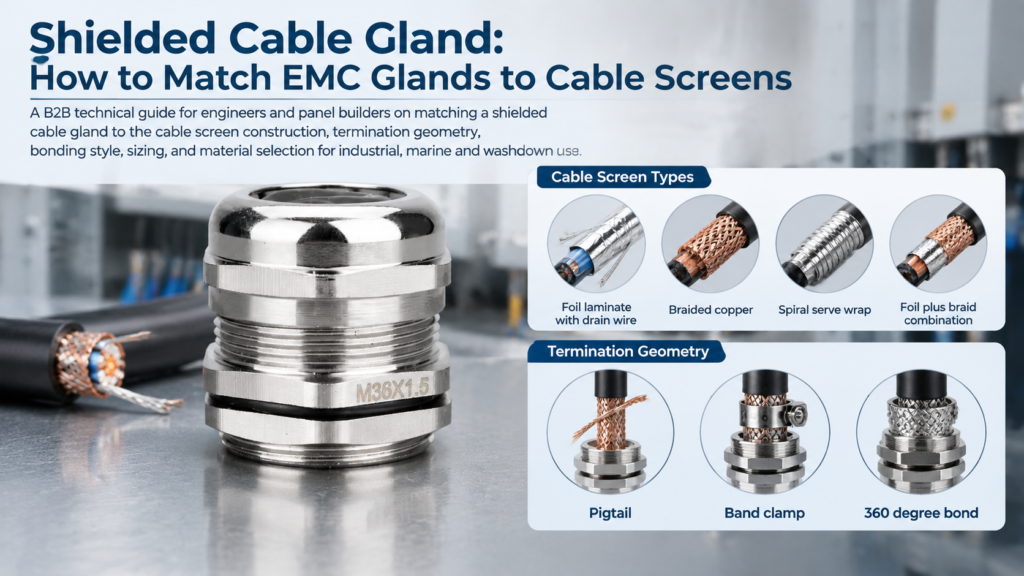
Match an EMC cable gland to the cable screen: foil, braid, spiral and combination constructions, termination geometry, bonding rules and sizing on jacket OD.
There is no HS heading for cable glands. Why the material decides the chapter, the four copper headings a brass gland can legally occupy, and what the wrong code costs at the border.
Выбор правильного водонепроницаемого кабельного ввода имеет решающее значение для обеспечения безопасности и долговечности ваших электрических и промышленных установок. Эти маленькие, но мощные компоненты защищают кабели от воды, пыли и вредного воздействия окружающей среды, что делает их незаменимыми во многих отраслях - от телекоммуникаций до морской и тяжелой промышленности. Но как выбрать правильный уровень защиты и [...].
Мы используем файлы cookie для улучшения вашего восприятия, предоставления персонализированной рекламы или контента, а также для анализа нашего трафика. Нажав кнопку "Принять все", вы соглашаетесь с использованием нами файлов cookie.