PG63 is the largest gland in the PG series, and most of what goes wrong with it comes from the name. The 63 is a nominal figure inherited from a withdrawn German standard. The thread it cuts is 72 mm across, the hole in the panel is 72 mm, and the cable it grips runs from 42 to 52 mm. Order on the assumption that 63 means 63 and two errors are made before the goods ship: a hole that will not pass the gland, and a size that will not take the cable.
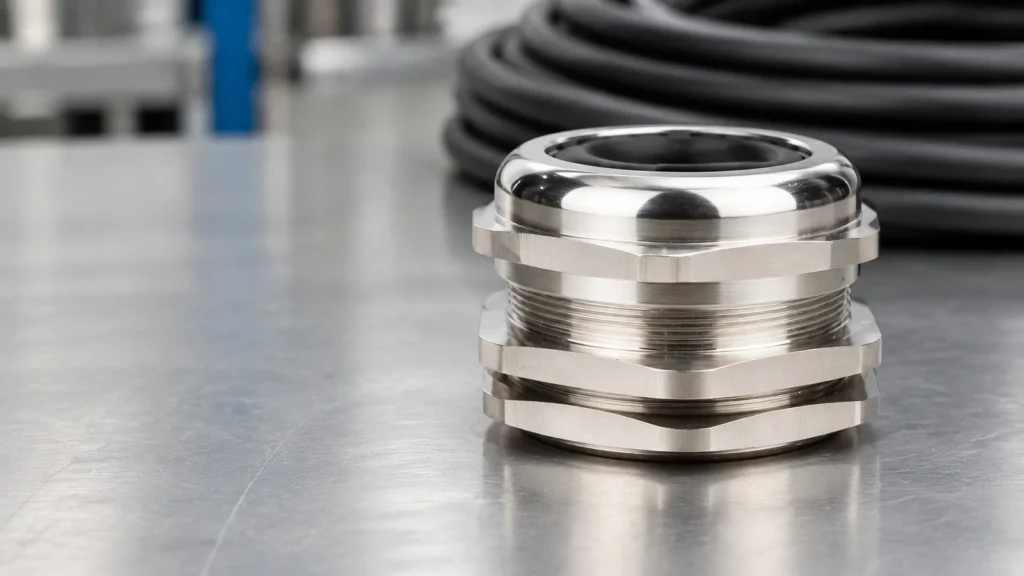
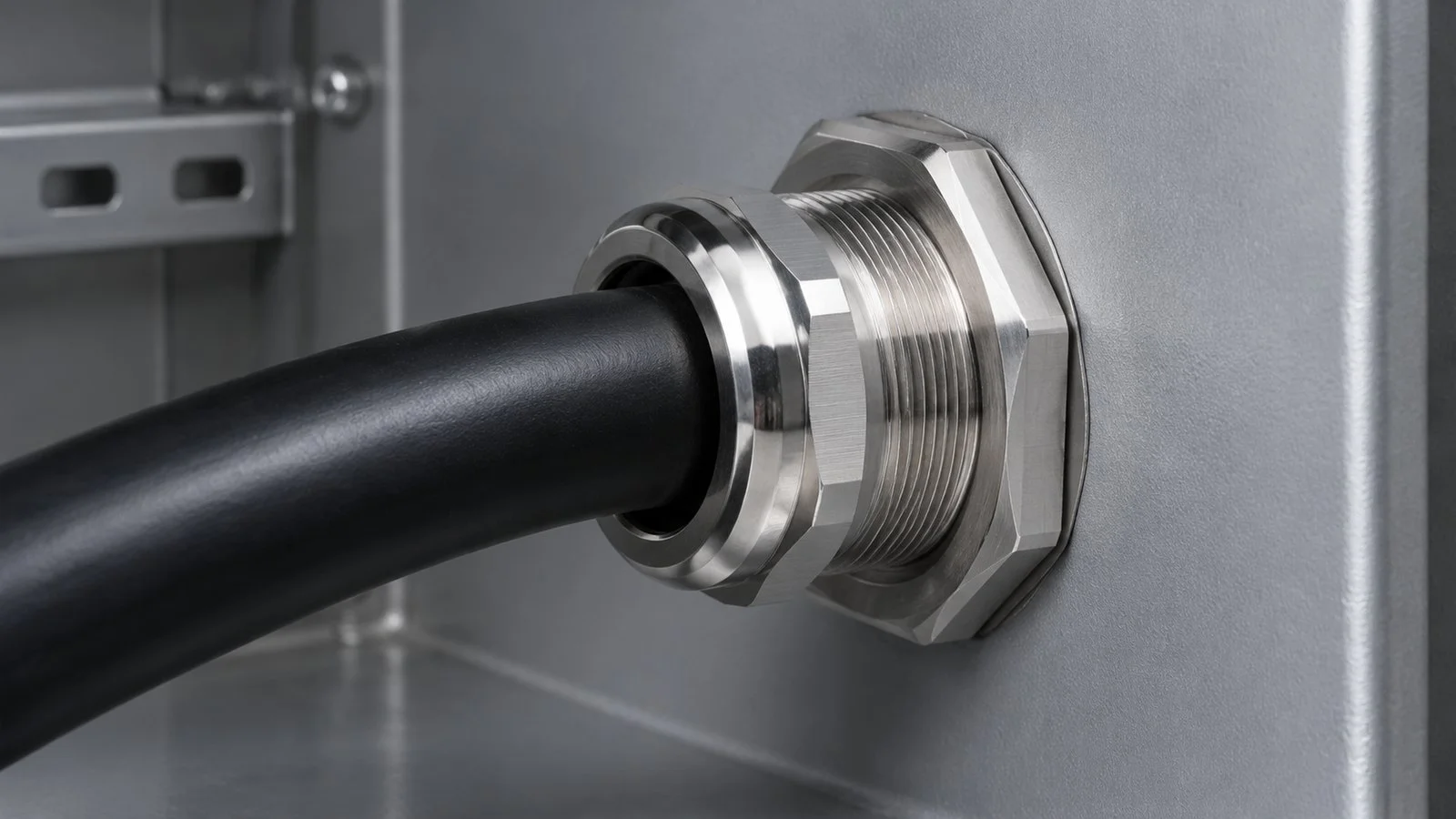
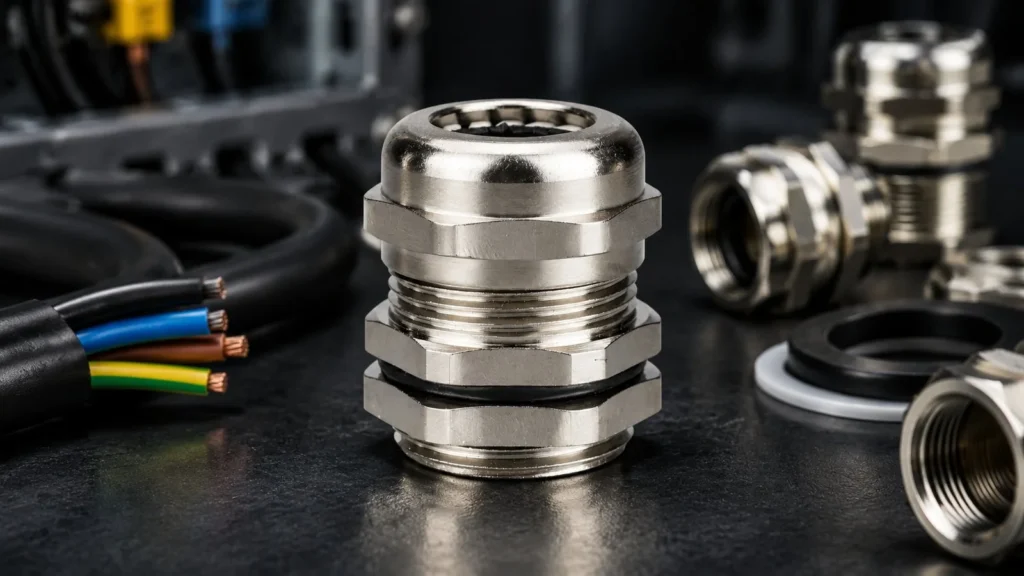
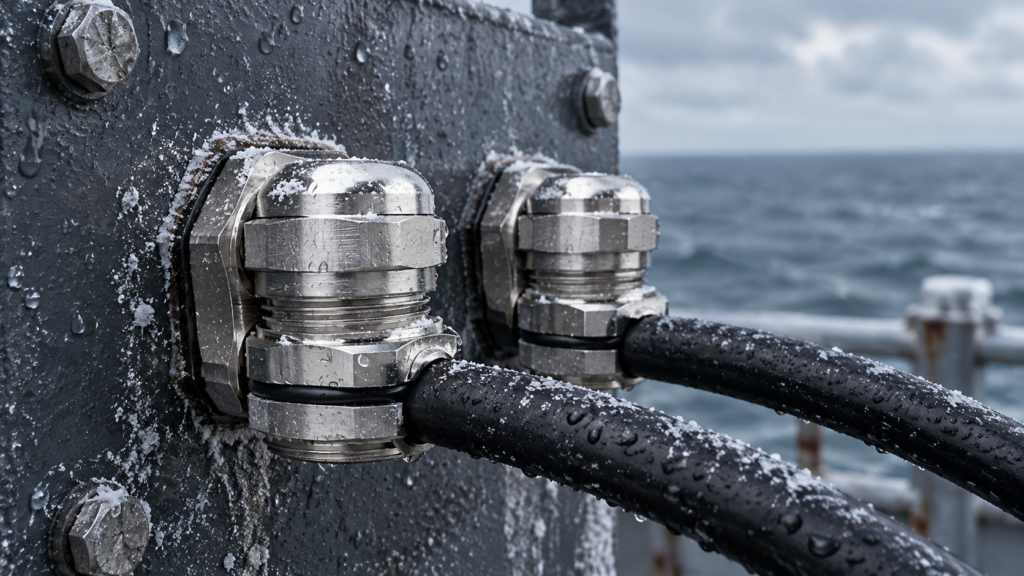
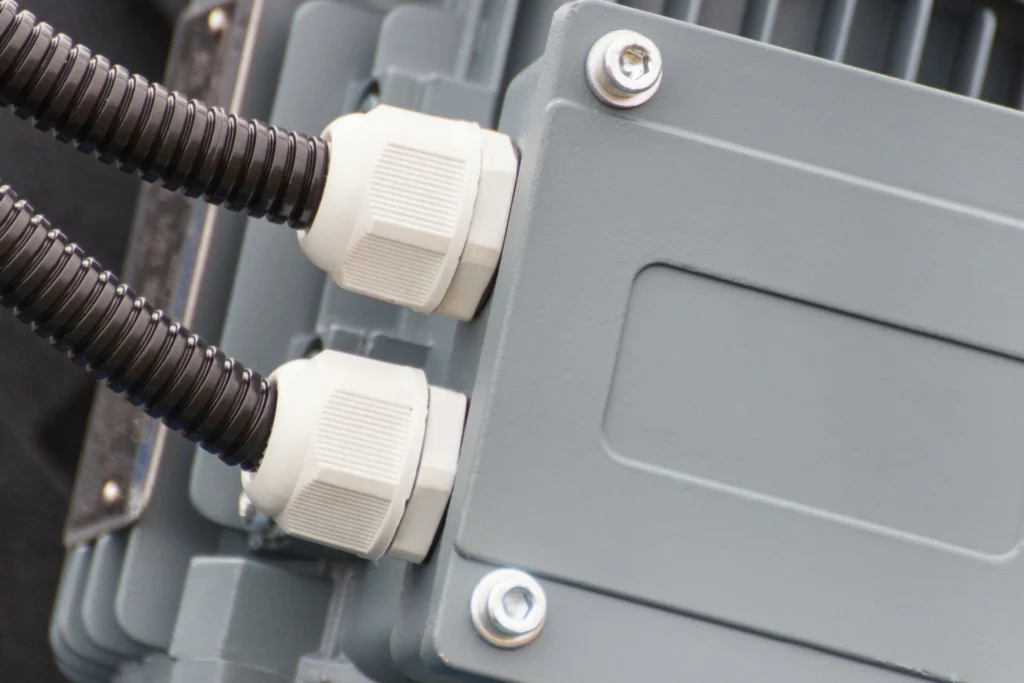
PG63 is a straight threaded entry gland. A rubber insert is compressed onto the sheath by a dome nut, and a face washer under a locknut seals against the enclosure. In the ranges sold here it exists in nickel-plated brass and in 304 or 316 stainless steel, and the mounting dimensions are identical between the two materials, so a material change late in a project does not force the panel to be redrawn.
It is a large-part item. The thread is 72 mm across, the hex is 78 mm, and the bonding length, measured from the sealing face into the insert, is 42 mm. None of those are numbers you discover after delivery. They set the panel layout, the tool and the cable support.
Why “63” Is Not a Hole Size
The PG series numbers its sizes by nominal inner diameter, not by the diameter of the thread it cuts. PG63’s nominal 63 mm corresponds to a real thread outside diameter of 72 mm, a difference of 9 mm. On the small sizes the same offset is easy to absorb as a drawing tolerance. On PG63 it is either a hole that will not pass the gland or a gland that drops through a hole already cut.
The offset is not a constant, so there is no multiplier to memorise. It climbs from about 5.5 mm at PG7 to roughly 12 mm at PG42 and PG48, then comes back to 9 mm at PG63. Extrapolating from the size you already use is how the mistake happens. Outside diameter is the only figure to drill against, and it sits on the datasheet next to the mounting hole.
The Numbers on a PG63 Datasheet
Параметр
PG63 value
What it decides
Нить
PG63, 80 degree PG form
Fixed by the series; adapters exist but add stack height
Cable range
42 to 52 mm
The sheath outside diameter must sit inside the band, not on its limit
Thread outside diameter
72 mm
The figure the hole is drilled against
Mounting hole
72 to 72.2 mm
Thread outside diameter plus 0.2 mm, as across the whole range
Thread length GL
15 mm
Must exceed panel thickness plus washer plus locknut plus any earth tag
Длина скрепления
42 mm
Insert travel; sets how much sheath ends up inside the body
Spanner size
78 mm
The tool that has to exist on the day
PG63 Is Not Metric 63
The two sizes read as equivalents in a specification and are not. M63 is 9 mm smaller on the thread, one spanner size down, and its cable band stops 8 mm short of where PG63 begins.
Size
Диаметр резьбы O.D.
Cable range
Mounting hole
GL
Spanner
PG63
72 mm
42 to 52 mm
72 to 72.2 mm
15 mm
78 mm
M63
63 mm
37 to 44 mm
63 to 63.2 mm
13 mm
64 / 68 mm
PG48
59.3 mm
37 to 44 mm
59.3 to 59.5 mm
14 mm
64 mm
Read down the cable column rather than the thread column. PG48 and M63 cover exactly the same 37 to 44 mm band despite a 3.7 mm difference in thread diameter, which is why they are interchangeable on a cable and not on a panel. If a drawing says “M63 equivalent” and the actual sheath measures 48 mm, nothing in the standard metric series will take it.
Where the Metric Series Stops
Convert the metal ranges to cable range and a gap opens above 44 mm. Within the brass and stainless series M50 tops out at 38 mm and M63 at 44 mm, with nothing larger behind it. PG63 begins at 42 mm and reaches 52 mm. That band above 44 mm is the reason a size from a withdrawn standard is still stocked in volume: in metal, it is the only thing that covers 45 to 52 mm.
Moulded nylon does reach further, with M72 covering 45 to 50 mm, so the metric route is not closed. It is a different decision, though, because it changes the material rather than the thread. Where the duty needs metal, the honest options are a larger heavy-duty range or a thread adapter into PG63. The adapter is not free: it adds to the GL budget and moves the sealing face away from the enclosure wall, which matters more at this diameter than at M20.
Thread Length Is the Tightest Ratio in the Range
GL on PG63 is 15 mm. That is one millimetre more than PG48 in absolute terms and less in relative terms, because the body is 72 mm across. Divide one by the other and PG63 has the lowest ratio in the entire PG series, about 0.21, against 0.24 for PG48, 0.25 for PG36 and over 0.3 for everything from PG25 downwards.
The consequence is arithmetic rather than opinion. Panel thickness plus flat washer plus locknut plus any earth tag has to come in under 15 mm. A locknut and washer will take a substantial share of that on their own, so measure the parts you intend to use instead of assuming a standard stack. Where the sum approaches the limit, the answers are a machined backing pad to spread the load on a thin wall, a gland with a longer thread, or a change of entry position to a thicker part of the enclosure. A thread that engages only two or three turns holds the gland in place and does not seal it.
A 72 mm entry leaves little margin: the locknut sits against the inside wall, so panel thickness is taken out of the 15 mm of thread before the washer and any tag are counted.
Setting the Hole and the Bearing Face
The hole is 72 to 72.2 mm. A hole at 73 mm will bolt up and still leak, because the washer seals against the face and not the bore; the extra clearance lets the washer extrude outwards instead of compressing. At this diameter a hole saw cuts a hole that is neither round nor clean at the breakout, so the bearing face is the part to inspect after drilling. Burrs, a rolled lip or a dished face all reappear later as a leak that comes back after each attempt to fix it.
The 0.2 mm allowance is uniform across the range and exists so the thread enters without being forced. It is a clearance, not an adjustment. If the hole is already oversize, the fix is a thicker sealing washer or a weld-on pad, never a larger gland.
Spanner 78 and the Tooling Question
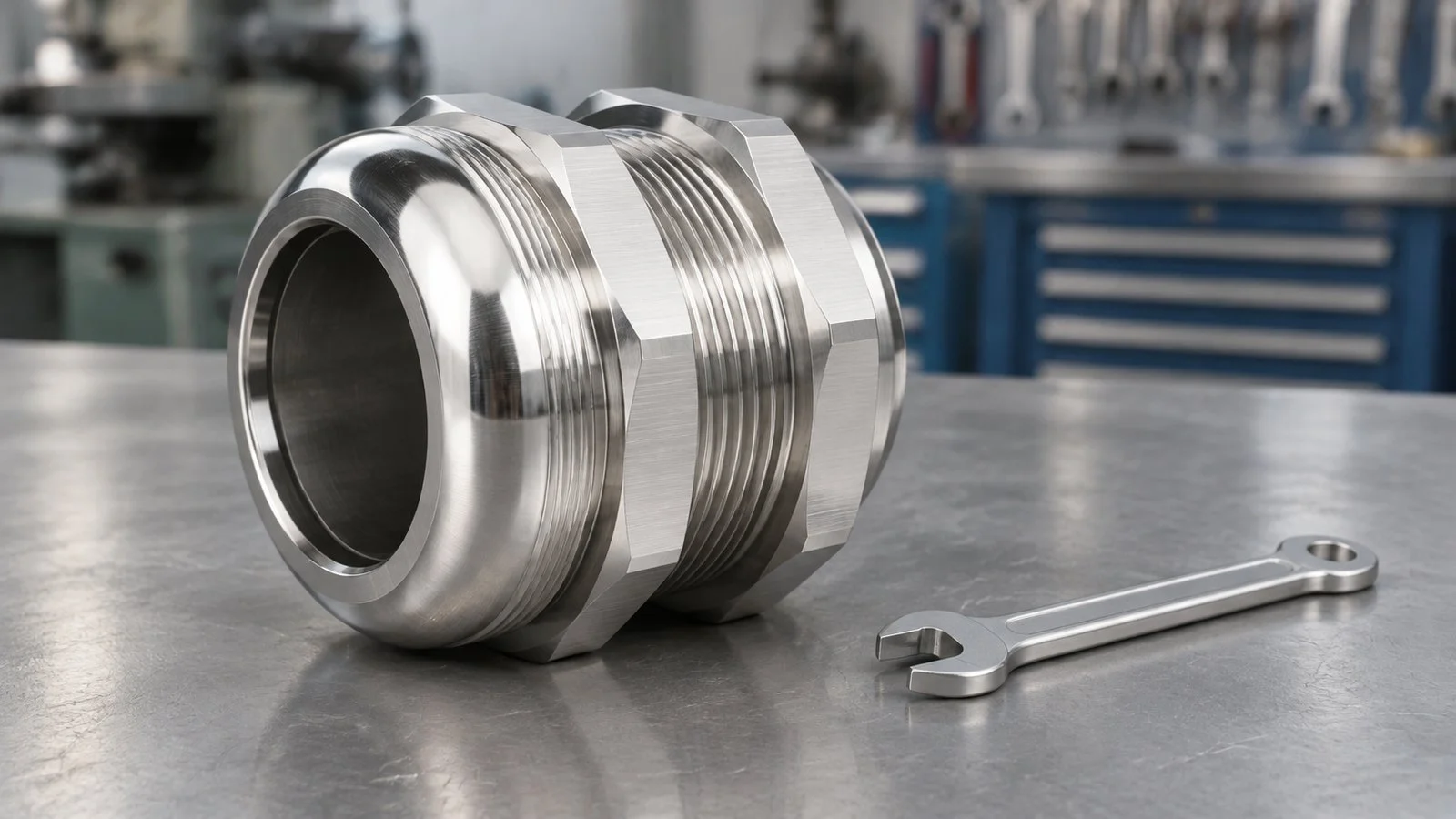
78 mm across flats is past the comfortable range of an adjustable wrench. The hex is also only as deep as the body allows, so a strap wrench has little to grip and a pipe wrench will mark the plating before it turns the nut. Confirm before the installation day that an open-end wrench or socket at 78 mm exists on site.
Access is the second half of the problem. A hex that size needs that much clear swing plus the arc of the wrench. An entry placed near a wall, a gland plate edge or another gland immediately beside it will be assembled loose on the bench with the cable already threaded through, which reverses the normal order of work and has to be allowed for in the method statement rather than discovered by the fitter.
At 78 mm across flats the body is past the comfortable range of an adjustable wrench, and the hex is shallow, so the right tool has to be confirmed before the installation day.
Material: Brass, Nickel-Plated or Stainless
Option
Working temperature
Where it is the right answer
Where it is not
Никелированная латунь
-40 to +120 C
Industrial enclosures indoors and in shelter
Chloride atmospheres, coastal air, chemical splash
304 stainless steel
-40 to +200 C
Outdoor, food areas, general washdown
Marine air and chlorides generally
316 or 316L stainless steel
-40 to +200 C
Marine, coastal, chemical, regular washdown
Hot concentrated chlorides and stagnant pockets
At PG63 the material question is less about the seal than about the thread. A 72 mm brass thread in a steel enclosure is a large galvanic couple, and the plating is thinnest exactly where the thread is loaded. Where the gland will sit wet, stainless into stainless avoids the couple but brings galling instead, so the assembly needs a lubricant that is approved for the location. Check the grade on the certificate rather than treating “stainless” as a synonym for 316.
What to Put on the Purchase Order
Field
What to state
Why it matters
Нить
PG63, and the thread standard it is made to
“PG63” on its own does not define the thread form to a new supplier
Cable range
The measured sheath outside diameter, one figure
Inside the band is not the same as a good grip
Материал
Grade plus certificate, for example 316L with mill cert
Drives both the corrosion answer and the document pack
Уплотнение
IP rating and the immersion condition
IP68 without a depth and duration is not a specification
Thread length
GL 15 mm, or the panel stack it must clear
Thin and thick panels need different answers
Accessories
Locknut, washer, earth tag, shroud as separate lines
Items described as “with gland” are often not in the carton
Documents
Material certificate, IP test report, RoHS and REACH
72 to 72.2 mm. The hole is the thread outside diameter plus 0.2 mm, and drilling to the nominal 63 mm will not pass the gland.
What cable diameter does PG63 take?
A sheath outside diameter of 42 to 52 mm. Measure the finished cable rather than adding up conductor diameters, and keep the sheath away from the ends of the band where the insert has least travel left.
Is PG63 the same as M63?
No. PG63 is 72 mm across the thread against 63 mm for M63, and it covers 42 to 52 mm cable against 37 to 44 mm. They are not interchangeable in either the hole or the cable range.
Can a PG63 gland be used on a thin panel?
Only within the 15 mm GL budget. If panel, washer, locknut and earth tag together approach 15 mm, use a backing pad to spread the load or specify a longer thread rather than accepting two or three engaged turns.
Is PG63 available in stainless steel?
Yes, in 304 and 316 or 316L, with the same thread outside diameter, mounting hole, GL and spanner size as the brass version. Only the temperature range and the corrosion behaviour change.
A brass-first thread guide for cable glands: metric, PG, NPT and G availability, size and hole data, cut versus rolled threads, sealing points, and thread damage that cannot be repaired.
Why 316 stainless steel cable glands fail at sea, and what the position of the entry has to do with it. Exposure zones, crevice corrosion, free iron, washdown and installation discipline.
Откройте для себя прочные водонепроницаемые кабельные вводы со степенью защиты IP68, изготовленные из нейлоновой латуни или нержавеющей стали для безопасного использования на открытом воздухе и в море.
Мы используем файлы cookie для улучшения вашего восприятия, предоставления персонализированной рекламы или контента, а также для анализа нашего трафика. Нажав кнопку "Принять все", вы соглашаетесь с использованием нами файлов cookie.