A 304 vs 316 stainless steel cable gland comparison is often written as if the two grades sit at different points on a corrosion scale. They do not. Chemically they are close cousins: both are austenitic chromium-nickel steels, both are non-magnetic when annealed, both machine and thread the same way. The single meaningful addition in 316 is molybdenum at roughly 2 to 3 per cent, with a little more nickel.
That one element is what buyers are paying for, and everything in this article follows from it.
Недвижимость
304
316
Consequence for a gland
Chromium
About 18%
About 16–18%
Both form the passive film; neither is short of chromium
Nickel
About 8%
About 10–14%
316 is more stable under cold work and deep drawing
Molybdenum
Нет
2–3%
The whole difference: resistance to localised attack
Pitting resistance equivalent (PREN)
Around 18
Around 25
A ranking, not a service limit
Механическая прочность
Comparable
Comparable
Not a reason to choose either
Read the fourth row carefully. PREN is a useful way to rank alloys and a poor way to predict a service life, because it says nothing about temperature, oxygen, stagnation or crevice geometry — and those four decide the outcome in a real installation.
What Molybdenum Does at a Pitting Site
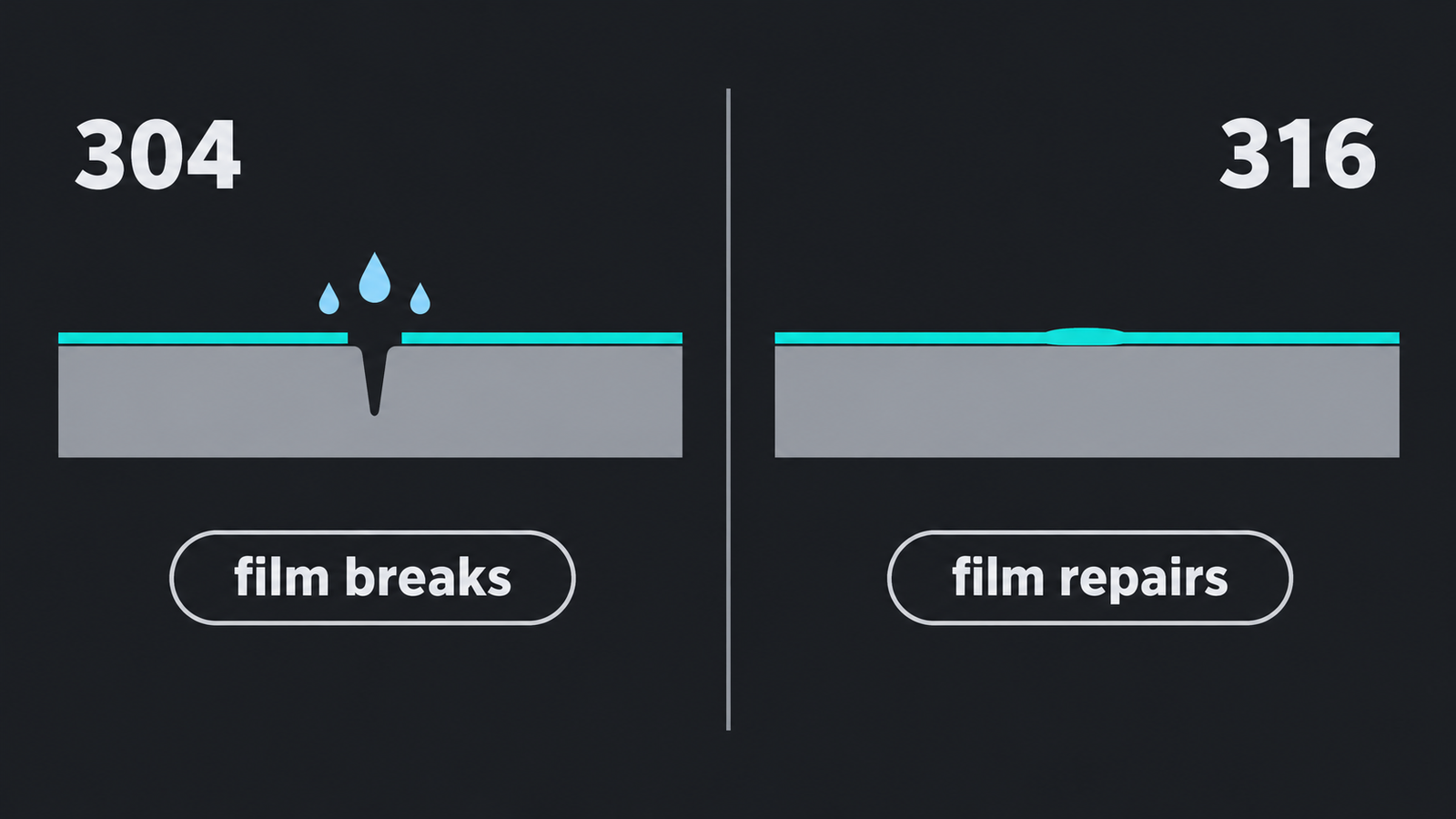
Stainless resists corrosion because of a passive chromium oxide film a few nanometres thick. Chloride ions attack that film at weak points; once the film breaks locally, the pit that follows is self-sustaining, because the pit interior becomes acidic and oxygen-starved while the surrounding surface stays passive.
Molybdenum works inside that mechanism. It concentrates in the film at the point of breakdown, slows the dissolution of metal in the pit and helps the film repassivate. The practical effect is not that 316 never pits — it is that 316 needs a higher chloride concentration, a higher temperature, or a longer time to start, and it recovers more readily when the aggressive condition passes.
Same film, different ability to heal.
For a cable gland this translates into a specific behaviour: a 304 gland in a salty crevice develops a pit that grows; a 316 gland in the same crevice may hold for years and then still fail if the crevice never dries.
There is a second, quieter benefit. Because 316 repassivates more readily, it tolerates the ordinary insults of installation — a scratched thread, a scuffed shroud, a tool mark on a flat — better than 304 does. Those are not service conditions, they are handling damage, and on a site where glands are installed with whatever spanner is in the bag, the grade that recovers from scratching is the one that lasts.
No Chloride Number Can Be Quoted for You
Suppliers are often asked for “the chloride limit of 316” and the honest answer is that no single number exists. Critical chloride concentration depends on temperature, dissolved oxygen, pH, surface finish, whether the joint is wet continuously or cyclically, and whether a crevice exists.
Two consequences follow. First, any quotation that promises a chloride concentration without asking about those variables is guessing. Second, the crevice is usually worse than the open surface, and a cable gland is almost entirely crevice: under the shroud, under the washer, between the thread and the enclosure wall, and in the gap between cable sheath and seal.
So design the entry so it drains and so the crevice is short, then choose the grade. Getting the grade right and leaving a permanent puddle around the gland is the more common failure.
The Magnet Test Proves Nothing
Both grades are austenitic and both are effectively non-magnetic after annealing. Both also become slightly magnetic after cold work, which is exactly what happens to a rolled thread or a deep-drawn shroud. A magnet that sticks slightly tells you the part was cold worked; a magnet that does not stick tells you nothing about molybdenum.
The check that does work is documentary: a mill certificate to EN 10204 3.1 naming the grade and the heat number, matched to the parts you actually received. A chemical spot test can confirm molybdenum presence in the field if a certificate is missing, and it takes about a minute.
The Certificate Covers the Body, Not the Gland
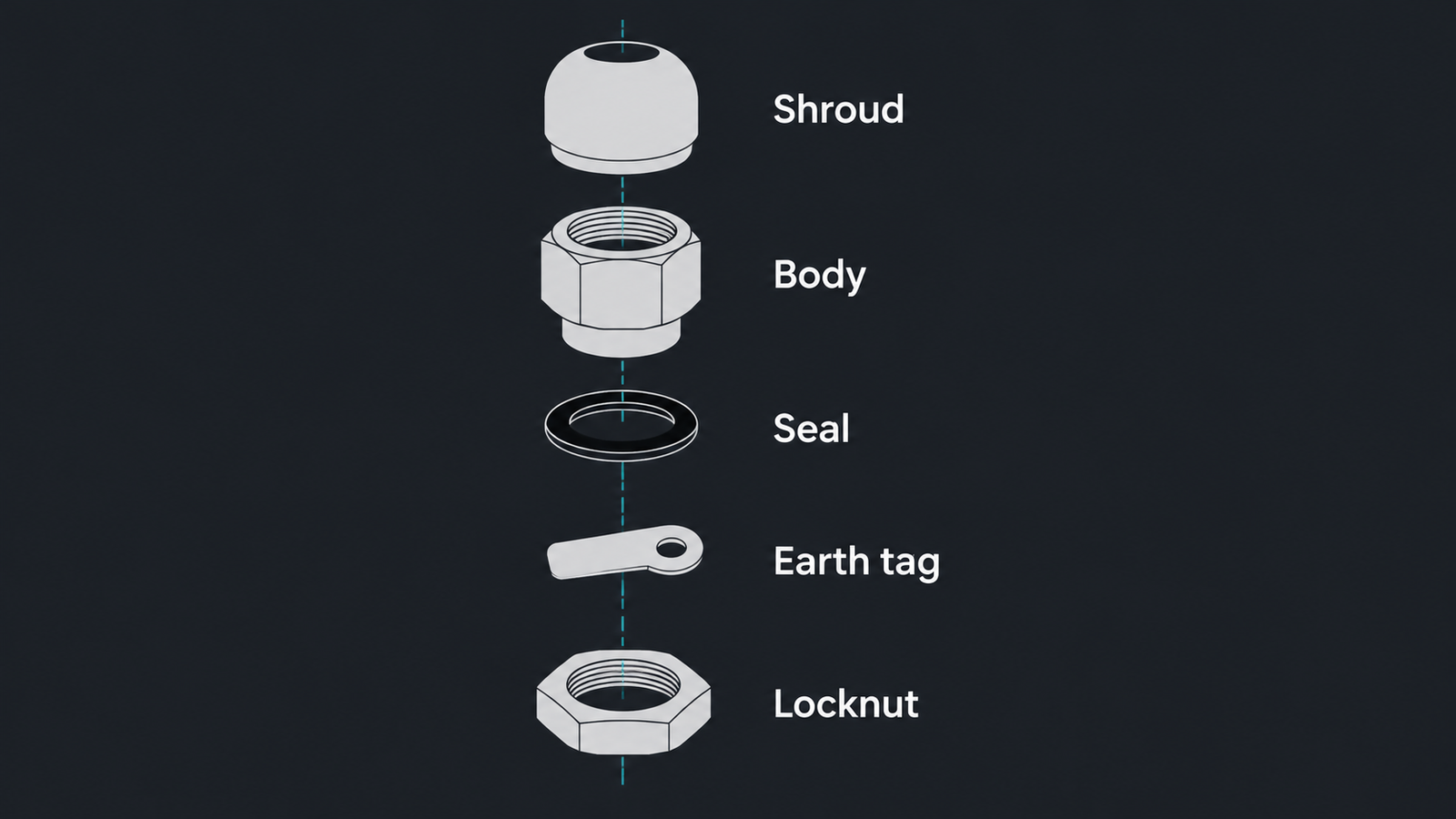
This is the most common gap between what a buyer thinks they ordered and what arrives. The mill certificate covers the bar or casting the body was machined from. It says nothing about the locknut, the earth tag, the screws or the shroud.
Five parts, five separate material decisions.
Part
What is often supplied
What to write on the order
Тело
316, certified
316 or 316L, mill certificate 3.1
Контргайка
304, or plated brass, or zinc-plated steel
Same grade as the body unless stated
Earth tag
304, tinned copper, or plated brass
Grade and plating, because this is the part that corrodes first
Seal and O-ring
NBR as standard
NBR, EPDM or silicone, with the temperature range
Shroud
Nylon or silicone
Material and UV stability, or omit if not wanted
A 316 body with a 304 locknut is a 304 joint in practice, and it is where the first rust stain appears. If the specification matters, list the parts rather than the product.
What the L Changes, and Whether It Matters Here
The L in 316L means low carbon, held below about 0.03 per cent. The reason is welding: at the temperatures a weld reaches, carbon combines with chromium at the grain boundaries and leaves the adjacent metal short of chromium, so it corrodes along the boundary. Low carbon removes that risk.
Cable glands are machined or cast, not welded, so for the body the L adds very little — 316 and 316L behave the same in service. It matters in two places: cast bodies with thick sections and slow cooling, and welded accessories such as brackets or earth tags welded to a plate. Where it matters, the certificate has to name the L, because 316 and 316L are not interchangeable on paper.
Where 304 Is the Correct Answer
304 is underrated in this product category, because most content treats it as the budget compromise. In the right environment it is simply the correct grade at a lower cost.
Indoor dry plant rooms, heated cabinets, food production areas that are washed with clean water and dried, inland sheltered enclosures, and any location where the gland is inside an outer enclosure that already excludes the weather — these are 304 conditions. The material’s weakness is chloride in a wet crevice, and none of those environments supplies it.
There is also a purchasing argument. 304 is the grade that most mills hold in stock, so lead times are shorter and small quantities are easier to consolidate with the rest of a stainless order. On a project where only two or three entries face weather, using 304 everywhere except those three is cheaper and no worse in service than grading the whole panel up.
The price difference is real but not fixed, because 316 carries a molybdenum and nickel premium that moves with the alloy surcharge month to month. That is a reason to get a current quotation rather than to assume a percentage.
Where Neither Grade Is Enough
There are environments where specifying 316 is a mistake because it creates false confidence rather than because it fails to help.
Warm stagnant seawater is the clearest case: above roughly 60 °C in chloride, both grades are at risk of chloride stress corrosion cracking, and 316’s molybdenum does not protect against that mechanism. Splash zones that stay wet and never dry, chemical plant atmospheres with hydrochloric acid or hypochlorite, and pulp or paper environments with chlorides plus sulphur compounds all sit outside what either grade promises. Those call for duplex 2205, a 6% molybdenum grade, a coating system, or a different entry design.
The same applies to temperature. Stainless steel glands are rated −40 to +200 °C, but chloride cracking, not melting point, is the limit in a wet salty environment.
Option beyond 316
Availability as a gland
Where it is the right call
Duplex 2205
On request, quoted per size
Splash zone, warm seawater, pulp and paper
6% molybdenum austenitic
On request, quoted per size
Chlorinated seawater, hypochlorite service
Coated stainless
Standard option on the SS range
Chemical splash, where the coating is the barrier
Grade change is not the fix
—
Stagnant water: re-site the entry so it drains
Note the last row. In several failed installations the alloy was upgraded twice without moving the entry, and the third gland failed exactly like the first because the crevice never drained.
No. In dry indoor and clean-washdown service 304 performs the same and costs less. 316 is worth the premium where chloride reaches a wet crevice.
Can I tell 304 from 316 with a magnet?
No. Both are austenitic and both become slightly magnetic after cold work. Ask for a mill certificate to EN 10204 3.1, or use a molybdenum spot test.
Is 316 a marine grade?
Not in the sense buyers assume. It resists atmospheric and splash exposure reasonably when the entry drains, but it pits and suffers crevice corrosion in warm stagnant seawater.
Does 316L cost more than 316?
The material cost is close and both are quoted per size. Specify L only where the part is cast or welded, and make sure the certificate names it.
What temperature do these glands take?
Stainless steel bodies are rated −40 to +200 °C, but the seal sets the real limit and chloride cracking is the constraint in wet salty service. Sealing performance itself depends on installation, which is covered in the installation guide.
Why 316 stainless steel cable glands fail at sea, and what the position of the entry has to do with it. Exposure zones, crevice corrosion, free iron, washdown and installation discipline.
How to size an SWA cable gland from the cable itself: the three dimensions that set the inner seal, armour clamp and outer seal, why the same thread has two variants, and how to avoid the wrong-part order.
Выбор правильного водонепроницаемого кабельного ввода имеет решающее значение для обеспечения безопасности и долговечности ваших электрических и промышленных установок. Эти маленькие, но мощные компоненты защищают кабели от воды, пыли и вредного воздействия окружающей среды, что делает их незаменимыми во многих отраслях - от телекоммуникаций до морской и тяжелой промышленности. Но как выбрать правильный уровень защиты и [...].
Мы используем файлы cookie для улучшения вашего восприятия, предоставления персонализированной рекламы или контента, а также для анализа нашего трафика. Нажав кнопку "Принять все", вы соглашаетесь с использованием нами файлов cookie.