A gland tightened to the correct torque in the workshop can still be found hand-loose two years later, and the reflex response, tightening it again, treats the symptom rather than the cause. Cable gland loosening has four distinct mechanisms, and each one answers to a different countermeasure. Applying all of them to every joint is expensive, and in a hazardous area some of them are not permitted at all.
This guide is about the joint rather than the seal: what actually allows a threaded body to rotate under load, which hardware addresses which mechanism, and how to prove a gland is still tight without taking it apart. It assumes the gland is correctly sized and installed to begin with; if that is still open, the brass cable gland range and the stainless steel equivalents cover the sizes referenced here.
Why a Gland That Was Tight Comes Loose
A threaded joint holds because tightening stretches the threads elastically, and that stored energy keeps the mating faces pressed together. The joint only fails in two ways: the nut or body rotates back, or the preload drains away while nothing rotates. Those are physically different events and they leave different evidence on site.
A gland is also two joints, not one. The body-to-enclosure thread carries mechanical load and the dome nut-to-body thread carries seal compression, so a gland can be perfectly tight in the panel and hand-loose at the dome nut, which is the joint most people check.
The Four Mechanisms and What Each One Needs
Mechanism
What you find on inspection
What actually fixes it
What makes it worse
Transverse vibration
Body or locknut rotated a fraction; a paint line is broken
Mechanical locking, or a thread locker off hazardous sites
A spring washer on its own
Thermal cycling
Nut still in position, seal no longer compressed
Matched materials and a re-torque after the first cycle
Extra torque at installation
Plastic creep
Dome nut bottomed out, cable now loose in the insert
A metal body, or a larger size with more insert travel
Treat that table as a diagnostic. Adding locking hardware to a gland that is suffering from creep, or re-torquing one whose thread engagement never held preload, fixes nothing and hides the real cause for another season.
Vibration: The Only Mechanism That Actually Unwinds Threads
Vibration along the axis of a bolt does very little. Vibration perpendicular to it is what unwinds threads, a result established by Junker in the late nineteen sixties and still the basis for how locking hardware is tested today. A hanging cable that swings, a motor that shakes its terminal box, a gland at the end of an unsupported run: all of these deliver transverse motion at the thread.
The failure is progressive rather than sudden. Preload keeps the faces clamped until the working load briefly exceeds it, a microscopic gap opens, and the nut slips back by a fraction of a thread pitch. The gap closes, the cycle repeats, and the joint walks loose over thousands of cycles without ever feeling loose in the hand.
So the first fix is not hardware, it is load path. If the gland is the last point of restraint on a cable that can move, no locking hardware will make it a good joint. Clamp the cable close to the entry so the gland sees almost no transverse load, and choose a gland with a clamping cage rather than one that merely pinches, as covered in our guide to cable gland strain relief. Locking hardware then handles residual motion rather than the whole problem.
Thermal Cycling and Creep Move the Joint Without Rotating It
A nickel plated brass gland in a steel panel moves differently from the panel it is screwed into, and a nylon gland moves differently again. The differential is small per event but repeated for years, and each cycle works the elastomer further towards permanent set. The nut never rotates, the paint line never breaks, and the seal still stops sealing.
Plastic behaves worse because it creeps rather than simply expanding. A PA66 gland held at the top of its range relaxes under the load of its own compressed insert, so the dome nut reaches the end of its travel while clamping force quietly falls. The material window is the constraint: nylon is rated roughly minus forty to plus one hundred degrees Celsius with short excursions higher, plated brass to about plus one hundred and twenty, and stainless steel to plus two hundred. Above the plastic limit the answer is a metal gland, not a tighter one.
The practical countermeasure is a re-torque event tied to the first thermal cycle rather than to a calendar, because that is when most of the relaxation happens. After that the joint is stable enough to be inspected rather than adjusted, and the inspection should cover the seal as well, since compression set and loosening are two different ageing processes on the same joint. Our guide to seal materials covers which elastomer survives which duty.
Assembly Errors That Look Exactly Like Loosening
A gland that was never right cannot come loose, and it will be reported as a loosening problem anyway. Four errors account for most cases: a mounting hole drilled oversize so the body never sits flat; a thread engagement of two or three turns because wall plus locknut exceeded the thread length; a locknut on the outside of the panel acting as a spacer; and a cable at the extreme top of the clamping range, where the insert cannot compress and the dome nut bottoms out while still feeling firm.
Each of these produces a joint that reads tight and behaves loose, none is fixed by locking hardware, and all are cheaper to prevent at the drilling stage. That is why the hole size chart and the torque guide are worth checking before the gland is unpacked.
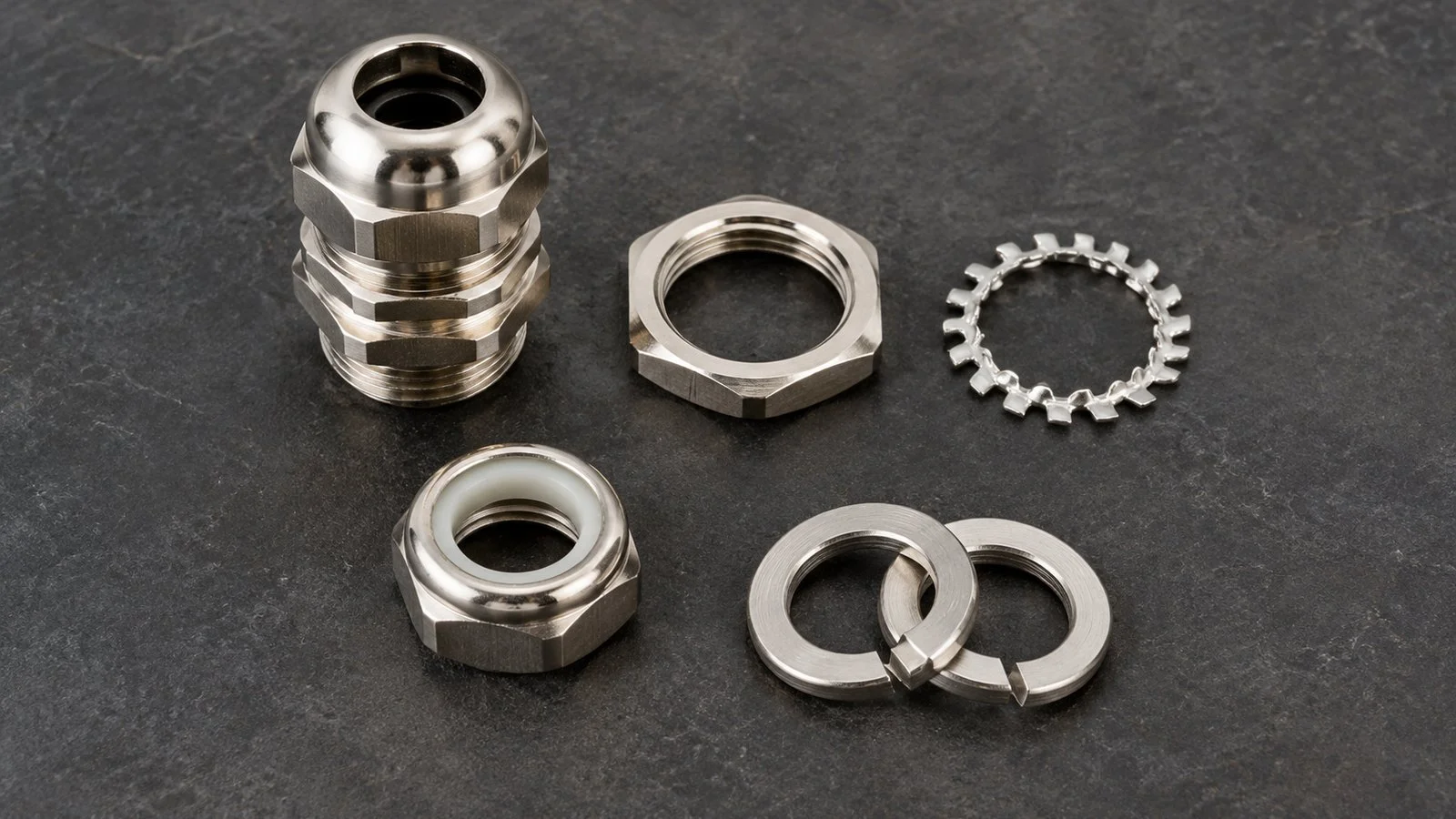
Locknut, Serrated Washer or Thread Locker: What Each One Does
Hardware
Mechanism it addresses
Where it works
Where it fails
Second locknut (jam nut)
Rotation
Metal bodies, thick or reinforced panels
Thin sheet that deflects; crevice corrosion between the two nuts
Serrated or toothed washer
Rotation and bonding
Painted enclosures where earth continuity is also needed
Breaks the coating and starts corrosion; never on a sealing face
Nylon insert locknut
Rotation
General industrial duty
High temperature, where the insert loses its grip
Anaerobic thread locker
Rotation, plus gap filling
Small threads off hazardous sites
Changes the torque reading; hard to dismantle; not acceptable on certified equipment
Spring or split washer
Nothing measurable
Não recomendado
Standard transverse vibration tests show it does not prevent loosening
Wedge locking washer pair
Rotation under severe vibration
Heavy machinery where thickness is available
Adds stack height; needs a flat, hard bearing face
The honest summary: a locknut and a wedge washer both work on rotation and both cost stack height, a thread locker works on rotation but changes a certified product, and a serrated washer is a bonding device that happens to resist rotation. Choosing by catalogue description rather than by mechanism is how panels end up with three devices on one gland and none of them doing the job.
There is no universal answer: each device acts on a different mechanism, and some act on none.
What You Cannot Do in a Hazardous Area
An Ex certificate covers a specific assembly as the manufacturer tested it. Adding a thread locking compound, a second locknut, a non-original washer or a field-applied sealant creates something that was not tested, and the certificate no longer describes what is installed. That is true regardless of how sensible the addition looks.
In practice this leaves three legitimate routes: use the locknut and sealing accessories the manufacturer lists, install to the documented procedure, and manage residual risk by inspection. Loosening prevention in a hazardous area is a selection and inspection problem, not an adhesive problem, and our guide to explosion proof gland installation sets out the checks that replace the shortcut.
Marking, Re-Torque and Inspection Interval
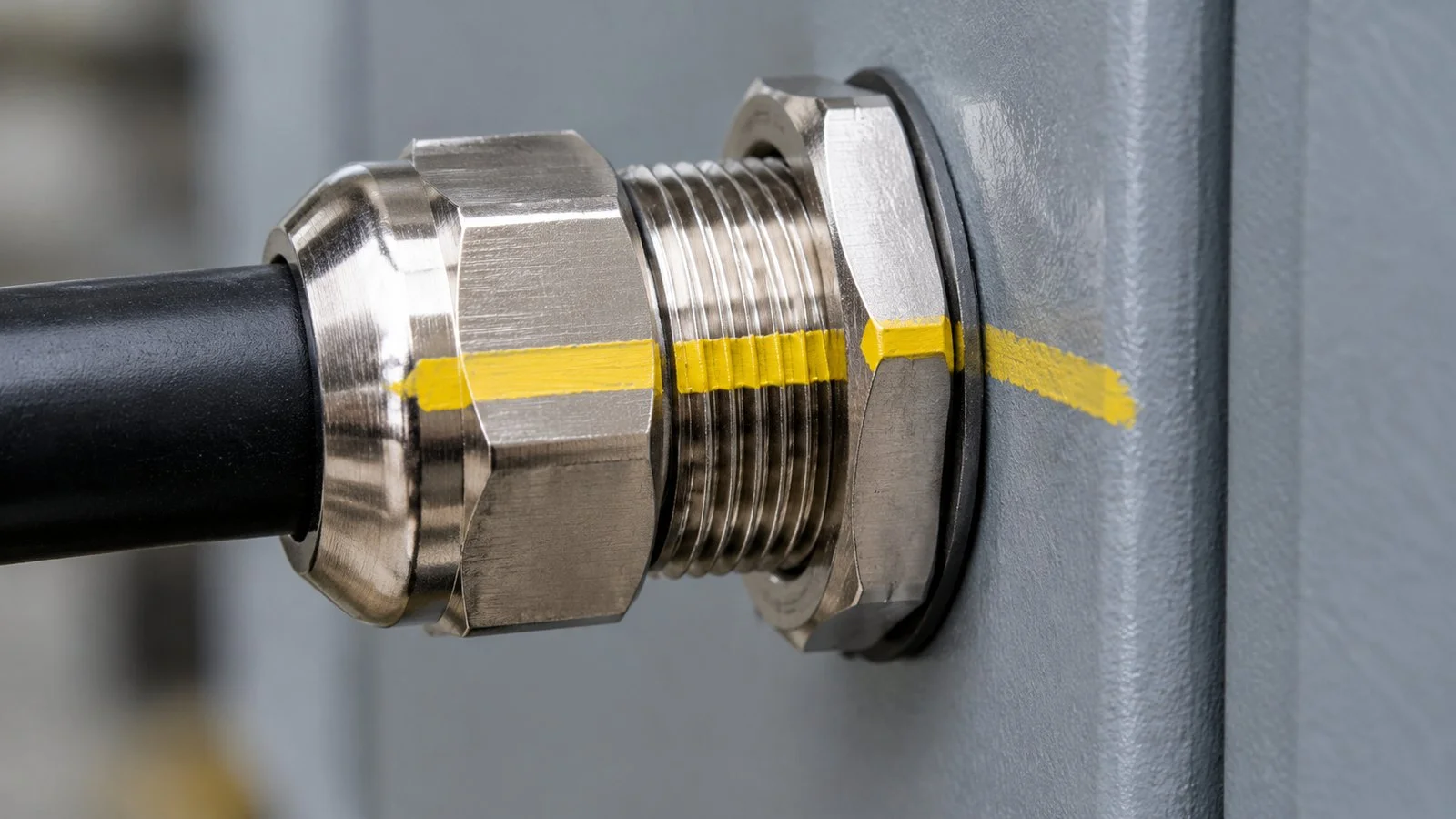
A paint stripe drawn across the body, the locknut and the panel is the cheapest diagnostic in the plant, and it costs a minute per gland. An unbroken line proves the joint has not rotated. It says nothing about preload, so it will not catch creep or thermal relaxation, which is why it has to be paired with a physical check rather than replacing one.
A paint stripe across body, locknut and panel proves the joint has not rotated, but says nothing about preload.
Check
What it proves
How often
Paint line intact
No rotation has occurred
Every visual round
Dome nut re-torque by hand
Insert still under compression
First shutdown after commissioning, then annually
Body torque check with a wrench
Preload is still present
Annual on vibrating duty
Cable pull test by hand
Clamping force, not just seal
Annual, and after any cable work
Set the interval from the mechanism rather than from a generic schedule. A gland on a compressor skid with continuous transverse motion needs a shorter round than one in a static panel seeing a single thermal cycle a day. Recording the mechanism next to the interval is what turns an inspection list into a maintenance plan.
An Order of Operations That Actually Prevents Loosening
Work through these in order, because each step removes load from the next. Support the cable so the gland is not the last restraint. Size the gland so the cable sits mid-range rather than at the top. Confirm the thread engagement exceeds wall thickness plus locknut plus washer. Then add mechanical locking, and only then mark and schedule the inspection. Jumping straight to locking hardware is the commonest order error, and it is why panels carry three devices per gland and still lose them.
For high-cycle machinery the joint is only part of the story; our guide to industrial cable glands covers where glands survive duty cycles and where a different cable entry method is the right answer. Where the cable carries armour the load path changes entirely, and the armoured gland selection rules apply instead of the ones above.
Perguntas frequentes
Why does my cable gland keep coming loose?
Almost always transverse vibration combined with a cable that is unsupported near the entry. The gland is being used as a cable restraint, so the thread sees reversing load. Support the cable first, then decide whether locking hardware is still needed.
Does a spring washer stop a cable gland loosening?
No. Standard transverse vibration testing shows that a split washer does not prevent a joint from unwinding, because it cannot maintain preload once a gap opens. A locknut or a wedge washer pair does.
Can I use thread locking compound on a cable gland?
Off hazardous sites, on small threads, yes, with the caveat that it changes the torque reading and makes later dismantling difficult. On certified Ex equipment, no, because the certificate no longer covers the assembly you have created.
How often should cable glands be re-torqued?
Once after the first thermal cycle, then on a schedule set by the dominant mechanism. Vibration duty justifies an annual check; static panels with slow thermal cycling can go considerably longer.
Will a nylon gland loosen more than a brass one?
It relaxes rather than unwinds. Plastic creeps under sustained load and heat, so clamping force falls while the nut stays put. Above the plastic temperature window, a metal gland is the correct choice.
Site class decides more than the datasheet. How UV dose, enclosure wall temperature, IP68 conditions and entry orientation should shape outdoor solar cable gland selection for a 25-year asset.
Os prensa-cabos à prova d'água desempenham um papel fundamental no mercado B2B. Quer você seja um fabricante de equipamentos solares, um empreiteiro de engenharia naval ou um integrador de automação industrial, a escolha do prensa-cabo à prova d'água correto afeta diretamente a durabilidade e a segurança de seus dispositivos. Alguma vez você já se perguntou o que mantém nossos cabos sãos e salvos, mesmo sob chuva forte [...]
Usamos cookies para aprimorar sua experiência de navegação, veicular anúncios ou conteúdos personalizados e analisar nosso tráfego. Ao clicar em "Aceitar tudo", você concorda com o nosso uso de cookies.