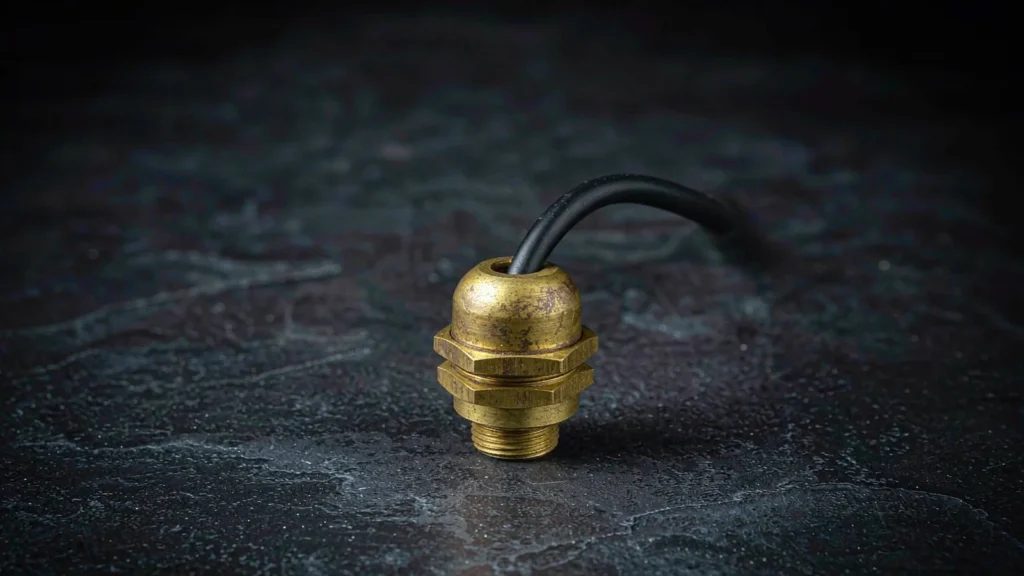
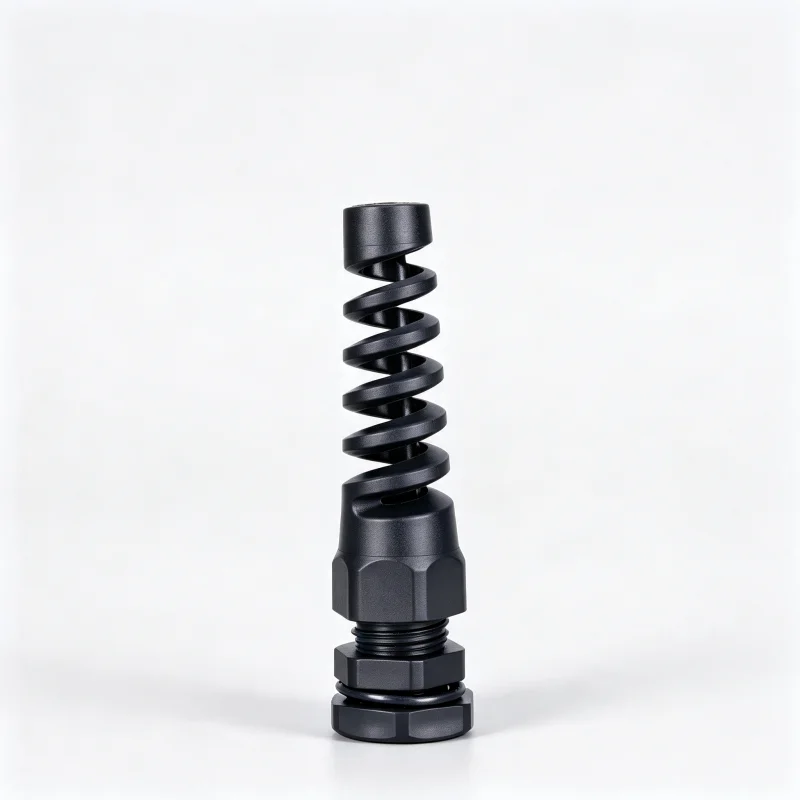
“Brass” is not a material specification. It is a family of copper-zinc alloys that differ in copper, in lead content, and in what the mill did to the bar before it reached the machine shop. Two glands can both be described as brass and behave differently on the lathe, in the hole and after five years in a wet plant.
Why the Grade Matters
For a cable gland, the grade decides four things a buyer eventually notices: how fast the body can be turned, whether the thread tears or forms cleanly, whether the part can be staked or riveted without cracking, and whether the alloy is legal in the market it ships to. None of those is visible in a photograph, and only the last one appears on a compliance document.
The second half of the problem is that a gland is not one grade. The body, the dome nut, the locknut, the earth tag and the washer can each come from a different bar, and the certificate in the envelope usually describes only the body. Reading “brass” on a quotation tells you nothing about which of those parts was upgraded and which was not.
Reading a Brass Designation
The European designation is a recipe, and it can be read without a datasheet. In CuZn39Pb3, the 39 is the nominal zinc content and the Pb3 is the lead addition, both in percent, with copper making up the balance. CuZn40Pb2 is the same logic with more zinc and less lead. The CW number beside it is a registry entry, not a second description of the alloy.
That registry number is where confusion starts, because the same alloy carries different numbers in different systems, and a drawing that quotes only one leaves the mill to interpret.
Alloy
EN number
Old DIN
BS
UNS
CuZn39Pb3
CW614N
2.0401
CZ121
C36000
CuZn40Pb2
CW617N
2.0402
CZ122
C37700
CuZn36Pb2As
CW602N
–
CZ132
C35330
CuZn21Si3P
CW724R
–
–
–
CuZn39Pb3 Versus CW617N
These two are routinely written together as if they were the same alloy, and they are not. CuZn39Pb3 is CW614N and carries roughly 3 percent lead; CW617N is CuZn40Pb2 and carries roughly 2 percent. One is the free-cutting rod grade, the other the forging grade, and the lead difference is what separates them.
The practical consequence is a machinability gap. On the copper-alloy scale where free-cutting brass is 100, CuZn39Pb3 sits at the reference point and CW617N sits around 90 to 95. On a high-volume gland body turned from hex bar, that gap is cycle time, tool life and chip control. On a hot-forged body that is later machined, CW617N is the correct choice and the small loss of machinability is the price of forgeability.
Propriété
CuZn39Pb3 (CW614N)
CW617N (CuZn40Pb2)
Copper
57 to 59 percent
57 to 59 percent
Lead
2.5 to 3.5 percent
1.6 to 2.5 percent
Intended process
Turning from bar
Hot forging, then machining
Machinability index
100, the reference
About 90 to 95
Cold ductility
Poor
Limitée
Product standard
EN 12164, EN 12167
EN 12165, EN 12420
What Lead Does to a Chip
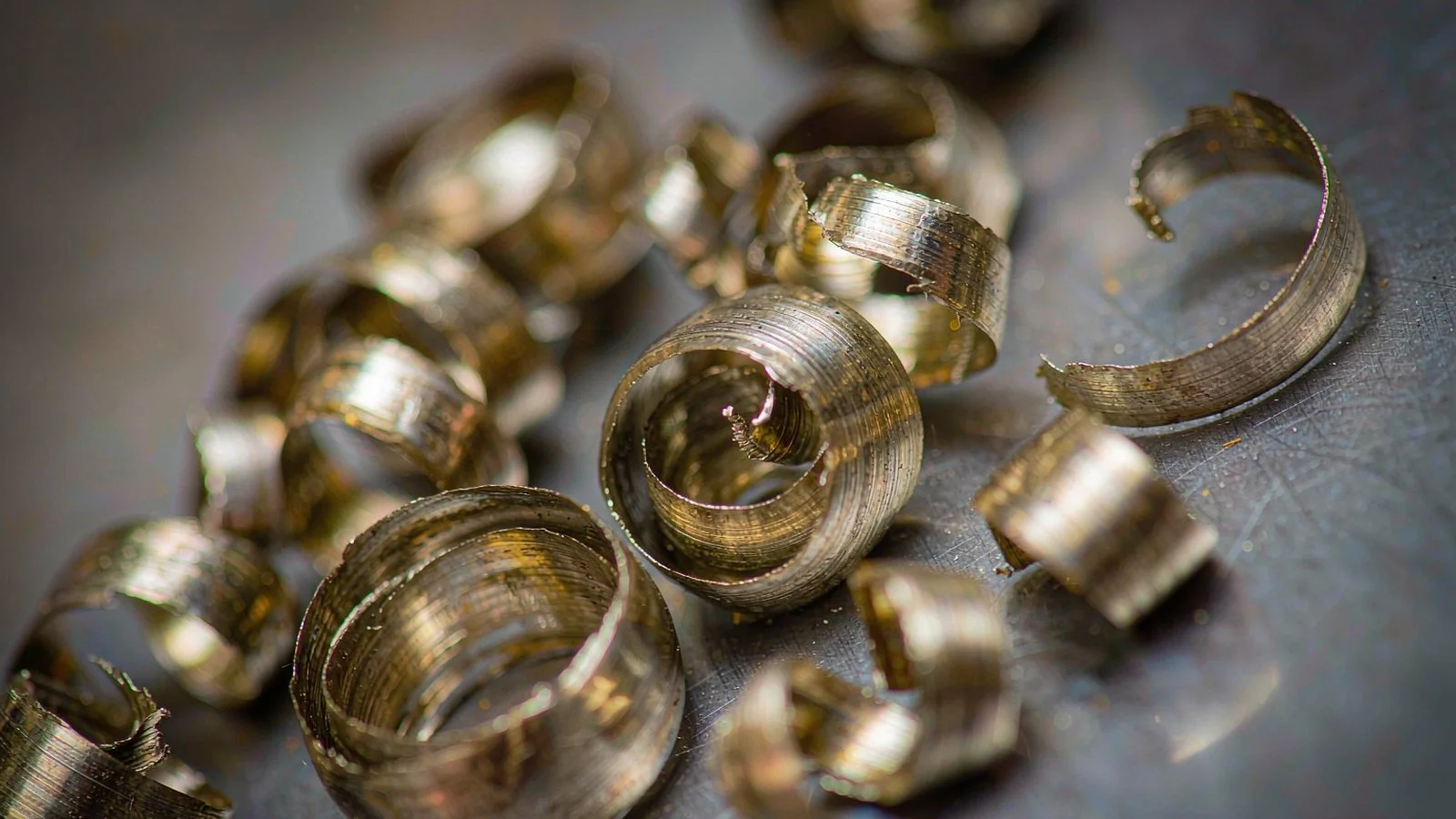
Lead is almost insoluble in brass, so it does not strengthen the metal or alloy with it. It sits as discrete particles through the matrix, and those particles break the chip as the tool cuts. Short, controlled chips leave the cutting zone instead of wrapping the tool, and the result is lower cutting force, less heat, longer tool life and a finer surface on the thread flanks.
That is why a leaded grade exists, and why it has a limit. The same particles that break a chip give the alloy almost no capacity for cold deformation, which is why CuZn39Pb3 is rated poor for cold forming. A gland body that is turned is fine. An earth tag that is bent, or a locknut feature that is staked, is not a good candidate for the same bar.
Lead does not strengthen the alloy; it sits in it as particles that break the chip, which is why a free-cutting grade turns cleanly at production speed.
Product Form and Standard
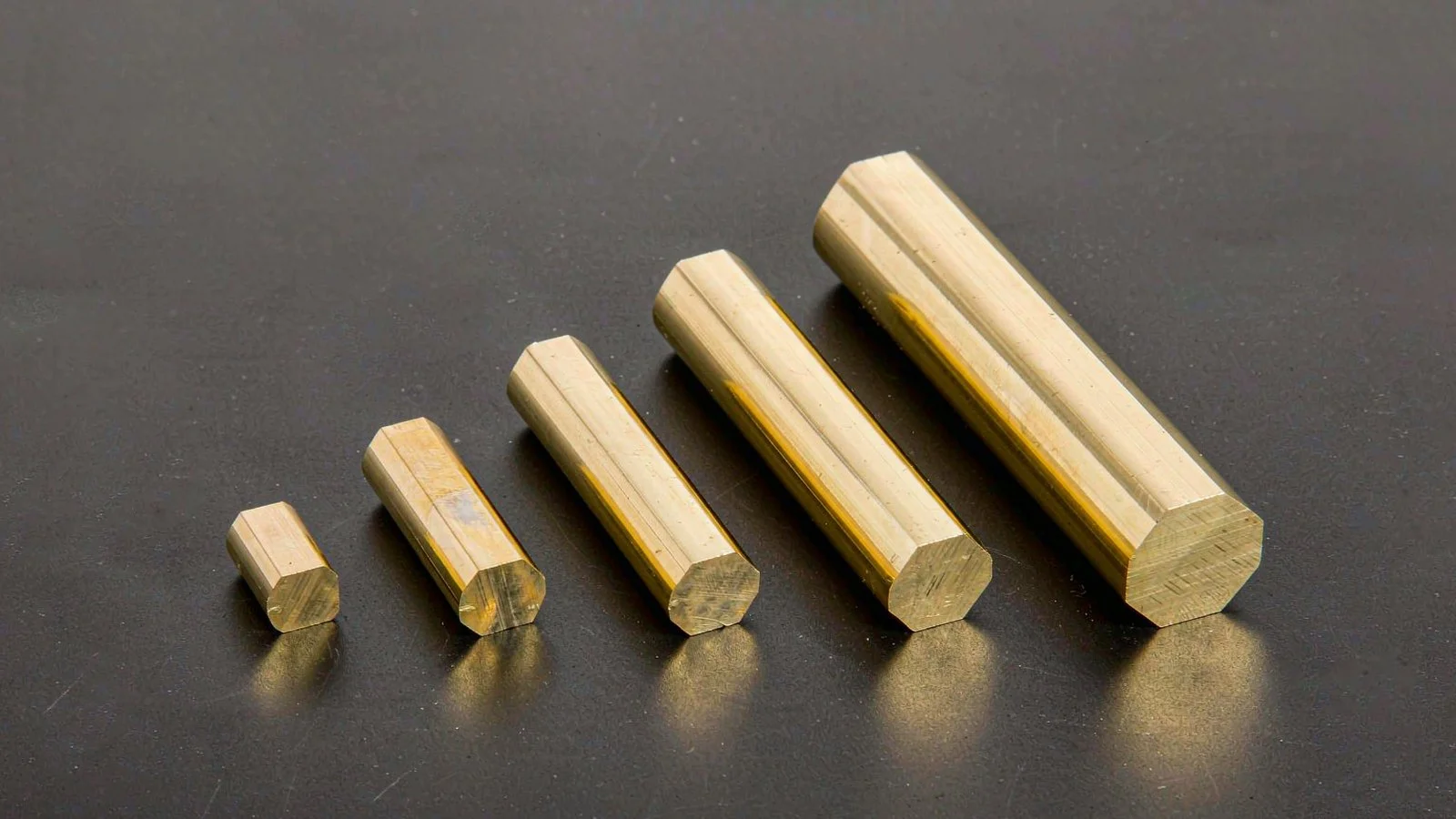
A grade symbol describes composition only. What you actually receive is fixed by the product standard and the temper: EN 12164 covers free-machining rod for machining, EN 12165 covers forging stock, and EN 12167 covers profiles and bars for general purposes. The same CuZn39Pb3 supplied as drawn rod and as stress-relieved rod will machine differently and hold straightness differently.
This is why a complete callout has three parts: alloy, product standard, and temper or condition. A purchase order carrying only “CuZn39Pb3” leaves the mill free to choose the condition, and a bar that is straight enough for one shop’s bar feeder can be marginal in another’s.
The same alloy symbol can arrive as drawn rod, stress-relieved rod or forging stock. The condition, not the name, decides how it machines.
Lead and Compliance
Leaded brass is legal in electrical equipment only through an exemption, not through compliance with the general limit. RoHS restricts lead to 0.1 percent by weight in a homogeneous material, while these alloys contain around 2 to 3 percent by design. Annex III exemption 6(c) permits up to 4 percent lead in copper alloy, and under Delegated Directive (EU) 2025/2364 that exemption runs to 30 June 2027.
Lead is also on the REACH Candidate List, which brings a separate obligation at 0.1 percent by weight: communication down the supply chain under Article 33 and, for articles, a SCIP notification. A supplier who answers “RoHS compliant” without naming the exemption has either used a lead-free alloy or skipped the legal basis. The document trail behind those statements is set out in the test report and certificate guide.
Lead-Free Alternatives
Where the exemption is unacceptable, two families replace it. Silicon brass CW724R, CuZn21Si3P, removes lead entirely and substitutes a silicon-phosphide phase that performs part of the chip-breaking job; it is also dezincification resistant. Low-lead DZR brass CW602N, CuZn36Pb2As, keeps a small lead addition and uses arsenic to suppress dezincification rather than removing lead.
Option
Lead
Machinability
Where it fits
CuZn39Pb3
2.5 to 3.5 percent
100, reference
High-volume turned bodies under exemption 6(c)
CW617N
1.6 to 2.5 percent
About 90 to 95
Forged bodies, slightly lower lead
CW602N
Low lead, arsenic added
Haut
Dezincification resistance with reduced lead
CW724R
0.1 percent or less
About 85
Lead-free programmes, potable water, food zones
None is a drop-in swap. Silicon brass machines at roughly 85 against the 100 reference, so cycle times rise and tool wear changes, and it is harder on some tool geometries. The saving is in compliance and in markets that no longer accept the exemption, not in the machine shop.
Dezincification in Service
Free-cutting brass is not dezincification resistant, and no amount of it being “brass” changes that. In warm, stagnant water with chloride, and faster in ammoniacal environments, the zinc-rich beta phase dissolves first and leaves a porous copper sponge behind. The surface turns pink or red, then chalky, and the part loses section from the inside of the thread.
The environments that catch glands are specific: ammonia in refrigeration plant and cold stores, ammonia-bearing fertiliser dust, some cleaning chemistries, and stagnant chloride water in a gland that never drains. Resistance is tested to ISO 6509-1, and only a DZR grade is worth quoting a number from. A standard free-cutting grade will pass a dimensional check and fail the same fitting two winters later.
Grade Mixing in One Gland
An inspection certificate issued to EN 10204 3.1 describes the heat that the bar came from. Once that bar becomes several thousand bodies in a bin, the certificate still describes the bar, and the parts around it in the assembly may come from three other heats. That is normal, and it is also why a grade claim needs to be attached to a part number rather than to a product family.
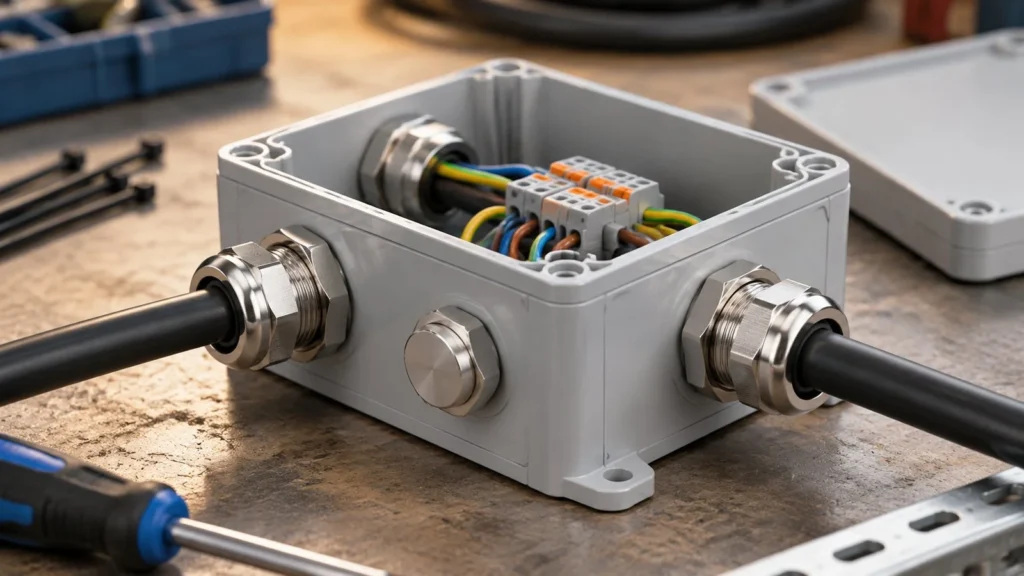
For a buyer the practical move is to state the grade against each component that matters: body, dome nut, locknut, earth tag and washer, with the standard and temper for each. Where the earth tag or locknut is the part in contact with the enclosure, the grade there is as decisive as the body, and it is the part most often left at the supplier’s default.
Price, MOQ and Lead Time
The grade itself is a small share of the price, because both leaded grades carry similar copper content and copper is the dominant material cost. What moves the quotation is the process: bar-turned versus forged, the number of operations, plating, and the documentation pack. A switch from CuZn39Pb3 to CW724R is felt in cycle time and tooling, not in the metal.
Brass glands on this site run at 1,000 pieces per size with no tooling charge, and trial quantities of 100 to 500 so a buyer can verify thread and plating before committing. Stainless steel and Ex-rated variants start at 300 pieces per size. Lead time is confirmed per order and is driven by plating and by whether a material certificate to EN 10204 3.1 is required for a specific heat.
Is CuZn39Pb3 the same as CW617N?
No. CuZn39Pb3 is CW614N, a free-cutting rod grade with roughly 3 percent lead. CW617N is CuZn40Pb2, a forging grade with roughly 2 percent lead. A datasheet that lists them as equivalent is describing two different alloys with one line.
Is leaded brass RoHS compliant?
Only through Annex III exemption 6(c), which allows up to 4 percent lead in copper alloy and currently runs to 30 June 2027. The general RoHS limit is 0.1 percent, so a leaded alloy cannot meet it directly. Ask which legal basis the declaration relies on.
Can I substitute CW617N for CuZn39Pb3?
Not safely without agreeing the process route. CW617N is a forging grade with slightly lower machinability; putting it on a high-volume turned part costs cycle time. Going the other way, CuZn39Pb3 where CW617N was specified, risks cracking if any feature is staked or cold formed.
Is brass suitable for drinking water or food contact?
Standard leaded brass is not. Lead migrates, and both potable water approvals and food-contact rules sit far below the 2 to 3 percent these alloys contain by design. A lead-free grade such as CW724R is the starting point, and even then the elastomer and the geometry have to be assessed separately, as the hygienic gland selection explains.
How do I check the grade I received?
Ask for the EN 10204 3.1 certificate and read the heat number against the bar, not against the carton. A quick check with a magnet proves nothing, because both grades are non-magnetic in the annealed condition. Where the risk justifies it, a laboratory can confirm lead content by spectroscopy in a few minutes.
Un boîtier de raccordement est un nœud, et non un simple boîtier. Le fonctionnement du boîtier, le cheminement du courant, la chaîne IP et la condensation déterminent la configuration des presse-étoupes, et c'est pourquoi le fait de serrer les presse-étoupes ne résout jamais le problème de l'eau à l'intérieur d'un boîtier.
Pourquoi les presse-câbles en acier inoxydable 316 tombent-ils en panne en mer, et quel est le rôle de l'emplacement du point d'entrée dans ce phénomène ? Zones d'exposition, corrosion interstitielle, fer libre, lavage et respect des règles d'installation.
La cosse de mise à la terre est l'élément le moins cher de la chaîne de mise à la terre, mais c'est aussi celui qui, discrètement, rend l'ensemble inutilisable. Comment la dimensionner, le filetage qu'elle nécessite, et pourquoi un presse-étoupe en nylon ne peut pas la supporter.
Nous répondrons à votre demande dans les 24 heures
Nous accordons de l'importance à votre vie privée
Nous utilisons des cookies pour améliorer votre expérience de navigation, vous proposer des publicités ou des contenus personnalisés et analyser notre trafic. En cliquant sur "Tout accepter", vous consentez à notre utilisation des cookies.