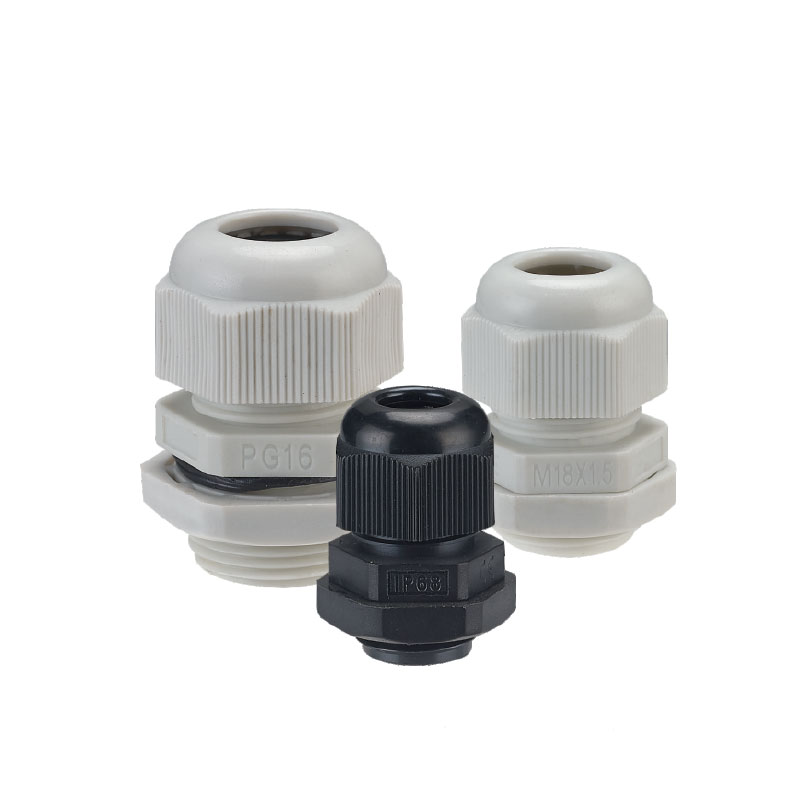
Presse-étoupe étanche
Cable Gland Earthing and Bonding Guide
Earthing and bonding do different jobs. The three return paths a gland can provide, the seven interfaces that break continuity, and how to test them on site.
Lire la suite

Parmi les nombreux accessoires de connexion électrique, le Presse-étoupe étanche joue un rôle crucial. Il protège non seulement les câbles pénétrant dans les boîtiers des équipements contre la pénétration de l'eau et de la poussière, mais il améliore également la sécurité et la fiabilité globales du système. Comprendre les matériaux et les applications des presse-étoupes étanches aide les ingénieurs et les acheteurs des secteurs de l'industrie, de la communication et de la marine à faire les choix les plus appropriés.
Aujourd'hui, nous vous proposons une analyse approfondie des principaux matériaux utilisés dans les presse-étoupes étanches et de leurs principales applications, afin de vous aider à répondre facilement aux besoins de protection des câbles dans divers environnements complexes.
The material of a waterproof cable gland directly determines its durability, corrosion resistance and sealing performance. The table below compares the four materials we machine most often on the parameters that actually decide a specification — working temperature, UV resistance, salt-spray resistance and relative cost:
| Matériau | Working temperature | UV resistance | Salt-spray resistance | Relative cost (brass = 1) | Typical IP rating | Typical application |
|---|---|---|---|---|---|---|
| Laiton nickelé | −40 to +120 °C (seal-limited) | Excellent — metal body does not degrade under UV | Very good — plated body passes 96 h neutral salt spray; pitting possible in strong chlorides | 1 (baseline) | IP65-IP68 | Industrial machinery, petrochemical, marine electrical connections |
| Stainless steel 304 / 316L | −60 to +200 °C (metal parts; seal-limited) | Excellent | Outstanding — 316L exceeds 500 h neutral salt spray; 304 may pit in chlorides, so specify 316L offshore | 4–6 | IP68, IP69K | Offshore equipment, food and pharmaceutical washdown, chemical and water treatment |
| Nylon / Polyamide PA66 | −40 to +100 °C | Good only in the UV-stabilised grade; unstabilised nylon chalks and embrittles outdoors | Good — salt water has no effect, but solvents and aromatics attack the polymer | 0.2–0.4 | IP65-IP68 | Communications, équipements d'automatisation, éclairage extérieur |
| Plastic (PVC / PP) | −10 to +60 °C (PVC) −20 to +90 °C (PP) | Fair — needs a UV stabiliser; PVC yellows and hardens in direct sun | Fair — resists salt water, not chlorinated or acidic washdown | 0.1–0.25 | IP65–IP67 | Éclairage extérieur, petits appareils, dispositifs à faible coût |
Working temperature is limited by the seal compound rather than the body: an NBR seal narrows it to roughly −30 to +100 °C, while EPDM widens it to −40 to +120 °C. Relative cost compares pre-purchase unit cost at the same thread size and quantity, with nickel-plated brass as the baseline; stainless steel and Ex-certified versions are quoted separately.
Vous vous demandez peut-être pourquoi les presse-étoupe étanches fabriqués à partir de différents matériaux varient autant. En fait, chaque matériau a son champ de bataille : le laiton est fiable et solide, en particulier pour les environnements à haute pression tels que les plateformes pétrolières ; l'acier inoxydable est un excellent choix pour les environnements extrêmement corrosifs ; le nylon convient pour les installations de communication légères et flexibles ; le plastique convient aux applications générales et à budget serré.

Brass, stainless steel, nylon and PVC cover the large majority of orders, but three more materials come up often enough to be worth knowing before you write the specification:
| Matériau | Key characteristics | Where it makes sense |
|---|---|---|
| Aluminium alloy | Lightweight with moderate strength and some corrosion resistance; needs plating or anodising for anything chloride-bearing | Light industrial housings, transport equipment and machinery where weight matters more than corrosion resistance |
| Polycarbonate | Transparent, impact-resistant, good electrical insulation | Equipment connections where the cable entry has to be visually inspected |
| Halogen-free flame-retardant compound | Halogen-free, flame-retardant, low smoke and low toxicity on combustion | Rail transit, tunnels, smart buildings and safety-critical interiors where halogen-free construction is a specification requirement, not a preference |
For genuinely aggressive chemical duty there is one more worth raising at the enquiry stage: PVDF. It resists chlorides and most acids where even 316L is marginal, at the cost of lower mechanical strength, and it is quoted on request rather than held in stock.
Material properties only tell half the story. The table below reads the same four materials the other way round — by the environment they are going into — because that is how the specification usually gets written. Ratings shown are what the standard range is supplied to; a specific model can differ, so confirm against the datasheet for the size you need.
| Project environment | Nylon PA66 | Laiton nickelé | Stainless steel 304 / 316L | Other / special materials |
|---|---|---|---|---|
| Outdoor (general) | Moderate use — UV-stabilised grade only | Excellente ; bonne résistance à la corrosion et aux intempéries | Excellent, particularly in marine and harsh environments | Depends on the material; moderate use |
| Usine chimique | Résistance chimique limitée | Bon | Excellente résistance à la corrosion | Halogen-free flame-retardant preferred where specified |
| Marine / offshore | Not recommended for permanent exposure | Acceptable in sheltered spaces only | Highly recommended — specify 316L | En fonction des besoins du projet |
| High-temperature service | Up to +100 °C | Up to +120 °C | Up to +200 °C | Depends on the material |
| Typical IP rating as supplied | IP65–IP68 | IP65–IP68 | IP68, IP69K | Mostly IP65–IP68, depending on design |
| Budget and service life | Economical; shorter service life | Medium cost; longer service life | Highest cost; longest service life | Le prix varie en fonction du matériau |
| Fréquence d'entretien | Facile à entretenir et à remplacer | Modéré | Low maintenance, long life | Dépend du matériau et de l'environnement |
Temperatures above are for the body material; the seal compound can narrow the usable range — an NBR seal limits service to roughly −30 to +100 °C, while EPDM holds −40 to +120 °C. “Not recommended” for nylon offshore refers to permanent salt-spray and UV exposure, not to occasional splash.
L'un des indicateurs techniques les plus importants des presse-étoupes étanches est l'indice de protection (IP), qui garantit l'étanchéité du dispositif dans divers environnements.
| Indice de protection | Contenu de la protection | Scénarios d'application typiques |
|---|---|---|
| IP65 | Etanche à la poussière, protégé contre les jets d'eau | Équipement photovoltaïque extérieur, protection générale des machines |
| IP66 | Etanche à la poussière, protégé contre les jets d'eau puissants | Équipements marins, armoires de commande pour l'automatisation industrielle |
| IP67 | Étanche à la poussière, protégé contre l'immersion temporaire | Environnements temporairement inondés, équipements électriques à proximité des piscines |
| IP68 | Étanche à la poussière, protégé contre l'immersion continue | Équipement submersible, sous-sols, environnements aquatiques rigoureux |
Bien entendu, l'étanchéité d'une enceinte ne suffit pas à elle seule ; le matériau d'étanchéité est également essentiel. Voici une comparaison des matériaux d'étanchéité, souvent négligés mais importants :
| Matériau d'étanchéité | Caractéristiques | Environnements appropriés |
|---|---|---|
| Caoutchouc nitrile (NBR) | Excellente résistance à l'huile, à l'usure et au vieillissement | Pétrochimie, étanchéité des machines |
| Caoutchouc EPDM | Excellente résistance aux intempéries, aux UV et aux températures élevées | Équipement extérieur, environnement marin |
| Caoutchouc de silicone | Large gamme de températures, souple et compressible | Dispositifs médicaux, instruments électroniques |
Ces matériaux d'étanchéité complètent les matériaux du boîtier pour assurer une protection stable et fiable.
Les presse-étoupes étanches ont un large éventail d'applications. Nous allons nous pencher sur des industries spécifiques et comprendre leur utilisation typique et leurs caractéristiques.
Utility-scale PV is one of the harshest outdoor duties a cable gland ever sees. A tracker junction box or string combiner box sits in full sun, cycling from −20 °C overnight to 70–80 °C inside the enclosure by mid-afternoon, and after a heavy storm it may be standing in several centimetres of rainwater. Three requirements follow directly from that:
A typical specification for a 50 MW single-axis tracker plant: UV-stabilised nylon glands at IP68 on string cable entries, and nickel-plated brass or stainless steel glands on tracker drive-motor feeders and the DC feeder into the inverter station, where vibration and mechanical load are higher. On coastal or desert sites, move the combiner-box entries to stainless steel 316L and ask for the neutral salt-spray report with the order.
Water and wastewater plants combine permanent humidity, chemical attack and periodic flooding inside the same building, which makes them a poor place to economise on materials. Three distinct zones usually appear in one municipal plant:
One detail specific to this industry: submersible pump and mixer cables are frequently oval, or multi-core with a non-circular bundle. Size the gland on the real cable cross-section and use the matching sealing insert — a gland that seals perfectly on a round test mandrel can leak on an oval cable at half the rated depth.
Shipboard installation is a corrosion problem first and a sealing problem second. Deck lighting, deck machinery, ballast and fire-pump controls, and on gas carriers the hazardous zones, all have to survive continuous salt spray, deck washdown, vibration and years of temperature cycling.
For seal material, EPDM covers general deck duty; use nitrile only where oil resistance is genuinely needed, because ozone and UV in a marine atmosphere harden NBR and shorten service life.
Le tableau suivant résume les matériaux et les indices de protection recommandés pour les principaux domaines d'application :
| Champ d'application | Matériau recommandé | Indice de protection IP recommandé | Caractéristiques |
|---|---|---|---|
| Automatisation industrielle | Laiton, acier inoxydable | IP66~IP68 | Résistant à la corrosion et à la haute pression, il convient aux environnements intérieurs et extérieurs. |
| Équipements marins et portuaires | Acier inoxydable | IP68 | Excellente résistance à la corrosion et au brouillard salin, adaptée aux environnements marins |
| Eclairage extérieur | Nylon, plastique | IP65~IP67 | Léger et résistant aux intempéries, adapté à différents climats |
| Moyens de communication | Nylon | IP65~IP68 | Excellente isolation et étanchéité, bonne protection mécanique |
| Environnements chimiques et dangereux | Laiton, acier inoxydable | IP66~IP68 | Conforme à la certification antidéflagrante, sûre et fiable |
| Solar PV Plants | UV-stabilised Nylon; Brass or Stainless Steel 316L | IP68 | UV and ozone resistant, withstands standing water in combiner boxes |
| Water & Wastewater Treatment | Acier inoxydable 316L | IP68 (2 m / 24 h) | Resists hypochlorite, H2S and continuous humidity |
Lors de l'achat de presse-étoupes étanches, il convient de tenir compte de l'ensemble de ces facteurs :
Le tableau ci-dessous vous permet d'évaluer rapidement les critères de sélection :
| Facteur de sélection | Principales considérations | Actions suggérées |
|---|---|---|
| Environnement | Niveau de corrosion, température, humidité, rayonnement | Choisir des matériaux résistants à la corrosion et des matériaux d'étanchéité appropriés. |
| Indice de protection | IP65~IP68 et supérieur | Confirmer que la protection est conforme aux exigences environnementales |
| Taille du câble | Diamètre extérieur du câble | Choisissez un presse-étoupe adapté à la taille du câble afin d'éviter les fuites ou les dommages au câble. |
| Installation et maintenance | Facilité d'installation, effet d'étanchéité durable | Choisir des produits avec des bagues d'étanchéité de qualité et des conceptions saines |
| Certification | Certifications CE, UL, ATEX et autres certifications de sécurité | Privilégier les produits certifiés pour leur sécurité et leur fiabilité |
Choisir le bon presse-étoupe étanche protège efficacement votre équipement contre l'eau et la poussière, tout en réduisant les coûts de maintenance et en améliorant la stabilité du système. Que vous travailliez dans le domaine de la marine, de l'industrie ou de la communication, il vaut la peine d'investir dans des presse-étoupes de haute qualité et d'un matériau adapté à votre projet.
Si vous êtes à la recherche de presse-étoupes étanches professionnellement personnalisés, veuillez nous contacter pour obtenir des solutions de produits sur mesure et un support d'échantillonnage. Laissez-nous vous aider à réaliser vos projets en toute sécurité et stabilité à long terme !
Plus l'indice IP est élevé, plus la protection contre la poussière et l'eau est forte. Par exemple, l'indice IP67 permet une immersion de courte durée, tandis que l'indice IP68 permet une immersion de longue durée. Choisissez en fonction de l'environnement d'utilisation réel.
1. Le laiton est adapté à la résistance aux chocs mécaniques et aux environnements industriels complexes.
2. L'acier inoxydable s'adapte à la corrosion extrême et aux environnements à haute température.
3. Le nylon convient aux applications de l'industrie légère, de la communication et de l'éclairage extérieur.
Lors de l'installation, nettoyez soigneusement les câbles et les interfaces, choisissez les bonnes dimensions et assurez-vous que les bagues d'étanchéité ne sont pas endommagées. Évitez de trop serrer, ce qui risquerait d'endommager les câbles, ou de trop peu serrer, ce qui entraînerait des fuites.
IP68 means the enclosure is dust-tight and has been tested for continuous immersion in water. Unlike IP67, which covers temporary immersion, IP68 is declared with a depth and a duration — for our standard range that is 2 m for 24 hours. Always ask for those two numbers, because “IP68” on its own does not define the test.
Yes, provided you specify the UV-stabilised PA66 grade. Unstabilised nylon chalks and embrittles under direct sun within a few seasons. For permanent outdoor, coastal or washdown duty, or anywhere the entry is in standing water, move to nickel-plated brass or stainless steel 316L instead.
Yes. Explosion-proof glands are made from brass or stainless steel and carry ATEX / IECEx certification for the specific zone and gas group of the site. Tell us the zone and the standard you need and we will confirm the certificate against the exact model — a waterproof rating alone is never a substitute for Ex certification.
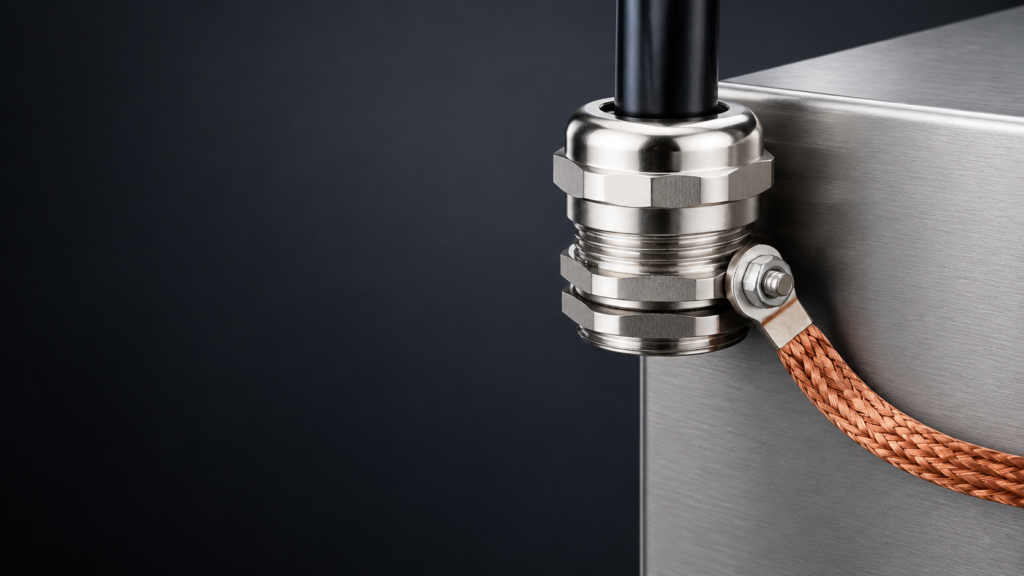
Earthing and bonding do different jobs. The three return paths a gland can provide, the seven interfaces that break continuity, and how to test them on site.
Lire la suite
When I speak with buyers, I notice the same pattern again and again: everyone asks for a “Waterproof Cable Gland” but what they actually need is a reliable sealing solution that matches cable size, enclosure type, operating environment, and purchasing risk. That is exactly why choosing among waterproof cable gland suppliers is not a small […]
Lire la suite
Lorsqu'il s'agit de protéger les connexions électriques, le choix du bon presse-étoupe étanche est crucial. Ces composants, petits mais puissants, garantissent que les câbles restent bien fixés et secs, même dans des environnements difficiles. Mais avec le grand nombre de matériaux disponibles, en particulier le plastique et le métal, comment faire son choix ? Quelles sont les différences et lequel répond à vos besoins spécifiques ? Cette [...]
Lire la suite