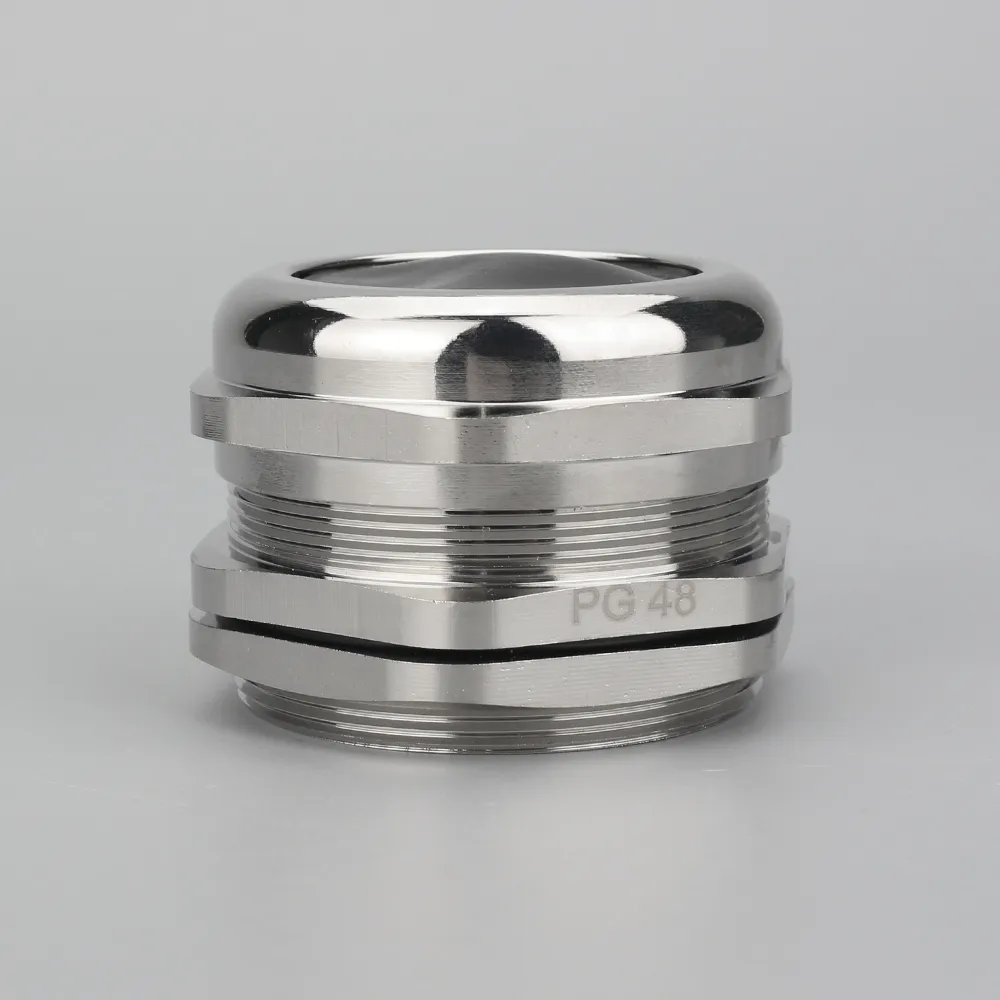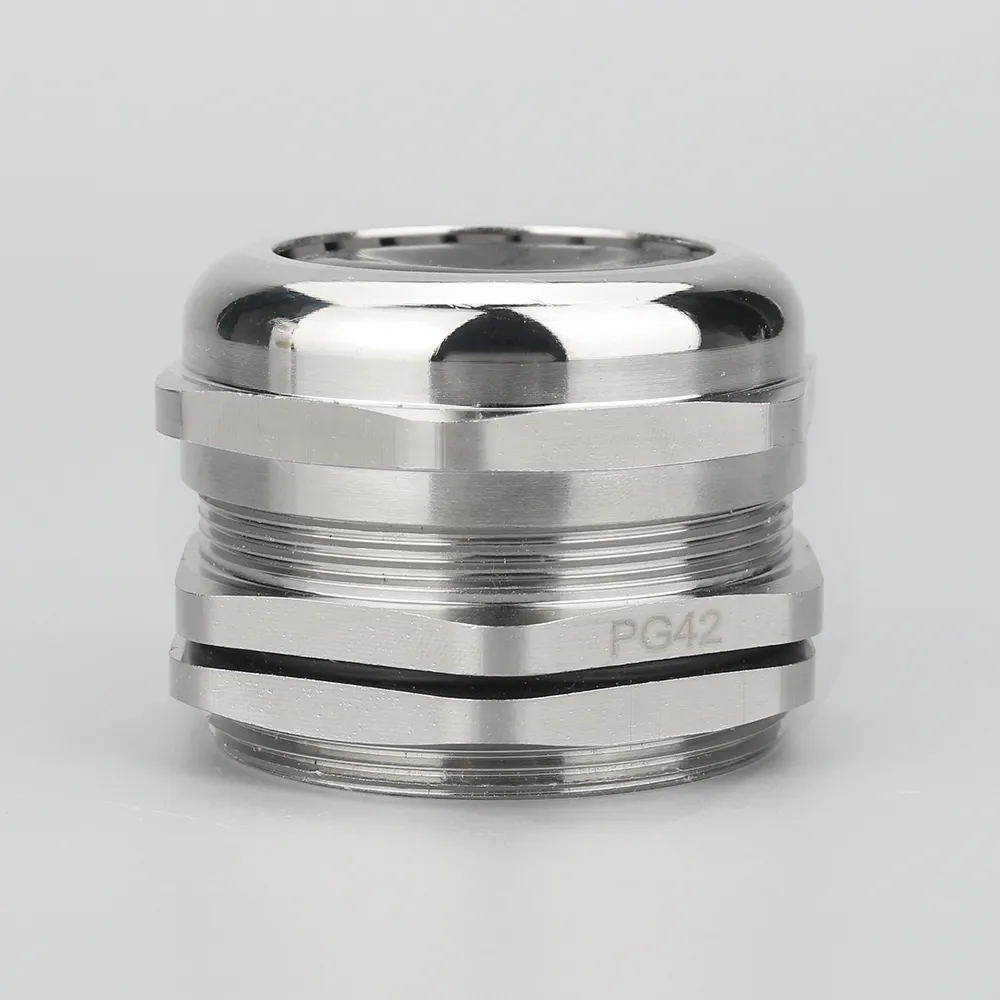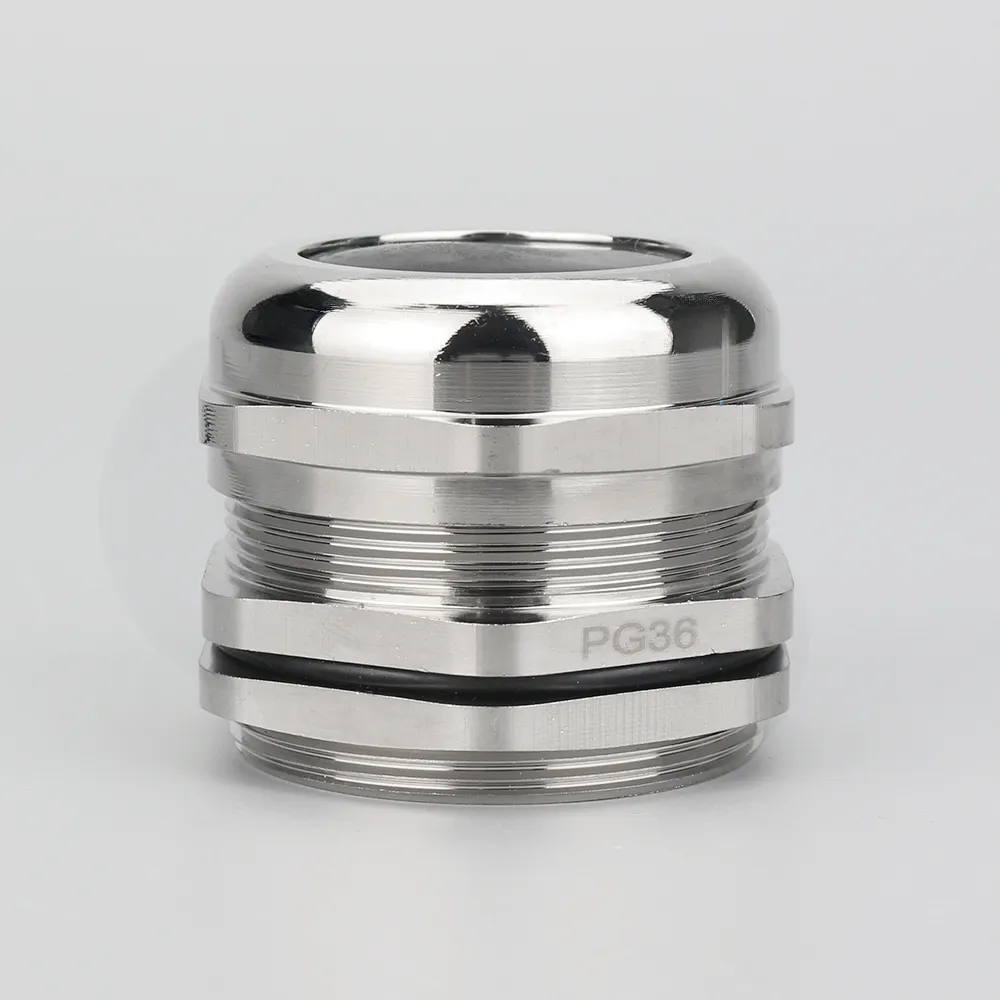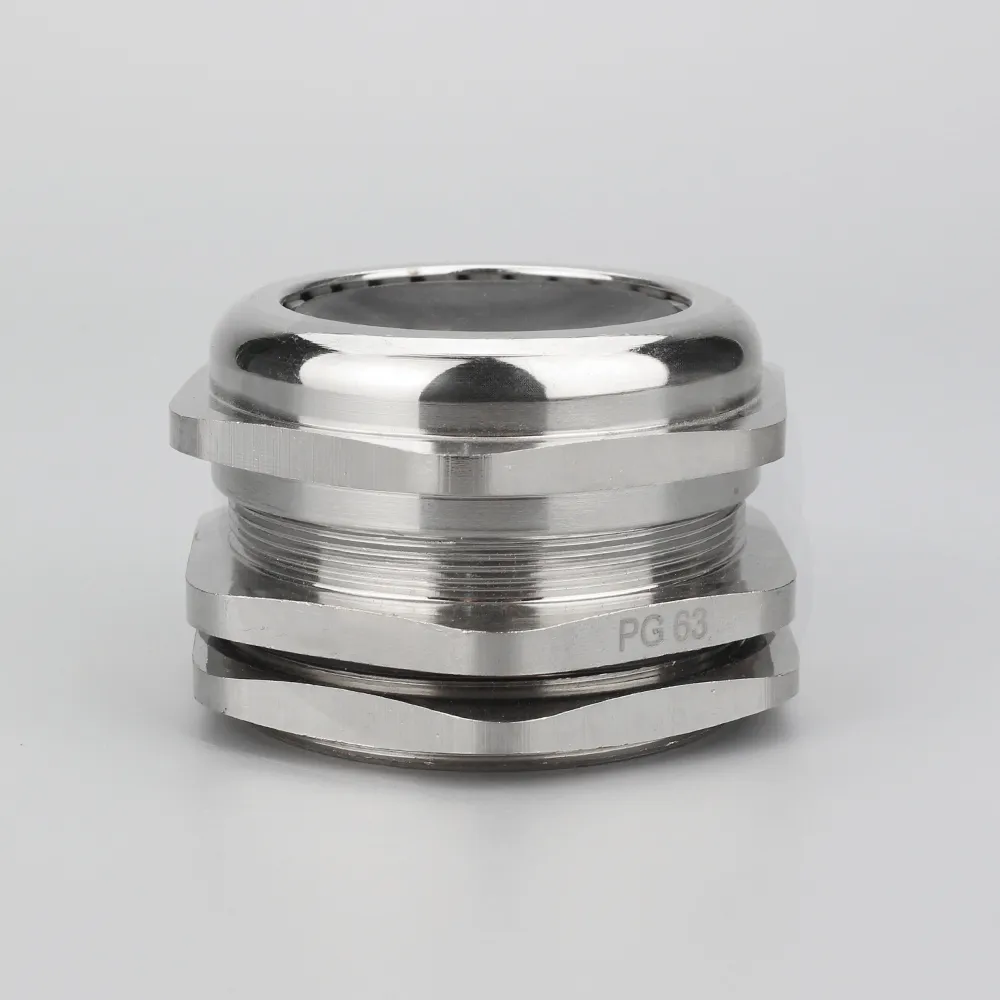
Longueur du filetage : Le filetage court convient pour l'ouverture de trous dans des panneaux minces ou des dispositifs à filetage interne, le filetage long convient pour l'assemblage de panneaux épais, et le filetage étendu peut être personnalisé.
Ce presse-étoupe métallique en acier inoxydable sert d'accessoire de câble, une extrémité bloquant fermement le câble et l'autre entrant dans l'appareil par une boîte de jonction ou une entrée filetée correspondant au filetage interne de l'appareil. Son corps principal est en laiton nickelé, les pièces de serrage sont en plastique nylon et les composants d'étanchéité, y compris les joints toriques, sont en caoutchouc nitrile, offrant une surface lisse et brillante avec une forte résistance à la pression, une flexibilité, une absence d'odeur et d'excellentes performances en matière d'étanchéité à l'eau, à la rouille et à la corrosion. Le presse-étoupe en acier inoxydable assure une connexion étanche, une forte conductivité et un assemblage facile et rapide.

Principales caractéristiques du presse-étoupe en acier inoxydable
Fabriqué en acier inoxydable de haute qualité, il offre une excellente résistance à la corrosion et une grande durabilité.
La résistance mécanique élevée garantit une protection fiable des câbles dans les environnements exigeants.
Conception étanche à l'eau et à la poussière, adaptée aux applications intérieures et extérieures.
Installation facile et sûre grâce à un mécanisme de serrage robuste.
Compatible avec une large gamme de diamètres de câbles pour répondre aux différents besoins d'installation.
Répond aux normes internationales de sécurité et de qualité.
Convient pour une utilisation dans des environnements industriels, marins et dangereux.

Les principales caractéristiques du presse-étoupe en acier inoxydable comprennent une excellente étanchéité (jusqu'au niveau IP68/IP69K), une résistance aux acides, une résistance aux huiles, une résistance aux UV et une résistance au vieillissement, qui conviennent à une utilisation dans divers environnements difficiles. Sa structure robuste et sa grande résistance à la traction peuvent empêcher efficacement le câble d'être arraché et retiré, ce qui garantit la sécurité et la stabilité de la connexion. En outre, après le nickelage, l'acier inoxydable présente une forte résistance à la corrosion et une longue durée de vie, ce qui le rend adapté à diverses applications industrielles telles que les boîtes de distribution, le contrôle automatique, l'ingénierie d'usine, etc.
Les presse-étoupes en acier inoxydable sont relativement faciles à installer. La plupart des produits adoptent une structure de verrouillage à clipser ou à visser, qui peut être fixée sans outils complexes, ce qui permet de gagner du temps lors de l'installation. Lors de l'installation, il suffit d'insérer le câble dans le connecteur et de serrer l'écrou de verrouillage pour obtenir une connexion solide et une bonne étanchéité. Dans l'ensemble, la conception du presse-étoupe en acier inoxydable tient pleinement compte de la commodité de la construction sur site et convient aux besoins d'installation rapide et efficace.
Tableau des paramètres
Type de filetage PG
| Modèle | Fil AG | Gamme de câbles (mm) | Filetage D.O. (mm) | Diamètre du trou de montage (mm) | Longueur du filetage GL(mm) | Longueur de la liaison (mm) | Taille de la clé (mm) |
| PG7-NP | PG7 | 6.3-3 | 12.5 | 12.5-12.7 | 7 | 19 | 14 |
| PG9-NP | PG9 | 8-4 | 15.2 | 15.2-15.4 | 8 | 20 | 18 |
| PG11-NP | PG11 | 10-5 | 18.6 | 18.6-18.8 | 8 | 21 | 20/21 |
| PG13.5-NP | PG13.5 | 12-6 | 20.4 | 20.4-20.6 | 8 | 22 | 22 |
| PG16-NP | PG16 | 14-10 | 22.5 | 22.5-22.7 | 9 | 23 | 24 |
| PG19-NP | PG19 | 14-10 | 25 | 25-25.2 | 9 | 25 | 24/27 |
| PG21-NP | PG21 | 18-13 | 28.3 | 28.3-28.5 | 9 | 27 | 30/32 |
| PG25-NP | PG25 | 22-15 | 32 | 32-32.2 | 10 | 29 | 35 |
| PG29-NP | PG29 | 25-18 | 37 | 37-37.2 | 11 | 31 | 40 |
| PG36-NP | PG36 | 33-25 | 47 | 47-47.2 | 12 | 37 | 50 |
| PG42-NP | PG42 | 38-32 | 54 | 54-54.2 | 13 | 38 | 57 |
| PG48-NP | PG48 | 44-37 | 59.3 | 59.3-59.5 | 14 | 38 | 64 |
| PG63-NP | PG63 | 52-42 | 72 | 72-72.2 | 15 | 42 | 78 |
Type de filetage métrique
| Modèle | Fil AG | Gamme de câbles (mm) | Filetage D.O. (mm) | Diamètre du trou de montage (mm) | Longueur du filetage GL(mm) | Longueur de la liaison (mm) | Taille de la clé (mm) |
| M14-NP | M14×1.5 | 8-4 | 14 | 14-14.2 | 7 | 19 | 17 |
| M16-NP | M16×1.5 | 8-4 | 16 | 16-16.2 | 8 | 20 | 18 |
| M18-NP | M18×1.5 | 10-5 | 18 | 18-18.2 | 8 | 21 | 20 |
| M20-NP | M20×1.5 | 12-6 | 20 | 20-20.2 | 8 | 22 | 22 |
| M22-NP | M22×1.5 | 14-10 | 22 | 22-22.2 | 8 | 23 | 24 |
| M24-NP | M24×1.5 | 14-10 | 24 | 24-24.2 | 9 | 25 | 24/27 |
| M25-NP | M25×1.5 | 14-10 | 25 | 25-25.2 | 9 | 25 | 24/27 |
| M28-NP | M28×1.5 | 18-13 | 28 | 28-28.2 | 9 | 27 | 30 |
| M30-NP | M30×1.5 | 18-13 | 30 | 30-30.2 | 9 | 29 | 30/32 |
| M32-NP | M32×1.5 | 22-15 | 32 | 32-32.2 | 10 | 29 | 35 |
| M33-NP | M33×1.5 | 22-15 | 33 | 33-33.2 | 10 | 29 | 35 |
| M36-NP | M36×1.5 | 25-18 | 36 | 36-36.2 | 10 | 31 | 40 |
| M37-NP | M37×1.5 | 25-18 | 37 | 37-37.2 | 10 | 31 | 40 |
| M40-NP | M40×1.5 | 25-18 | 40 | 40-40.2 | 11 | 31 | 40/45 |
| M42-NP | M42×1.5 | 30-22 | 42 | 42-42.2 | 11 | 35 | 45 |
| M48-NP | M48×1.5 | 33-25 | 48 | 48-48.2 | 11 | 37 | 50/52 |
| M50-NP | M50×1.5 | 38-32 | 50 | 50-50.2 | 12 | 37 | 57/55 |
| M63-NP | M63×1.5 | 44-37 | 63 | 63-63.2 | 13 | 38 | 64/68 |
Specification, sealing and ordering
How to read the parameter table above
| Column | What it tells you | What to check before ordering |
|---|---|---|
| Modèle | Thread system and size, for example M20 or PG13.5 | Must match the hole already punched or planned in the enclosure |
| Thread AG | Actual thread specification, including pitch | Pitch decides whether an existing locknut or thread adapter will fit |
| Cable range | The sheath diameter the seal will grip and seal | Your cable OD must sit inside the range, not on its limit |
| Filet O.D. | Outside diameter of the thread | Drives the hole size: hole equals thread O.D. plus about 0.2 mm |
| Mounting hole | Recommended panel hole for that size | Larger and the washer will not seal; smaller and the thread will not enter |
| Thread length GL | Thread length available through the wall | Must exceed panel thickness plus locknut and washer |
| Spanner size | Wrench across flats for body and nut | Confirms you can torque it in the space available |
IP rating: what this gland is tested to
Stainless steel glands are rated IP68 and IP69K depending on the seal set. The material does not improve the seal; it protects the body so the seal keeps its compression over years of exposure. That is the part buyers miss: a brass gland and a stainless gland usually start at the same IP rating, and diverge only after the plating has gone.
IP68 is published in written grades: 1.5 m for 30 minutes, 2 m for 24 hours as standard, 5 m for 72 hours for marine and tunnel work, 10 m for 168 hours by special order. Specify the grade and the test duration rather than the label.
Installation sequence
- Check the thread, hole and cable OD against the parameter table before opening the enclosure.
- Fit the body through the hole with its sealing washer, then tighten the locknut. Where an earth tag is used, it sits under the body, not over the washer.
- Pass the cable through the dome nut and the sealing insert. Strip the sheath only if the design calls for it; the seal works on the sheath, not on the conductors.
- Seat the insert so the sheath sits inside the stated clamping range, then tighten the dome nut by hand and finish to the torque on the datasheet.
- Verify by pulling and rotating the cable by hand, and by checking that the seal is evenly compressed with no insert extruded from its housing.
Torque figures depend on size and material, so they are published on the datasheet rather than in a general guide. The acceptance criterion is the result, not the number on the wrench.
Where this gland is used
- Marine deck, bulkhead and offshore entries where salt spray is continuous
- Chemical plants, water treatment and effluent lines exposed to acids or chlorides
- Food, beverage and pharmaceutical washdown areas cleaned with hot detergent
- Outdoor and coastal installations where repainting or re-plating brass is not acceptable
Choose 304 where the exposure is atmospheric and inland, and 316L where chlorides, acids or continuous wetting are present. The difference in price is small next to the cost of replacing a corroded entry on a live installation.
Documents and quotation
Material: Stainless steel 304 or 316L with silicone or EPDM seal. Working temperature: −40 °C to +200 °C. Full dimensional data for every size is in the parameter table above; the 2025 catalogue carries the same tables for the whole range, and the quotation form takes cable OD, thread and quantity.
Send cable OD, thread and quantity for a same-day price. Samples of 1 to 2 pieces are available for verification.
Demander un devis maintenant
Notre équipe vous répondra dans les 24 heures.