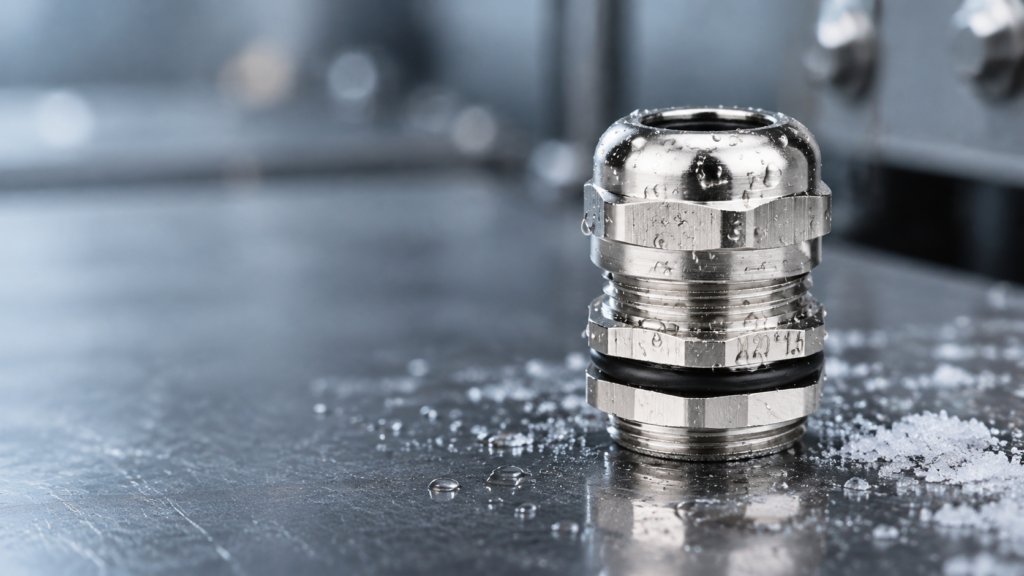
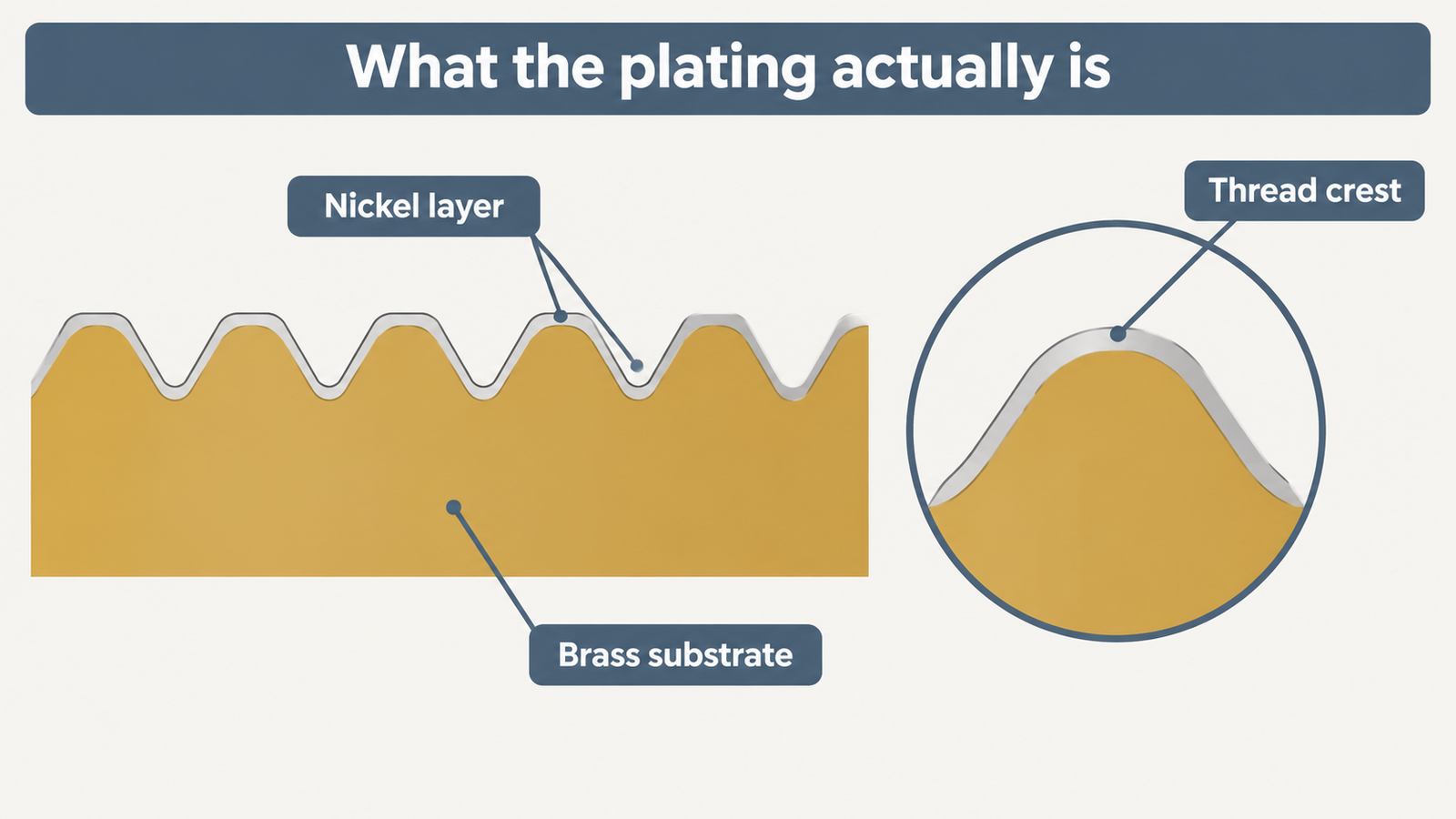
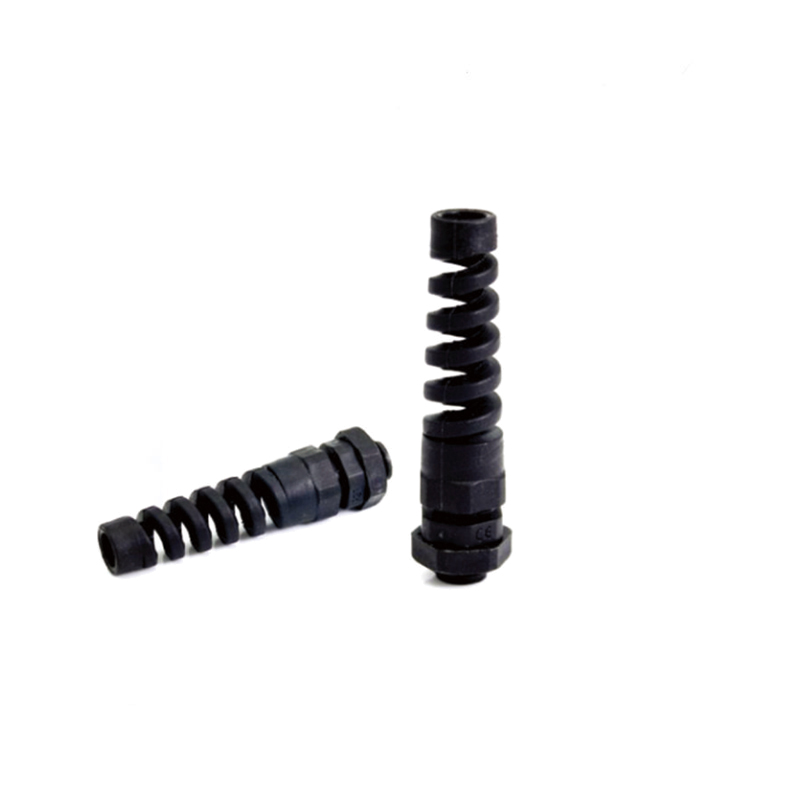
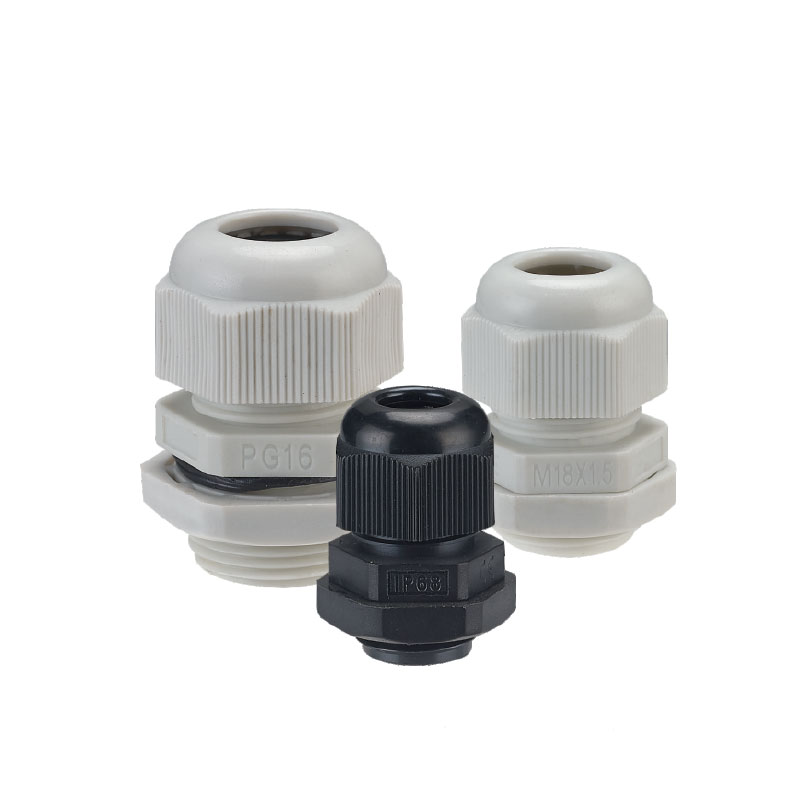
A nickel plated brass cable gland is a machined or forged brass body with a thin electrodeposited nickel layer over the whole surface. The layer is measured in micrometres, it follows the machined profile including the threads, and it is applied after machining rather than before.
That last point matters more than it sounds. Because the coating goes on last, it covers the thread flanks as well as the flats, and it is thinnest exactly where the geometry concentrates current during plating: the crests of the threads and the sharp machined edges. Understanding that distribution explains most of what follows about how plating performs and how it fails.
Two processes dominate. Electroplated nickel uses a current to deposit metal and gives a bright finish quickly; electroless nickel deposits chemically, covers recesses and thread roots more evenly and is harder, at higher cost. For a cable gland the practical difference appears at the thread crests, where electroplating is thinnest, and in the recesses, where electroless holds its thickness. Ask which process is used before comparing two quotations on price alone, because they are not the same product.
A barrier layer, not a change of material.
What Plating Solves, and What It Does Not
Plating is a barrier, and a barrier is a limited promise. Suppliers who describe it as corrosion protection without qualification are describing the good case only.
Plating does
Plating does not
Separates the brass from the atmosphere and slows tarnishing
Change the alloy underneath or its mechanical limits
Gives a harder surface that resists light abrasion and handling marks
Survive deep scratches, cut edges or thread damage
Keeps visible outdoor equipment looking serviceable for longer
Make brass suitable for continuous chloride or ammonia exposure
Reduces friction on threads compared with bare brass
Raise the temperature rating, which is set by the elastomer
The most misunderstood item is the last row of the left column. Bright, consistent appearance is evidence of a well-controlled plating process, not evidence of corrosion performance. Two glands can look identical on a bench and behave very differently after a year outdoors.
This is the point where the brass cable gland range deserves a closer look than a photograph. The catalogue image shows the finish; it cannot show the thickness, the adhesion or the salt spray criterion behind it, and those are the three properties that decide how the gland looks in five years.
Thickness: The Number That Is Rarely Quoted
Plating thickness is the single specification that separates a finish description from a finish requirement. A quotation that says “nickel plated” states a process; it does not state how much nickel is present, and without that number there is nothing to inspect against.
What to ask
Why it changes the answer
Minimum thickness in micrometres
A minimum is an acceptance criterion; an average is not
On which surface the figure applies
Thread crests plate thinner than flats, and crests are where wear starts
Which measurement method
X-ray fluorescence, coulometric and microscopy give different numbers
Whether it is per batch or per sample
A single coupon does not describe a production lot
Industrial nickel plating on brass hardware generally sits in the single-digit to low-double-digit micrometre range, with heavier deposits used where abrasion or chemical exposure is expected. The exact figure is the supplier’s to declare. What matters for the buyer is that a figure exists, applies to a defined surface and comes with a method.
Reading a Salt Spray Claim
Salt spray hours are the most quoted and least comparable figure in cable gland marketing. A number without a standard, a corrosion criterion and a test specimen description tells you very little.
Three questions turn a claim into information. First, which standard: neutral salt fog testing to ASTM B117 or ISO 9227 is the usual reference, and accelerated tests are not service-life predictions. Second, which failure point: hours to white corrosion of the coating is a different number from hours to base metal corrosion, and the second is the one that matters for structural integrity. Third, was the specimen scribed or damaged before testing, because a scribed sample tests the coating’s ability to protect a breach rather than its ability to stay intact.
A supplier who can answer all three is describing a tested product. A supplier who quotes a large number and nothing else is describing a brochure.
It is also worth remembering what a salt fog chamber does not reproduce. It holds one temperature, one salt concentration and a continuous wet condition, which is harsher than a sheltered industrial site in some ways and much easier than a coastal one in others. Use the result to compare finishes against each other, not to estimate years of service.
Plated or Unplated: Where Each Belongs
Environnement
Reasonable finish
Reasoning
Indoor cabinet, dry, not visible
Unplated brass
Plating adds cost and buys nothing indoors
Indoor, visible equipment, showroom panels
Nickel plated
Appearance retention is the actual requirement
Sheltered outdoor, occasional rain
Nickel plated
Barrier plus harder surface for handling and cleaning
Exposed outdoor, industrial atmosphere
Nickel plated, inspected
Works if the coating stays intact; damage is the failure mode
Coastal, marine, continuous chloride
Acier inoxydable
Plating is a barrier that chlorides eventually breach
Washdown with chlorinated or caustic cleaners
Acier inoxydable
Chemistry attacks the coating and then the brass
The dividing line is not indoor versus outdoor. It is whether the coating can reasonably be expected to stay continuous for the service life of the installation. Where mechanical damage is likely and the environment is aggressive at the same time, plating is the wrong tool regardless of thickness.
Where Plating Fails on Site
Almost every plating failure in service begins as mechanical damage during installation, not as a chemical attack on an intact coating.
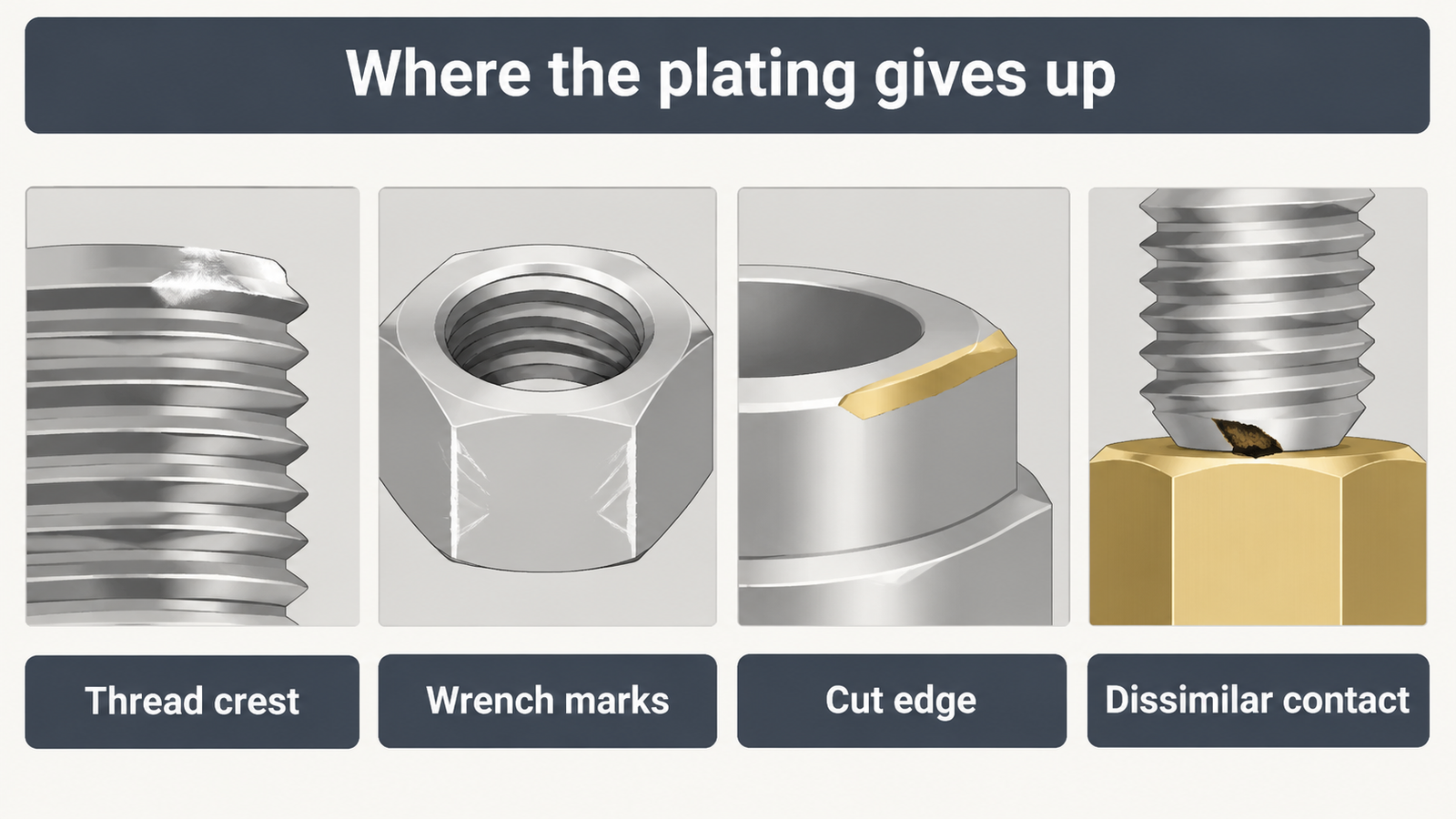
Four places where a bright new gland becomes a bare brass one.
Thread crests wear as the gland is run in and out, and a gland that has been fitted twice already has exposed brass on its most highly stressed surface. Wrench marks are the most visible and the most avoidable: a correctly sized spanner or a strap wrench leaves the coating intact, while grips and pipe wrenches do not. Cut edges from machining or from trimming a thread expose the substrate along a line, which is a far more effective starting point for corrosion than a round scratch. Dissimilar contact, particularly against aluminium, sets up a small galvanic couple at the joint that keeps the exposed area active.
The practical consequence is that plating quality and installation discipline cannot be separated. A heavier coating survives rougher handling, but no coating survives a pipe wrench.
Nickel Against the Other Finishes
Finish
Strength
Limitation
Unplated brass
Cheapest, no coating to damage, natural patina
Tarnishes quickly, appearance degrades, no abrasion benefit
Nickel
Hard, bright, good barrier, widely available
Thin at crests and edges; obvious when damaged
Chrome over nickel
Harder and brighter still
Brittle deposit, can flake at edges, rarely needed on glands
Zinc
Sacrificial protection on steel
Not the usual finish for brass bodies
Tin
Soft, good contact resistance
Wears quickly on threads
Epoxy or powder coat
Thick barrier, colour options
Thickness bridges threads; damage is hard to see
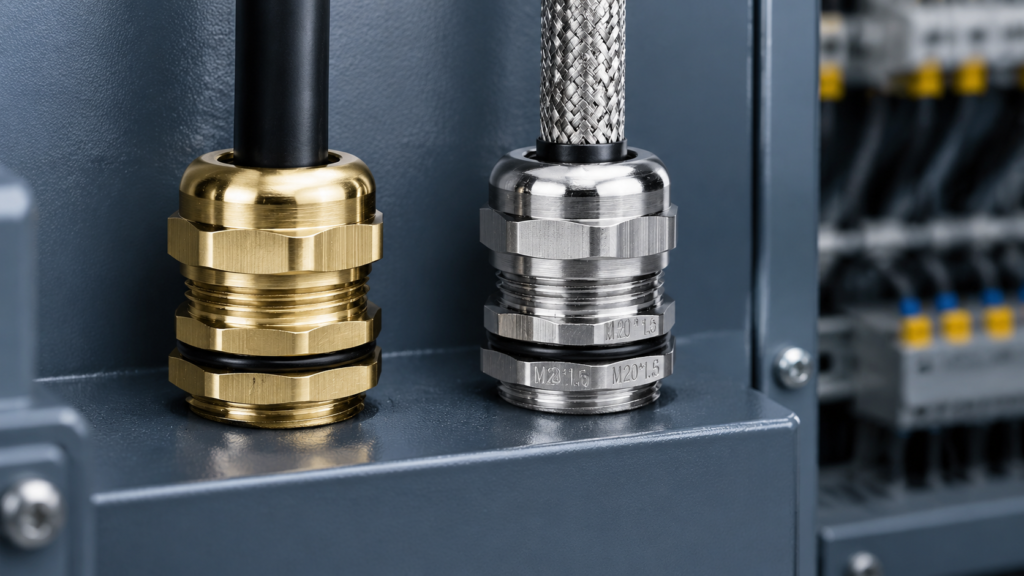
For most industrial work the real choice is between unplated brass, nickel plated brass and stainless steel. The middle option is the right one more often than either extreme, provided the specification includes a thickness figure.
When to Stop Plating and Move to Stainless
Four conditions should end the plating discussion. Continuous chloride exposure, including coastal air and marine decks. Washdown with chlorinated water or caustic cleaners. Immersion or frequent standing water. And sustained temperatures above the elastomer rating, where the seal rather than the body becomes the limit.
In each case the answer is a different body material, not a thicker coating. The stainless steel range covers the sizes that replace plated brass directly, and the brass gland guide explains where the brass family as a whole stops being appropriate.
One related decision is easy to overlook: on an entry that is both wet and exposed, the finish is not the only variable. The number of seals the gland carries often matters more than the coating on its body, and BW vs CW cable glands sets out how to decide that for a given location.
Specifying Plating on a Purchase Order
Line
What to write
1
Nickel plated brass, with the minimum thickness in micrometres and the surface it applies to
2
The measurement method accepted for inspection
3
Salt spray requirement, with the standard, the corrosion criterion and whether the specimen is scribed
4
Appearance acceptance: no bare brass on thread crests, no blistering or flaking
5
Packing that protects the coating in transit, since bag abrasion damages threads
Five lines are enough to make the finish inspectable at goods-in, which is the only point where a plating problem is cheap to resolve.
The check itself takes seconds per box: look at the thread crests of a sample, look for blistering on the flats and look at the machined edges. Bare brass at a crest on a brand-new part is not normal wear, it is a plating defect, and it is worth rejecting at receipt rather than explaining to a client eighteen months later. Where the installation also has to meet a sealing requirement, the IP rating guide explains how finish and sealing class are assessed together.
Price, MOQ and Ordering Reality
Plating adds a small per-piece cost rather than a step change, so nickel plated standard sizes sit at the upper part of the standard brass band rather than in a separate price class. Standard brass glands typically run from about US$0.08 to US$1.20 depending on size, with plated versions quoted at the upper end; EMC versions run from about US$0.90 to US$6.50 and Ex versions from about US$2.50 to US$14.00. These are indicative FOB Ningbo or Shanghai prices at 1,000 pieces per size for brass and 300 pieces per size for Ex.
Minimum order quantity for brass, plated or not, is normally 1,000 pieces per size with no tooling charge, and trial orders of 100 to 500 pieces are usually accepted at a higher unit price. Because plating is applied per batch, changing the finish after the order is placed means re-running the batch, which is why the finish belongs in the first enquiry rather than the last email.
Le choix du bon presse-étoupe étanche est crucial pour garantir la sécurité et la longévité de vos installations électriques et industrielles. Ces composants petits mais puissants protègent les câbles de l'eau, de la poussière et des dommages environnementaux, ce qui les rend indispensables dans de nombreux secteurs, des télécommunications à la marine en passant par l'industrie lourde. Mais comment choisir le bon niveau de protection et [...]
Découvrez les presse-étoupes doubles étanches et durables avec un indice de protection IP68, idéaux pour les panneaux solaires des véhicules de plaisance, les bateaux et les solutions d'étanchéité des câbles en extérieur.
EMC and standard cable glands seal and grip identically; only the screen termination differs. Compare specs, indicative FOB prices, and use a four-check test to decide per circuit.
Nous répondrons à votre demande dans les 24 heures
Nous accordons de l'importance à votre vie privée
Nous utilisons des cookies pour améliorer votre expérience de navigation, vous proposer des publicités ou des contenus personnalisés et analyser notre trafic. En cliquant sur "Tout accepter", vous consentez à notre utilisation des cookies.