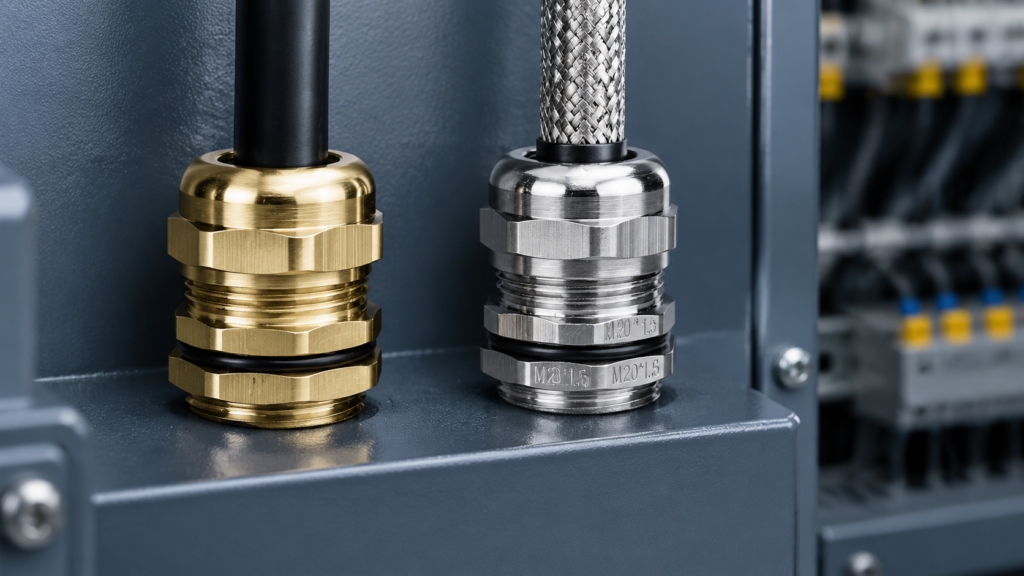
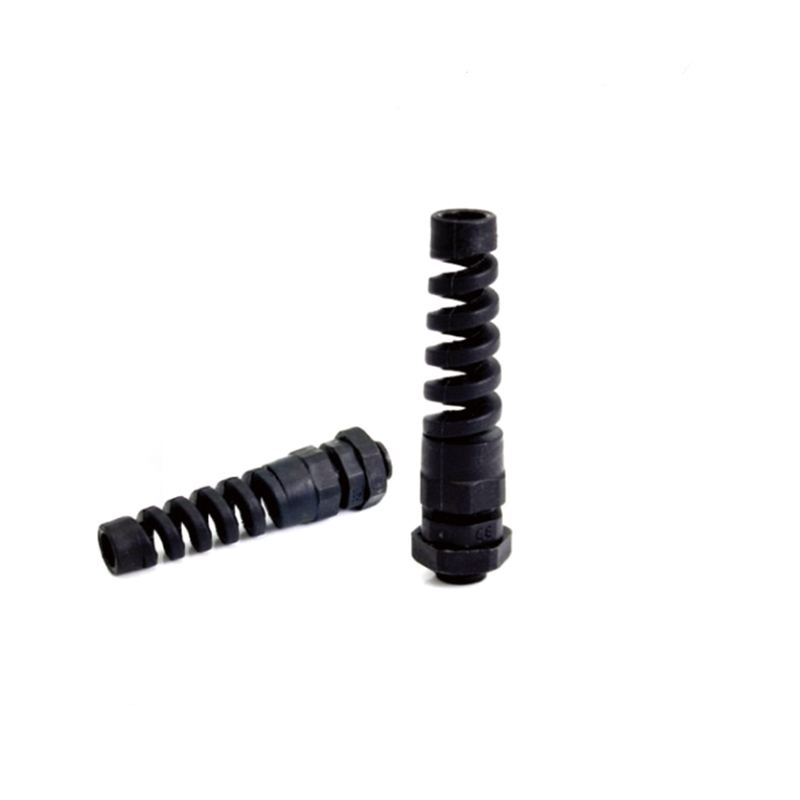
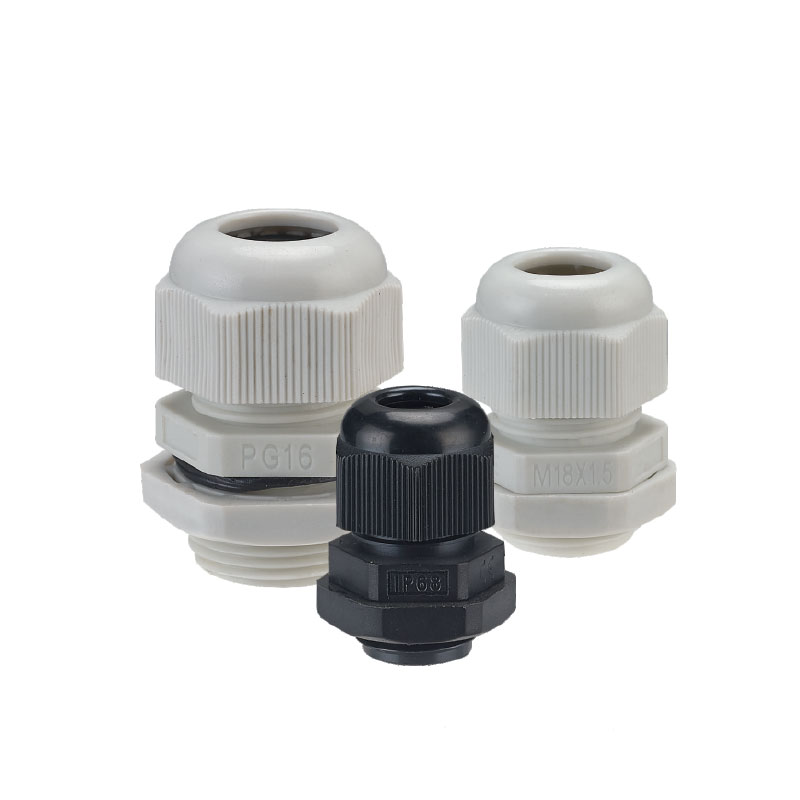
An غدة كابل EMC and a standard cable gland are the same component in every respect except one: the EMC version has a conductive contact element that bonds the cable screen to the enclosure at the point of entry. Sealing, clamping, strain relief and thread dimensions are unchanged. So the choice is not “better or worse” — it is whether the cable entry is part of your screen-termination strategy or not.
That single difference drives a real price gap, and it is where most panel specifications either over-spend or leave a shielding path broken. Below is a specification-level comparison, the indicative FOB price difference, and a four-check test you can apply circuit by circuit.
What Actually Differs Between the Two Glands
Three things change when you move from a standard gland to an EMC gland, and nothing else does.
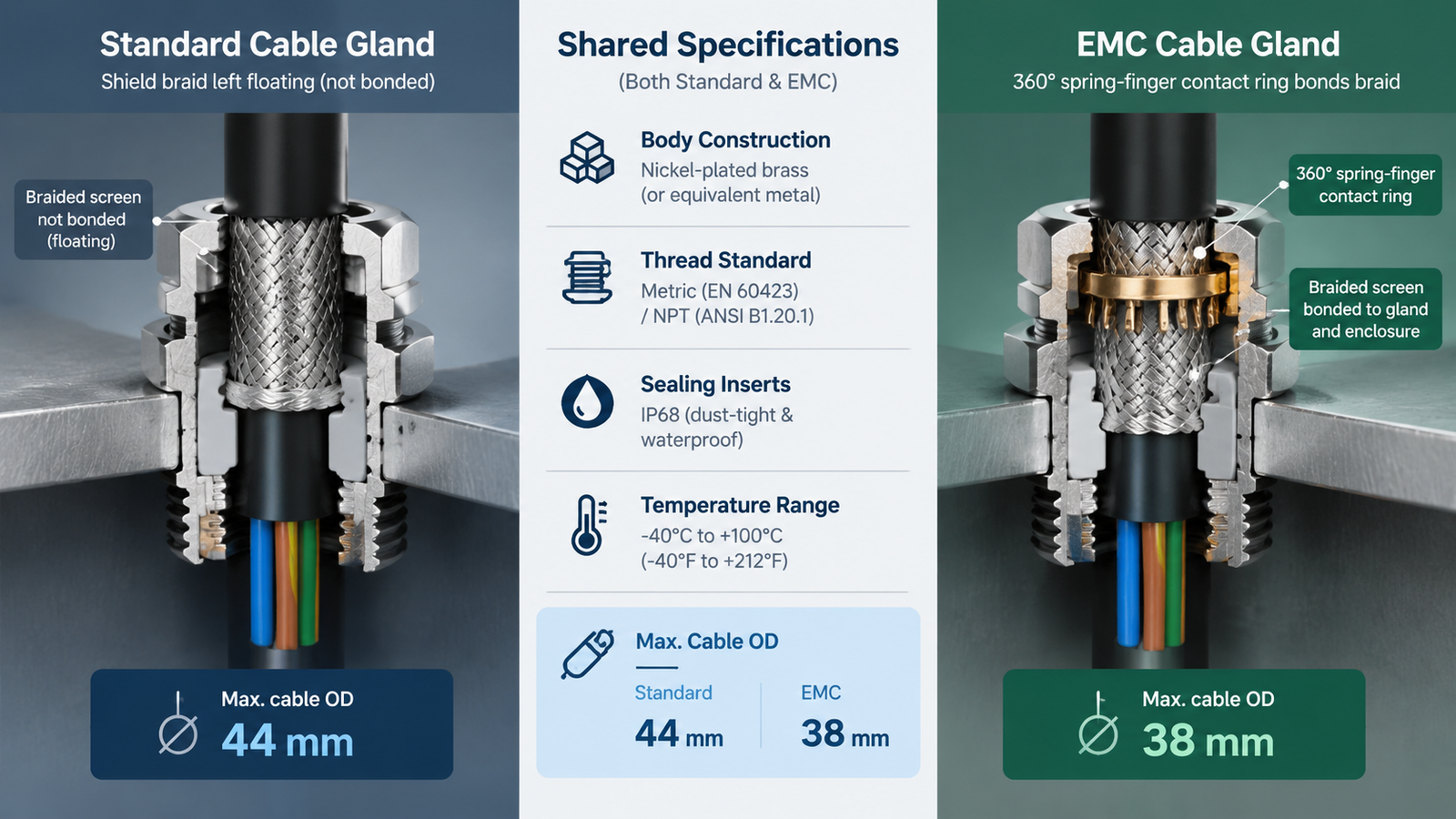
A contact element is added. A spring-finger (crown) ring, a contact cone or a shield clamp presses the screen against the gland body around its full circumference.
The body becomes part of the electrical path. The gland must conduct and must be bonded to the enclosure, so conductive metal construction is mandatory.
The installation gains a step. The screen has to be exposed, folded or seated correctly, and the contact ring torqued — then verified with a continuity measurement.
Everything else is shared: thread standard, sealing inserts, IP rating, temperature range and locknut are identical between the two families at the same size. The one dimension that can shift is the maximum cable OD — because the contact ring occupies part of the bore, EMC glands top out lower in each series (up to 38 mm OD, against 44 mm for standard glands). If an EMC gland is specified and the screen is never bonded to the gland body during installation, you have paid the EMC price for a standard part. For a full explanation of the contact mechanism, see what an EMC cable gland is and how it works.
Where the Two Glands Are Identical
This is the part that keeps over-specification in check. Both types seal against water and dust to the same IP rating, both retain the cable against pull-out, both provide strain relief, both are available in the same metric, PG and NPT threads, and both are tested to the same standards — IEC 62444 for the gland itself and IEC 60529 for ingress protection.
A standard nickel-plated brass gland in IP68 is not a “weaker” product; it is the same sealed metal body without a screen contact. On an unshielded power feeder the EMC function has nothing to connect to, so the extra cost buys nothing.
Specification Comparison: EMC vs Standard Cable Gland
Conductive metal only — nickel-plated brass or stainless steel 316
Screen termination
None by design
360° contact ring bonded to the enclosure
Cable type it serves
Unshielded, or shielded with termination elsewhere
Shielded, screened, braided or foil-screened cable
Ingress protection
IP68 as standard (IP66 option)
IP68 as standard
نطاق درجة الحرارة
Nylon −40 to +100 °C; brass −40 to +120 °C; SS −40 to +200 °C
Brass −40 to +120 °C; SS316 −40 to +200 °C
Threads and cable range
M12–M63, PG7–PG48; cable OD 3–44 mm
M12–M63, PG7–PG48; cable OD 3–38 mm
Installation time
One step — insert and tighten
Plus screen preparation, contact torque and continuity check
IP68 immersion test report, CE, RoHS, REACH
Included
Included
The Cost Difference, in Numbers
The price gap between the two families is real but narrower than most specifications assume — and it is far smaller than the cost of one unexplained drive fault. For reference, our indicative FOB pricing at 1,000 pcs per size:
النوع
Specification
Typical application
Indicative FOB price
Standard nylon gland
PA66, IP68, PG7–PG48 and M12–M63, cable OD 3–44 mm
Indoor panels, junction boxes, light-duty outdoor
US$0.08–1.20 / pc
Standard nickel-plated brass gland
Metal body, IP68, metric / PG / NPT
Industrial panels, machinery, outdoor enclosures
US$0.08–1.20 / pc
EMC nickel-plated brass gland
Nickel-plated brass with 360° contact spring, IP68
VFD and servo feeders, instrumentation, panel comms
US$0.90–6.50 / pc
Indicative FOB Ningbo / Shanghai, 1,000 pcs per size, standard export packing. Stainless steel and custom-thread versions are quoted separately.
Both specifications are built on the same metal bodies — the standard M20 brass gland and the 316 PG13.5 stainless gland use the same sealing design and thread dimensions that an EMC version carries with a 360° contact spring added. Upgrading does not change your panel drilling or thread standard.
On a cabinet with 40 drive and encoder entries, that difference is a few hundred dollars of hardware. Set it against the cost of one afternoon of field diagnosis on an intermittent encoder fault — or one scrapped batch from a drifting weighing signal — and the comparison stops being about unit price. The reverse also holds: on a distribution board with 200 unshielded lighting feeders, paying the EMC premium 200 times buys nothing at all.
When a Standard Cable Gland Is the Right Answer
The cable is unshielded — utility power, lighting, general wiring.
The enclosure is electrically quiet : no drives, inverters, servo amplifiers or switching supplies inside.
The screen is already terminated on a dedicated EMC gland plate, shield clamp or grounding bar just inside the panel, at low impedance.
The circuit is not covered by an EMC plan — mechanical and sealing performance are the only requirements.
Where the choice is between body materials rather than EMC function, the decision is environmental — corrosion, UV exposure and washdown duty — and both families are supplied in the same غدد الكابلات الفولاذ المقاوم للصدأ and nickel-plated brass bodies.
When You Need the EMC Version
Circuit
Gland choice
السبب
VFD motor cable entering the drive cabinet
EMC
PWM common-mode current must return to the enclosure at the entry
Motor terminal box end of the same cable
EMC
Both ends must be bonded or the Faraday cage is open
Encoder, resolver and feedback cables
EMC
Corrupted position feedback presents as mechanical faults
Instrumentation, load cells and weighing signals
EMC
Low-level analogue signals are corrupted first
Industrial Ethernet and fieldbus entries
EMC
Comm faults appear under load and are hard to trace
Solar and battery inverter DC and monitoring cables
EMC
High-frequency switching shares the enclosure
Unshielded feeder into an outdoor junction box
قياسي
No screen to terminate; sealing is the requirement
Shielded cable with a certified internal shield clamp
Standard brass
Termination already handled inside the cabinet
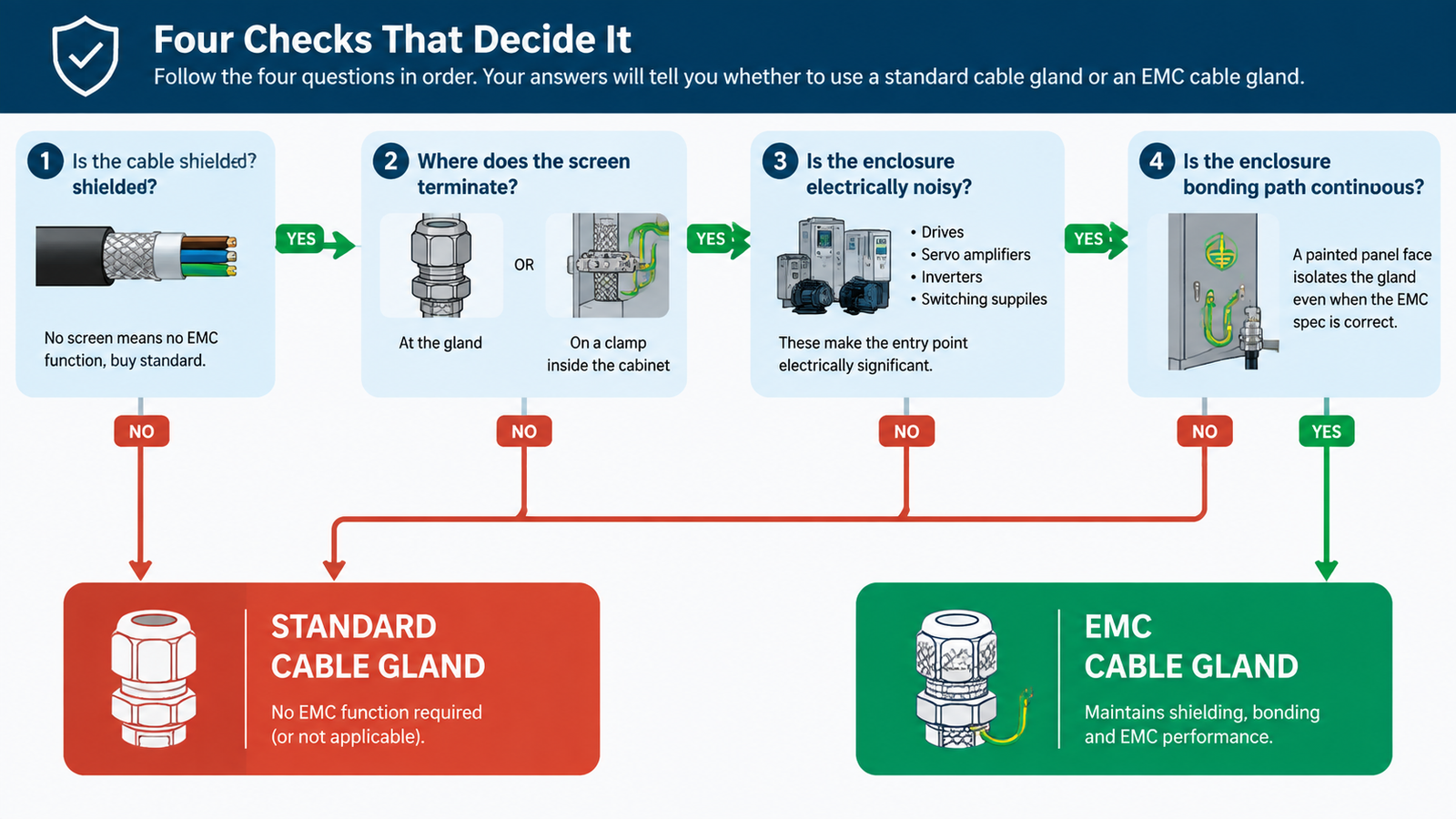
Four Checks That Decide It
Is the cable shielded? No screen means no EMC function. Stop here and buy standard.
Where is the screen supposed to terminate? At the gland, or on a clamp or plate inside the cabinet. If the answer is “at the gland”, specify EMC construction; if it is “inside”, a standard metal gland can be correct.
What else is in the enclosure? Drives, servo amplifiers, inverters and switching supplies make the entry point electrically significant. A quiet junction box does not.
Is the enclosure bonding path continuous? An EMC gland installed through a painted panel face is electrically isolated. Confirm locknut, earth tag or masked bonding surface before paying for the EMC spec.
Common Selection Mistakes
Mistake
Consequence
Choosing by size fit alone on a shielded drive cable
Mechanically correct, electrically open — the screen is broken at the entry
Assuming every shielded cable needs an EMC gland
Unnecessary cost where the screen is terminated internally by design
Specifying nylon on a screened cable
No conductive path exists at any price
Buying EMC glands, then bonding them to a painted panel
The premium is spent and the shield stays isolated
Comparing only unit price across the two types
The relevant comparison is hardware cost versus the cost of one EMI-driven fault
Conclusion
The two glands share a body, a thread and an IP rating. What separates them is whether the enclosure entry is used to terminate the cable screen. Once you know where the screen is bonded, the decision is mechanical: shielded cable entering a noise-heavy enclosure with the entry as the termination point gets the EMC version; unshielded cable, quiet enclosures and internally terminated screens get the standard version.
Most plants need both, and it is not a compromise to mix them — it is the correct specification. Decide per circuit, and check the bonding path before you approve the EMC premium. For thread and size confirmation across metric, PG and NPT, the thread types guide and the IP rating guide cover the rest of the specification.
Send us your cable list — shielded and unshielded, with outer diameters and thread sizes — and our engineering team will return a circuit-by-circuit gland schedule, a certificate pack and an FOB quotation within one working day. Contact us here.
الأسئلة الشائعة
What is the main difference between an EMC and a standard cable gland?
The EMC version contains a conductive contact element that bonds the cable screen to the enclosure around its full circumference. A standard gland seals, grips and strain-relieves the cable but provides no designed screen termination.
Are EMC cable glands more expensive?
Yes. Indicative FOB pricing is US$0.90–6.50 per pc for nickel-plated brass EMC glands against US$0.08–1.20 for standard glands at 1,000 pcs per size. The relevant comparison is that hardware difference against the cost of diagnosing one EMI-driven fault.
Can I use a standard brass gland on shielded cable?
Only if the screen is terminated somewhere else — for example on an EMC gland plate or grounding bar inside the cabinet. If the entry point is the only place the screen can be bonded, a standard gland leaves the shielding open.
Do EMC cable glands have a higher IP rating?
No. Both types are typically IP68 as standard to IEC 60529. The EMC version adds a screen contact, not extra sealing, so the IP rating and temperature range are the same at the same size and material.
Do I need EMC glands on both ends of a motor cable?
On drive-fed circuits, yes — at the drive end and the motor terminal box, so the Faraday cage is closed. Bonding one end only leaves the interference current with nowhere to return.
استكشف موصلات غدة الكابلات المتينة المقاومة للماء مع تصنيفات IP67 وIP68 من النايلون والنحاس الأصفر والفولاذ المقاوم للصدأ لحماية الكابلات وتخفيف الضغط بشكل آمن.
من بين العديد من ملحقات التوصيلات الكهربائية، تلعب غدة الكابلات المقاومة للماء دورًا حاسمًا. فهي لا تحمي الكابلات التي تخترق أغلفة المعدات من دخول الماء والغبار فحسب، بل تعزز أيضًا من السلامة والموثوقية العامة للنظام. يساعد فهم المواد والتطبيقات الخاصة بغدد الكابلات المقاومة للماء المهندسين والمشترين في صناعات مثل الصناعة والاتصالات و [...].
في المشاريع الصناعية والإنشائية، تُعد غدة الكابلات المقاومة للماء من المكونات الأساسية التي تضمن سلامة الكابلات وتشغيلها المستقر. سواء كنت تواجه المطر والغبار في البيئات الخارجية أو تتعامل مع المخاطر القابلة للانفجار في المناطق الخطرة، فإن اختيار غدة الكابلات المناسبة أمر بالغ الأهمية. اليوم، دعنا نستكشف نوعين شائعين من غدد الكابلات - غدد الكابلات المقاومة للماء و [...].
نحن نستخدم ملفات تعريف الارتباط لتحسين تجربة التصفح الخاصة بك، وعرض إعلانات أو محتوى مخصص، وتحليل حركة المرور لدينا. بالنقر على "قبول الكل"، فإنك توافق على استخدامنا لملفات تعريف الارتباط.