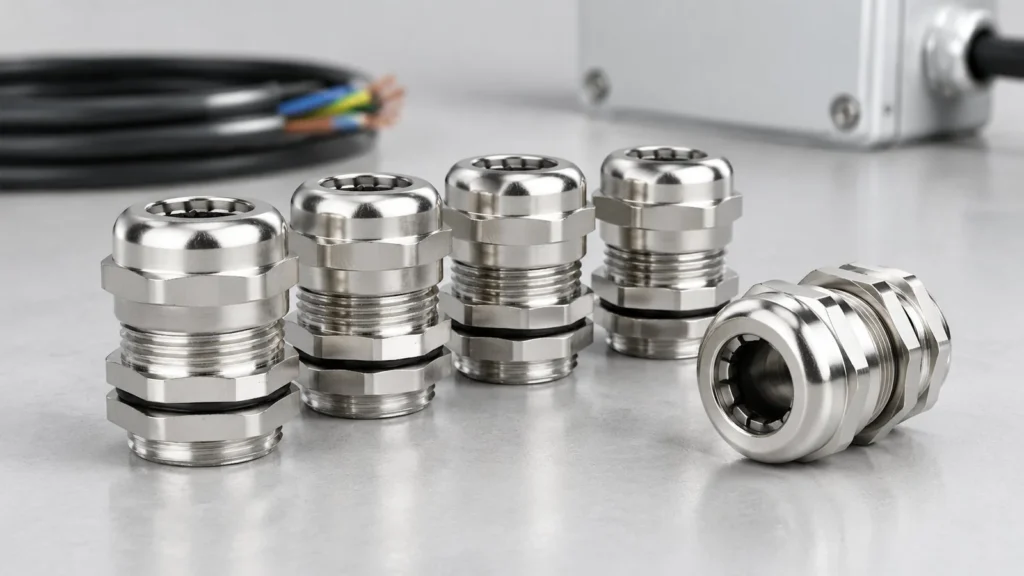
M20 is the most common cable gland thread in the world, and it is also the most frequently mis-ordered. Two buyers can both ask for “an M20 gland” and receive parts that will not interchange: different pitches, different cable ranges, different thread lengths, different spanner flats. The size label describes the thread only, and the thread is one of four things that have to match.
This page takes one size apart. Everything below refers to our standard nickel-plated brass M20 gland, and the dimensional values are the ones published for that part rather than a generic table copied from elsewhere.
What “M20” Actually Commits You To
An M20 designation fixes the major diameter at twenty millimetres and tells you nothing about pitch. The common metric fine pitch for cable glands is 1.5 millimetres, written M20 x 1.5, and that is what our range uses. A coarser M20 x 2.0 or a finer M20 x 1.0 will screw into nothing you already own, and neither will accept your existing locknuts.
This is why the pitch belongs in the requisition and on the drawing, not only the diameter. It is also why a “20 mm gland” from an unfamiliar source should be checked with a thread gauge before a whole panel is punched for it.
The Four Numbers That Define an M20 Gland
Four dimensions decide whether a part will work on your enclosure: the thread and its pitch, the cable range, the thread outside diameter that sets the hole, and the thread length that has to pass through the wall. A fifth, the spanner size, decides whether you can turn it in the space available.
المعلمة
M20 standard gland
Why it matters at the panel
الخيط
M20 × 1.5.5 مليمتر × 20 × 1.5
Pitch must match every locknut, adapter and tapped hole on the site
Cable range
6 to 12 mm sheath diameter
Your measured sheath OD must sit inside this band, not at its edge
Thread outside diameter
20 mm
Sets the hole: the gland needs a hole of 20 to 20.2 mm
Thread length GL
8 mm
Must cover wall thickness plus locknut plus washer
Spanner size
22 mm across flats
Decides clearance to the next gland and which tools reach it
The hole and thread relationship is worth stating plainly, because it is where most M20 problems start: a gland is not designed to seal in a hole that is already oversized. The mounting hole for this size is 20 to 20.2 mm, which is the thread outside diameter plus about two tenths of a millimetre. Anything larger and the sealing washer has nothing to press against.
Cable Range 6 to 12 mm: How to Measure It
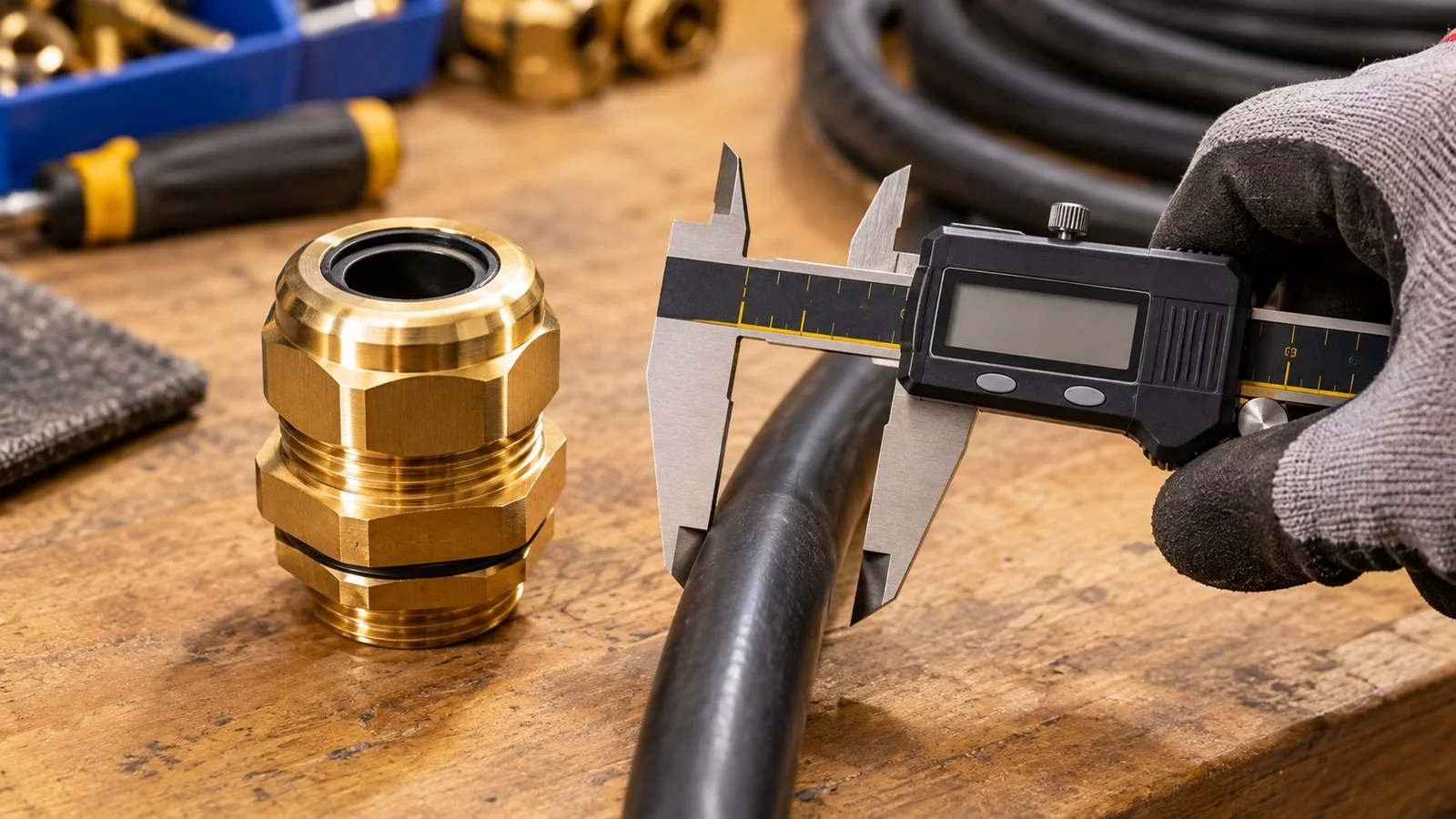
The range refers to the cable sheath outside diameter, not the conductor size, not the nominal cable designation and not the diameter over the armour. Measure the finished cable with a caliper at three points along the length you intend to seal, and use the largest reading.
Working at the top of the range is a mistake that looks like efficiency. A gland at twelve millimetres on a twelve millimetre cable has no insert compression left to accommodate thermal expansion, eccentricity or a slightly oval sheath. It will seal on the day of installation and leak in the first cold snap. The comfortable working band is the middle of the range, and a cable that measures close to either limit is a signal to move up or down a size rather than to force the fit.
Measuring the sheath outside diameter, not the conductor size and not the nominal cable designation.
The reverse error is equally common: an undersized cable in an oversized gland relies entirely on the insert closing down, which distorts it and reduces pull-out resistance. If the measured diameter is below the bottom of the range, the correct answer is a smaller gland or a reducing insert, not a thicker tightening hand.
Thread Length, Wall Thickness and the Locknut Stack
GL of eight millimetres has to cover the panel thickness, the locknut and the washer, with enough thread left for full engagement. On a two millimetre sheet with a thin locknut this is comfortable. On a six millimetre plate, or through a wall plus a gland plate, it is not, and the gland will bottom out with the body standing off the surface.
Two honest solutions exist. One is a longer-thread variant of the same size, which is a different part number rather than a modification. The other is to tap the plate and delete the locknut, which changes the sealing face and should be a deliberate decision rather than a workaround. What must never happen is a gland with three threads engaged being signed off as installed, because the compression seal depends on the body being pulled down flat.
For the arithmetic, take the plate thickness, add the locknut and washer thickness from their own datasheets, and confirm the remainder of GL still allows the seal to compress. Our cable gland hole size chart covers the drilling and wall-thickness side in more depth.
M20 Against Its Nearest Neighbours
Most M20 questions turn out to be a size-boundary question, and the boundary is smaller than people expect. The table below uses our published values so the comparisons are real rather than approximate.
Size
Cable range
مؤشر الترابط O.D.
Mounting hole
GL
Spanner
M18 x 1.5
4 to 8 mm
18 mm
18 to 18.2 mm
8 mm
20 mm
M20 × 1.5.5 مليمتر × 20 × 1.5
6 to 12 mm
20 mm
20 to 20.2 mm
8 mm
22 mm
M22 x 1.5
10 to 14 mm
22 mm
22 to 22.2 mm
8 mm
24 mm
M25 × 1.5.1.5
10 to 14 mm
25 mm
25 to 25.2 mm
9 mm
24 / 27 mm
PG13.5
6 to 12 mm
20.4 mm
20.4 to 20.6 mm
8 mm
22 mm
Two rows in that table catch people out. M22 and M25 share the same cable range, so if you need a bigger bore you go to M32 rather than M25, and the choice between M22 and M25 is about hole size and strength rather than cable. And PG13.5 clamps exactly the same six to twelve millimetre cables as M20 while needing a hole four tenths larger, which is enough to make the two incompatible in an existing panel. That comparison is the subject of our PG13.5 cable gland size guide, and the general thread relationship is set out in PG versus metric cable glands.
Accessories That Must Match the Pitch
An M20 gland is rarely installed alone. Locknuts, sealing washers, shrouds, blanking plugs and thread adapters all have to engage the same M20 x 1.5 thread, and each one adds a failure point if it comes from a different source with a different tolerance class.
The two that matter most are the locknut and the sealing washer. A locknut with a coarse pitch will start on the thread and cross-thread under load, which damages the very threads that carry the seal. A washer with a different outside diameter leaves the sealing face partly unsupported. Buying the assembly as a matched set from one supplier is not a procurement convenience, it is the only way to be sure the stack works.
Where the enclosure is metallic and the gland is metallic, the locknut also becomes part of the bonding path, so its material and its coating matter. Our cable gland earthing guide covers that interface.
One Footprint, Three Materials
M20 x 1.5 exists in nickel plated brass, in stainless steel and in nylon, and all three share the same thread and the same hole. That makes substitution easy on paper and risky in practice, because only the thread is common. The cable range can differ, the thread length can differ, and the temperature and chemical limits differ substantially.
Nylon versions are usually the cheapest and the lightest and are correct for a plastic enclosure where no bonding is required. Brass is the default for general industrial panels. Stainless is the answer where chloride or washdown would strip a plating. Swapping one for another without checking the range and the GL is how a straightforward replacement becomes a leak.
Where M20 Is the Wrong Choice
Three situations call for a different size or family rather than a different tightening technique. The first is a cable above twelve millimetres, which needs M25 from the table above. The second is a wall thick enough to consume GL, which needs a long-thread part. The third is a cable with armour or a braid that must be clamped and bonded, which is a different gland construction entirely, not a larger M20.
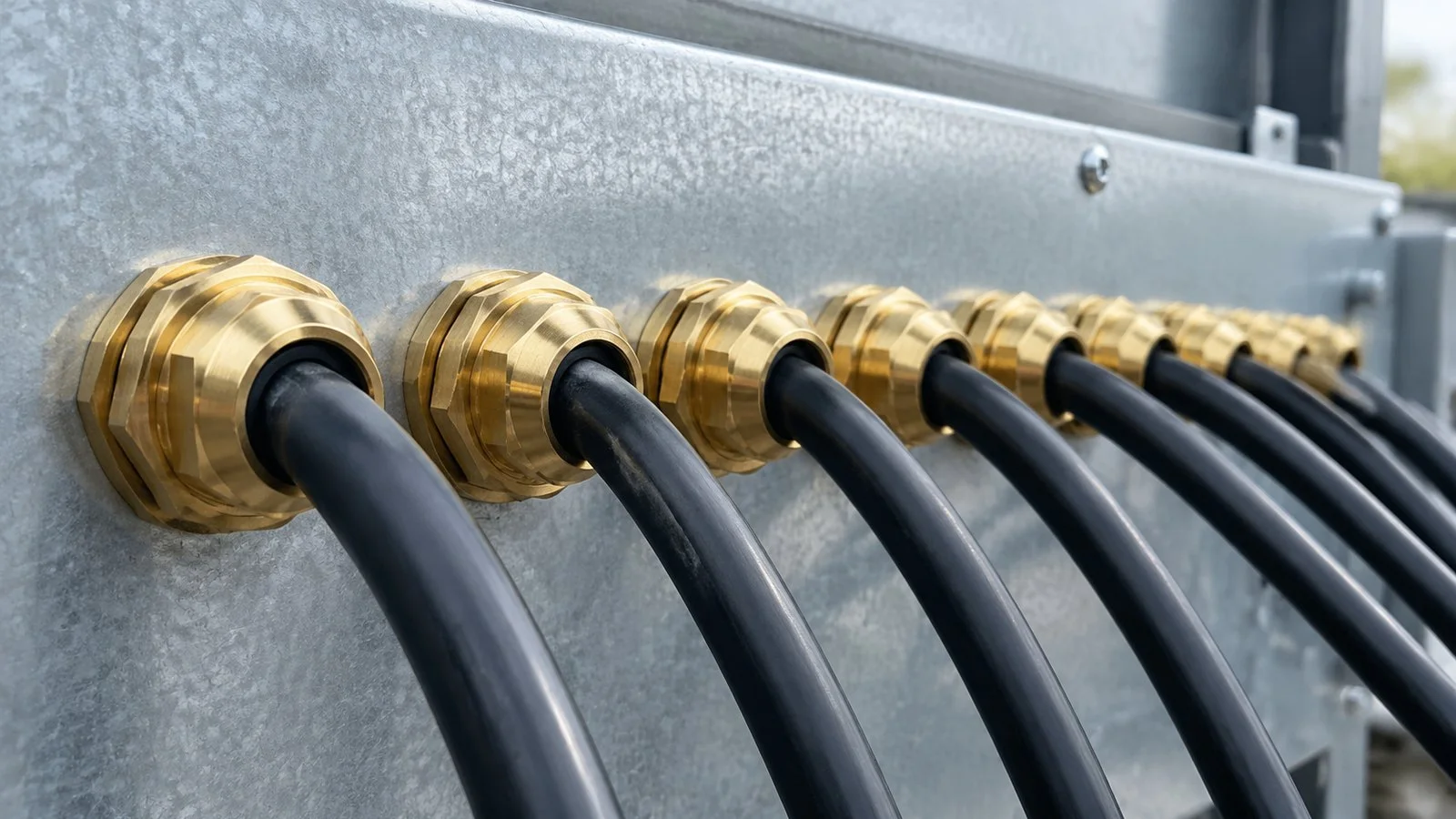
There is also a fourth case that is not about the cable at all: space. An M20 body needs a twenty-two millimetre spanner plus swing room. Where entries are pitched at thirty millimetres, that is workable; where they are pitched at twenty-five, the glands fit but the tools do not, and the installation will be finished with pliers and a seal that was never compressed properly.
A row of M20 entries in a galvanised panel. Clearance to the next gland decides whether a wrench can reach the flats.
Ordering an M20 Gland Without Ambiguity
Field to specify
Example for this size
What it prevents
Thread and pitch
M20 × 1.5.5 مليمتر × 20 × 1.5
Receiving a different pitch that fits nothing on site
Material and finish
Nickel plated brass, or 316L stainless
Unplated brass supplied into a washdown area
Cable range required
8 to 10 mm measured sheath OD
A part whose range barely brackets the cable
IP rating with conditions
IP68, 2 m for 24 h
“IP68” with no depth or duration stated
Accessories
Locknut, washer and shroud in the same thread
A mismatched stack that cross-threads
Thread length
Standard GL, or long thread for 6 mm plate
A body standing off the panel
Our M20 standard brass cable gland is the reference part for this size, and the full size table from M14 to M63 sits alongside it on the same page, so you can check the neighbours before committing to a hole. The brass cable gland range carries the rest of the family in the same thread system.
الأسئلة المتداولة
What size hole do I drill for an M20 cable gland?
Twenty to twenty point two millimetres. That is the thread outside diameter plus about two tenths, and it applies to the standard M20 gland in brass or stainless.
Will an M20 gland take a 12 mm cable?
It will clamp it, because twelve millimetres is the top of the range, but it is a poor choice. At the limit there is no compression left for thermal movement, so specify M25 and use the middle of its range instead.
Can I use a PG13.5 gland in an existing M20 hole?
No. PG13.5 needs a hole of twenty point four to twenty point six millimetres, so it will not enter a hole drilled for M20, even though both clamp the same cable diameters.
Is M20 available with a longer thread for thick panels?
Yes, as a separate part number rather than a modified standard part. Confirm GL against your wall thickness plus locknut and washer before ordering.
Does an M20 gland fit an M20 tapped hole?
Yes, if the hole is tapped M20 x 1.5 and the thread is clean. In a tapped hole the locknut is normally omitted, which changes the sealing face and should be reviewed rather than assumed.
هل تساءلت يومًا كيف تضمن تلك الأجهزة الصغيرة التي تبدو غير مهمة أن تظل الكابلات آمنة وموثوقة في البيئات الرطبة أو القاسية؟ هذا هو السر وراء غدة الكابلات المقاومة للماء. فهي تعمل "كحارس بوابة" للكابلات التي تدخل وتخرج من المعدات، فهي لا تحقق اتصالاً آمنًا فحسب، بل تحمي الكابلات من الرطوبة والغبار و [...].
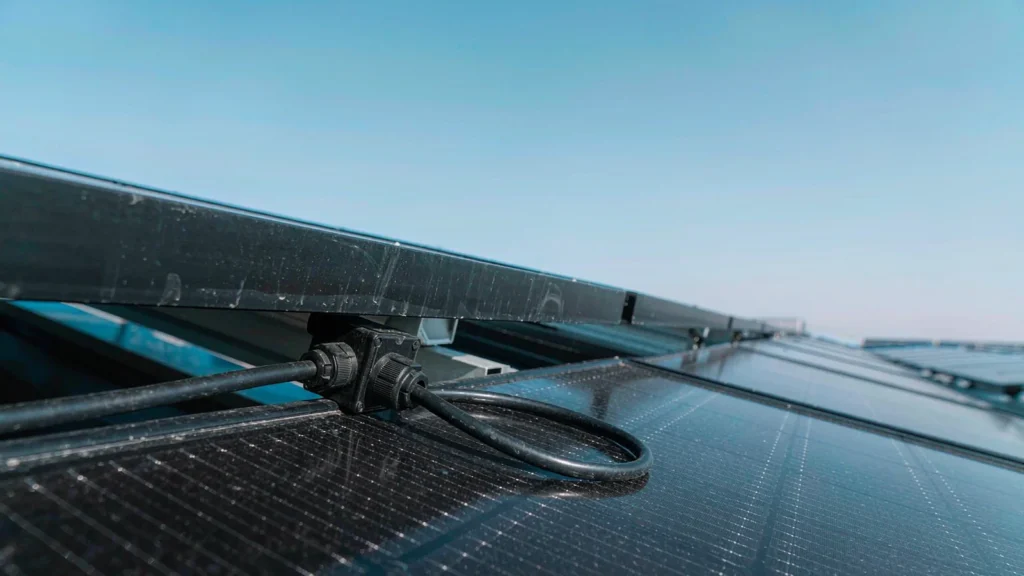
A PV cable entry has to survive twenty-five years of sun and thermal cycling with no maintenance access. What that changes about cable sizing, UV stability, material choice and entry geometry.
تلعب غدة الكابلات المقاومة للماء دورًا حيويًا في سوق B2B. سواء كنت مُصنِّعًا لمعدات الطاقة الشمسية أو مقاول هندسة بحرية أو مُدمج أتمتة صناعية، فإن اختيار غدة الكابلات المقاومة للماء المناسبة يؤثر بشكل مباشر على متانة وسلامة أجهزتك. هل تساءلت يومًا ما الذي يحافظ على سلامة وسلامة الكابلات لدينا، حتى في الأمطار الغزيرة [...]
نحن نستخدم ملفات تعريف الارتباط لتحسين تجربة التصفح الخاصة بك، وعرض إعلانات أو محتوى مخصص، وتحليل حركة المرور لدينا. بالنقر على "قبول الكل"، فإنك توافق على استخدامنا لملفات تعريف الارتباط.