BW, CW and E1W are not good, better and best. They are three answers to one question: which surfaces of this cable need to be sealed, given where the entry is. Get that question right and the letter code follows. Get it wrong and a perfectly well-made gland will let water in for a reason no one finds at commissioning.
This article is about making that decision on a real project. The parts inside the gland and what each one does are covered in the armoured gland anatomy; here the subject is the failure mode each type prevents and what it costs to get the answer wrong.
Think Like Water: Two Paths In
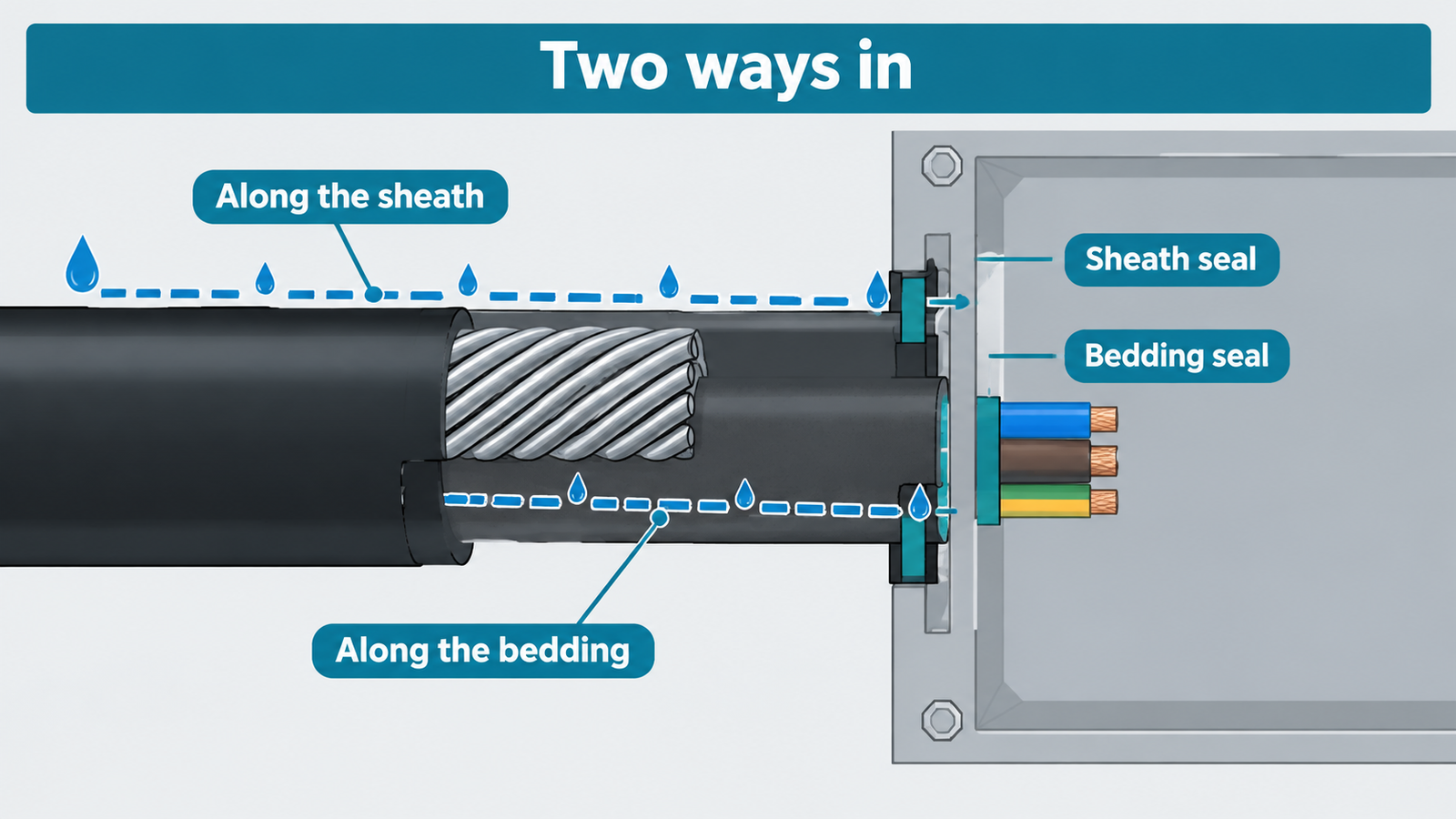
Water reaches a terminal enclosure along two different surfaces of an armoured cable, and they are not the same problem. The obvious one is the outside of the sheath: rain runs down the cable and pools at the entry. The less obvious one is inside the cable, where water that has entered a damaged or poorly terminated sheath travels along the bedding under the armour, sometimes metres, until it arrives somewhere it can do damage.
Two different ingress paths, sealed by two different elastomer seals.
Path
What it follows
Seal that stops it
When it matters
External
Outside surface of the outer sheath
Sheath seal at the cable entry
Any outdoor or washdown entry
Internal
Bedding, under the armour wires
Bedding seal further inside the gland
Cable with damaged sheath, long runs, wet trenches
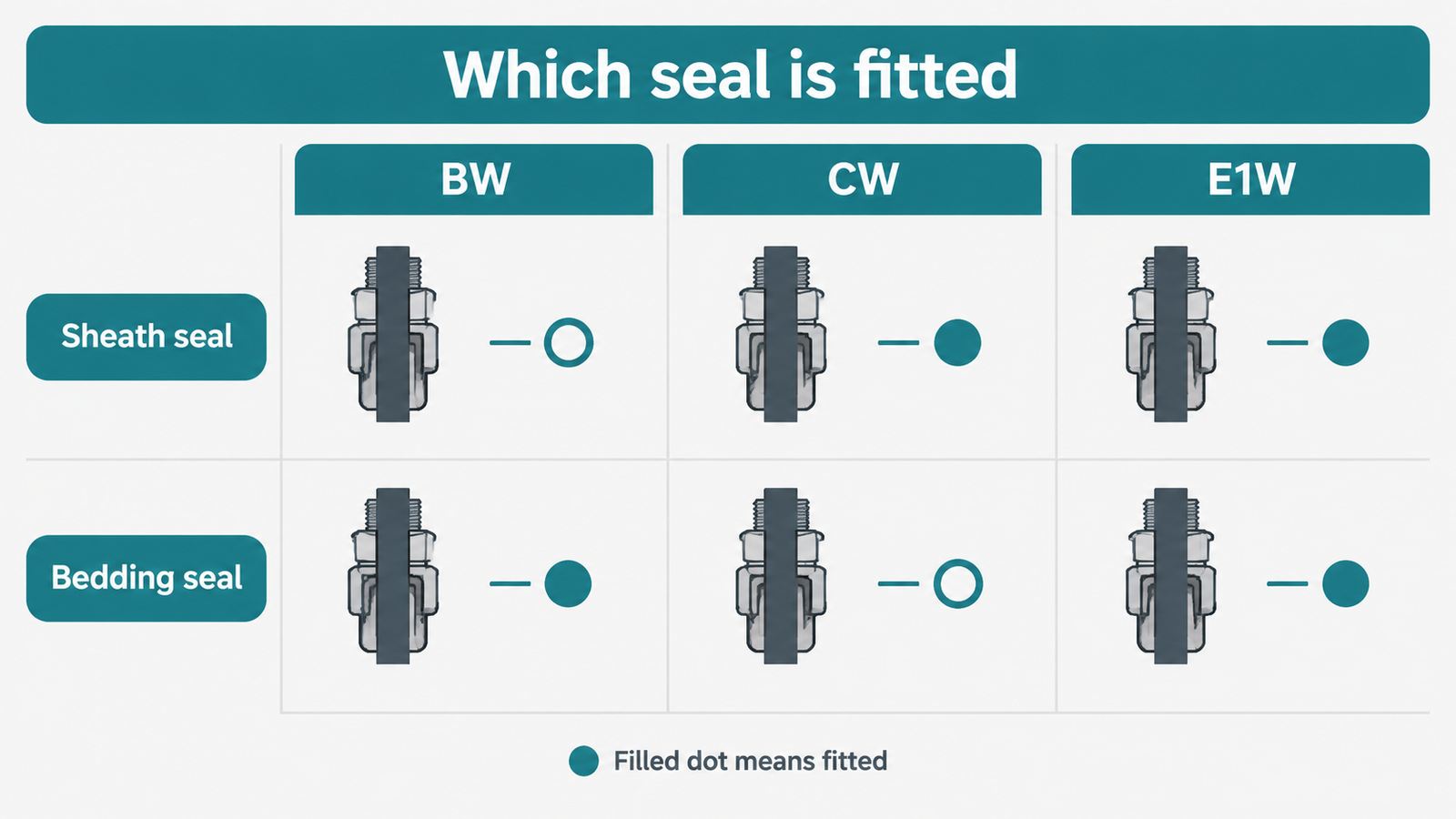
Each type of gland fits one or both of these seals. That is the whole difference, and it is why the letter code should never be chosen from a price list.
What a BW Gland Can and Cannot Promise
A BW gland clamps the armour and seals on the bedding. It does not seal the outer sheath. Used where it belongs, that is a complete and correct termination: the armour is gripped and bonded, and the internal path is closed.
What it cannot do is stop water on the outside of the sheath. A BW entry in a location where rain lands on the cable is a designed leak, even though every part did its job. This is the single most common misuse of the type: it is cheaper, it fits, it looks right, and it is specified for an outdoor enclosure because nobody checked which seal it has.
It is worth being precise about what is not compromised. Armour clamping and bonding are unaffected by the seal count, so a BW gland still provides the mechanical retention and the earth path that make an armoured termination compliant. The failure it invites is environmental, not electrical, and that is why it passes an inspection that only checks continuity and grip.
Which seal each type fits, and which path it therefore closes.
What a CW Gland Adds
A CW gland seals the outer sheath at the cable entry. That closes the external path, and it is what turns an armoured termination into something that can sit on an outside wall and survive rain.
The trade is that the closed surface is now the sheath, so its condition matters. A sheath scratched during pulling, or pinched by a cleat, gives the seal a damaged surface to work against. The seal has no redundancy at that point, which is exactly the gap the next type covers. CW is the correct default for most outdoor industrial entries and the wrong answer for immersion and for heavy exposure, where a second barrier is expected.
When E1W Is the Only Defensible Answer
E1W fits both seals. That makes it the answer wherever the two paths can occur together: submersion, jet wash, long vertical drops where water sits on the entry, tunnels, marine and offshore locations, and any cable whose bedding could be wet before it reaches the gland.
It is also the answer when the specification itself demands redundancy rather than when the site obviously needs it. Some end users write double sealing into their standard because they cannot control how the cable was handled before it arrived. That is a legitimate reason to pay for E1W, and arguing against it on the basis of a dry-looking installation usually loses.
Note that makers offer variants within each letter code. Read the seal arrangement from the datasheet rather than inferring it from the letters alone, particularly when comparing two suppliers.
A Location-Based Decision Table
Location
Cable sheath condition
Reasonable choice
Inside a dry cabinet or plant room
Intact
BW
Sheltered outdoor, under a canopy
Intact
CW as the safe default
Exposed outdoor wall or rooftop
Intact
CW
Vertical drop with the entry at the top
Any
E1W
Washdown, food and beverage, jet cleaning
Any
E1W
Trench, pit or sump subject to standing water
Any
E1W
Marine, offshore, coastal salt exposure
Any
E1W, in stainless
Long cable run, unknown sheath history
Suspect
E1W
The table assumes the gland is installed correctly and the thread is sealed. Neither type produces ingress protection on its own; the IP rating guide explains what the finished assembly can claim and what it cannot.
The Economics: Upgrade Cost vs Rework Cost
The price difference between the three types is small against the cost of returning to a site. A BW gland is the least expensive, CW adds one sealing stage, and E1W adds the second. In volume purchases that difference is real money per unit, which is why the choice gets argued.
The comparison that matters is not per gland but per failure. A wet terminal box means drying, corrosion inspection, possible replacement of terminals, and in a plant that cannot stop, a temporary fix that becomes permanent. One return visit usually exceeds the entire upgrade cost for the enclosure involved. The calculation is straightforward once it is framed that way, and it is worth putting in front of whoever is pushing the cheaper option.
Stockholding is the other side of the argument, and it is usually where the decision is really made. Carrying three sealing arrangements in every thread size multiplies the SKUs a distributor or a maintenance store has to keep. The practical compromise most sites reach is to standardise on CW indoors and outdoors and stock E1W only in the sizes used on vertical drops and washdown areas. That keeps the fast-moving line simple and still covers the entries where one seal is genuinely not enough.
Four Ways the Choice Goes Wrong
Mistake
Why it happens
What it looks like later
BW specified for an outdoor entry
Same thread, lower price, looks identical from outside
Water tracking in along the sheath after the first heavy rain
CW specified for a vertical drop
Outdoor rating assumed to cover all outdoor conditions
Seal sits under standing water and degrades; slow, recurring dampness
Letter code copied from an old drawing
Drawing predates a change of location or cable
Type matches the paperwork and not the site
Seal count assumed from the photograph
Catalogue images look alike between variants
Ordered CW, received a variant with a different seal arrangement
All four are documentation failures rather than product failures. The fix is a line on the enclosure drawing that states the seal requirement in words, next to the letter code, so a substitution is visible instead of invisible.
Installation Details That Decide the Outcome
The type sets the ceiling; the installation decides whether it is reached. Three details carry most of the risk on an armoured entry.
First, the sheath must be cut back cleanly and squarely. A ragged cut gives the sheath seal nothing to compress against, and a nick in the surface under the seal is a permanent leak path. Second, the armour must be dressed so the wires sit evenly around the cone; uneven wires load the clamp on one side and can pinch the bedding underneath. Third, the thread into the enclosure must be sealed properly, because an unsealed thread bypasses everything the gland does. The sequence for a full termination is set out in the installation guide, and the common field errors are collected in the installation precautions article.
There is a fourth detail that only matters on E1W, and it is the one fitters miss. The bedding seal works on the bedding, so the bedding has to be clean and dry when the gland is assembled. Cable stored on an open drum through a wet season, or pulled through a flooded duct, arrives with water already inside the sheath. Closing both seals over a wet bedding traps that water on the enclosure side of the gland, where it will find the terminals. On long or exposed runs, check the cable end before assembly; if there is water in the interstices, dry the cable back, or accept that the seal is only stopping new water and not old.
Writing It on the Purchase Order
Because the three types share a thread and often a body shape, the purchase order has to carry the distinction in words. A bare letter code invites substitution with whatever variant is in stock.
Item to state
Why
Letter code plus a plain-language seal requirement
Makes a wrong delivery visible at goods-in
Both cable dimensions, bedding and overall
A sheath seal and a bedding seal are sized on different diameters
Location and IP class
Justifies the choice and gives a testable acceptance criterion
Material and finish
Brass, nickel plated or stainless, named with the environment
Whether an earth tag and shroud are included
Common kit difference between suppliers
For material selection on wet and coastal sites, the stainless steel range is the practical alternative to plated brass, and the brass range covers the standard and nickel plated versions of all three sealing arrangements.
Como acessório crucial que conecta cabos e equipamentos, o prensa-cabo desempenha um papel fundamental na proteção dos cabos, evitando a entrada de água e poeira e fornecendo aterramento. Seja na automação industrial, no controle elétrico, na marinha, na mineração ou em outros ambientes exigentes, a escolha do prensa-cabo correto é essencial. Hoje, vamos dar uma olhada mais de perto nos principais tipos [...]
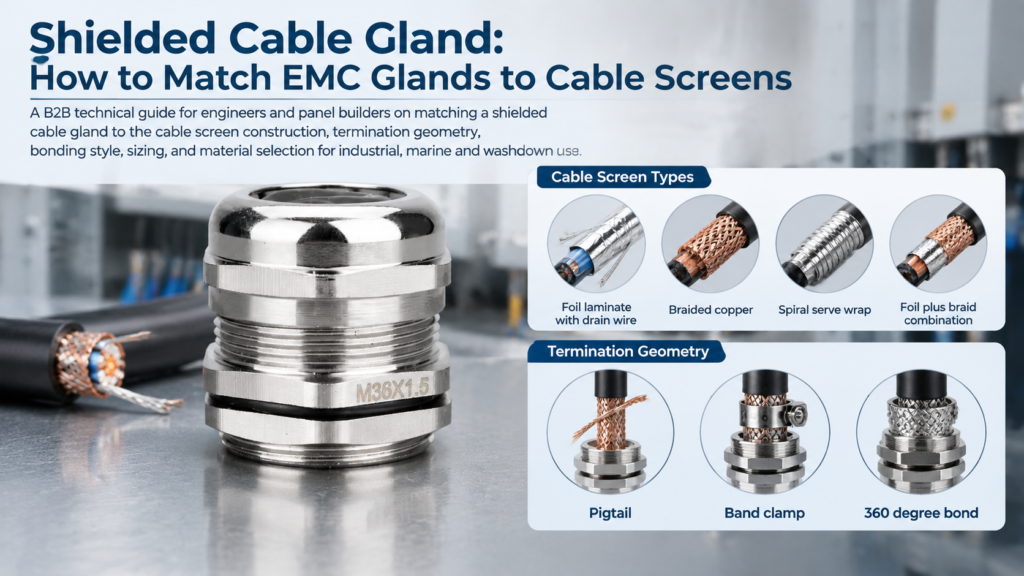
Match an EMC cable gland to the cable screen: foil, braid, spiral and combination constructions, termination geometry, bonding rules and sizing on jacket OD.
Explore os conectores de prensa-cabos à prova d'água duráveis com classificações IP67 e IP68 em nylon, latão e aço inoxidável para proteção segura do cabo e alívio de tensão.
Usamos cookies para aprimorar sua experiência de navegação, veicular anúncios ou conteúdos personalizados e analisar nosso tráfego. Ao clicar em "Aceitar tudo", você concorda com o nosso uso de cookies.