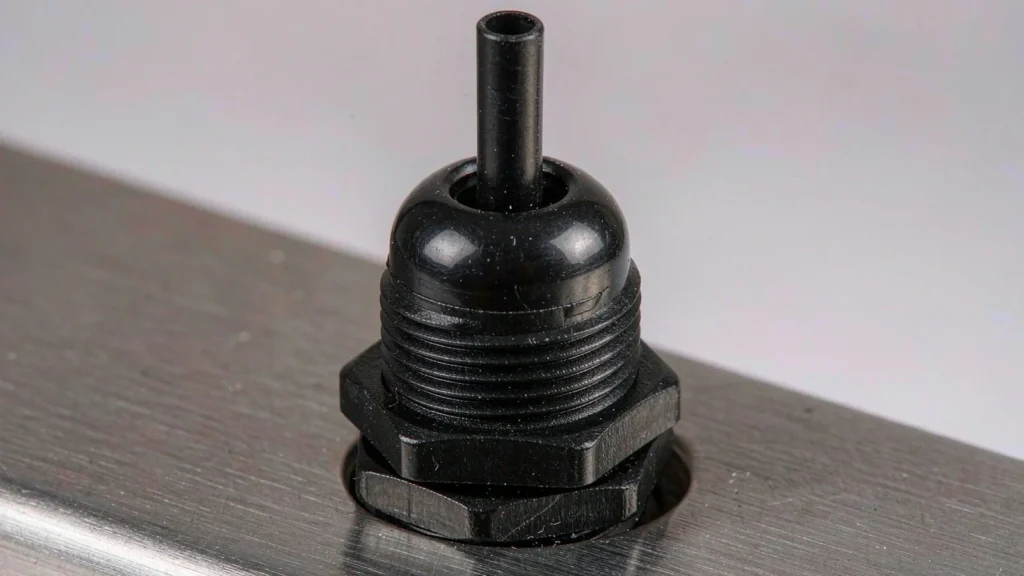
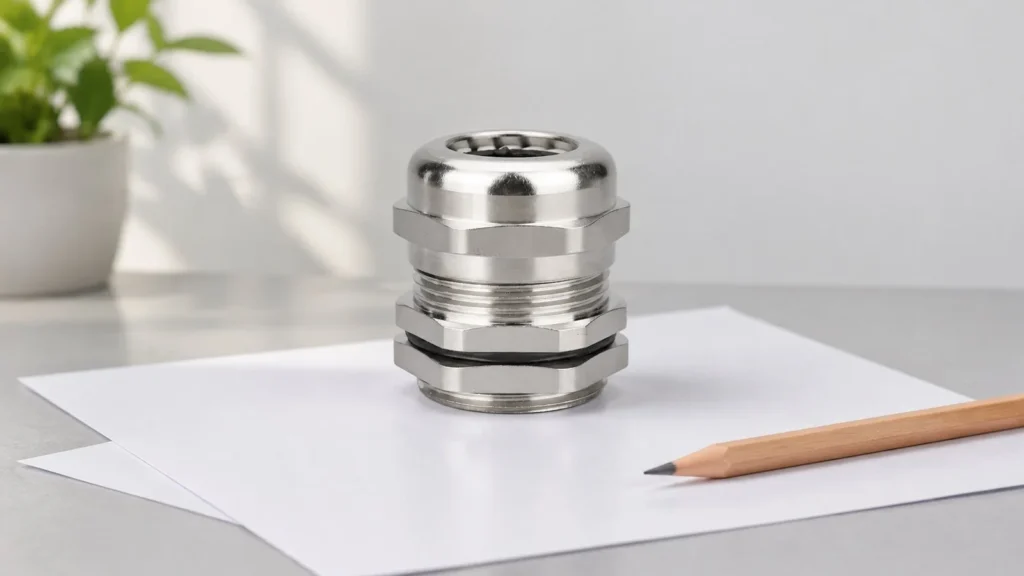
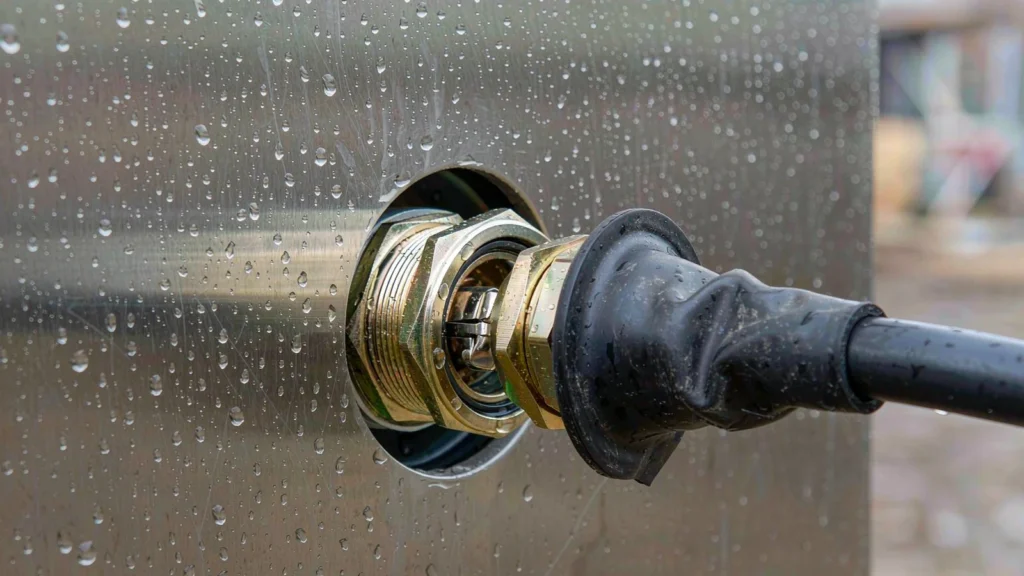
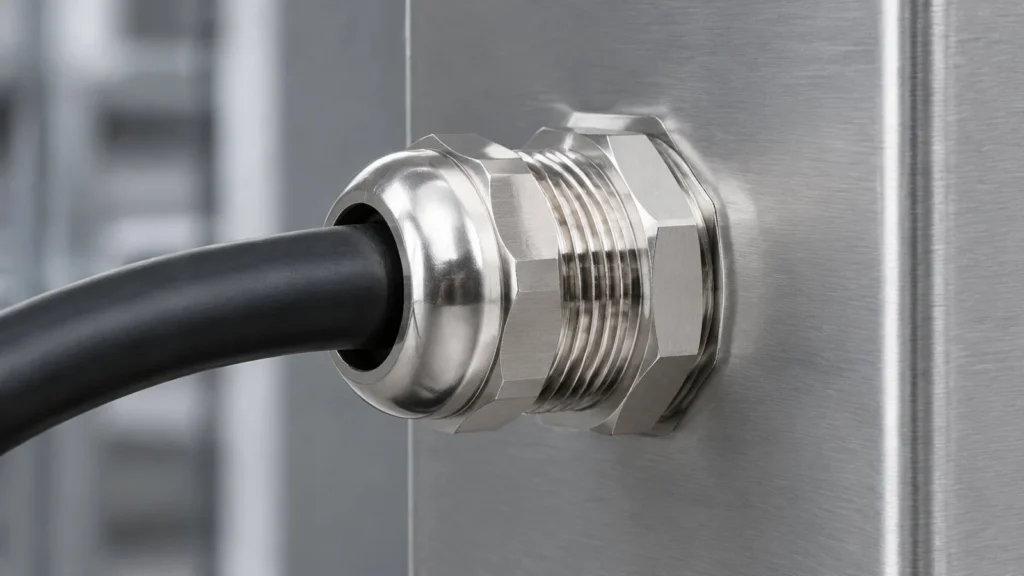
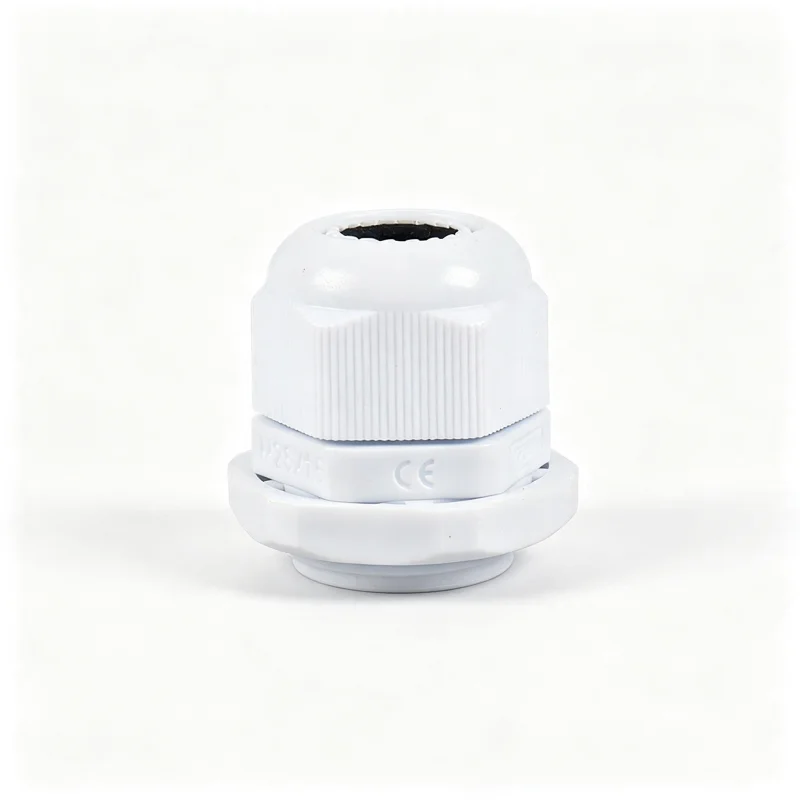
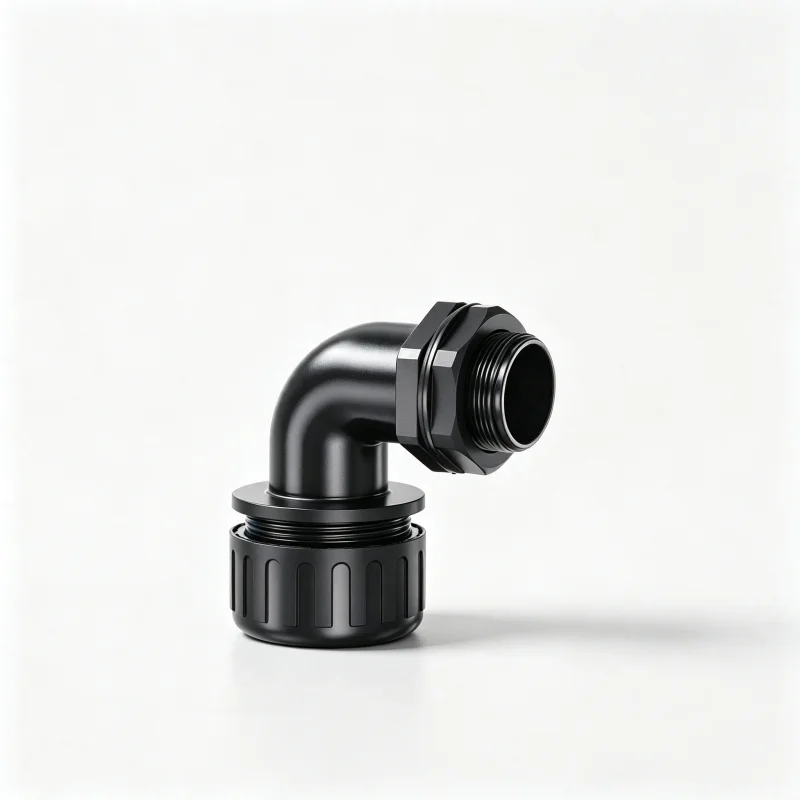
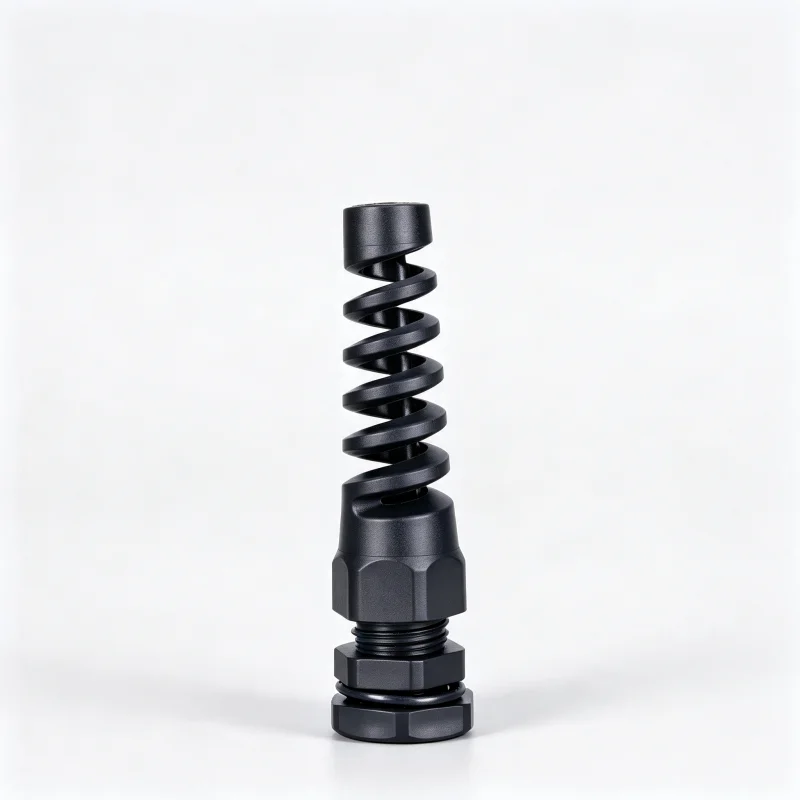
A grommet and a cable gland both fill a hole in a panel, and both keep a sharp sheet edge off a cable jacket. That is the whole of the overlap. A grommet is a moulded rubber ring with a free bore; a gland is a threaded assembly that clamps the cable and seals against the panel. One protects the cable from the metal. The other joins the cable to the metal, and keeps what is on one side from reaching the other.
The two parts differ by roughly an order of magnitude in price, which is why the cheaper one gets substituted on drawings written for the dearer one. What follows separates them by function: the four jobs an entry has to do, which of those a grommet performs, the arithmetic at the hole, and the cases where a grommet is the correct choice.
What a Grommet Does
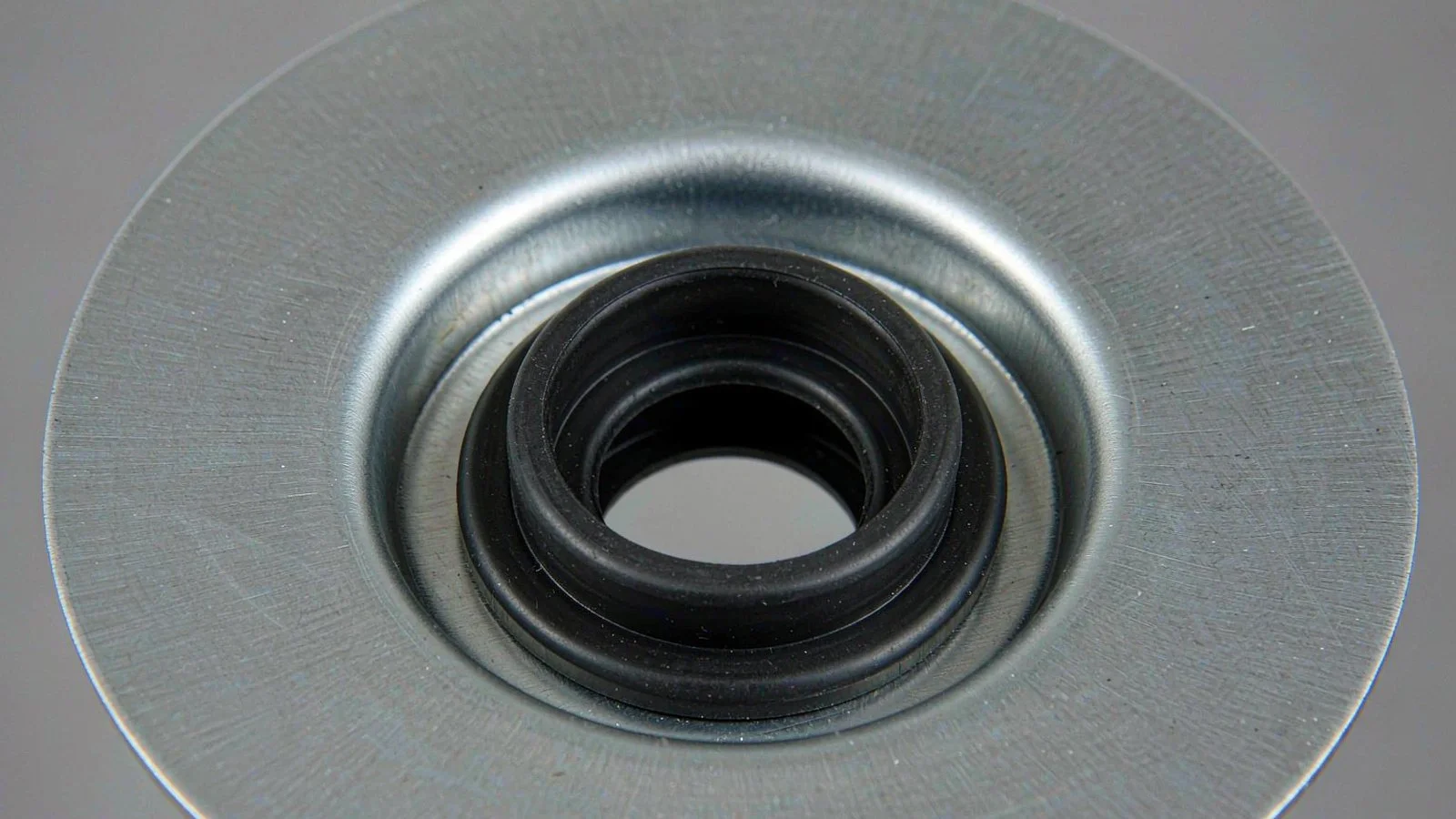
A grommet is specified by two numbers: the hole it fits and the panel thickness it grips. A groove moulded around its outside straddles the sheet edge, and the inner bore is left open, because the bore has to be large enough to admit the cable in the first place.
That free bore is the whole story. There is no compression on the jacket, no grip on the jacket, and no metal-to-metal contact with the panel. The grommet holds its own position and does nothing else.
The tell is on the datasheet. A gland carries a cable range, because it grips the cable across a stated span of diameters. A grommet carries a hole diameter and a panel thickness range and no cable range at all. If there is no cable range on the sheet, the part is not holding the cable.
A grommet in its only working position: the outer groove straddles the sheet, and the bore stays open around the cable.
The Four Functions of a Cable Entry
Every entry, whatever it looks like, is being asked to do four separate things. Scored against that list a grommet returns one out of four, and the three it misses are the three that usually matter.
الوظيفة
What it means physically
Grommet
Gland
Edge protection
Keeps the sheet edge off the jacket
Yes, this is the design purpose
Yes, as a side effect of the body
Ingress sealing
Compresses an elastomer against the sheath and the panel face
No, the bore is clearance
Yes, insert plus washer
Retention
Holds the cable so pull does not reach the terminals
No, the cable slides
Yes, the insert clamp
Bonding
Carries fault current or screen current to the panel
No, rubber is an insulator
Yes, metal body and earth tag
The first row is the only one a grommet was designed for, and it does that job well. The mistake is not that a grommet is a poor gland. It is using one where the other three rows were the point.
Sealing Without Compression
An IP rating is not a property of a part. It is the result of a test on an assembly, and inside a gland the seal works by squeezing an elastomer insert onto the sheath with a dome nut. The cable range is the span of diameters over which that squeeze lands between too little and too much. Below the range there is not enough compression; above it the insert cannot close and the dome nut will not seat.
A grommet has no link in that chain. The bore is larger than the cable by design, so an annular gap runs from the outside face straight through to the inside. Water does not have to defeat anything; it only has to run downhill into the gap.
There is a second interface as well. A gland seals to the panel with a washer clamped between the body shoulder and the panel face. A grommet’s groove holds the sheet but applies no axial compression, so that joint is a contact, not a seal. An enclosure keeps its rating only up to its weakest entry, which is the argument in the enclosure cable entry guide: one grommet in a row of glands spoils the box. When an entry does leak, the first question in the leak fault tree is whether it was ever a sealed type.
Retention and Pull-Out
Retention comes from two mechanisms together: friction from the compressed seal, and a mechanical clamp on the jacket. A gland has both, and the dome nut is what converts spanner torque into clamp load on the insert.
A grommet has neither. Pull the cable and it slides through the bore until something else takes the load, normally a terminal screw or a connector backshell never designed as a strain relief. The site test is simple: pull at the entry and watch whether anything moves at the terminal. If it moves, the entry is not doing the job, and the strain relief guide sets out the three proper fixes.
This is where a grommet gets misread on moving equipment. It lets the cable slide, which is right where sliding is intended and wrong where the design needs the cable held. Both requirements look identical on a drawing and are opposite in service.
Bonding and Armoured Cable
A metal enclosure has to be bonded, and the cable entry is one route that bonding can take. A gland body is a metal column through the panel, and with an earth tag or a toothed washer it makes the connection deliberately. The دليل التأريض والتوصيل shows where the tag sits, because outside the shoulder and inside the locknut both work and between the washer and the panel face does not.
A rubber grommet interrupts the path completely. Where the panel is part of the protective conductor arrangement, a grommet entry leaves the cable armour or screen floating and the fault current has to find another route.
With armoured cable the discussion ends before cost is mentioned, because a gland terminates the armour and a grommet cannot begin to. The same goes for screened cable in an EMC installation, where a 360 degree contact is the requirement and an insulating ring is its opposite.
Hole Size and Panel Thickness
The hole arithmetic is shared, which is why substitution seems easy. On our brass and stainless ranges the panel hole runs 0.2 mm over the thread outside diameter, so M20 takes 20.0 to 20.2 mm. On the nylon range the allowance is 0.3 mm, so N-M20 takes 20.2 to 20.5 mm. Full charts are in the جدول أحجام الثقوب, and the per-size nylon figures sit alongside the cable ranges in the جدول مقاسات غدة الكابلات النايلون.
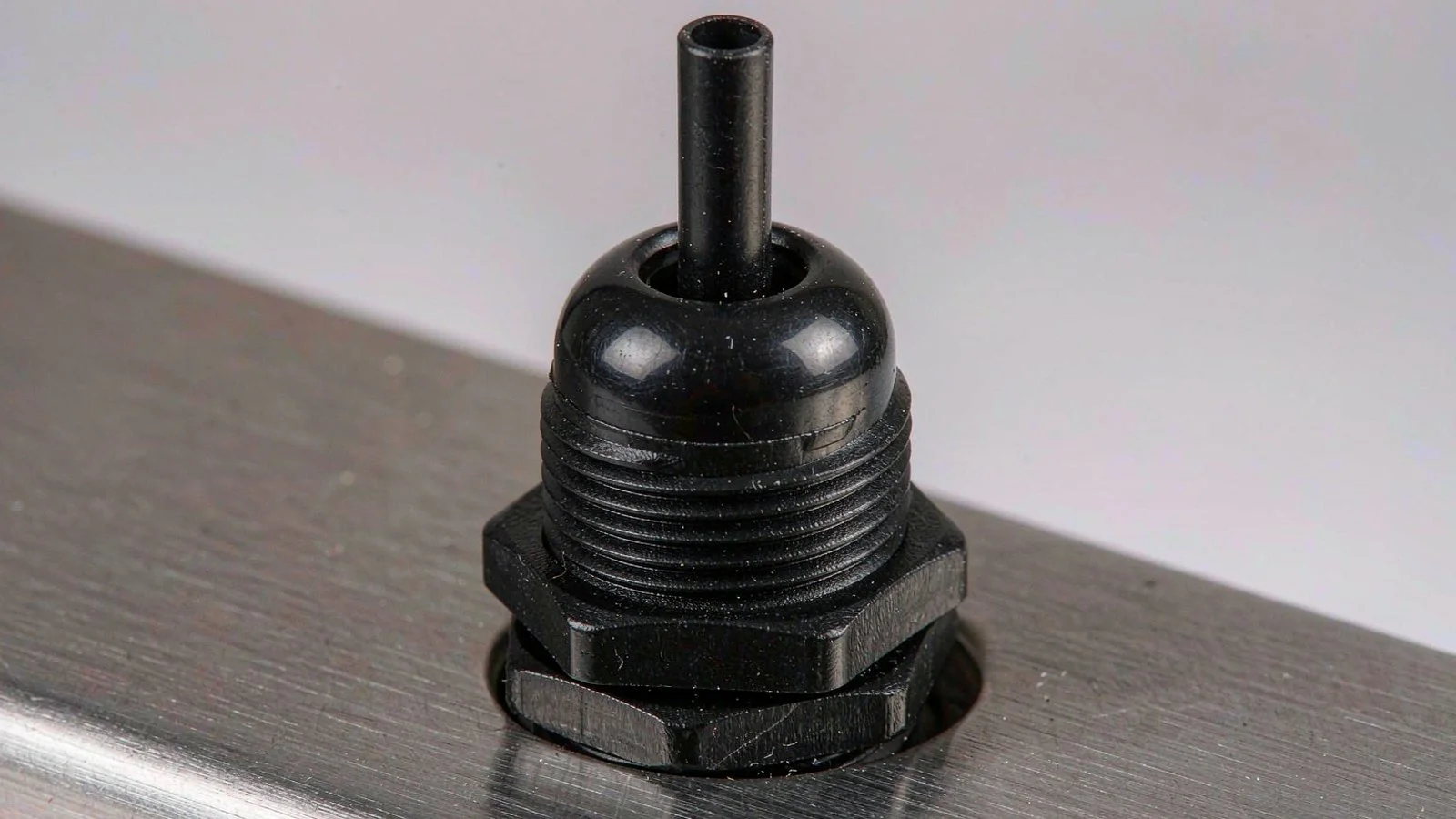
What the same hole buys when a gland takes it: thread through the wall, a washer against the panel face, and a locknut underneath.
The divergence appears below the panel. A gland needs thread length to cross the wall, then the washer, then the locknut, then two threads proud of the nut. On brass that budget runs 7 mm at M14 to 13 mm at M63; on nylon, 9 mm at M12 to 29 mm at the largest sizes. Thin sheet is easy for a gland and awkward for a grommet, whose groove is moulded for a range of gauges, so a 0.8 mm lid can sit loose in a groove meant for 1.5 to 3 mm plate. Thick plate is the reverse, and the routes out of a short thread are covered in the long thread cable gland مقال.
Grommet Materials and Temperature
Most grommets are moulded in one of four compounds, and the choice follows what the rubber must survive rather than what the cable carries.
Compound
Handles
Fails on
EPDM
Water, steam, ozone, weather
Mineral oil and fuel, which swell it
إن بي آر
Oils, fuels, grease
Ozone and long UV exposure
Polychloroprene
Weather with moderate oil
Concentrated acids and ketones
سيليكون
Widest temperature span
Mechanical wear and tear strength
The procurement difference is larger than the chemistry. A grommet bought as a commodity item usually arrives with no material certificate, no temperature rating and no UV statement, and black rubber is not automatically UV stabilised. A gland’s seal compound appears on its datasheet, which is what lets a buyer put a temperature and a chemical exposure into a specification at all.
Where a Grommet Is the Right Answer
Service condition
Grommet acceptable
What the entry must do instead
Dry cabinet interior, static signal cable
نعم
Edge protection only, no sealing duty
Panel that is not an enclosure boundary
نعم
Passing between two internal compartments
Outdoor or rain-exposed enclosure
لا يوجد
Sealed entry with a stated IP rating
Washdown or hose-directed cleaning
لا يوجد
Sealed entry with jet-rated protection
Immersion or tank entry
لا يوجد
Sealed entry with published depth and time
Vibration, or a cable pulled in service
لا يوجد
Clamped entry that holds the jacket
Armoured or screened cable
لا يوجد
Metal entry that terminates the armour
Metal enclosure requiring bonding
لا يوجد
Metal entry with a bonding path
The rule that resolves the table is short. If the panel is part of the enclosure’s IP boundary, the entry has to be a gland. If the panel is only a divider, a grommet is a legitimate and cheaper answer.
Cost per Thousand Entries
The unit gap is real. Our standard glands run 0.08 to 1.20 USD per piece at 1,000 pieces per size, and a commodity rubber grommet of comparable diameter costs a fraction of the bottom of that band.
Cost line
Grommet
Gland
Unit price at 1,000 pieces
Cents
0.08 to 1.20 USD, size dependent
Hole preparation
Same punch or drill
Same punch or drill
Installation time
Push in
Thread, washer, locknut, torque
Verification
None available
Torque and continuity can be checked
Failure exposure
The whole enclosure rating
Confined to the entry
Saving the unit price is only a saving where the entry had no sealing duty. Where it did, the difference across a thousand entries is smaller than one wet cabinet, one re-termination, or one failed inspection at commissioning.
الأسئلة الشائعة
Can a grommet be sealed with silicone around the cable?
Not in any assembly that will be inspected or has to stay sealed. Sealant over a clearance gap has no controlled compression, no defined bond length and no way to be verified, and it makes the entry unserviceable. It is also the first thing an inspector looks for.
Is a grommet enough for an outdoor junction box?
Only if it is not in the enclosure boundary. On a box carrying an IP rating every entry has to be a sealed type, because the rating belongs to the assembly and not to the lid.
Do I need a gland if the cable is never pulled?
Pull is one of four functions. If the panel is a boundary, the enclosure is metal and needs bonding, or the cable is armoured, the answer is still a gland. Retention being unnecessary does not make the other three unnecessary.
Can a gland go into a hole that already has a grommet?
Often yes, and it is the cheapest upgrade on an existing panel. Measure the actual hole rather than trusting the nominal size: a hole cut for a grommet is frequently a few tenths larger and may need the next size up or a washer that covers the gap.
What is a split grommet for?
Retrofitting an existing cable without disconnecting it. It is still an edge bush, with an open bore and a second leak path at the split. Use it where the panel is a divider, not where it is a boundary.
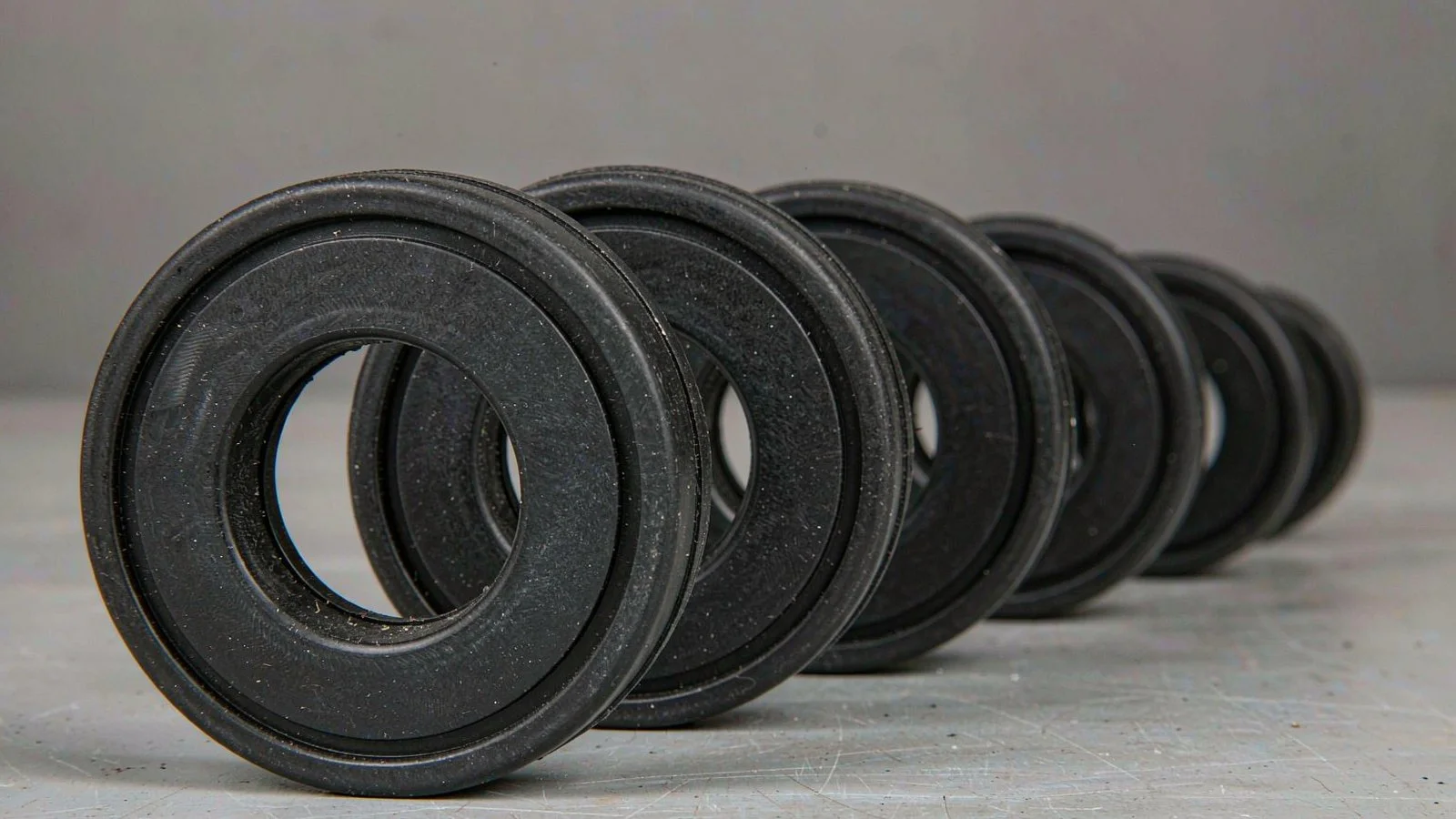
The groove that straddles the sheet edge is moulded for a range of panel gauges, so one grommet cannot serve both a thin lid and a thick plate.
تجيب المعايير EN 50262 وIEC 62444 وIEC 60529 على ثلاثة أسئلة مختلفة، وقد تم سحب أحدها. ما الذي يغطيه كل معيار، وأين ينتهي نطاقه، وما الذي تتطلبه المواصفات.
قد لا يتناسب الغلاف مع المكان المخصص له لسبب واحد: وهو مقارنة التجويف مع الخيط أو الكابل بدلاً من المقاس السداسي عند زواياه. الحجم، والمواد، والغلاف القابل للانكماش الحراري مقابل الغلاف القابل للتركيب بالضغط، وحالات التي يؤدي فيها الغلاف إلى تفاقم مشكلة الدخول.
The half inch is a nominal pipe size, not the thread. A 1/2 inch NPT gland measures 21.34 mm, needs a 21.5 mm clearance hole or a tapped entry, and gets its cable range from the insert rather than the thread.
نحن نستخدم ملفات تعريف الارتباط لتحسين تجربة التصفح الخاصة بك، وعرض إعلانات أو محتوى مخصص، وتحليل حركة المرور لدينا. بالنقر على "قبول الكل"، فإنك توافق على استخدامنا لملفات تعريف الارتباط.