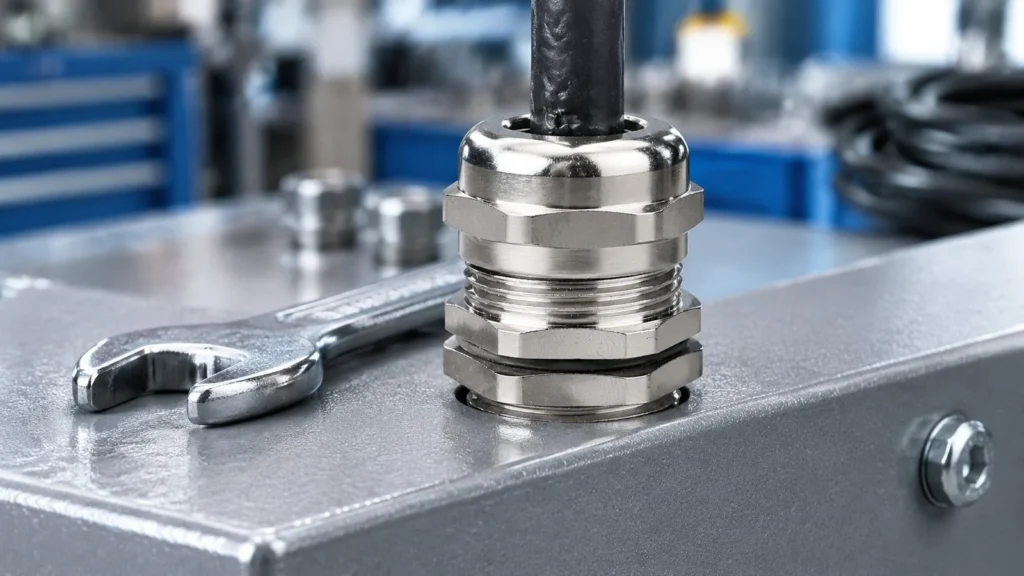
A gland that spends its working life under water is specified by two numbers a weatherproof gland never needs: how deep, and for how long. Everything else — body material, seal compound, insert geometry — follows from those two answers, and without them “submersible” is only a word on a drawing. This guide covers what IP68 commits a supplier to, how depth becomes pressure at the gland, why submerged entries seep slowly instead of failing at commissioning, and what decides whether the rating survives contact with a wet well. The sizes come from the nylon cable gland range that covers most pump and tank entries below 18 mm.
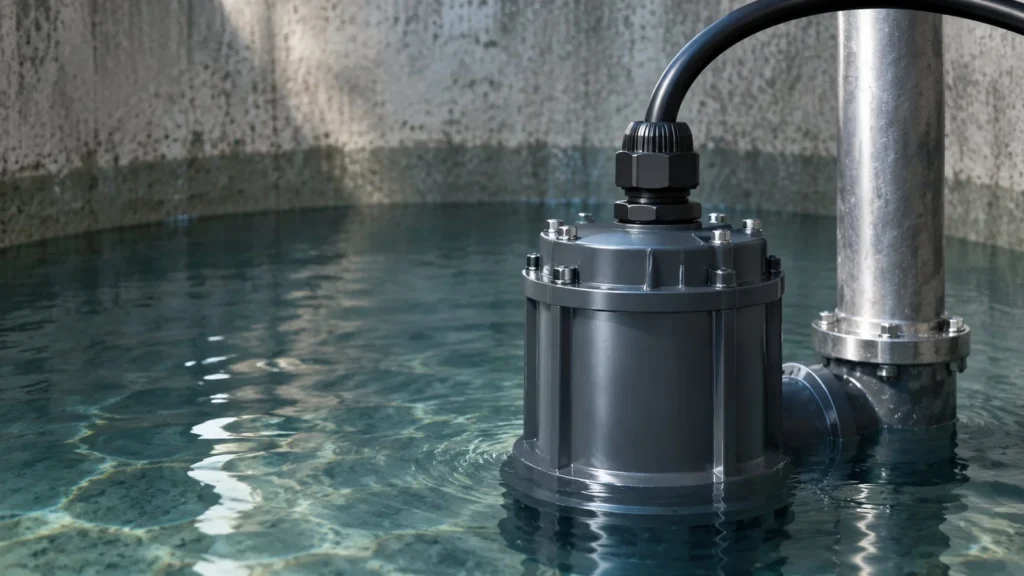
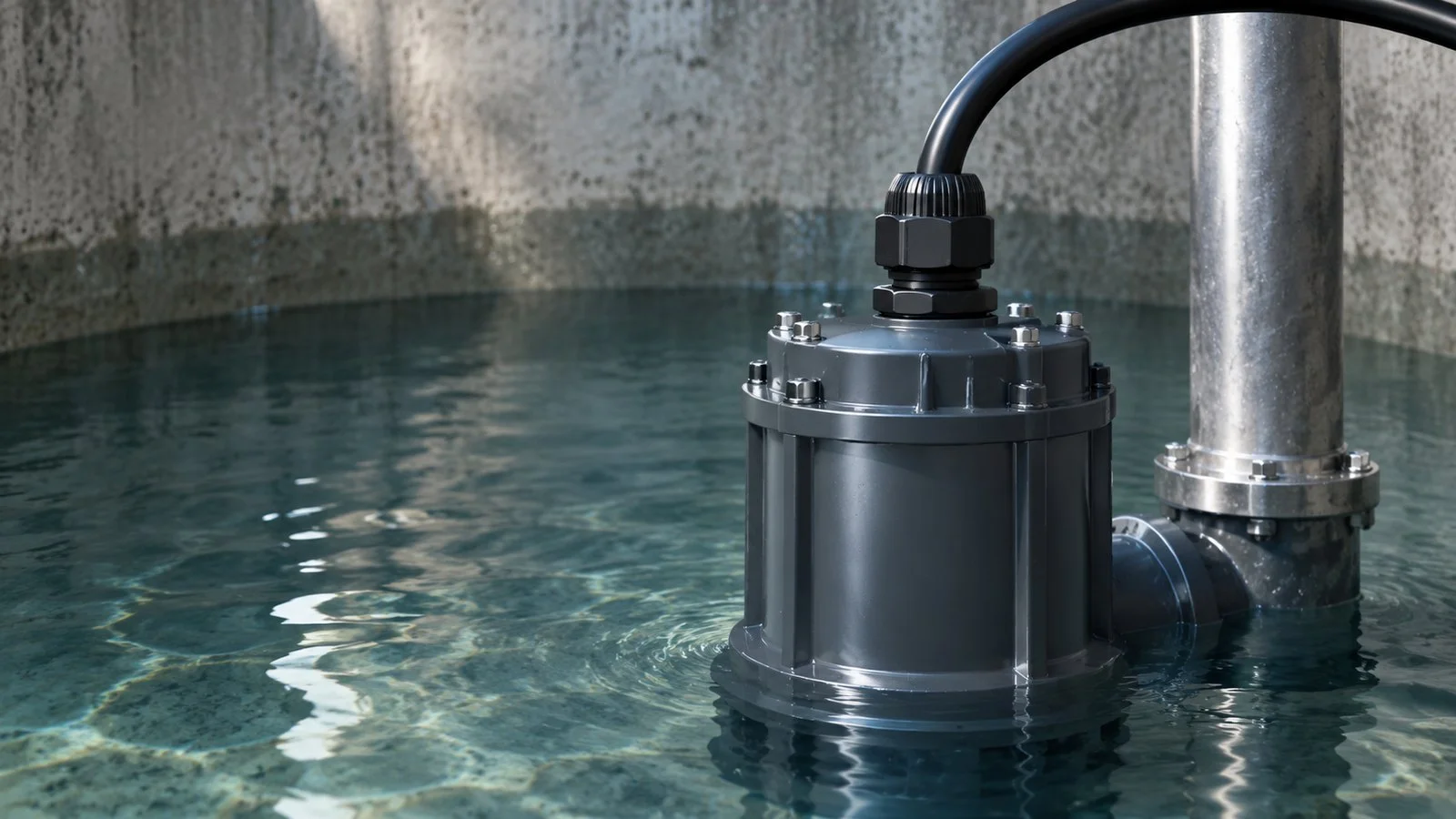
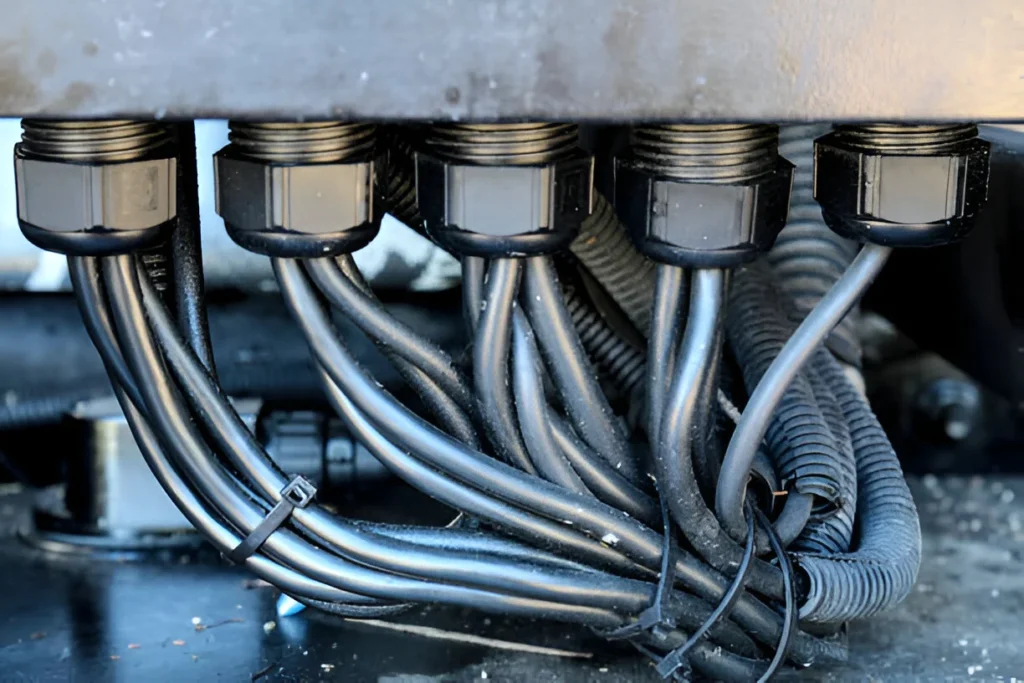
A submersible pump entry. The gland is the only part of the assembly that has to be watertight in both directions and stay that way for years.
Immersion Is a Different Load From Weather
A gland on an outdoor enclosure is tested by water hitting it from outside for a few minutes. A submerged gland sits in water that presses from every direction, continuously, for months. The direction reverses and the duration changes by orders of magnitude, so the mechanism changes too: a jet is stopped at the sealing lip, while an immersion has to be resisted by the whole assembly, including the thread, the washer and the interface with the wall.
That is why a gland with a long IP66 record can still seep at two metres. IP66 is a statement about jets; it says nothing about how a seal behaves after a week under a static head.
IP68 Is a Placeholder Until Someone Writes a Depth and a Time
In IEC 60529 the second digit 8 means continuous immersion, and the conditions are agreed between manufacturer and user. The standard fixes no depth. Two glands can both carry an IP68 label having been tested to conditions a factor of ten apart, so the useful question is not “is it IP68” but “which depth, for which duration, against which report”.
Most submersible pumps and tanks; the usual baseline
Extended
5 m for 72 hours
Marine, tunnel drainage, deep sumps and longer dwell
Custom
10 m for 168 hours
Offshore and pressure vessels; quoted per order with a report
The band you need is set by the worst case in service, not the average. A tank that normally holds half a metre but fills to three metres during washdown needs the extended band, because the seal cannot tell a process level from a cleaning level.
Depth Into Pressure, Pressure Into Time
Water adds roughly 1 bar for every 10 m of depth, so a gland 4 m below the surface sees about 0.4 bar above atmosphere and a 30 m outfall sees about 3 bar. Those numbers look small next to a pressure washer, and they are. Pressure is usually not what fails a submerged gland. Time is.
Depth at the entry
Gauge pressure
Typical situation
What actually tests the seal
0.5 m
0.05 bar
Pump top in a wet well
Capillary wicking along the jacket, not pressure
2 m
0.2 bar
Submerged pump, flooded tank
Holding compression for days without recovery
5 m
0.5 bar
Deep sump, tunnel drainage
Holding for weeks at a fixed deflection
10 m
1 bar
Tank bottom entry, outfall
Resisting extrusion at the edge of the insert
A datasheet line such as “IP68 to 10 bar” is a pressure statement, not an immersion result: it describes what the geometry can take, not how long. Only a report quoting a depth and a duration answers the question a pump actually asks.
Why Long Dwell Fails: Compression Set, Not a Hole
An elastomer seal works by being squeezed. Hold it squeezed at a fixed deflection for weeks in warm water and it gradually stops pushing back. That is compression set, and the gland has not developed a leak path — it has lost the force that closed the path. The part that failed looks intact when it is removed, which is why these entries are so often re-tightened instead of repaired.
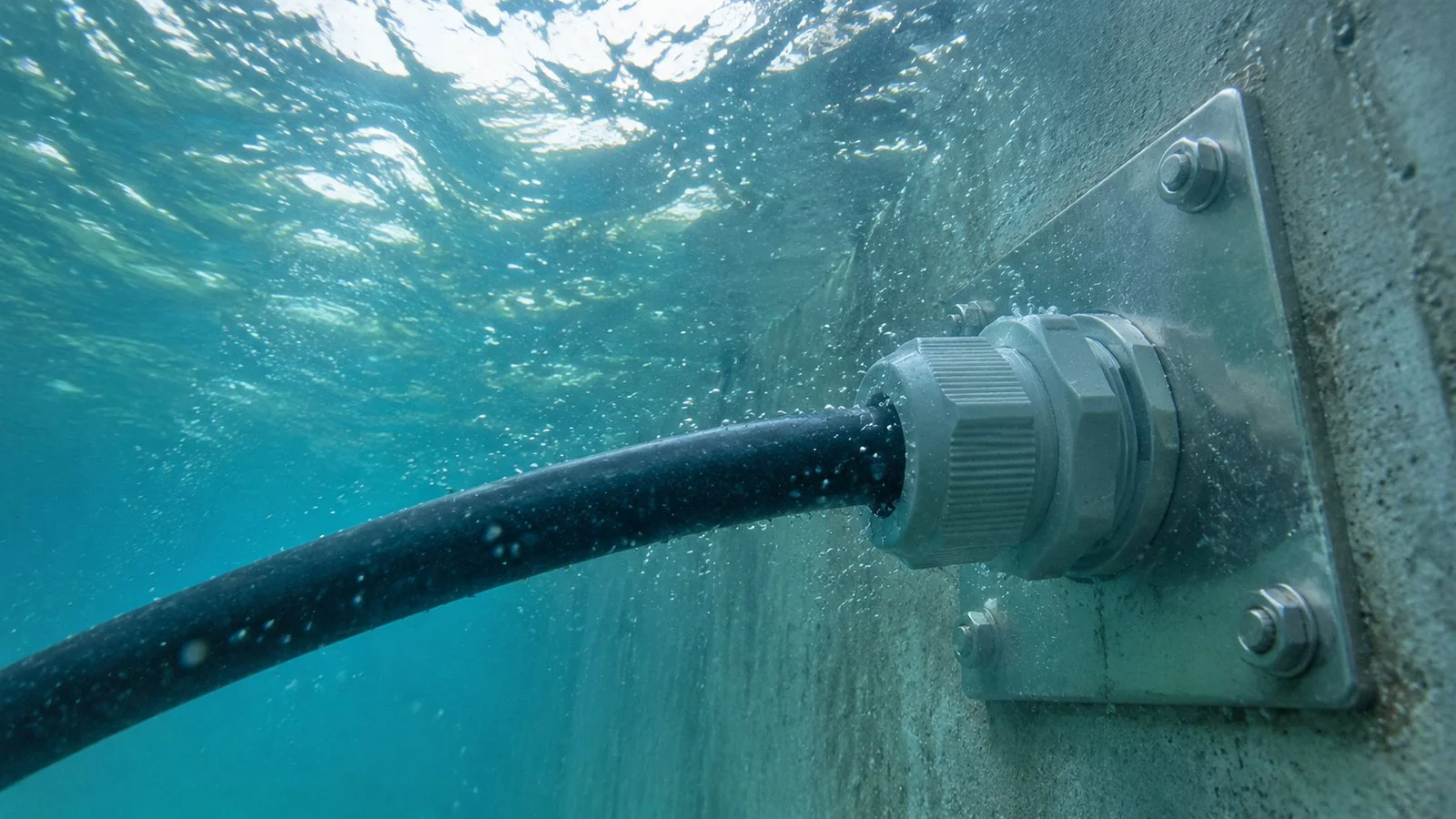
An entry below the water line is loaded from outside in, at every point at once. The seal has to hold that load while the jacket slowly creeps under the clamp.
That is why the symptom is slow: water arrives as a film rather than a puddle, usually after the first hot season, because heat accelerates set. It is also why replacing the insert alone often fails — if the cable is still hanging on the entry, the new seal goes back under the same deflection.
Two conditions make set worse and are easy to check before ordering: water above about 60 °C shortens the life of any standard compound, and a level that empties and refills works the seal in a way a static head does not.
Pumps: The Cable Is a Load Path
On a submersible pump the cable leaves the top of the motor housing and runs up the riser. Its weight is carried by whatever holds it, and the gland is not that thing. A gland clamps so the cable cannot be pulled out of the terminal box, and seals so water cannot follow it in. Ask it to hang fifteen metres of cable as well and it will lose both jobs, slowly and in that order.
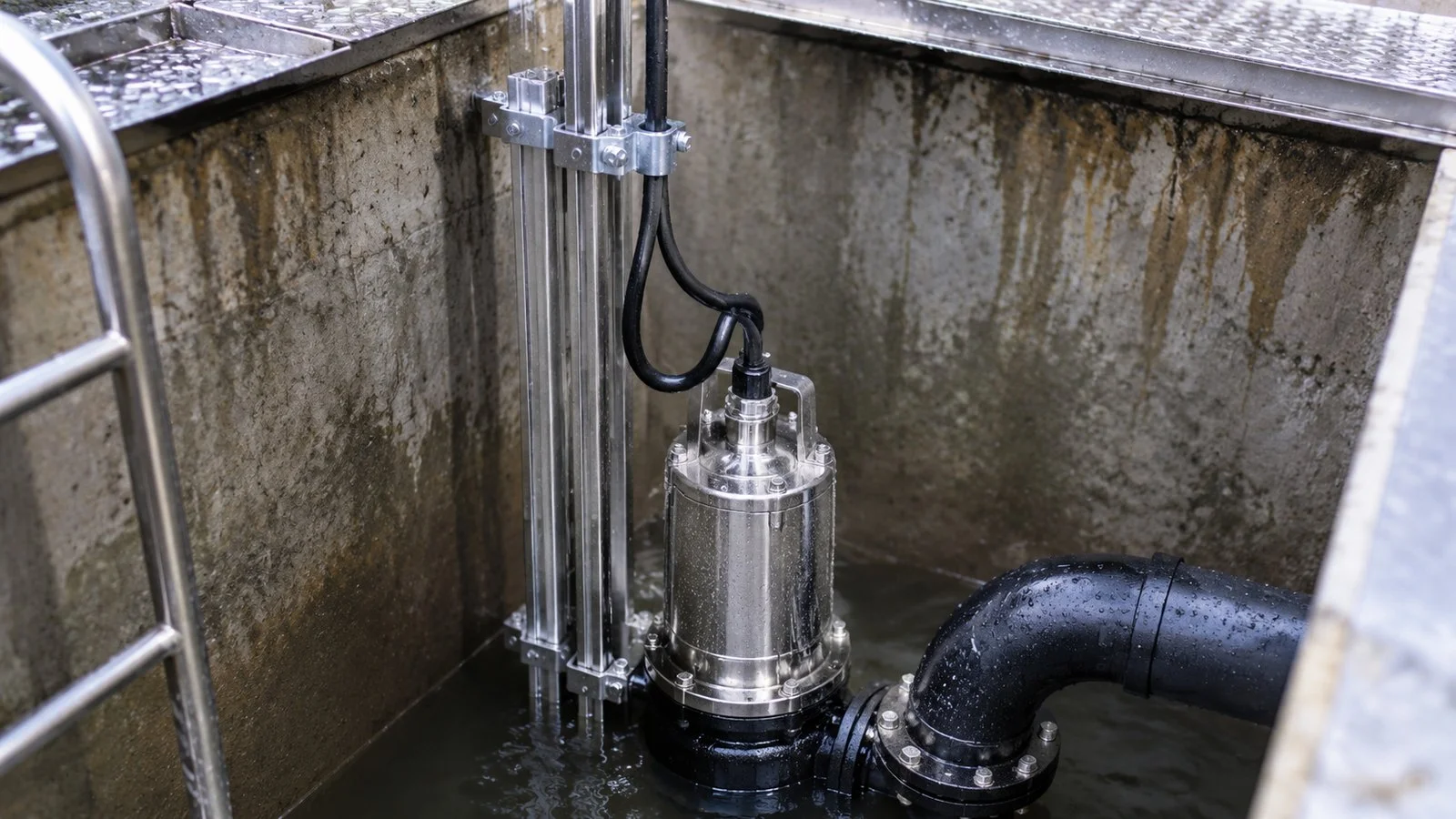
The weight is taken by a grip above the pump, and the cable drops into a loop before it enters the gland so water runs off rather than standing at the fitting.
The fix is mechanical rather than a better gland. A grip takes the weight a short distance above the pump, and the cable gets a drip loop before the entry so water runs off instead of standing in the fitting. The same division of labour governs strain relief on any gland, with a heavier cable and a worse consequence when it is ignored. Pump vibration adds a second load at the same point.
Pump cable is also awkward for a generic gland: the jacket is thick, hard and often slightly oval. Measure it rather than assuming the size that suits the terminal box suits the entry.
Tanks and Vessels: Where the Water Sits Relative to the Entry
The position of the entry sets the head it sees. A gland at the bottom of a tank carries the full depth all the time; a side entry near the normal level sees the level cycle; a top entry sees splash only, until somebody overfills the tank. Where the vessel can be filled above the entry during cleaning, design for the cleaning level, not the process level.
Top entries have the opposite problem. An enclosure sealed against immersion also traps vapour, and condensation forms on the inside face, where it looks exactly like a leaking gland. A breather or drain is a separate decision from the gland rating.
Wet Wells and Sump Pits: The Water Is Not Clean
A wet well is the hardest of the three cases because the water is a suspension. Grit abrades the jacket where it enters the seal, fats hold a film against the washer, and hydrogen sulphide from septic sewage attacks any copper alloy in the fitting — first as a black tarnish, then as the dezincification that turns brass brittle and porous. Choosing the body material is therefore part of the sealing decision, not a separate purchasing question.
Body material
In permanent immersion
Where it stops
PA66 nylon
No metal to corrode, good in fresh and waste water, lowest cost
Softens with heat, hex yields under torque, not for hot effluent
نحاس مطلي بالنيكل
Best thread life and retention force
The plating is the only barrier; sulphides and chlorides reach the brass at any break
Stainless 316
Handles sulphides and chlorides without a coating to lose
Cost, and it still depends on the right seal compound
The cycling level is the other half of the problem. Every fill and empty cycle makes the seal recover and re-compress, which is what a compressed elastomer cannot do indefinitely: a pit cycling ten times a day ages an entry far faster than a full tank that never moves.
The Installation Details That Decide Whether the Rating Holds
Seal on the jacket, not on the cores. The insert has to sit where the sheath is still continuous, and the strip length decides whether that happens.
Engage the full thread through the wall, with the locknut bearing on bare metal rather than on a paint film.
Fit round cable only. An oval or twisted cable leaves a gap that no amount of tightening closes.
Keep hydrocarbon and silicone grease away from EPDM seals, which swell in both. If a lubricant is needed, use the one the seal supplier names.
Re-check the gland after the first fill-and-empty cycle, not on a calendar date.
Then prove it. An entry accepted because it “looks tight” has no evidence behind it, and a submerged failure stays invisible until the enclosure is opened. Record the depth, the duration and the test applied.
What to Put in the Enquiry
Six lines turn a submersible enquiry into a specific part instead of a range of options.
Item
What to state
What it selects
Depth and dwell
Worst case in metres and hours
Which IP68 band applies
Water
Fresh, waste, chlorinated or saline, plus temperature
Body material and seal compound
Cable
Measured jacket diameter at three points, and whether it is round
Size and insert
Entry
Wall material and thickness, tapped or plain hole
Thread length and accessories
Load
Whether the cable weight is supported elsewhere
Grip, drip loop, strain relief
Cycles
Static level or cycling level
Warning on compression set and service life
The seal compound is worth a separate question, because it is the part that decides how long the entry lasts. The comparison between EPDM, NBR and silicone, and what each one does in water, is set out in cable gland seal materials. What IP66, IP67 and IP68 each promise, and how the grades are tested, is covered in how to choose the right IP rating, and the six components that make up the assembly are described in the six key components of a waterproof gland. Standard moulded sizes are in the nylon gland range, and where the cable has to move as well as stay dry, in the flexible nylon gland.
الأسئلة المتداولة
What is a submersible cable gland?
A cable entry designed to stay sealed with water on the outside for a defined depth and duration, rather than against rain or jets. The depth and duration are part of the specification, not an optional extra.
Is IP68 the same as submersible?
Not by itself. IP68 means continuous immersion under conditions agreed between manufacturer and user, so the label carries no depth. A pump entry usually needs a stated depth and a stated duration, plus the report that proves them.
How deep can a submersible cable gland go?
It depends on the band the gland was tested to: commonly 2 m for 24 hours, with extended options at 5 m for 72 hours and custom versions to 10 m for 168 hours. Depth without a duration is only half an answer.
Can I use a standard waterproof gland under water?
Only where the immersion is shallow and brief. A gland rated for jets keeps water out of a splash but has not been tested for days under a static head, and compression set gives no visible warning before it seeps.
Why does a submersible gland leak after a few months?
Usually compression set in the insert, often accelerated by the cable’s weight hanging on the entry and by warm water. The seal looks intact when it is removed. Support the cable, replace the insert, and verify the entry under the same depth it will see in service.
عندما يتعلق الأمر بحماية التوصيلات الكهربائية، فإن اختيار غدة الكابلات المقاومة للماء المناسبة أمر بالغ الأهمية. تضمن هذه المكونات الصغيرة والقوية في نفس الوقت بقاء الكابلات آمنة وجافة، حتى في البيئات الصعبة. ولكن مع وجود العديد من المواد المتاحة، خاصةً البلاستيك والمعدن، كيف تقرر؟ ما هي الاختلافات، وأيها يناسب احتياجاتك الخاصة؟ هذا [...].
Loosening has four mechanisms, not one: transverse vibration, thermal cycling, plastic creep and assembly error. Each needs a different fix, and in a hazardous area some fixes are not allowed at all.
A brass waterproof cable gland helps protect cable entries from water, dust, and strain in industrial and marine installations. Learn how to choose the right model, size, and supplier.
نحن نستخدم ملفات تعريف الارتباط لتحسين تجربة التصفح الخاصة بك، وعرض إعلانات أو محتوى مخصص، وتحليل حركة المرور لدينا. بالنقر على "قبول الكل"، فإنك توافق على استخدامنا لملفات تعريف الارتباط.