A PG9 cable gland is what you reach for when the cable is past control-wire size but nowhere near a motor lead: its seal grips anything from 4 mm to 8 mm. That band is also the most crowded one in any catalogue, which is why the size gets ordered wrong. Two metric sizes cover exactly the same 4 mm to 8 mm, and one of them is functionally identical to PG9 apart from a fraction of a millimetre of thread. This guide gives the five numbers that define a PG9 cable gland and explains the two places it fails on site: the mounting hole and the bottom edge of the cable band. Every dimension comes from this range’s published PG series specification.
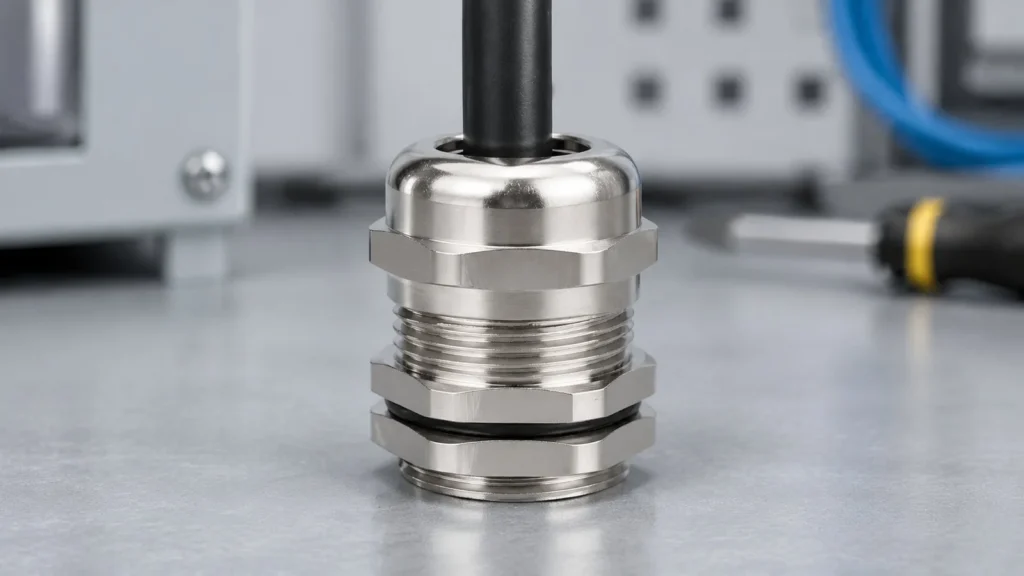
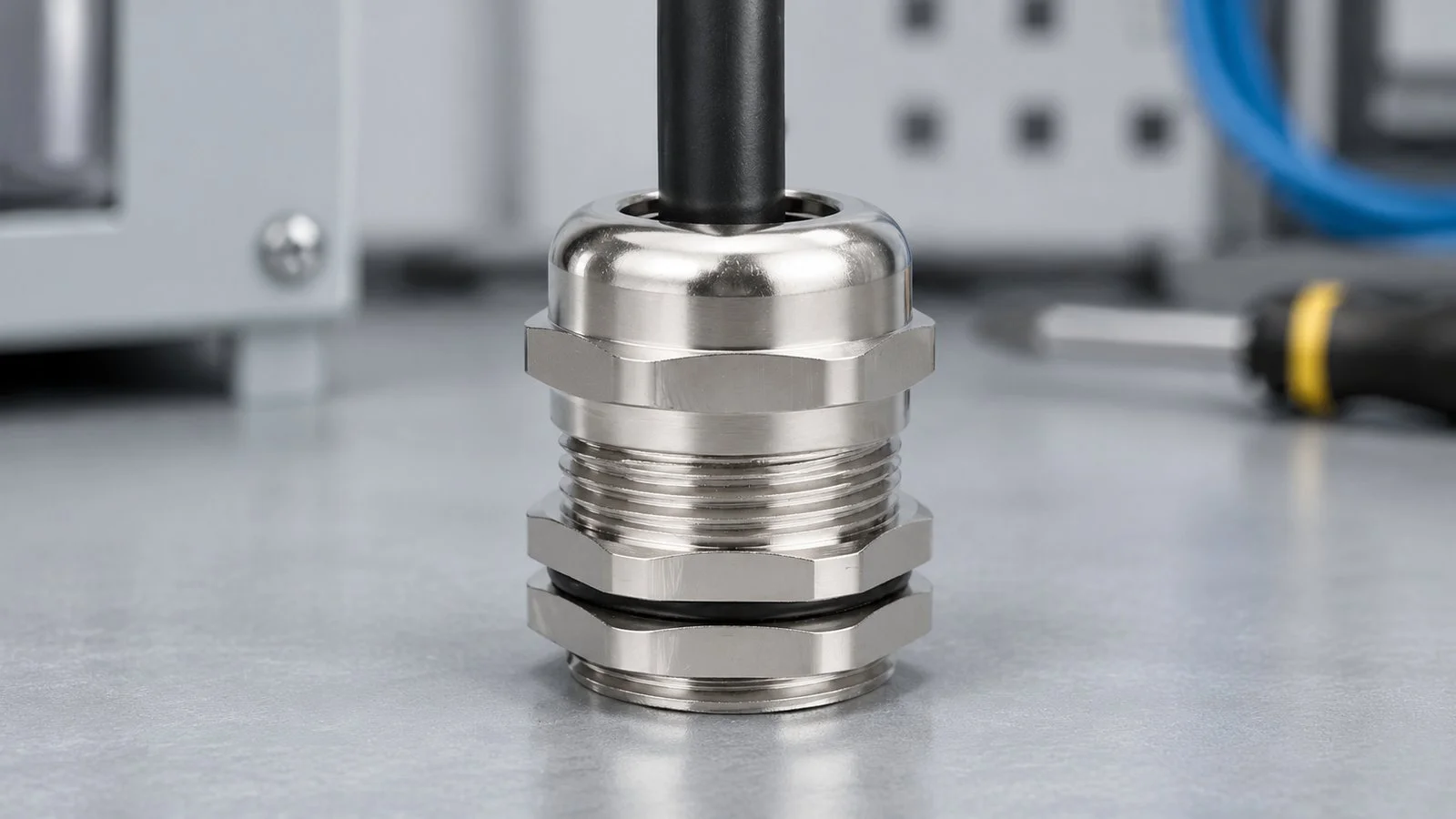
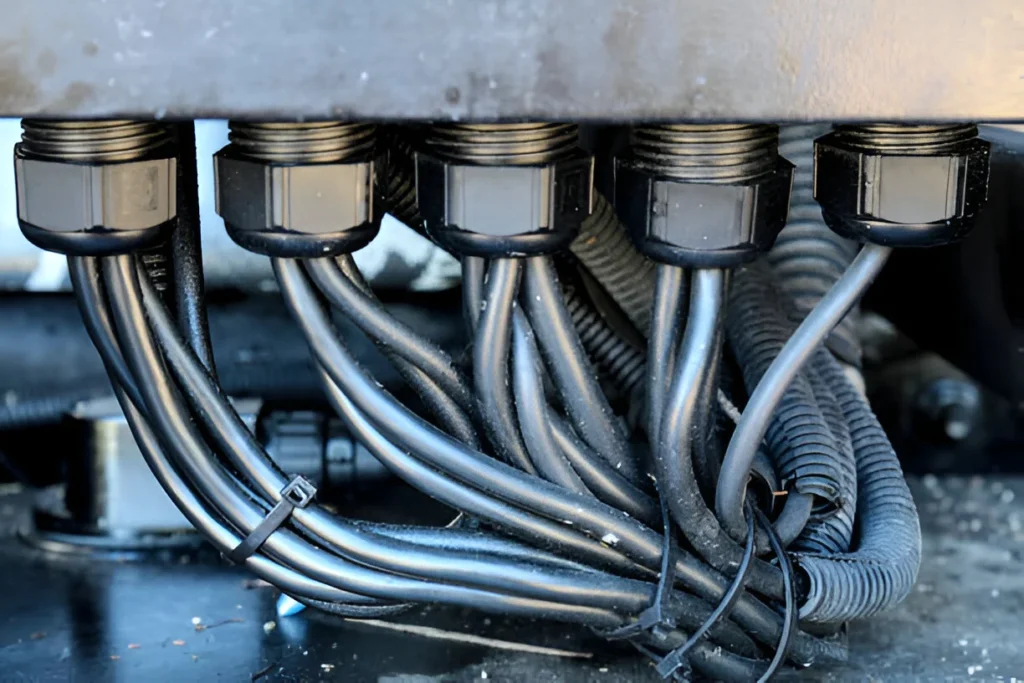
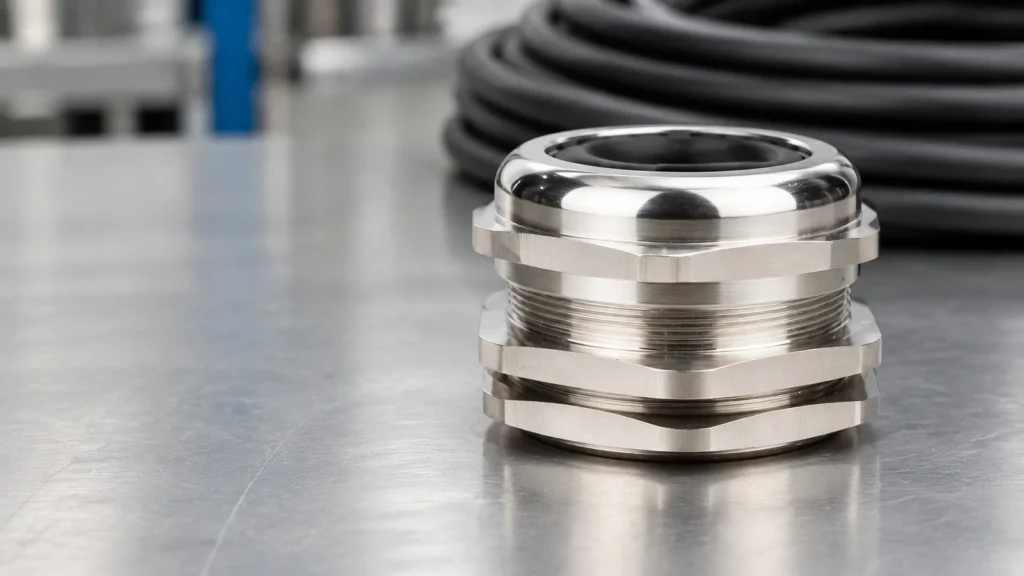
A PG9 body with a 4 mm to 8 mm cable fitted. The size is defined by five numbers, and only one of them relates to the cable.
The Five Numbers Behind “PG9”
The 9 in PG9 is a nominal conduit size, not a dimension you can put a caliper on. The thread outside diameter is 15.2 mm, and the hole it needs is 15.2 mm to 15.4 mm: the thread plus the usual clearance. Those two are what most buyers check, and they are only half the specification.
The remaining three decide whether the gland can be installed at all. Cable range fixes what it seals, thread length decides which wall it passes through, spanner size decides whether you can reach it. Read them in that order.
Dimension
PG9 value
What it constrains
Cable range
4 mm to 8 mm
What the insert can grip and seal; the cable must sit inside it, not on its limit
Thread outside diameter
15.2 mm
Which hole the gland physically enters
Mounting hole
15.2 mm to 15.4 mm
The hole to drill or punch; wider and the washer cannot bridge the gap
Thread length GL
8 mm
Wall thickness plus washer plus locknut has to fit inside it
Spanner size
18 mm across flats
Access for tightening, and the pitch you can use between adjacent entries
Comprimento da ligação
20 mm
Depth needed inside the enclosure behind the wall
Three Threads Share One Cable Band
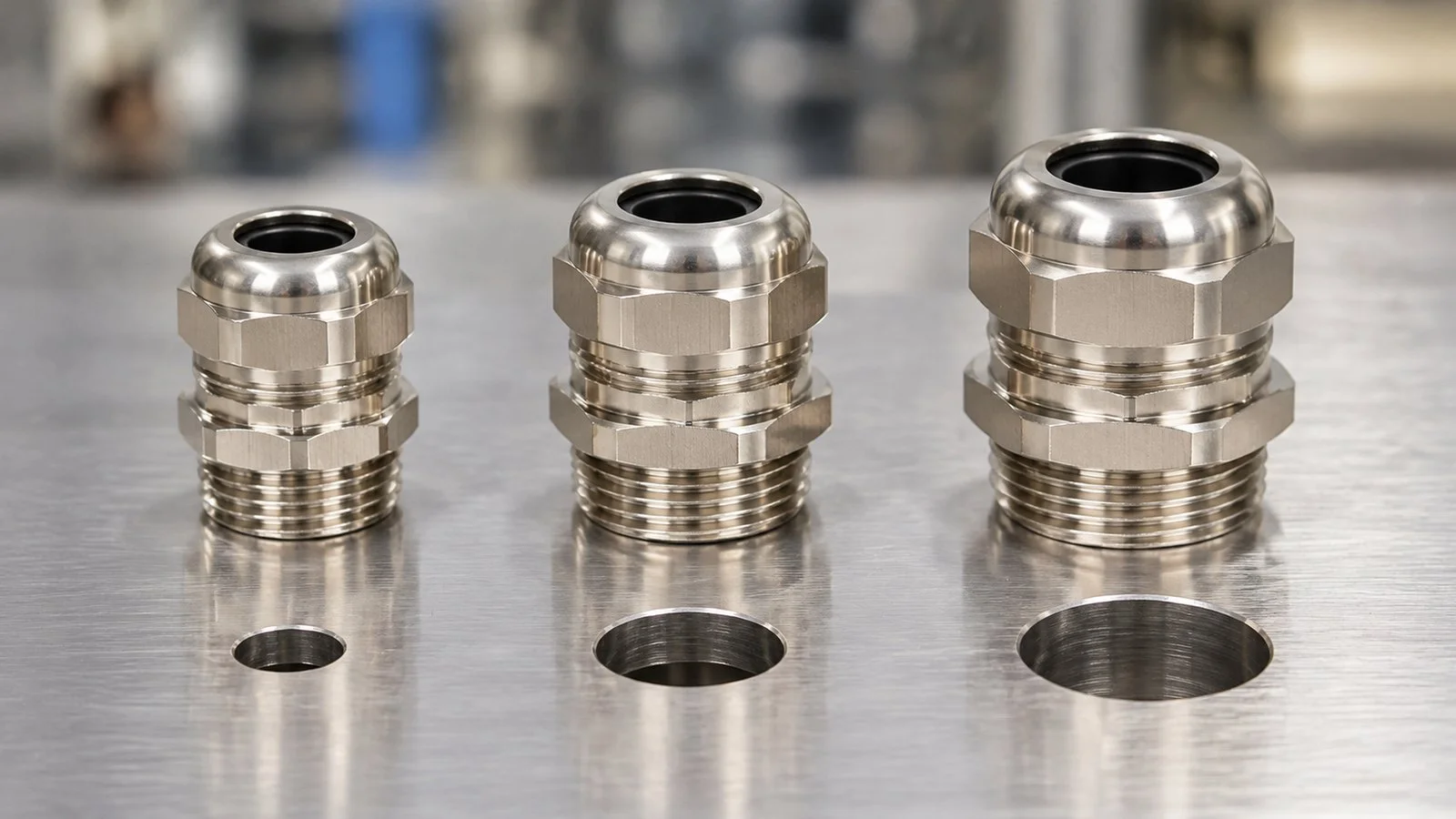
The 4 mm to 8 mm band is not unique to PG9. In the same catalogue the M14, PG9 and M16 entries all state 4 mm to 8 mm. Three threads, three holes, one cable band. The cable therefore cannot be what chooses between them, even though it is the only thing most people quote when they raise an enquiry.
Size
Cable range
Diâmetro externo da rosca
Mounting hole
Thread length GL
Spanner
PG7
3 mm to 6.3 mm
12.5 mm
12.5 mm to 12.7 mm
7 mm
14 mm
M14
4 mm to 8 mm
14 mm
14 mm to 14.2 mm
7 mm
17 mm
PG9
4 mm to 8 mm
15.2 mm
15.2 mm to 15.4 mm
8 mm
18 mm
M16
4 mm to 8 mm
16 mm
16 mm to 16.2 mm
8 mm
18 mm
PG11
5 mm to 10 mm
18.6 mm
18.6 mm to 18.8 mm
8 mm
20/21 mm
M14 is the budget option of the band, with a 7 mm thread and a 17 mm spanner, so it will not clear a thick panel or a tight pitch. PG9 and M16 are separated by 0.8 mm of thread and nothing else worth mentioning. PG11 starts where PG9 ends.
PG9 and M16 Are the Same Gland on a Different Hole
Set the two rows side by side and five columns match: 4 mm to 8 mm cable range, 8 mm thread length, 20 mm bonding length, 18 mm spanner, same body. The only real difference is the thread, 15.2 mm against 16 mm.
That 0.8 mm decides the order. A 16 mm knockout will not seal a PG9: the thread drops through, the washer sits over a gap it cannot bridge, the body hangs off-centre, and the joint weeps on one side — usually on the first wet day rather than at commissioning. In the other direction a 15.2 mm hole will not accept an M16 at all. Cross-reference charts that print “M16 = PG9” describe the cable range, and the statement holds only while nobody looks at the hole.
M14, PG9 and M16 all take the same 4 mm to 8 mm cable, but each needs its own hole: 14 mm, 15.2 mm and 16 mm. The cable does not choose between them; the panel does.
So a PG9 enquiry that arrives with an existing panel is really a question about the hole. If it is already punched, the thread is fixed and the cable range is whatever that thread takes. If the hole is still on the drawing, PG9 becomes one of three interchangeable ways to seal the same cable, best chosen on thread length and access.
The 4 mm Edge Is Where PG9 Is the Wrong Answer
A 4 mm to 8 mm range does not mean every cable inside it is equally well served. At 4.0 mm or 4.5 mm the insert sits at the bottom of its travel: it touches the jacket but compresses very little, so sealing pressure and retention are weakest exactly where a small cable is most likely to be pulled. A PG7 covering 3 mm to 6.3 mm, or a moulded M12 covering 3 mm to 6.5 mm, puts the same cable near the middle of the band where the insert has room to hold.
The top edge behaves the same way: a cable measuring 8.0 mm to 8.5 mm should move up to PG11 rather than be forced into a PG9 whose insert is already fully compressed. Specify so the measured jacket lands in the middle half of the range, not on either endpoint.
Measure at three points around the circumference rather than trusting the size printed on the drum. A jacket that reads 8.2 mm one way can read 7.7 mm the other, and the gland seals on the smallest figure.
GL 8 Is Shorter Than It Looks
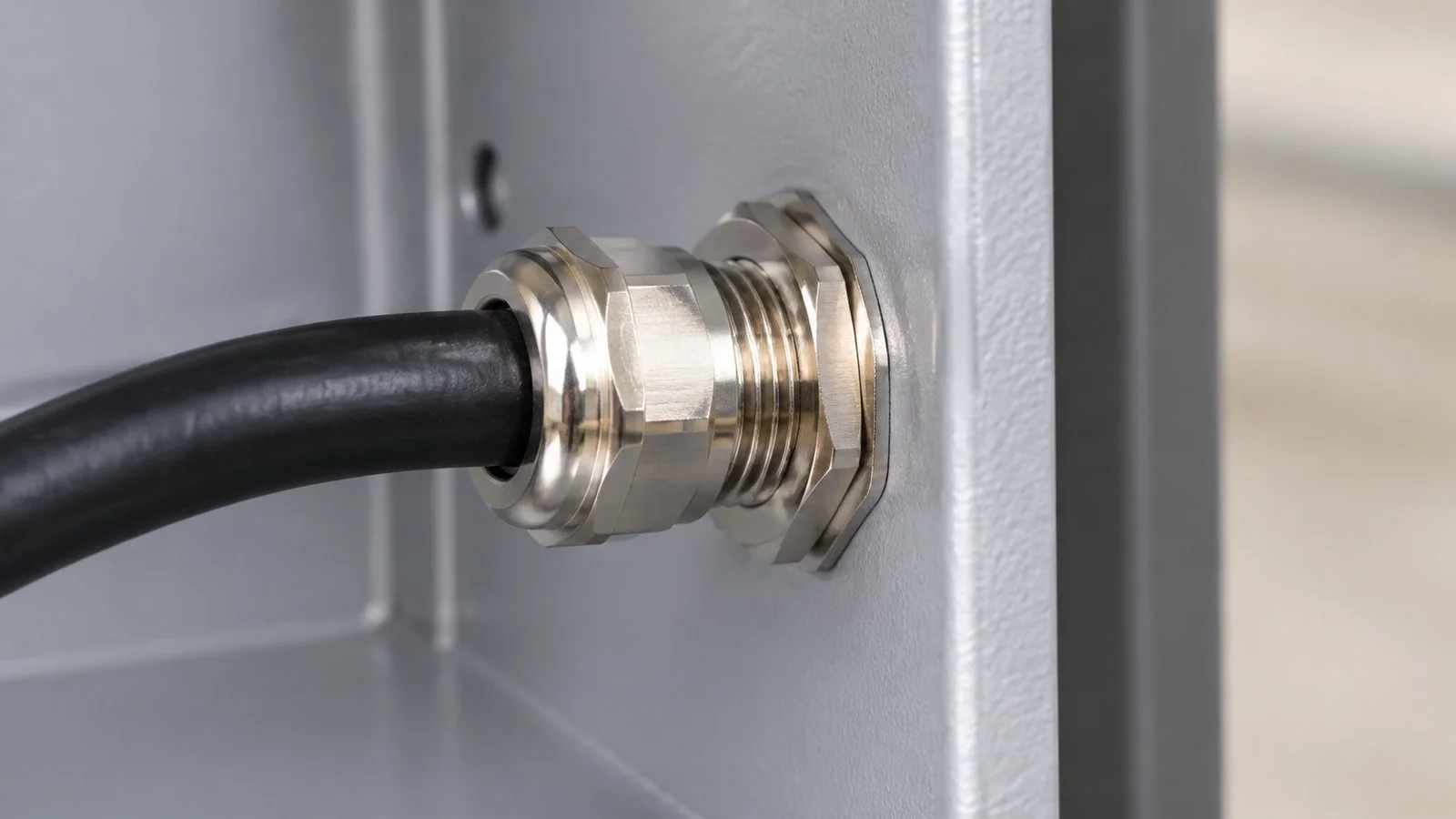
Thread length is the number that ends a project late. GL 8 mm has to cover the panel, the sealing washer and the locknut in that order, and whatever is left is the margin. On a 5 mm plate there is nothing left.
Wall construction
Rough stack-up
Does GL 8 mm work?
1.5 mm sheet, washer, locknut
1.5 + 1 + 4 = 6.5 mm
Yes, with about 1.5 mm spare
3 mm plate, washer, locknut
3 + 1 + 4 = 8 mm
At the limit; no margin for a paint film or a second washer
5 mm plate, washer, locknut
5 + 1 + 4 = 10 mm
No; needs a long-thread variant or a thinner mounting point
6 mm tapped plate, no locknut
6 mm
Yes; the thread is the only thing in the wall
Insulated panel with a liner
Liner plus core plus washer
Depends on the liner; check it before drilling
A short-thread gland on a thin wall leaves visible thread behind the locknut. On a thick plate the same gland runs out of thread before the nut starts.
Tapped holes change the arithmetic, which is why the same gland can be right on one enclosure and wrong on the next. Where the wall itself is threaded, the thread only has to span the wall, and 8 mm is comfortable to about 6 mm of plate. Where it is a plain hole, the locknut takes its 4 mm out of the same 8 mm and usable wall thickness halves. Use the locknut thickness on the datasheet for the part you buy.
Material Changes the Hole, Not the Cable Range
The same nominal size is a different hole depending on body material. The metal PG9 needs 15.2 mm to 15.4 mm. The moulded nylon M16 states 16.2 mm to 16.5 mm, because a moulded thread runs thicker at the root than a cut one, and nylon M12 needs 12.2 mm to 12.5 mm against the metal M12’s 12 mm.
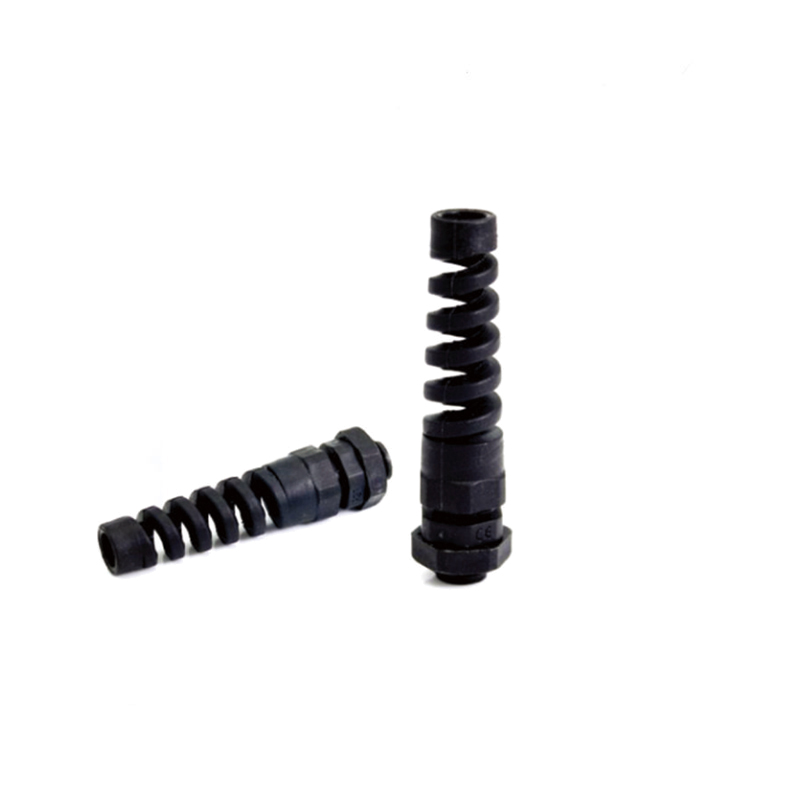
The flexible version adds a third variable without changing the hole. A PG9 flexible body keeps the 15.2 mm thread and the 4 mm to 8 mm range, but the spanner goes from 18 mm to 19 mm because the neck and dome nut are bulkier. The panel drawing does not change; the layout around it does. Stainless keeps the metal dimensions, so a stainless steel PG9 gland drops into the same hole, while the brass M14 e brass M16 each need their own.
The consequence is a sequencing rule: material first, then hole, then drill. Done the other way round, a workshop ends up with a punched 16 mm hole, a delivery of PG9 glands, and a box of penny washers nobody will sign off.
Spanner 18 and the Pitch Between Holes
18 mm across flats is the smallest size in the range that still gives a wrench something to hold. That matters at the layout more than at the gland: two entries need the spanner body plus a swing arc, not the hole plus a millimetre, so two PG9 glands on 20 mm centres cannot both be tightened.
The same wrench behaves differently by material. On metal the hex is deep and the thread limits torque. On a moulded body the hex is shallower and the plastic yields first, so the force that feels normal on brass rounds a nylon hex.
Five Ways a PG9 Order Goes Wrong
Four of the five patterns below are visible before anything ships.
What happens on site
What caused it
What fixes it
The gland drops through the hole
A 16 mm hole drilled for an “M16 equivalent”
Re-drill to 15.2 mm to 15.4 mm, or switch the order to M16
Water tracks in at the first rain
A 4.2 mm cable sitting at the bottom of the band
Move to PG7 at 3 mm to 6.3 mm, or re-specify so the cable sits mid-band
The locknut will not start
An M16 locknut supplied against a PG9 gland
Match the accessory to the 80 degree PG thread, not the metric one
The thread never reaches the nut
GL 8 mm against a thick plate plus washer plus locknut
Long-thread variant, or a thinner wall at the entry
The nylon hex rounds off
Metal-body tightening habit applied to a moulded body
Tighten to the datasheet figure and stop at seal contact
None of these is a manufacturing fault. Each is a decision taken at the drawing or the purchase order, so the fix always costs more than the gland.
What Belongs on the Drawing and the Purchase Order
Two lines on a drawing prevent most of the failures above: the thread callout with its standard, because PG is an 80 degree thread and a metric nut will appear to fit before it strips, and the hole with a tolerance, 15.2 mm to 15.4 mm rather than “about 15”.
Thread: PG9, 80 degree form, with the pitch standard named
Cable: measured jacket diameter at three points, stated as a range, with sheath material
Body and finish: nickel-plated brass, stainless steel or PA66, plus colour where it matters
Hole: 15.2 mm to 15.4 mm, with wall thickness and whether it is tapped or plain
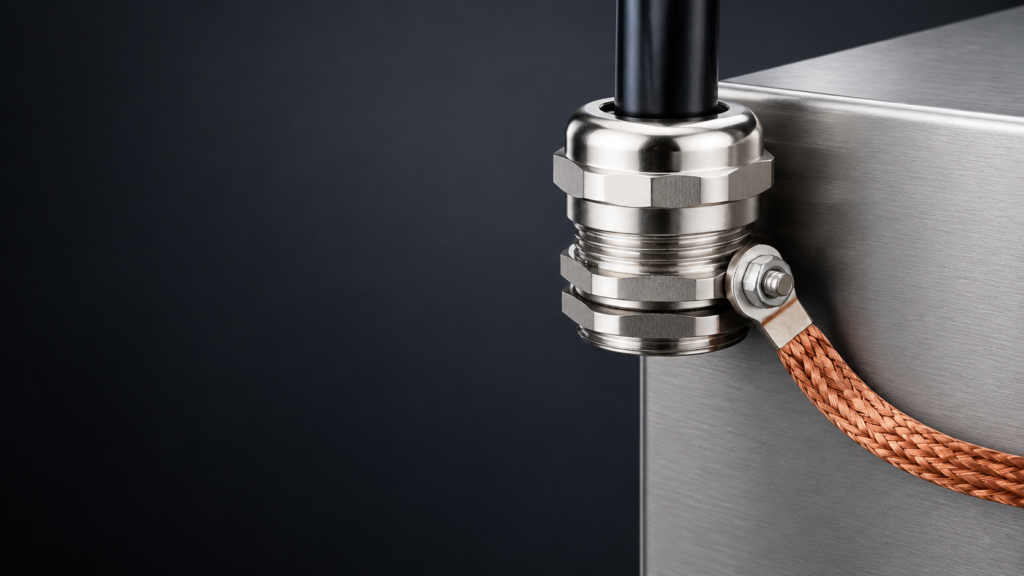
Accessories: locknut, sealing washer, shroud or earth tag, each listed rather than assumed
4 mm to 8 mm jacket diameter. That is the sheath, not the conductor, and the seal works best when the measured diameter sits mid-band rather than at either end.
What size hole do I need for a PG9 cable gland?
15.2 mm to 15.4 mm. The thread measures 15.2 mm, and the extra 0.2 mm covers thread tolerance and gives the washer a flat surface. A 16 mm hole is too large.
Is PG9 the same as M16?
For the cable, yes: both cover 4 mm to 8 mm and share the same thread length, bonding length and spanner. For the panel, no: PG9 needs 15.2 mm where M16 needs 16 mm to 16.2 mm.
Can I fit a PG9 gland into an M16 hole?
Only with an adapter or a washer wide enough to bridge the 0.8 mm gap, and neither is a good permanent answer. The gland sits off-centre under load and the seal becomes one-sided.
What is the thread diameter of a PG9 cable gland?
15.2 mm outside diameter. The 9 in the name is a nominal conduit size and does not correspond to any dimension you can measure on the gland.
A brass waterproof cable gland helps protect cable entries from water, dust, and strain in industrial and marine installations. Learn how to choose the right model, size, and supplier.
PG63 is not a 63 mm gland. The thread is 72 mm, the hole is 72 to 72.2 mm and the cable range is 42 to 52 mm. Dimensions, thread length and the tooling question at this size.
Earthing and bonding do different jobs. The three return paths a gland can provide, the seven interfaces that break continuity, and how to test them on site.
Usamos cookies para aprimorar sua experiência de navegação, veicular anúncios ou conteúdos personalizados e analisar nosso tráfego. Ao clicar em "Aceitar tudo", você concorda com o nosso uso de cookies.