Prensa-cabos à prova d'água
Waterproof Nylon Cable Gland for Industrial Cable Entry
Learn how to choose a waterproof nylon cable gland by thread type, cable range, IP68 sealing, and application needs for OEM, export, and bulk buying.
Leia mais

A hazardous area cable gland has to satisfy two masters at once. It must grip and seal the cable, and it must not weaken the protection concept of the enclosure it is fitted to. Get it wrong and the enclosure certificate effectively stops at the cable entry.
Selection is therefore less about picking a product than about reading two documents correctly. This guide covers what each one fixes, the four decisions you still own, and how they shift between oil and gas, chemical and dust duty.
In a classified area the gland is a boundary object. Gas, vapour or dust can travel along a cable into the enclosure, and an ignition inside a flameproof enclosure can try to escape through it. Either failure turns a certified enclosure into an uncertified one.
Most of the specification is settled before anyone opens a catalogue. The drawing states what hazard exists at the entry; the certificate states how the enclosure resists it and which entries it accepts. Together they fix the zone, the group, the temperature requirement, the protection concept and the thread.
Where they disagree, no gland resolves it: if the classification calls for Group IIC in Zone 1 but the enclosure is certified Ex e, change the enclosure.
| Document | What it fixes | Where projects go wrong |
|---|---|---|
| Area classification drawing | Zone at the entry point, gas or dust group, temperature class or maximum surface temperature, and whether gas and dust both apply | The drawing covers the plot rather than the equipment, and the entry may sit on the other side of a boundary than assumed |
| Enclosure Ex certificate | Protection concept, EPL, ambient temperature range, entry thread form and size, and any conditions of use | It is read for “ATEX approved” instead of for the entry conditions that actually bind the gland |
Two passes through the project documents are enough.
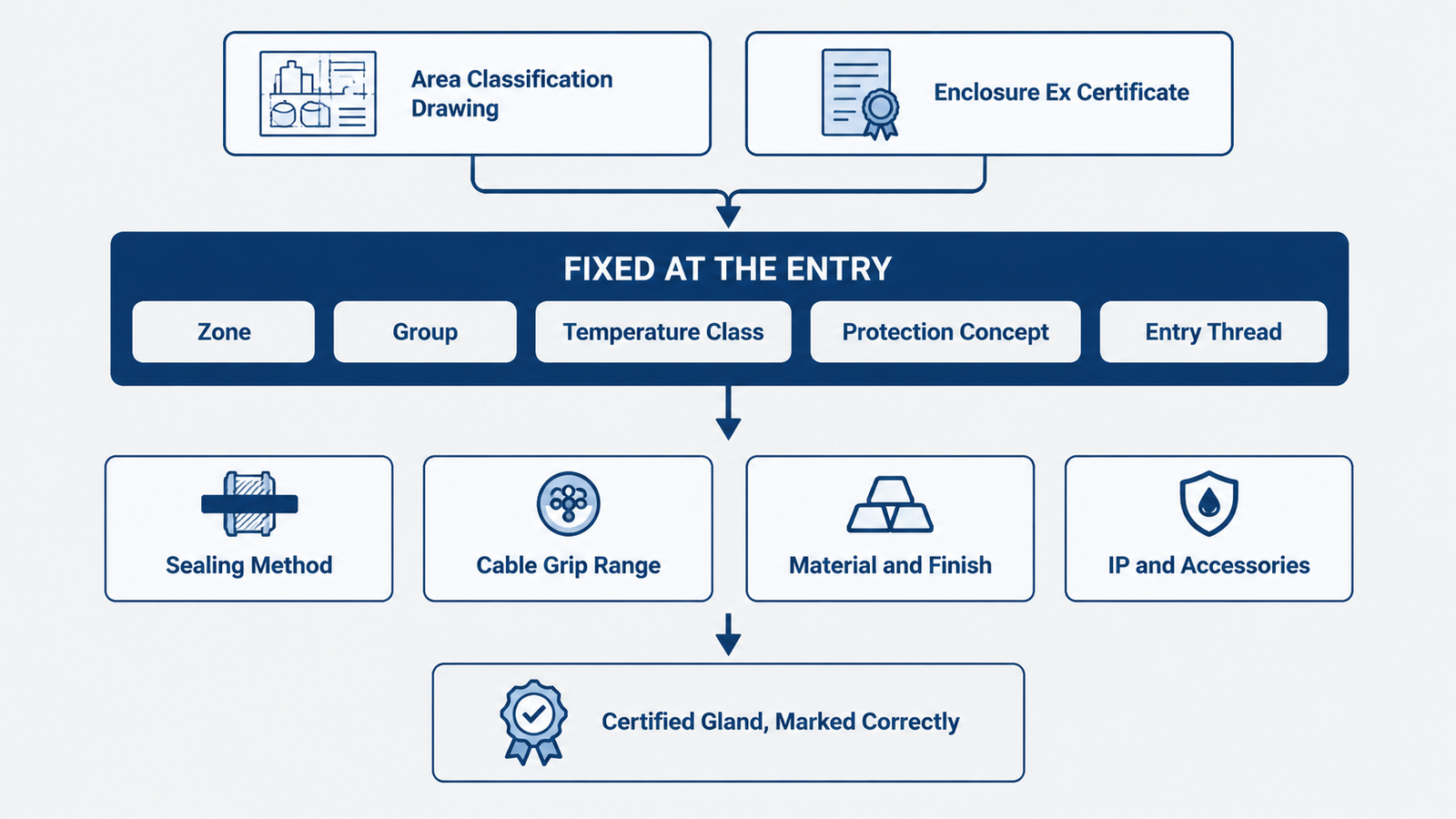
You need four facts, applied to the specific cable entry rather than the plant in general: the zone, the group, the temperature class or maximum surface temperature, and whether the hazard is gas, dust or both. A route crossing a boundary can carry a Zone 1 classification into a Zone 2 panel, so the entry point is what matters. Dust adds figures gas zones do not have: the limit is set against the dust cloud ignition temperature, and against the layer ignition temperature reduced by a margin, commonly 75 K under IEC 60079-14, wherever a layer up to 5 mm can settle. Our Zone 1 and Zone 2 selection guide shows how those classifications become purchase requirements.
The certificate tells you which protection concepts the gland may use, and here the combinations are not symmetrical. Under the permitted-combination table in IEC 60079-14, flameproof Ex d equipment with a directly fitted gland cannot use an Ex e gland; that pairing is not unsuitable but impermissible. The reverse holds, which is why flameproof and increased safety glands are specified together on mixed plants.
From the same certificate take the entry thread form and size, the ambient range, and any conditions of use that shift responsibility onto the installer. Metric, NPT and PG entries are not interchangeable even when diameters look close, so confirm the entry against our thread form guide.
| Enclosure protection concept | Gland concept that may be used | What it means in practice |
|---|---|---|
| Ex d flameproof | Ex d | An Ex e gland is not permitted on a directly fitted Ex d entry |
| Ex e increased safety | Ex d or Ex e | Flameproof glands are accepted here, so they are the safer stock choice |
| Ex t dust | Ex t | Powder tightness and surface temperature, not containment |
| Ex i intrinsic safety, Group II circuits | Ex d, Ex e or Ex n | The circuit cannot ignite, so the gland carries mechanical and ingress duty |
| Ex n and Ex nL | Ex d, Ex e or Ex n | Confirm against the wording of the specific certificate |
Combinations follow the IEC 60079-14 permitted-combination table; the equipment and gland certificates govern.
Once the documents are read, the specification comes down to four choices worth negotiating with a supplier.
Sealing method. A compression gland seals around the sheath with an elastomer. A barrier gland adds a compound encapsulating the individual cores, stopping gas from travelling through the cable interstices into the enclosure. Barrier glands need mixing, curing time and competent preparation.
Cable grip range. The declared range must span the cable’s measured outer diameter, taken from the delivered drum rather than a nominal tender figure. Adapting a cable with sealing tape or heat-shrink is not a workaround: IEC 60079-14 rules it out because it invalidates the IP and the protection concept.
Material and finish. Nickel-plated brass suits sheltered industrial areas, and aço inoxidável takes over under salt, washdown or chemical attack. Both appear across our nickel-plated brass and stainless ranges, and the material also sets the temperature range.
Ingress protection and accessories. The IP target comes from the environment rather than the Ex rating, and a higher IP rating does not protect against ignition. Every unused entry also needs a certified stopping plug of the same protection type.
| Tipo | Specification | Aplicação típica | Indicative FOB Price |
|---|---|---|---|
| Brass Ex gland | Nickel-plated brass, metric or PG, Ex e / Ex d | Standard Zone 1 and Zone 2 gas duty | US$2.50 – 6.50 |
| Stainless steel Ex gland | SS316L, Ex d / Ex e, IP68 | Offshore, chemical, washdown areas | US$5.00 – 14.00 |
| Dust-tight Ex t gland | Ex t, IP6X, dual seal | Grain, flour, wood and food dust | US$2.50 – 9.00 |
Indicative FOB prices, Ningbo and Shanghai, based on 300 pcs per size for Ex types; final pricing depends on thread size, material grade and certification route.
Upstream and offshore duty is usually Group IIA or IIB rather than the more demanding IIC case, and the environment attacks hardware through salt, humidity, washdown and vibration. Cables are frequently armoured, so the gland must clamp and bond the armour as well as seal the sheath. On sour service the metallic materials may also have to satisfy ISO 15156 or NACE MR0175, which belongs at enquiry stage. The most common failure is corrosion at the thread, where a plated brass entry meets a stainless or aluminium enclosure.
Chemical duty is where the temperature question becomes hard. Hydrogen sets the containment bar, because Group IIC has the tightest dimensional tolerances in flameproof design. Temperature class, by contrast, is set by chemistry rather than equipment: hydrogen ignites near 560 °C and sits in T1, while low-ignition-temperature solvents push the requirement several classes down the scale, so one plant can hold IIC at T6 in one unit with IIA at T3 next door. Corrosion reaches the soft parts too, since acid and solvent vapours attack the seal and the barrier compound.
Dust asks a different question: the hazard is a hot surface igniting a settled layer or a cloud, so an Ex t gland is judged on powder tightness and surface temperature rather than containment. The groups shift too, with IIIA covering fibres and flyings, IIIB non-conductive dust, and IIIC conductive dust from metal or coal, the severe case. A compound barrier is not the usual answer here the way it is for gas, because dust does not migrate through cable interstices in the same manner, so a dual-seal gland is normal. IEC 60079-14 also asks for glands to be arranged so that little dust accumulates and they stay accessible for cleaning.
Group I covers mines where methane and coal dust are both present, so a single entry satisfies a gas hazard and a dust hazard at once. The surface temperature limits follow: 150 °C where a coal dust layer may deposit, and 450 °C only where deposition is excluded and the marking says so. Group II equipment is not a substitute.
The scenarios differ less in the gland’s function than in which failure mode it defends against.
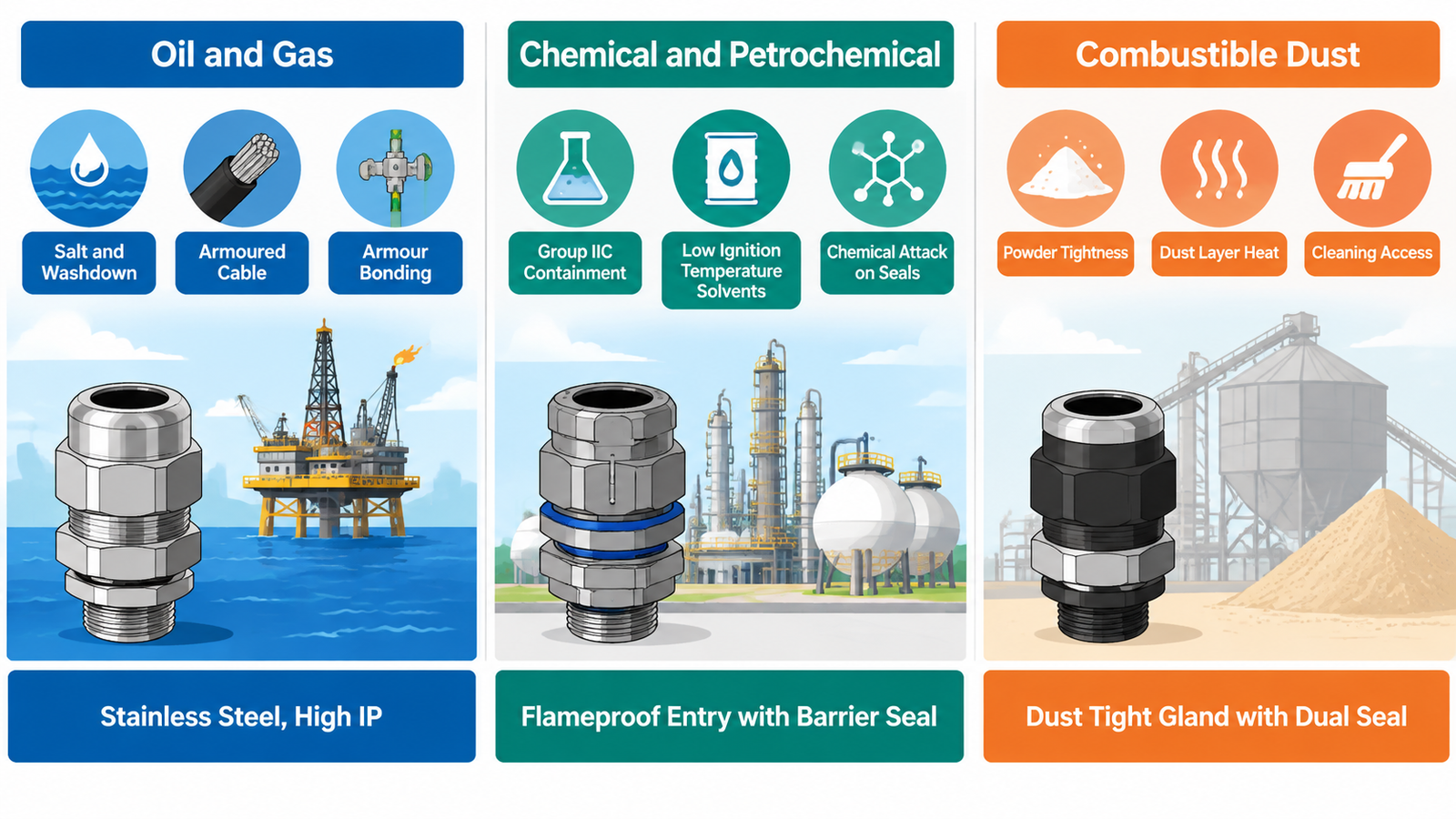
| Scenario | Governing hazard | Usual protection concept | Sealing approach | Material and IP | Most common failure |
|---|---|---|---|---|---|
| Oil and gas, offshore and downstream | Hydrocarbon gas, salt, vibration | Ex d flameproof, sometimes with barrier | Compression or barrier, with armour clamping and bonding | Stainless steel, IP66 to IP68 | Thread corrosion and a galvanic pairing at the entry |
| Chemical and petrochemical | Gas or vapour, sometimes Group IIC with a low ignition temperature | Ex d flameproof, barrier where the cable allows gas travel | Barrier compound plus compression | Brass indoors, stainless steel in wet and exposed areas | Seal and compound degradation under chemical attack |
| Combustible dust | Settled dust layers and dust clouds | Ex t dust tight | Dual seal, no compound barrier | Brass or stainless steel, IP6X as a minimum | Overheating beneath a dust layer, and blocked cleaning access |
| Mining, Group I | Methane gas plus coal dust | Group I flameproof | Compression with heavy-duty retention | Coated steel or stainless steel | Substituting Group II equipment for Group I duty |
If the entry is in a classified area and the enclosure is flameproof, a stainless steel flameproof range such as the PG42 gland for hazardous areas is a useful reference for what the specification should look like.
A quotation is only comparable if it answers the same questions. This is what we ask for before pricing.
| Item to state | Why it changes the answer |
|---|---|
| Zone, group and temperature class or maximum surface temperature at the entry | Sets the minimum equipment protection level and the surface temperature limit |
| Enclosure protection concept and certificate reference | Determines which gland concepts are permitted at that entry |
| Measured cable outer diameter range, with armour and bedding details | The grip range has to be a real range rather than a nominal size |
| Whether a barrier seal is required, and who supplies the compound | Changes cost, installation time and the competence required on site |
| Entry thread form, size and required engagement | Metric, NPT and PG entries are not interchangeable |
| Material, finish and IP target | Drives price, corrosion life and the cleaning regime |
| Accessories: certified stopping plugs, locknuts, shrouds and seals | Every item has to belong to the certified arrangement |
| Documentation: certificate of conformity, datasheet, installation instructions, IP test evidence | Determines whether the installation can be audited later |
The marking string is part of the specification, so ask for it in writing, because “ATEX approved” does not tell you which group, protection level or temperature range you are buying. Where the certification routes need comparing first, our ATEX and IECEx comparison sets out where the schemes agree and where they do not.
These errors survive a site walk because the installation looks complete, and they surface during an audit or after an incident.
| Mistake | What it looks like on site |
|---|---|
| Specifying from the zone alone | A correctly rated gland on an enclosure whose certificate does not permit that combination |
| Accepting “certified” without the marking string | No group, equipment protection level or temperature range recorded in the equipment register |
| Filling an out-of-range cable to make it fit | Sealing tape or heat-shrink beneath the seal, which invalidates the declared IP |
| General-purpose blanks on spare entries | Uncertified stopping plugs breaking an otherwise certified enclosure |
| Mixing materials without considering the pairing | A brass or plated gland corroding first inside a stainless steel or aluminium enclosure |
Read the two documents, write the four decisions into the enquiry, and ask for the marking string in the quotation. Send your classification drawing, enclosure certificate and measured cable diameter, and we will reply with a marking-level match for your entry.
Start from the cable rather than the gland. A barrier gland is needed where gas or vapour can travel through the cable interstices into the enclosure, which depends on the cable construction and on what the enclosure certificate permits. Where a compound seal is required, a compression gland is not an equivalent substitute.
No. For flameproof equipment with a directly fitted gland, an increased safety gland is not a permitted combination under the IEC 60079-14 table. The reverse works, so an Ex d gland may be used on Ex e equipment and on intrinsically safe or Ex n circuits.
Usually, yes. Dust duty is about powder tightness and surface temperature, so an Ex t gland with a dual seal is the normal answer and the compound barrier used for gas is not. Dust also changes the group to IIIA, IIIB or IIIC.
The measured outer diameter range on the delivered cable, the construction, the bedding details and the number of cores. The declared range must span the real diameter, and a cable must never be adapted to a gland with tape or heat-shrink.
A certificate of conformity with the reference and marking string, a datasheet covering the certified range, installation instructions with seal and torque requirements, IP test evidence, and material certificates where required. Keep them with the installation record, because a replacement part is only equivalent if you can show the original specification.
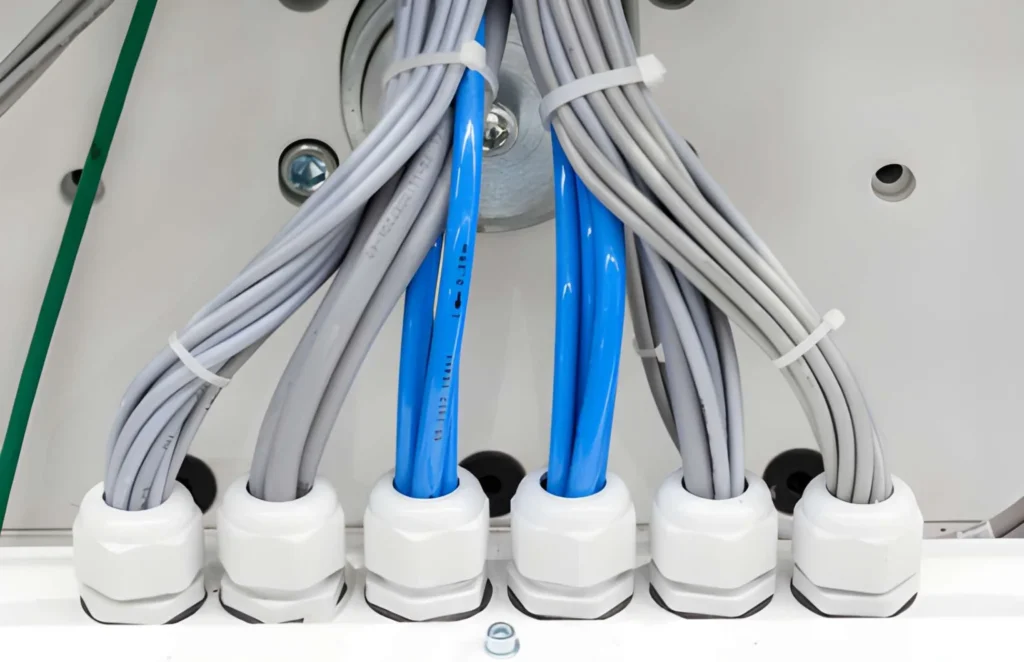
Learn how to choose a waterproof nylon cable gland by thread type, cable range, IP68 sealing, and application needs for OEM, export, and bulk buying.
Leia mais
Em projetos industriais e de construção, os prensa-cabos à prova d'água são componentes essenciais que garantem a segurança e a operação estável dos cabos. Seja para enfrentar chuva e poeira em ambientes externos ou para lidar com riscos de explosão em áreas perigosas, a escolha do prensa-cabo correto é crucial. Hoje, vamos explorar dois tipos comuns de prensa-cabos - prensa-cabos à prova d'água e [...]
Leia mais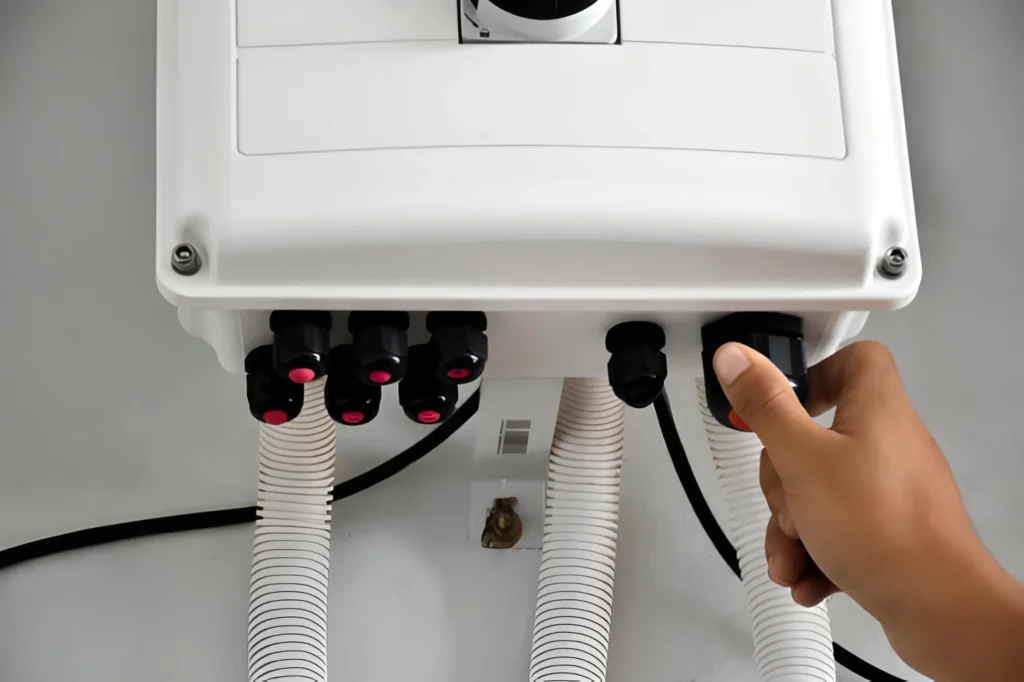
Explore os conectores de prensa-cabos à prova d'água duráveis com classificações IP67 e IP68 em nylon, latão e aço inoxidável para proteção segura do cabo e alívio de tensão.
Leia mais