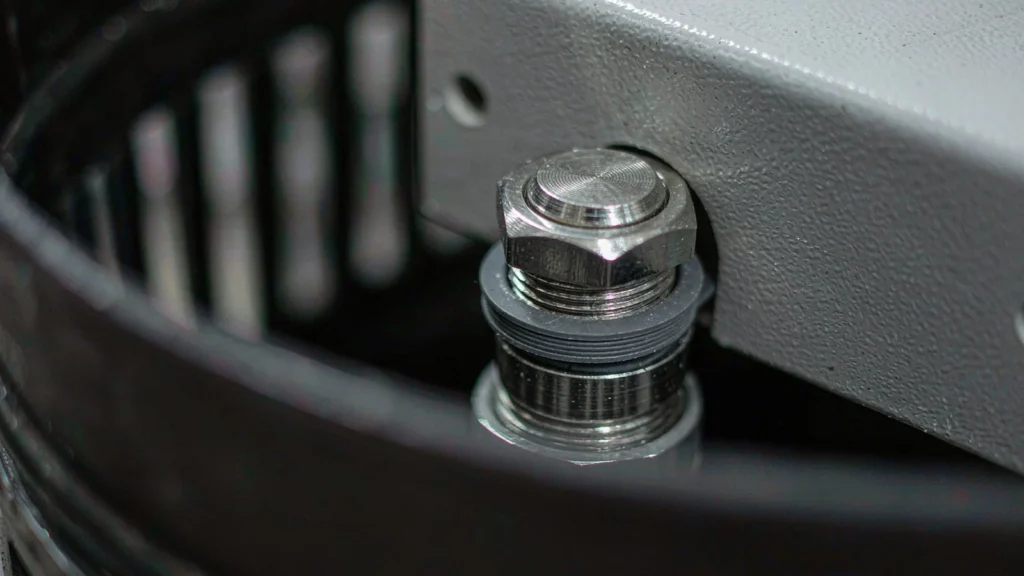
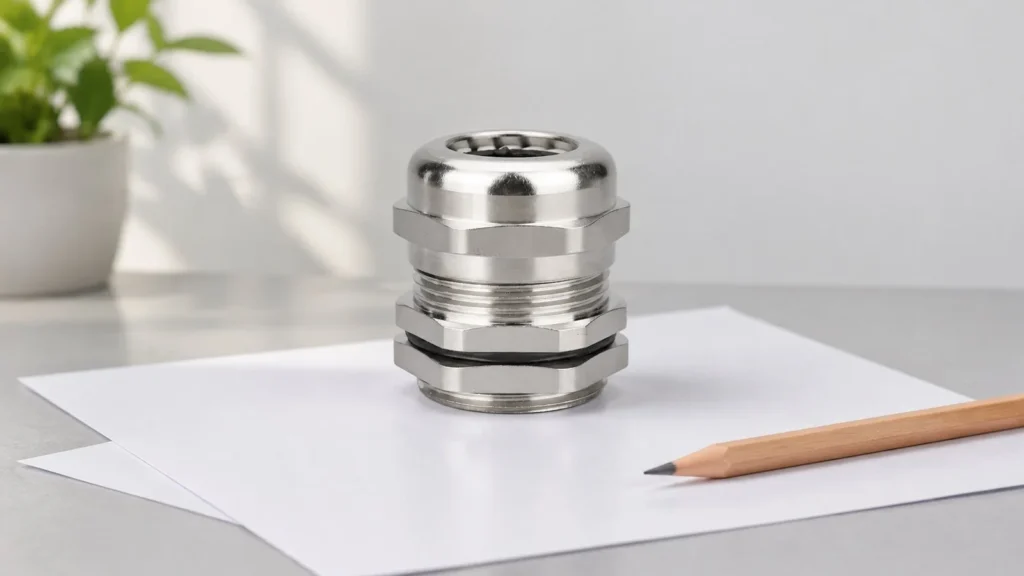
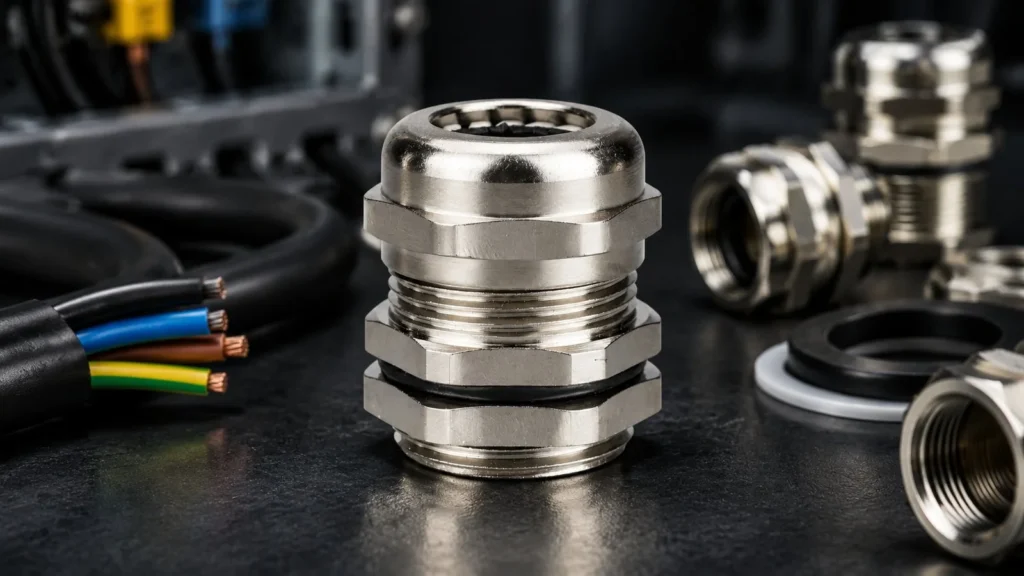
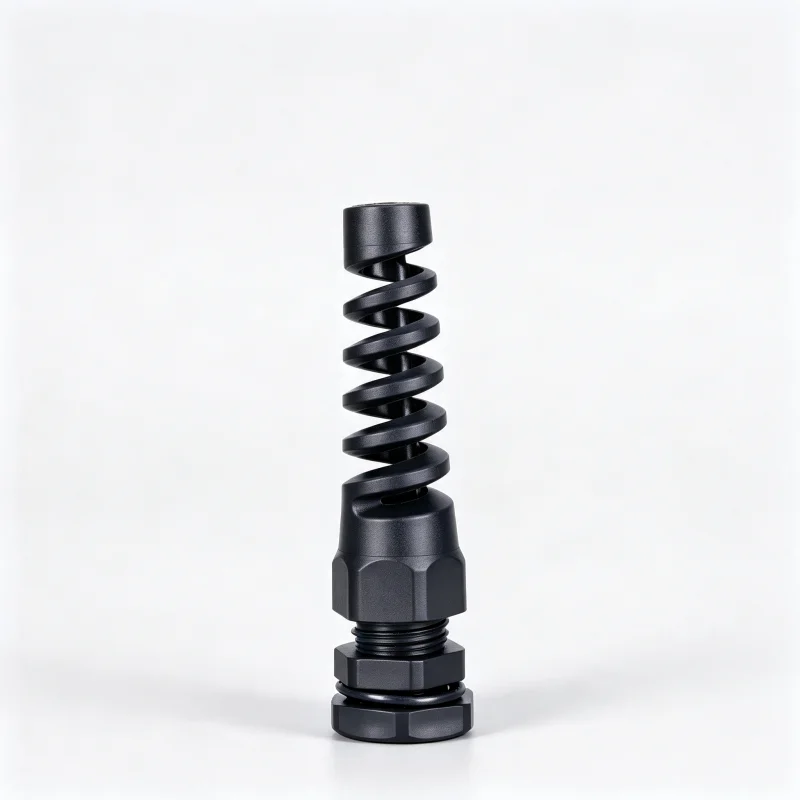
A cable gland locknut has one mechanical job: it pulls the gland body down onto its sealing washer. It does not seal anything itself, and it cannot flatten a wall that is not flat. Almost every locknut problem comes from treating it as an accessory chosen after the gland, when it is a structural part that eats thread length, decides which two spanners the job needs, and — on a coated enclosure — decides whether the body is bonded at all.
What the Locknut Does, and What It Cannot Do
The nut is loaded in tension against the inside face of the enclosure. Tightening it pulls the body inwards, so the washer is compressed between the body shoulder and the panel. The sealing force therefore comes from the body-to-washer interface, and a nut torqued hard against a warped panel does nothing for the seal. What the nut must do is hold its preload against vibration for years, which is a function of thread engagement and bearing area rather than of how hard the fitter leaned on the spanner.
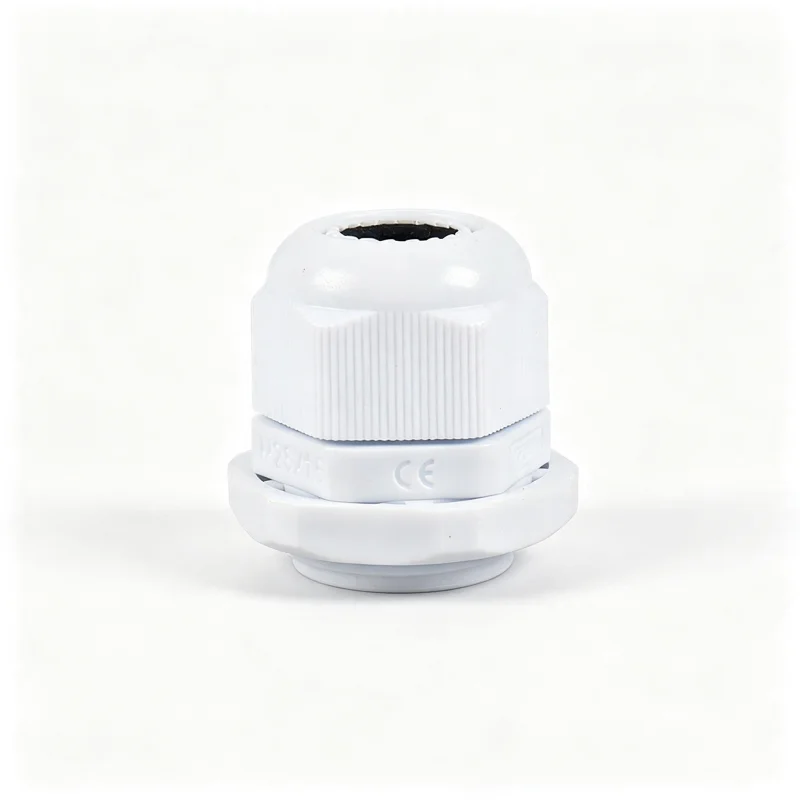
Both depend on the nut and body sharing a thread class and a surface treatment. A nut from a different supplier is often a different hex as well: a PG19 gland supplied with its locknut has a 24 mm body hex and a 27 mm nut, so a substitute nut is frequently a substitute spanner too.
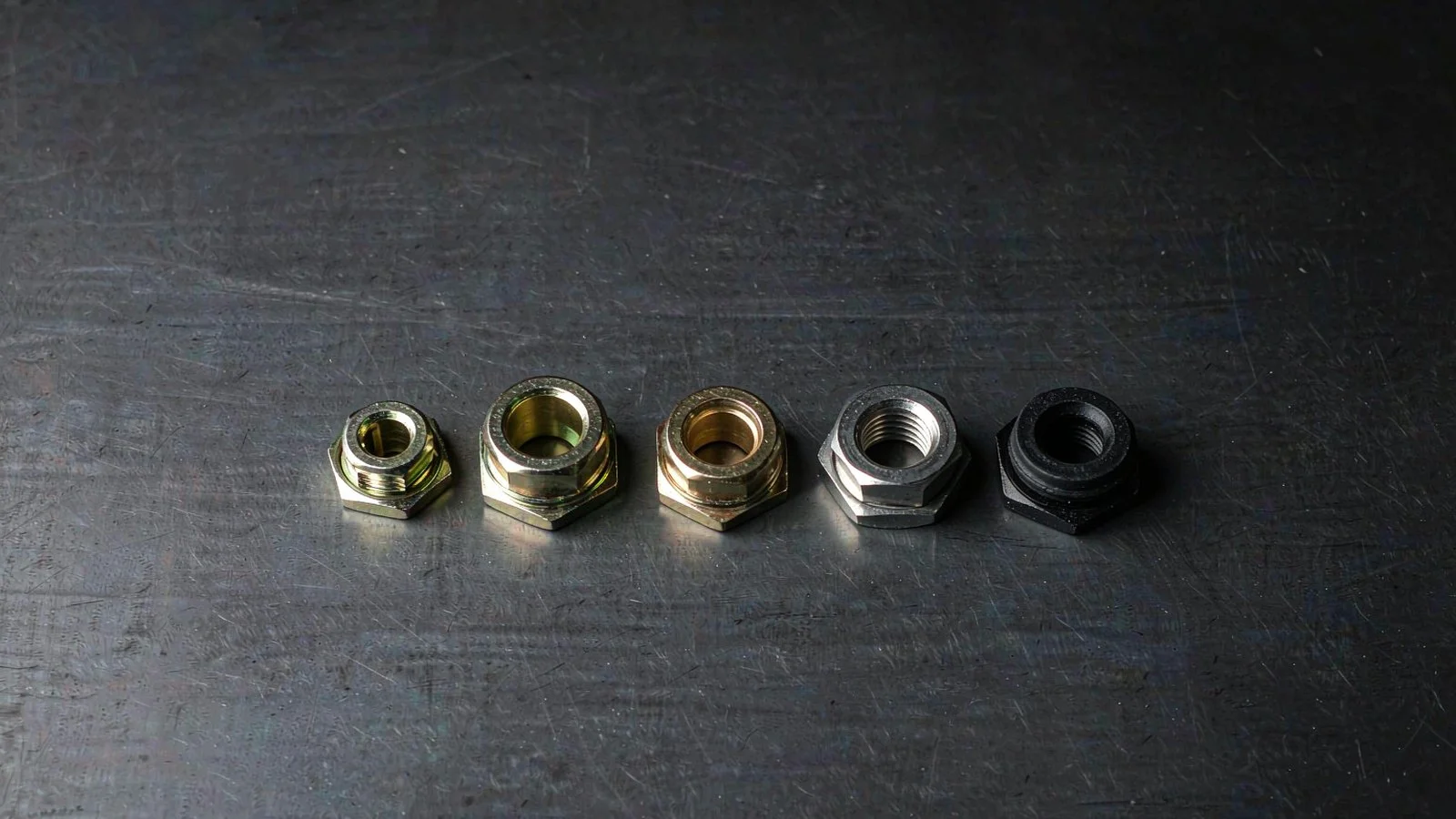
Six Nuts That Get Called a Locknut
The word covers parts with different geometry and different purposes, and two of them are not locking devices at all. Ordering “locknuts” without saying which one is how a box arrives with a nut that will not take the spanner the crew brought, or with teeth meant to cut through paint now sold as a grip feature. The spanner size chart gives the across-flats figure for every size we make.
Tipo
Geometry
What it is actually for
What it costs you
Standard hex locknut
Full thickness, two flat bearing faces
General clamping on sheet steel, spreading load around a thin wall
Full thickness taken out of the thread length
Thin / jam nut
Roughly half the thickness
Only where the thread length is nearly exhausted
Fewer engaged threads, so less preload margin
Serrated face nut
Teeth on the bearing face
Biting through coating to make a conductive path
Teeth are a corrosion site on the wet face
Earthing nut with boss
Hex nut with an integral boss or stud
A guaranteed, testable termination for a bonding conductor
Higher cost, and one more part to specify
Nylon-insert nut
Hex nut with a nylon collar
Vibration resistance without a second part
Adds height; the insert limits the temperature range
Two standard nuts
One nut locked against another
Holding preload where nothing else is available
Two full thicknesses out of the thread; hard to torque evenly
Five locknuts, five answers to the same question. Thickness is what the thread length pays for, and it is the figure that rarely appears on a quotation.
Thread Match Is Three Things, Not One
Matching a nut to a gland means matching thread form, pitch and tolerance class. The form is the family: metric 60 degree, PG 80 degree, NPT tapered 1:16, G parallel. The pitch is the number most often dropped — M20 is 1.5 mm, but M8 is 1.25 mm, so “the same size” is not the same thread. The class is the fit, and it is what makes a nut from one factory feel loose on a body from another while both are nominally correct.
A nut is also the fastest thread gauge on site. If a spare nut runs on two turns and stops, the thread is not what the drawing says — a test that costs nothing, which is why the parts bin, not the body, is the guide when an unmarked gland must be identified for replacement. The same principle runs through our PG19 size guide.
Thickness Is the Dimension Nobody Writes Down
Gland dimensions are standardised by product standards; a separately supplied locknut is an accessory, and its thickness is a catalogue figure rather than a standardised one. Thickness is subtracted from thread length, so a thread that is just long enough with a 3 mm nut is 3 mm short with a 6 mm one. The failure is quiet: two or three threads engage, the joint feels tight, and it lets go under vibration a season later.
The table below turns that into a decision. It assumes a 1 mm sealing washer and two threads left exposed, and reports the largest wall that still allows the nut to be used.
Size
Thread length GL (mm)
Max wall with a 3 mm nut
Max wall with a 6 mm nut
M14
7
1 mm
Not usable
M16
8
2 mm
Not usable
M20
8
2 mm
Not usable
M25
9
3 mm
0 mm
M32
10
4 mm
1 mm
M40
11
5 mm
2 mm
M50
12
6 mm
3 mm
M63
13
7 mm
4 mm
PG63
15
9 mm
6 mm
Read the second column as the reason thin nuts exist and the third as the reason they are a compromise. On the small metric sizes a 6 mm nut cannot be used at all, whatever the wall, because there is not enough thread to reach it.
Where the Nut Bears
The nut bears on the inside face, which is the face nobody deburrs, nobody paints and nobody inspects. A punched knock-out leaves a step or a raised ring, and a nut tightened onto that step rocks: it preloads one edge, the body tilts fractionally, and the washer seals on one side of the hole while lifting on the other. The leak then appears on the outside face, where the evidence points at the washer.
Two smaller details follow. On a coated enclosure the nut bears on paint, so it is not a conductive joint even when tight — the earth path has to be made deliberately, as the earthing and bonding guide sets out. And the nut face stays wet longest after a washdown, which makes it the first part to corrode and the last anyone looks at.
Thin Nut or Longer Thread: the Real Trade
A thin nut buys millimetres and spends strength. It carries fewer engaged threads, and on a brass assembly it is the nut’s thread, not the gland’s, that gives first when someone leans on a spanner. Manufacturers size the standard nut for the torque the gland expects, so a thinner one removes margin that was never advertised.
The structural answer is a longer thread, not a shorter nut. The long-thread variant of the same gland gives 15 mm where the standard body gives 8 or 9 mm, which covers a thick panel, a washer, a standard nut and an earth tag in series without changing the size or the hole. It is a different part number rather than a modification, and it is the right call whenever the arithmetic above lands on the line — see the long thread gland page.
Same Material or Different: Galling Against Galvanic
Material choice pulls two failure modes in opposite directions. A stainless nut on a stainless body makes no galvanic couple, but stainless on stainless galls: the threads pick up, the joint seizes, and the usual field outcome is a joint tightened far past spec because it felt loose. A nickel-plated brass nut on a stainless thread cannot gall, and it makes a couple whose importance is set by the environment.
That is why both practices exist and both are defensible. Matched stainless belongs in wet or chloride service, where the couple would be the shorter-lived problem and galling is managed with a suitable lubricant and a controlled torque. A plated brass nut on a stainless thread is common in dry inland work, where nothing will wet the joint. What is not defensible is mixing without deciding which failure is being accepted.
Serrated and Earthing Nuts Are Conductors
A serrated nut and an earthing nut look like fasteners and behave like terminals. The teeth on a serrated face cut through paint and oxide to make contact; they do not add grip, and calling them an anti-vibration feature is a category error. An earthing nut goes further and provides a boss or stud, so a bonding conductor lands on a point that exists by design rather than on whichever thread happens to be exposed.
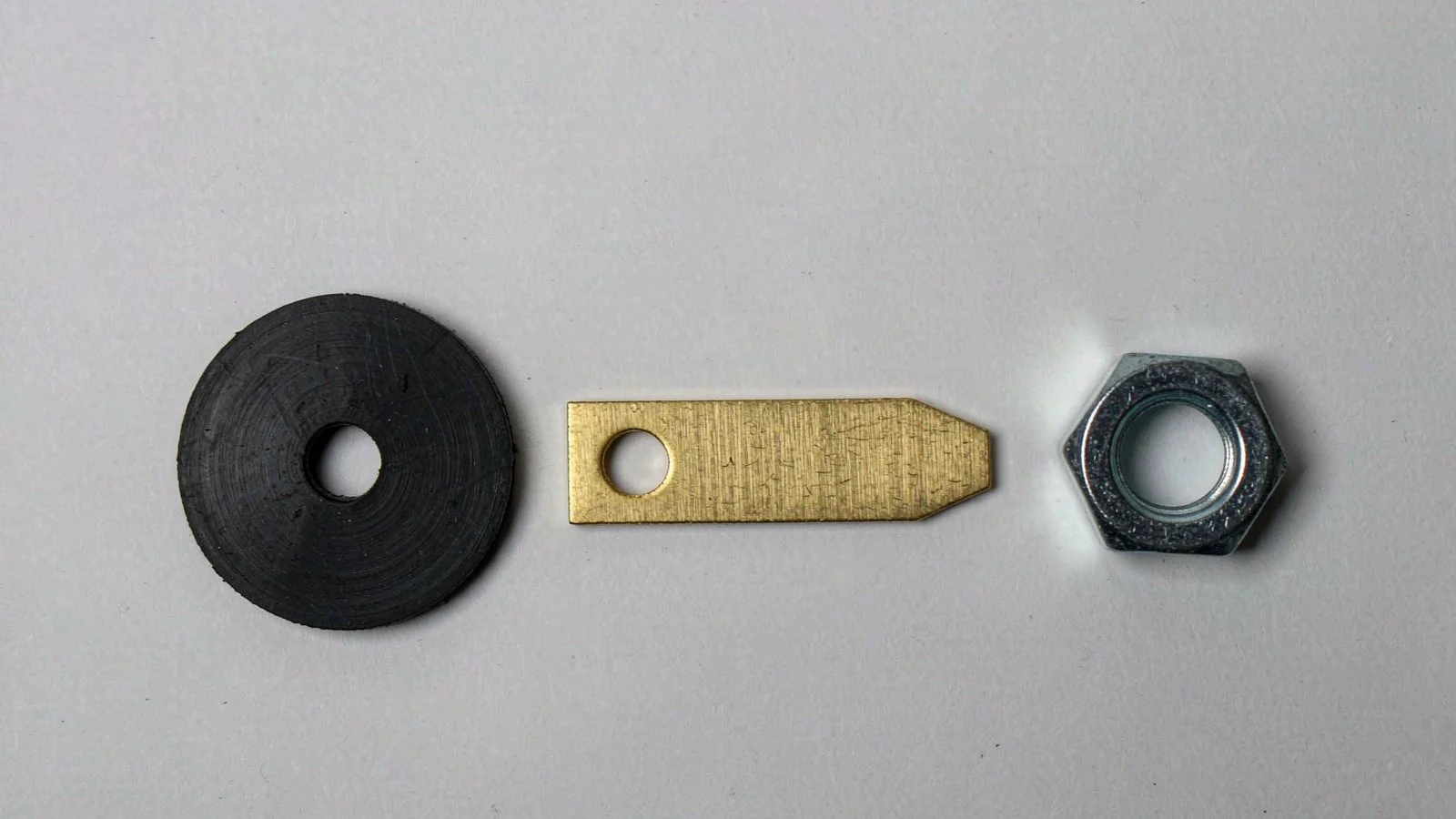
Both are the right part where the enclosure is powder coated, and both need the same discipline: bare metal under the teeth or stud, a defined conductor size, and continuity measured after assembly rather than assumed. Where a separate tag is used instead, it sits between the nut and the panel, never between the washer and the panel — the earth tag guide covers that path in full.
Washer, tag, nut. Only the washer belongs in the sealing path; the tag goes between nut and panel, and a plain nut has no conductive role at all.
When a Locknut Is the Wrong Part, and What to Order
A nut cannot bridge a hole that is already too large, flatten a curved or ribbed face, or stiffen a moulding that flexes under load; those three need a gland plate, a flat pad or a different fixing. On an explosion-protected enclosure the internal arrangement belongs to the certification, so adding a nut inside a certified assembly is a change to agree with the manufacturer. On a blind tapped hole there is nothing for a nut to do at all.
For everything else the order needs the numbers that describe the joint rather than the product. The enclosure entry guide covers how the wall decides the fixing, and the thread size chart gives GL and spanner figures per size.
Field
Why it decides the part
Thread form and pitch
M20 x 1.5 is not interchangeable with PG13.5 or with M8 x 1.25
Material and finish
Decides galling against galvanic corrosion, and whether it matches the body
Thickness in millimetres
Not standardised; it is subtracted from the gland’s thread length
Across-flats
Decides whether the crew needs a second spanner
Nut type and whether kitted
Serrated, earthing or plain; supplied with the gland or as a separate line
Frequently asked questions
Do I need a locknut on every cable gland?
No. It clamps the body against the panel and holds it against rotation, so it is needed on thin sheet, where the body could turn, and where the inside face must be reached anyway. On a thick machined face with a tapped thread, the thread is the fixing.
Does a locknut seal the cable entry?
No. It compresses the body onto the sealing washer, and the washer seals. Torque on the nut sets that compression; it is not a seal in itself, which is why a nut cannot rescue a warped panel or a damaged washer.
What is the difference between a thin locknut and a standard one?
Thickness and engaged thread. A thin nut takes roughly half the thread length and buys about 3 mm where the gland is running out. It also holds less preload. Where there is room, the longer-thread gland is the stronger answer.
Should the locknut be the same material as the gland?
Matched material avoids a galvanic couple but risks galling on stainless to stainless. A plated brass nut cannot gall but creates a couple. Matched stainless suits wet and coastal service; a dissimilar nut suits dry inland work.
Where does the earth tag sit relative to the locknut?
Between the locknut and the panel, on the inside face, so the nut clamps the tag against bare metal. It never goes between the washer and the panel, because that puts it in the sealing path and lifts the washer off the face.
EN 50262, IEC 62444 and IEC 60529 answer three different questions, and one of them has been withdrawn. What each standard covers, where its scope stops, and what a spec needs.
A brass-first thread guide for cable glands: metric, PG, NPT and G availability, size and hole data, cut versus rolled threads, sealing points, and thread damage that cannot be repaired.
If you work in shipbuilding, port equipment, offshore systems, or coastal control cabinets, you already know one truth: water always wants in. Salt fog, vibration, UV, washdown, and tight panel space turn a simple cable entry into a surprisingly expensive weak point. That is why marine waterproof cable glands matter so much in real projects. […]
Usamos cookies para aprimorar sua experiência de navegação, veicular anúncios ou conteúdos personalizados e analisar nosso tráfego. Ao clicar em "Aceitar tudo", você concorda com o nosso uso de cookies.