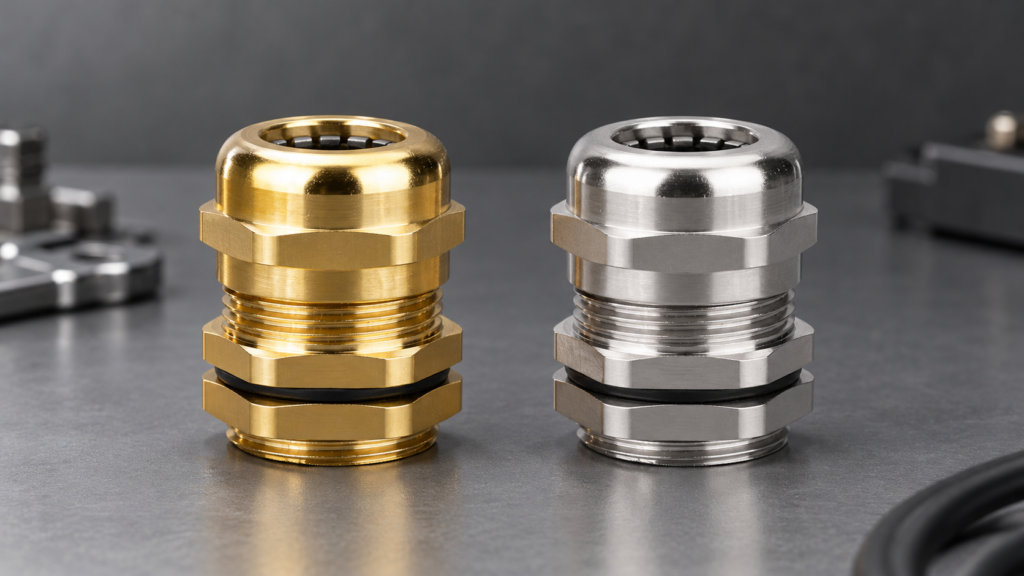
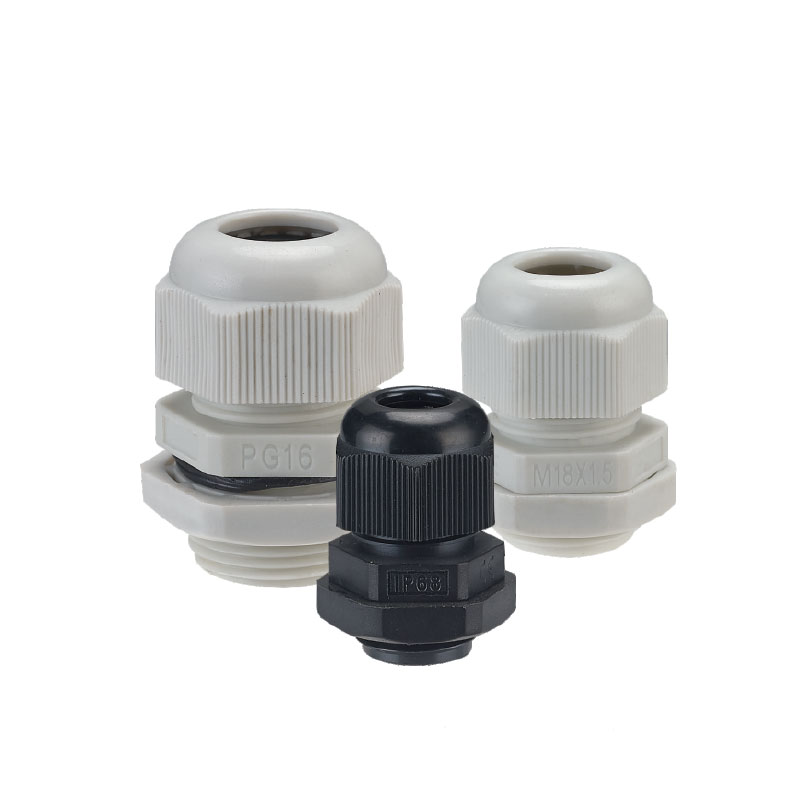
The brass vs stainless steel cable gland question is usually framed as a corrosion question. It is really a specification question, because the two are the same product made in different metals: same thread, same clamping range for the same size code, same mounting hole, same sealing principle. On an M20 entry both need a 20.2 mm hole and both engage an M20 x 1.5 thread, and the clamping range follows the size series rather than the material.
That matters because most comparisons of a brass vs stainless steel cable gland quietly change two variables at once — a brass standard gland against a stainless double-compression gland, or an M20 against a PG16 — then credit the whole difference to the metal. Reduce it to one variable and the question becomes answerable: for this hole, in this environment, which metal?
Two Properties Move in the Direction You Did Not Expect
Start with weight, because the assumption is usually wrong. Brass runs at about 8.4 to 8.5 g/cm³, stainless steel at 7.9 to 8.0. A stainless gland of identical geometry is roughly six per cent lighter, not heavier. Stainless feels heavier in the hand because it is normally bought in heavier families — double compression, longer thread — not because the metal is denser.
Electrical conductivity goes the other way by an order of magnitude, and thermal conductivity separates them by about a factor of seven in the same direction.
Propriedade
Latão
Aço inoxidável
Where you feel it
Density
8.4–8.5 g/cm³
7.9–8.0 g/cm³
Stainless is about 6% lighter at the same size
Electrical conductivity
About 28% IACS
About 2% IACS
Earth bond resistance, EMC contact design
Thermal conductivity
Alta
About one seventh of brass
The gland follows enclosure temperature more slowly
Machinability
Free-cutting, stable threads
Work-hardens, torn flutes if rushed
Tighter tolerances cost more per piece
Magnetism
Nenhum
None in the annealed condition
A magnet tells you nothing about the grade
Hold on to the last row. Buyers routinely “check” stainless with a magnet, and it confirms only that the part is not ferritic.
Temperature: Where the Metal Stops Being the Limit
Nickel-plated brass is rated −40 to +120 °C across this site’s standard range; stainless steel 304 and 316L are rated −40 to +200 °C. Read as a metal comparison, that gap decides a lot of specifications.
Read as a product comparison, the gap usually closes. The temperature a gland survives is set by the elastomer in the seal and the O-ring, not by the body. An NBR seal sits comfortably below the brass limit, a silicone seal reaches further, and nothing in the range reaches 200 °C without a seal to match. A stainless gland ordered with a standard NBR seal is a 120 °C gland in a 200 °C wrapper.
So the question worth asking is not what the body is rated to, but which seal, rated to what, and whether that number appears on the same line of the quotation. Once both numbers are on one line, the material choice often becomes secondary — which is frequently the correct answer.
Chloride Exposure Fails the Two Metals Differently
Neither metal is corrosion proof. They lose in different ways, and the way they lose decides how you inspect them.
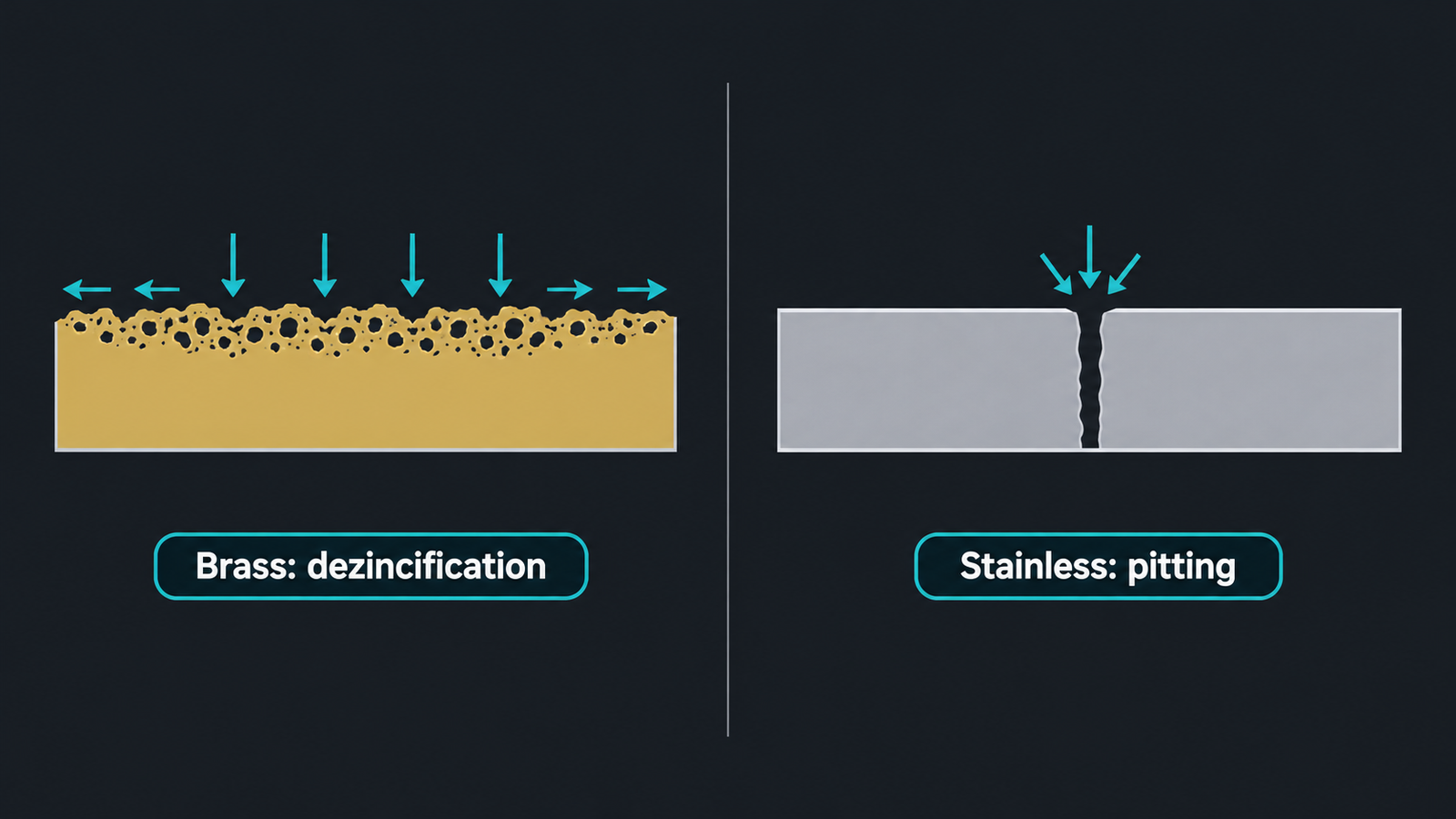
Brass fails by dezincification: the zinc leaves the alloy selectively, the surface turns copper-pink, then chalky, then porous and weak. It cannot be cleaned off, because the damage is not on the surface — the surface is what is left. The consolation is that you can see it coming for months.
Stainless fails by pitting and crevice corrosion. Attack is local, starts in a stagnant pocket under a washer or a shroud, and works through the wall. The gland looks untouched until a pinhole appears and the water is already inside the enclosure.
One metal warns you; the other does not.
Exposure
Latão niquelado
Stainless 304
Stainless 316
Indoor, dry, no chloride
Lasts the life of the panel
Over-specified
Over-specified
Coastal air, sheltered
Discolours, then dezincifies
Stains, pits in crevices
Good, but watch crevices
Chlorinated washdown
Fails within a season or two
Pits at crevices
Acceptable if it drains
Direct cyclic salt spray
Not suitable
Not suitable
Marginal, needs inspection
This asymmetry is the argument for stainless that rarely reaches a datasheet. It is not that stainless lasts longer everywhere; it is that where it is the right choice it fails more slowly and more quietly. Quiet failure is only an advantage if the inspection interval is short enough to catch it.
Galling: The Difference You Notice With a Spanner
Stainless on stainless cold-welds. Run a dry stainless nut down a stainless body fast enough and the surfaces pick up and seize before the seal is compressed. Brass does not do this, and a brass thread takes repeated assembly without complaint.
On a new build the difference is invisible. In maintenance it is expensive: a seized stainless gland cannot be backed off or re-torqued, and it usually has to be cut, which turns a five-minute re-termination into a cable joint.
The standard answer is nickel-based anti-seize on the thread. Copper grease is a poor substitute — copper plus chloride plus stainless is a galvanic cell and the grease dries to a paste that traps salt. A plated brass locknut against a stainless body is the other common answer, at the cost of a mixed-metal joint.
Earthing, Conductivity and EMC
The conductivity gap looks alarming on paper and matters less than expected for safety earthing, because the earth path through a gland is short, thick and bonded at both ends. Both metals pass a continuity test at the values inspectors actually apply. What the gap does change is behaviour at radio frequency, and therefore the design of EMC glands.
An EMC gland depends on a 360° contact between the cable screen and the body, made by a spring — usually nickel-plated brass or a copper alloy. In a stainless EMC gland that spring has to be a separate part. An “all-stainless EMC gland” with no contact element is a shield clamp with a poor bond, whatever the photograph suggests.
Earthing accessories follow the same logic. Stainless earth tags on stainless bodies are a galling pair, which is why plated brass tags are common: the tag then becomes the replaceable part rather than the body.
Mixing Both Metals on One Enclosure
Mixed pairs appear on almost every panel: stainless glands in a painted steel box, brass glands with stainless locknuts, stainless glands on an aluminium enclosure.
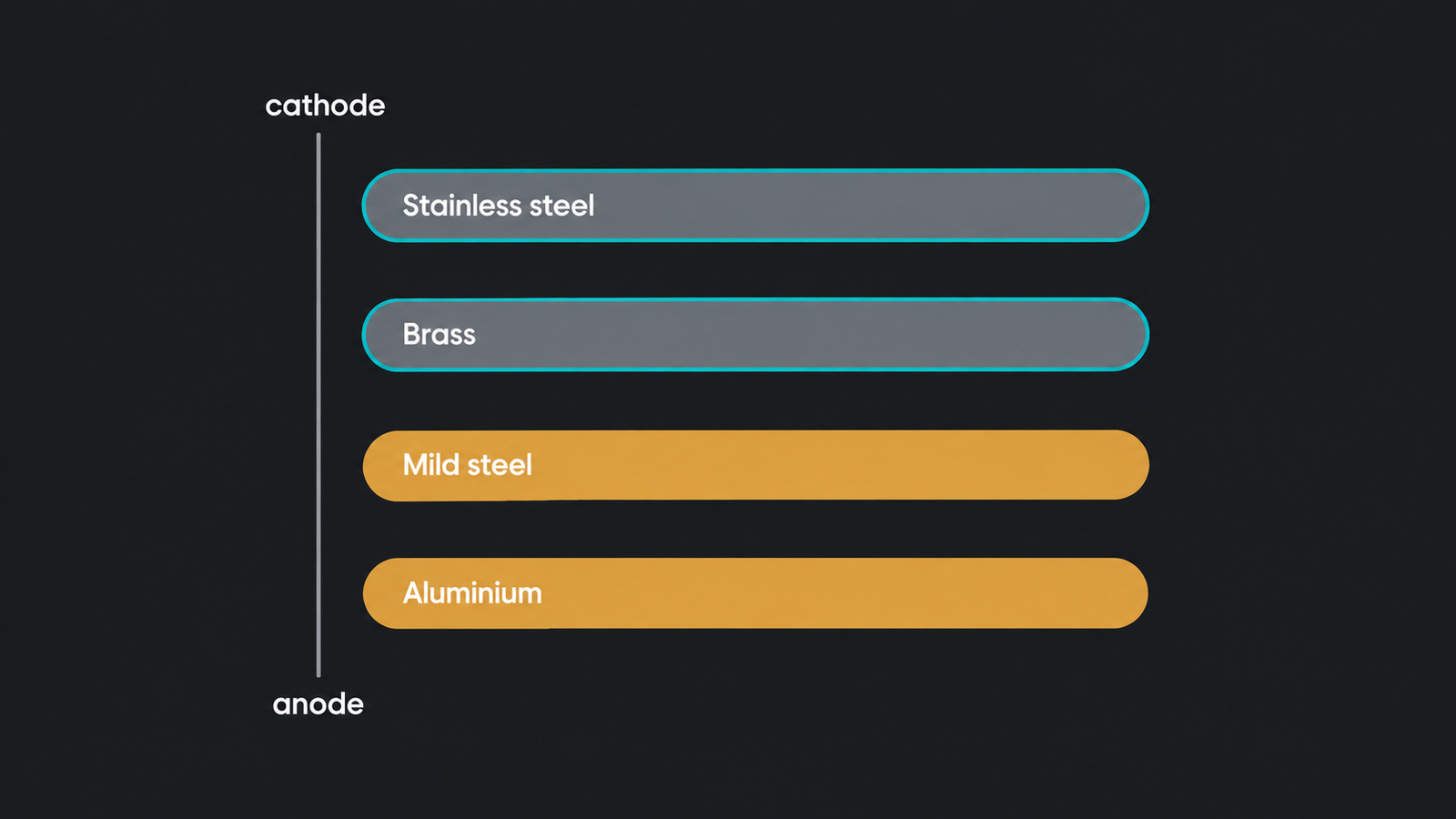
The pair people worry about — brass and stainless — is the least dangerous. In the galvanic series they sit close together. In a chloride-wet joint the brass becomes the anode, so the stainless survives and the brass thread takes the loss: real, but slow and local to the joint.
Which part is allowed to be the anode decides what corrodes.
The pair that actually fails is stainless or brass against aluminium or galvanised steel, where the potential difference is large and the aluminium is the anode by a wide margin. A stainless gland in an aluminium enclosure without an isolating washer produces white corrosion product around the hole long before the gland is affected.
Practical rule: one metal per entry where possible. Where you must mix, isolate the joint and decide deliberately which part is allowed to be the anode, because one of them will be.
What the Price Difference Actually Buys
The gap between the metals is a multiple, not a percentage. Stainless billet costs more, machines more slowly, work-hardens, and is normally quoted at 300 pcs per size against 1,000 pcs for brass without tooling charge. At small quantities the difference is dominated by setup rather than material.
Tipo
Specification
Typical application
Indicative FOB price
Brass standard gland
M12–M63 / PG7–PG48, IP68, nickel-plated option
Indoor panels, general industry
US$0.08–1.20
Brass EMC gland
M12–M63, 360° contact spring
Drives, shielded cable
US$0.90–6.50
Stainless 304 / 316L gland
PG9–PG63, IP68, −40 to +200 °C
Coastal, washdown, marine, chemical
Quoted per size
Indicative FOB Ningbo / Shanghai, 1,000 pcs per size, stainless and Ex versions 300 pcs per size.
What the multiple buys is not corrosion resistance in the abstract. It buys a different failure mode, a temperature ceiling you can actually use if the seal matches, and the removal of dezincification as a mechanism. Those are specific and checkable.
Where it buys nothing: an indoor dry panel with no washdown and no chloride. A brass gland will outlive the panel, and the extra money buys a property nobody will ever test.
A Size-for-Size Decision Table
Meio ambiente
Escolha
Motivo
Indoor control panel, dry, heated space
Latão niquelado
No chloride, no washdown
Outdoor enclosure, inland, sheltered
Latão niquelado
Plating handles rain, not salt
Coastal, within a few hundred metres
Stainless 316
Airborne chloride, crevices hold moisture
Chlorinated washdown
Stainless 316
Chlorine attacks brass quickly
Marine deck, splash zone
Stainless 316, inspected
Crevice corrosion is the limit, not the metal
Chemical plant, acid or alkaline splash
Stainless 316 plus matched seal
Brass is attacked by both
Above 120 °C continuous
Stainless plus high-temperature seal
Body limit first, then seal limit
Frequent re-termination
Latão
No galling on repeated assembly
Two rows are worth arguing about. Coastal within a few hundred metres is where budgets get cut, and also where the wrong choice fails in year two rather than year ten. Frequent re-termination is the row nobody writes into a specification, and it is the one maintenance engineers care about most.
No. Stainless is about six per cent lighter for the same geometry, because its density is 7.9 to 8.0 g/cm³ against 8.4 to 8.5 for brass. It only feels heavier when the stainless part is a heavier family or a longer thread.
Do brass and stainless glands fit the same hole?
Yes, at the same size code. An M20 brass gland and an M20 stainless gland both need a 20.2 mm hole and both use an M20 x 1.5 thread. Clamping range follows the size series, not the material.
Can I use a brass gland with a stainless locknut?
You can, but in a wet chloride joint the brass becomes the anode and takes the loss on the thread. If the joint will see salt, isolate it or use one metal throughout.
Which metal is better for earthing?
Both pass a continuity test. Brass conducts far better, which matters for EMC bonds at radio frequency rather than for safety earthing, where the path is short and thick.
Does stainless always last longer outdoors?
Only where chloride and crevices are present. Inland, dry and sheltered, a nickel-plated brass gland outlives the panel and the extra cost buys nothing measurable.
Você já teve dificuldades para escolher o prensa-cabo certo? Não se preocupe - você não está sozinho! Os prensa-cabos podem ser pequenos, mas desempenham um papel fundamental para garantir a segurança e a estabilidade de seus sistemas elétricos. Quer você trabalhe com automação industrial, petroquímica ou engenharia naval, a escolha do prensa-cabo errado pode levar a vazamentos de água, curtos [...]
Quando se trata de garantir a segurança, a durabilidade e a eficiência das instalações elétricas, o humilde prensa-cabo desempenha um papel fundamental. Quer você trabalhe com automação industrial, petróleo e gás, telecomunicações ou energia renovável, a escolha do prensa-cabo correto pode fazer toda a diferença no desempenho e na longevidade de seus sistemas. Neste artigo, exploraremos [...]
Usamos cookies para aprimorar sua experiência de navegação, veicular anúncios ou conteúdos personalizados e analisar nosso tráfego. Ao clicar em "Aceitar tudo", você concorda com o nosso uso de cookies.