The earth tag is the least expensive item in the earthing chain and the one most likely to quietly disqualify the assembly. It almost never fails electrically. It fails in two other ways: it is ordered separately from the gland and does not arrive, or it is fitted after the panel has been drilled and consumes thread that was not budgeted for. Both are purchasing and dimensional problems disguised as installation problems.
This article is about the tag itself: what it does and does not connect, how to size it, what it does to the thread stack, and how to make it a test point rather than a decoration. The circuit it belongs to is covered in cable gland earthing and bonding, and the armoured-specific hardware paths in armoured cable gland earthing.
What an Earth Tag Actually Does
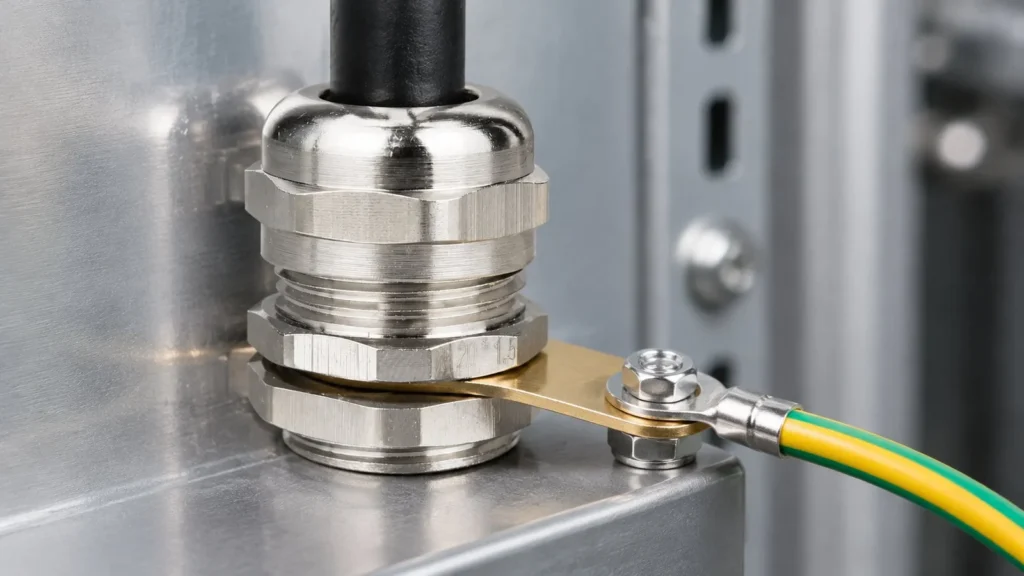
An earth tag is a flat brass tab with one or two holes, slipped over the gland thread and trapped under the locknut, with its protruding arm carrying a bolted ring terminal for an external earthing conductor. That is the whole component.
Its function is narrower than the name suggests. The tag does not create the bond between gland and enclosure; the thread does that. It does not create the bond to a cable armour or screen; the cone and clamping ring do that. What the tag does is give the assembly a fixed, accessible landing point for an external conductor, which converts a bond that existed invisibly inside a joint into one that can be seen, tested and re-tested. In an inspection regime that is the entire value.
The Forms, and What Each One Solves
Form
How it mounts
What it solves
Where it falls short
Single-hole tab
Slides over the thread, arm protrudes under the locknut
Cheapest way to land one conductor
One bolt means the tag can rotate around it
Two-hole tag
Same, but two bolts through the arm
Rotation is prevented, so the joint stays put under vibration
Takes more face area around the entry
Integral earthing nut or boss
Replaces the locknut with a nut that has a threaded earthing point
Removes the extra part from the stack entirely
Only available in the sizes and materials that offer it
Tag with captive screw
Tag carries its own fixing for the lug
No separate bolt to lose on site
Fixing is captive to that tag, not interchangeable
Tinned tag
As any of the above, with a tin coating
A more stable contact face for a copper lug, especially wet or salt-laden air
Costs more and is rarely a stocked item
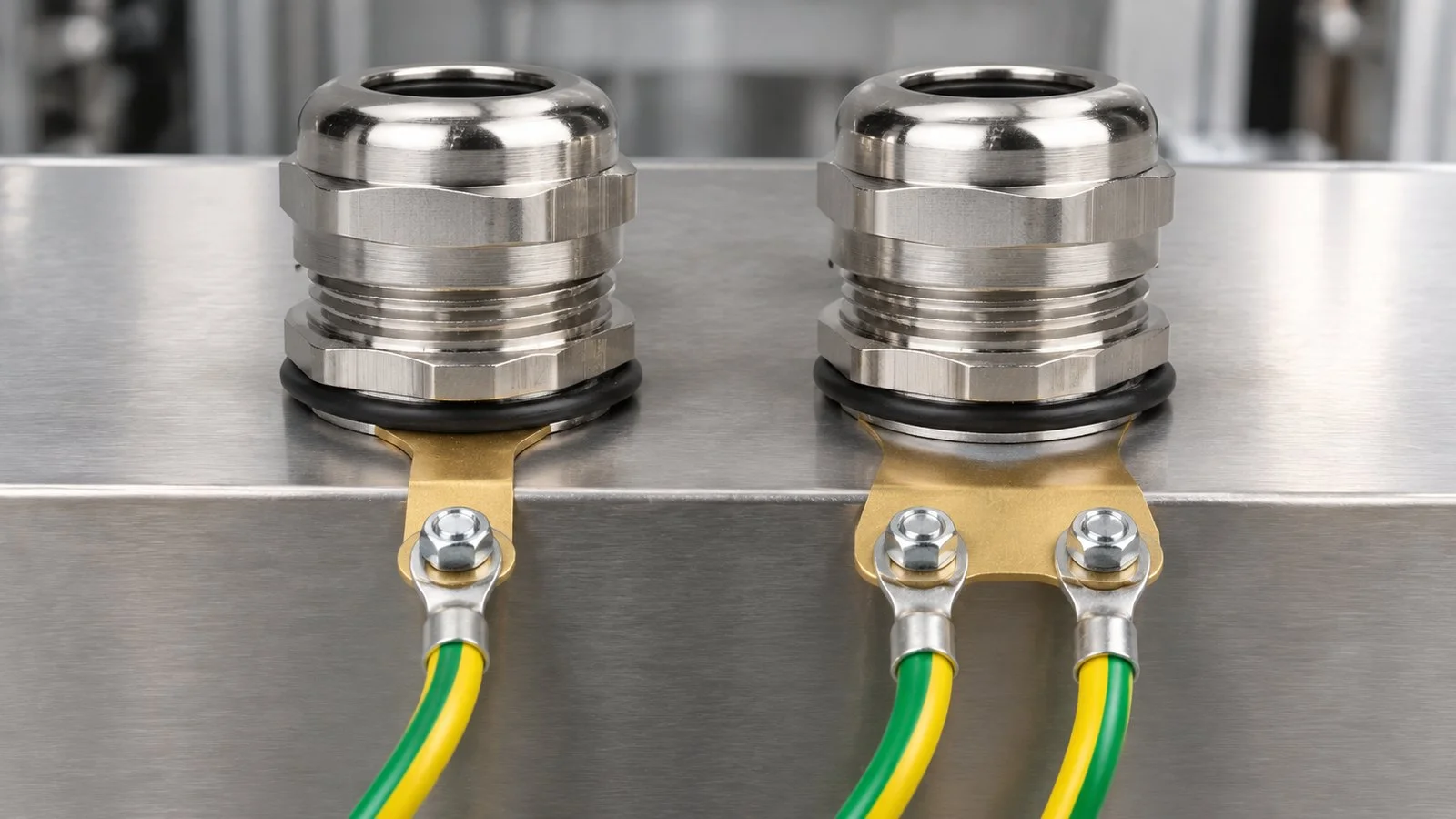
The first row is where most failures begin. A single-hole tab held by one bolt is a lever with a pivot, and vibration works it loose. Where the location vibrates, specify the two-hole tag or the integral boss rather than buying on price.
The two-hole tag on the right cannot rotate around its fixing. The single-hole tab on the left can, which is how a tight joint becomes a loose one under vibration.
Sizing Is Three Separate Questions
Three dimensions decide whether a tag fits, and they are usually answered by three different people. The bore has to pass the same thread as the gland. The stud has to accept the ring terminal on the conductor. The thickness has to fit inside the thread length you have left. Get any one wrong and the part is scrap, so all three belong on the same line of the purchase order.
Dimension
Matched to
What happens if it is wrong
Bore / thread
The gland thread, for example M20 for an M20 gland
It will not pass the thread, or it sits loose and does not seat
Stud or bolt size
The ring terminal on the earthing conductor
The lug does not fit, or fits with a fraction of its contact area
Thickness
The remaining thread beyond panel, washer and locknut
The locknut runs out of thread and the joint does not clamp
Arm length and reach
Space to the nearest obstruction and to the earth bar
The lug cannot be fitted, or the conductor has to bend sharply at the terminal
The stud question is the one that gets skipped. A tag drilled for a small screw will physically accept a large ring terminal clamped by a washer, and it will look correct while contacting over a ring rather than a face. That reads fine on a continuity check and is poor practice on a joint meant to carry fault current.
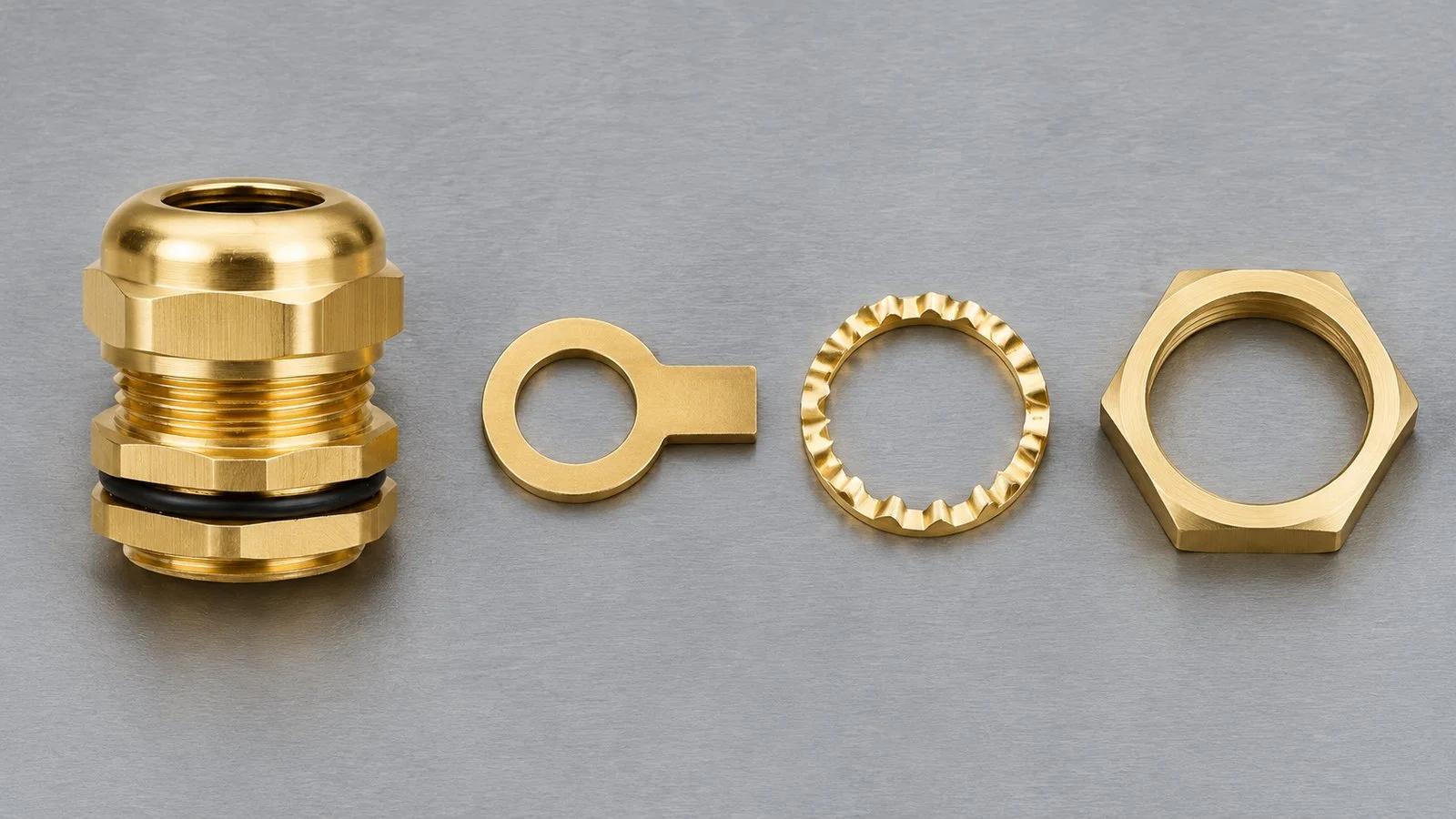
Four parts, one thread length. The tag is the part that was not on the drawing when the stack was calculated.
The Stack Height Problem
An earth tag sits in series with the panel, the washer and the locknut, and it adds its own thickness to that stack. The thread length GL is fixed by the gland, so the tag competes directly with the panel for the same millimetres.
The sizes where this bites are the ones with the shortest GL relative to their body. M22 has 8 mm of thread. PG63 has 15 mm on a 72 mm body, the lowest ratio in the PG series. Add a tag to either and the arithmetic changes, and the change is invisible on a drawing that shows only the gland.
There is an ordering consequence that costs more than the part. If the gland was selected and the panel drilled on the basis of a stack with no tag, and the tag is added at commissioning, the gland may no longer clamp even though every individual component is correct. The two ways out are a longer-thread variant of the same thread, or an integral earthing nut that replaces the locknut rather than stacking on top of it. Deciding at the specification stage is free; deciding at commissioning is a purchase order and a delay.
Contact Is a Surface Question
The tag only works where the metal is bare. A painted enclosure with a tag clamped onto the paint is an insulated joint with a brass decoration on it, and the continuity reading will be whatever the bolt thread happens to provide. Paint has to be removed at the bearing face, and the serrated washer, if one is used, must sit against bare metal rather than on top of a coating.
The stack goes together in a set order: bare enclosure face, serrated washer biting it, tag, then locknut. Reversing washer and tag puts the teeth against the tag instead of the enclosure, bonding the tag to the nut and leaving the enclosure out of the circuit.
Material pairing matters too: a brass tag on painted steel is unremarkable, but bolted directly to an aluminium enclosure it is a dissimilar joint that corrodes at the interface in wet air. A tinned tag is the cheap answer before corrosion starts rather than after.
Why a Nylon Gland Cannot Carry an Earth Tag
A moulded polyamide gland has no conductive path through its body, so a brass tag trapped under its locknut bonds the conductor to a metal nut and to nothing else. The joint reads as an earth connection, looks like an earth connection, and ends at the nut. This is not a manufacturing fault; it is what an insulating body means.
Where a plastic gland is used and an earth connection is required, the provision belongs on the enclosure rather than on the gland: a dedicated earthing stud, a tapped boss, or an earth bar bonded separately. Anything else is a fitting that satisfies a drawing without satisfying the circuit. The moulded options are set out in the nylon cable gland range, and the conductive alternatives are in the metal ranges.
The Conductor Side of the Tag
Half of the joint is on the tag and half is on the lug, and the lug end is the one that gets improvised. A ring terminal has to match the stud, sit flat on the tag face, and be crimped to a conductor sized for the fault current the circuit is expected to carry. A lug that is oversized for the stud, or a spade terminal squeezed under a washer, makes contact over a fraction of the area the joint was designed for.
Route matters as well. A conductor that leaves the tag and immediately bends hard puts a permanent side load on a thin flat section in the one place it is least able to take one.
Hazardous Areas Change the Rules
In a classified area the gland is part of a certified assembly, and the earthing arrangement is part of what was certified. Fitting an uncertified tag to a certified gland can take the assembly outside its certification even though nothing about the seal has changed.
Where the location is classified, buy the earthing provision as part of the certified item rather than adding it afterwards, and confirm that the documentation covers the configuration you are installing. The wider requirements are set out in selecting cable glands for hazardous areas and the installation evidence in explosion proof cable gland installation.
Making It a Test Point
The reason to fit a tag rather than rely on the thread is that the thread cannot be tested without dismantling the joint. The tag makes the bond measurable in place, so point the arm towards the earth bar rather than into a cable bundle and keep the lug reachable after the enclosure is closed.
Check
When
What to record
Bare metal at the bearing face
Before assembly
Photo of the prepared face
Stack order: washer, tag, locknut
During assembly
Nothing, but get it right the first time
Continuity from tag to enclosure
After tightening, before closing
Instrument, range and reading
Continuity from tag to earth bar
At commissioning
Reading, against the project criterion
Tag still tight
At each periodic inspection
Date, and whether re-torqued
The acceptance value comes from the project earthing specification or the assembly standard, not from the gland supplier, so quote the criterion you are working to and record the reading against it. Recording the instrument matters as much as the number: a reading from an uncalibrated meter proves nothing at handover.
Specifying an Earth Tag
Field
What to state
Why
Gland thread
The thread the tag must pass, for example M25 x 1.5
Bore and thread must match the gland, not the cable
Form
Single-hole tab, two-hole tag, or integral earthing nut
Determines whether the joint resists rotation
Stud size
The bolt size the ring terminal needs
Wrong stud means partial contact area, not a loose part
Thickness
The value, and the remaining GL you have
The tag competes with the panel for the same thread
Material and finish
Brass, tinned brass, or plated
Controls the dissimilar metal joint at the enclosure
Quantity
One per gland, on a separate line
Tags described as “with gland” are often not in the carton
A flat brass tab that slides over the gland thread under the locknut so an external earthing conductor can be bolted to it. It gives the bond a visible, testable connection point rather than leaving it buried in the thread joint.
Does every cable gland need an earth tag?
No. The gland-to-enclosure bond is made by the thread and does not require a tag. A tag is needed where an external earthing conductor must be connected, or where the bond has to be testable without dismantling the joint.
Where does the earth tag go in the stack?
Over the thread, against the bare enclosure face, under the locknut, with any serrated washer between the tag and the enclosure so its teeth bite bare metal rather than the tag.
Will an earth tag affect the thread length I need?
Yes. The tag adds its thickness to the stack of panel, washer and locknut, so the gland’s thread length has to cover one more part. On sizes with a short thread such as M22, this can decide whether the gland clamps at all.
Can I add an earth tag to an explosion proof gland?
Only if the earthing provision is part of the certified configuration for that gland and that location. Adding an uncertified tag to a certified assembly can take it outside its certification even though the seal is untouched.
Explore los duraderos conectores prensaestopas impermeables con clasificación IP67 e IP68 de nailon, latón y acero inoxidable para una protección segura de los cables y alivio de tensiones.
A control panel cable gland is usually chosen by hole size and paid for thirty centimetres later at the terminal block. Entry height, bend radius, door routing, shield bonding and the marking that makes a panel traceable.
A VFD cable gland has to bond the cable screen around the full circumference at both the drive and the motor end. How to size one for drive cable, where the bond path breaks, and what a gland cannot fix.
Utilizamos cookies para mejorar su experiencia de navegación, publicar anuncios o contenidos personalizados y analizar nuestro tráfico. Al hacer clic en "Aceptar todo", aceptas el uso que hacemos de las cookies.